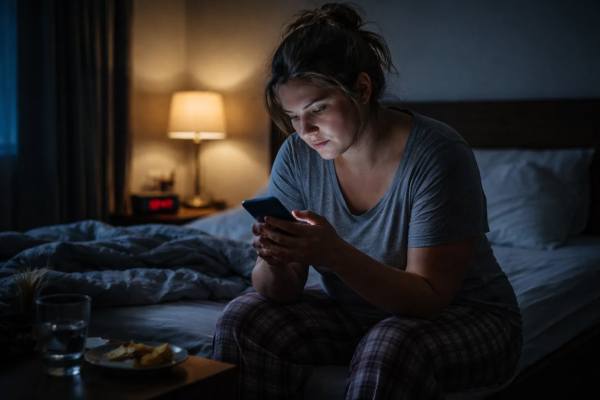
Revenge bedtime procrastination sounds dramatic, but the pattern is familiar: you are tired, you know you should go to bed, and you stay up anyway because late night feels like the only part of the day that belongs to you. That extra hour can feel harmless in the moment, yet repeated late nights can quietly make weight loss harder by increasing cravings, reducing self-control, disrupting meal timing, and cutting into recovery.
This does not mean one late night will cause weight gain. The issue is the repeated cycle. When bedtime keeps getting pushed back, sleep debt grows, appetite regulation gets shakier, and evening eating becomes easier to justify. This article explains what revenge bedtime procrastination really is, why it happens, how it can interfere with fat loss, and what to do if you want more free time at night without paying for it with poorer sleep and harder-to-manage hunger.
Table of Contents
- What revenge bedtime procrastination really means
- Why it happens after long stressful days
- How late nights can increase hunger and weight gain risk
- The screen time stress and snacking loop
- Signs your late-night habit is hurting progress
- How to break the cycle without losing all your evening freedom
- When to look beyond simple habit fixes
What revenge bedtime procrastination really means
Revenge bedtime procrastination is a popular term for staying up later than intended to reclaim personal time. It is not a formal medical diagnosis, but it describes a real behavior pattern: delaying sleep even when nothing external is forcing you to stay awake.
The “revenge” part is not about anger in the usual sense. It reflects the feeling that the day took too much from you, so the night becomes a way to take some control back. Maybe work ran late, your kids needed you nonstop, errands filled every gap, or your mind never got a chance to rest. By the time the house is quiet, going to bed can feel less like self-care and more like giving up the only time that is truly yours.
That is why this behavior is easy to misunderstand. It is not always laziness, poor discipline, or simple bad planning. Sometimes it is a form of emotional compensation. The problem is that it solves one need while worsening several others.
A typical pattern looks like this:
- You feel tired by evening.
- You delay bed because you want comfort, distraction, or freedom.
- You scroll, watch, snack, or “just stay up a little longer.”
- You go to sleep later than planned.
- You wake up under-rested and rushed.
- The next day feels harder, which makes late-night escape even more appealing.
Over time, this turns into a self-reinforcing loop. The later you stay up, the worse the next day often feels. The worse the next day feels, the more attractive late-night freedom becomes.
It also overlaps with other sleep and appetite issues. Someone may think their main problem is “lack of motivation,” when the real issue is that late nights are damaging recovery and increasing the chances of impulsive eating the next day. This is closely tied to how circadian rhythm and weight loss affect each other through sleep timing, appetite, and evening behavior.
Revenge bedtime procrastination can show up in different ways:
- endless phone scrolling in bed
- staying up for shows or gaming even when exhausted
- doing “finally my time” snacking after everyone else is asleep
- delaying bedtime because going to sleep feels like tomorrow is starting too soon
- pushing sleep later on work nights, then trying to recover on weekends
What makes the pattern important for weight loss is not just the bedtime itself. It is everything that late bedtime tends to bring with it: less sleep, lower morning energy, more cravings, worse meal timing, higher stress, and more nighttime eating opportunity.
In short, revenge bedtime procrastination is often less about loving late nights and more about feeling deprived during the day. That is why fixing it usually requires more than saying, “Just go to bed earlier.”
Why it happens after long stressful days
Most people do not procrastinate bedtime because they forgot sleep matters. They do it because late night feels emotionally rewarding in a way the rest of the day did not.
After a demanding day, your brain is often running low on patience, structure, and self-control. You may feel mentally spent but still emotionally hungry for something pleasant. That “something” is often not sleep. It is autonomy, entertainment, comfort, quiet, or the feeling that you got at least one part of the day for yourself.
That is why revenge bedtime procrastination tends to happen most often after days that feel highly controlled, overloaded, or draining. Common triggers include:
- long workdays with few breaks
- caregiving and parenting overload
- emotionally demanding jobs
- constant decision-making
- conflict at home or work
- feeling like the entire day was about obligations
- not having any real transition between work and rest
This is one reason the pattern overlaps so strongly with decision fatigue and overeating. When your mental bandwidth is already depleted, future-focused choices lose power. Going to bed on time is a classic delayed-benefit decision: it helps tomorrow more than it rewards you now. Scrolling, snacking, and binge-watching do the opposite. They reward you immediately, which makes them much harder to resist when you are emotionally depleted.
Another common factor is unfinished decompression. Some people spend the entire day in “go mode” and then try to relax for the first time at 10:30 p.m. The problem is that when relaxation starts too late, bedtime becomes the thing that interrupts it. Instead of sleep feeling inviting, it feels like a cutoff point.
Stress can make this even stronger. If you have been tense all day, a late-night routine may start to function like self-medication. Not in a dramatic sense, but in a practical one: your brain starts using TV, snacks, social media, or quiet nighttime alone time to downshift. That is why this pattern often sits beside stress eating at night. The food and the bedtime delay may be serving the same purpose: relief.
There is also a fairness feeling that shows up in many people: “I worked hard today, so I deserve this time.” That thought makes emotional sense, but it can create a hidden tradeoff. The time feels deserved tonight, but tomorrow’s energy, appetite control, and mood end up paying for it.
Importantly, not everyone with late nights has revenge bedtime procrastination. Some people simply have a naturally later schedule or poor sleep habits. The revenge pattern is more specific. It usually includes all three of these elements:
- you are intentionally delaying sleep
- you know it is probably not helping you
- you are doing it because the night feels like your only real personal time
Understanding that motive matters. If the real need is control, peace, or decompression, then the solution is not just stricter bedtimes. It is building more recovery into the day and earlier evening so bedtime stops feeling like a personal loss.
How late nights can increase hunger and weight gain risk
Late nights can interfere with weight loss through several pathways at once. Some are biological, some behavioral, and some emotional. That combination is why the impact can be larger than it seems from “just one more hour awake.”
The biggest issue is usually not the bedtime alone. It is what repeated short sleep and circadian disruption do to hunger, cravings, food choices, and recovery.
A late-night pattern can contribute to weight gain risk by:
- increasing appetite the next day
- making high-calorie foods feel more rewarding
- lowering impulse control when tired
- increasing opportunities for late-night snacking
- making regular meals harder to maintain
- reducing energy for activity and meal prep
- shifting eating later into the day
That is why people who regularly cut sleep often notice that the problem is not only fatigue. It is also stronger cravings, more “I deserve a treat” thinking, and weaker follow-through around food. This fits closely with the pattern explained in why poor sleep makes you hungrier.
A simple comparison makes the chain easier to see:
| Late-night pattern | What often happens next | Weight-loss impact |
|---|---|---|
| Going to bed too late | Shorter sleep and harder mornings | Lower energy and less structure |
| Using food and screens to unwind | Extra evening calories and delayed sleep | Higher intake and poorer recovery |
| Waking tired and rushed | Skipped meals or convenience eating | More afternoon and evening cravings |
| Chronic sleep debt | Higher appetite and food reward | Harder deficit adherence |
| Later sleep timing | Later hunger pattern and nighttime eating | More snacking and less consistency |
There is also a direct opportunity effect. Being awake longer simply creates more time to eat. Many people do not overeat because they are deeply hungry at midnight. They overeat because they are awake, tired, overstimulated, and near food.
Another problem is that repeated late nights make recovery uneven. If weekdays are short on sleep and weekends turn into catch-up days, the result can be a drifting appetite pattern, groggier mornings, and more instability around meals and motivation. If this has already been happening for a while, the bigger issue may be sleep debt, not just bedtime discipline, which is why sleep debt recovery for weight loss often becomes part of the fix.
One more detail matters: you do not need dramatic sleep deprivation for the effect to matter. Even modest, repeated sleep loss can make weight-loss behavior harder. You may still “function,” but with more cravings, weaker judgment, and lower resilience. That is often enough to flatten progress over time.
So while revenge bedtime procrastination is usually framed as a sleep problem, it often turns into an appetite and consistency problem too. That is where it starts to show up on the scale.
The screen time stress and snacking loop
For many people, revenge bedtime procrastination is not just about going to bed late. It is about what happens during that extra time. Screens, stress relief, and snacking often become bundled together into one late-night ritual.
A common pattern looks like this: you finally sit down, pick up your phone, start scrolling or streaming, and reach for something to eat without being especially hungry. The food is not the main event. It is part of the unwinding package.
That bundle is powerful for a few reasons.
First, screens make it easier to lose track of time. One video becomes four. One quick check becomes 45 minutes. When you are tired, it is especially easy to keep choosing low-effort stimulation over bedtime. This is one reason screen time and weight gain often travel together through sleep loss, distraction, and mindless eating.
Second, bright screens and stimulating content can keep your brain in a more alert state. Even if you feel physically tired, you may not feel ready to disengage. That creates a strange mix of exhaustion and resistance: you are sleepy, but you do not want to stop. This can become even worse when nighttime device use is paired with blue light and sleep problems that push sleepiness later and make bed feel less natural.
Third, late-night content often encourages passive eating. When attention is split, fullness cues are easier to miss. The goal shifts from eating to feel satisfied to eating to keep the experience going. That is why people often describe nighttime overeating as “not even worth it” afterward. The food was not chosen carefully or enjoyed fully. It was just there.
Stress makes this loop stickier. If the night is your only mental release valve, removing screens or snacks without replacing the stress relief often backfires. The brain does not want less relief. It wants enough relief earlier and in forms that do not cost tomorrow so much.
This is where people often get frustrated with themselves. They assume the problem is weak willpower when the real issue is an evening environment designed for drift:
- bright light
- easy snacks
- no stopping cue
- no planned wind-down
- high emotional need for comfort
- low mental energy to interrupt the pattern
That environment can turn one late night into a habit loop very quickly.
A more useful way to think about the problem is this: the phone, show, or snack is not always the true issue. Often, the issue is that nighttime has become your only recovery window. Once that happens, anything that makes the recovery feel better also starts to make bedtime harder.
If you want to break the pattern, it helps to stop asking only, “How do I use less screen time?” and start asking, “How do I stop needing midnight to be my entire emotional recovery plan?”
Signs your late-night habit is hurting progress
Not every late night is a problem. The issue is whether the pattern is consistent enough to affect how you eat, move, recover, and think.
A few signs suggest revenge bedtime procrastination is starting to sabotage weight loss:
- you regularly sleep less than you planned because you delay bedtime
- you feel most out of control around food after short nights
- late-night snacking happens mainly when you are tired, not truly hungry
- mornings feel rushed, foggy, or chronically unpleasant
- you keep promising to sleep earlier but repeat the same pattern
- your weekends turn into sleep recovery days
- your motivation for exercise drops after multiple late nights
- your evenings feel calm only when you are scrolling, snacking, or watching something
- you get into bed late and then still keep delaying actual sleep
Another clue is when appetite control feels much easier earlier in the day than at night. That often means the issue is less about general lack of discipline and more about accumulating fatigue and stress. If your night eating keeps intensifying as the evening gets later, it may overlap with the pattern behind night-time sugar cravings, where tiredness and reward-seeking create a strong pull toward highly palatable foods.
You may also notice a mismatch between your intentions and your actual behavior. For example, you might spend the day planning balanced meals and good decisions, then undo much of that progress in the last two waking hours. That does not mean your plan is bad. It may mean your nights are structured in a way that overwhelms the plan.
Another warning sign is when sleep quantity and sleep quality both start slipping. Some people assume the issue is only that they are not getting enough hours, but repeated bedtime delay can also make sleep feel lighter, more fragmented, or less refreshing. If you wake up feeling like you technically slept but still are not restored, the problem may go beyond total hours and into the territory of sleep quality versus sleep quantity.
It is also worth paying attention to the emotional tone of your nights. Do you feel peaceful and intentional, or trapped in a loop of “just a little longer”? Revenge bedtime procrastination often comes with a strange blend of pleasure and resentment. You are enjoying the time, but also aware that you are borrowing it from tomorrow.
That emotional friction matters because it creates shame. Shame then makes it harder to look at the pattern clearly. Instead of saying, “My evenings are overloaded and under-structured,” you may say, “I have no discipline.” The first thought helps. The second just keeps the cycle going.
A useful question is: If I got enough sleep for two weeks in a row, would my eating behavior likely get easier? If the honest answer is yes, then bedtime delay is probably not a side issue. It is part of the weight-loss problem itself.
How to break the cycle without losing all your evening freedom
The best fix is not to make nights feel like punishment. If bedtime starts to feel like the enemy, you will keep fighting it. The goal is to protect your sleep while still giving yourself enough decompression and autonomy that you do not feel robbed by bedtime.
Start with earlier recovery, not just earlier sleep. Ask yourself: where can I add a little more relief before 10 p.m.? That might mean a real break after work, a short walk, 20 minutes of solo quiet time, a planned shower, or a screen-free wind-down that starts before you are exhausted.
A practical reset often includes these steps:
- Choose a real bedtime target. Not an ideal fantasy bedtime. A realistic one.
- Create a stopping cue 30 to 60 minutes before bed. Dim lights, set an alarm, change into sleep clothes, or brush teeth early.
- Pre-decide your late-night boundary. For example: no shows started after a certain time, phone charging outside bed, kitchen closed after planned snack.
- Protect a little “me time” earlier. If all free time is delayed until the last hour of the night, bedtime will keep losing.
- Make the first 10 minutes of bedtime easier. This is where routines help most.
That last point matters. Bedtime procrastination is easier to reduce when bed feels like the next obvious step, not a cold stop from fun. A structured night routine to prevent overeating can work well because it links sleep with relief instead of deprivation.
Your routine does not need to be elaborate. It can be simple:
- turn off overhead lights
- put the phone on a charger away from bed
- make tea or take a warm shower
- do a short stretch or breathing exercise
- prepare tomorrow’s essentials
- get into bed at the same time most nights
If sleep hygiene is generally messy, it may help to tighten the basics first. A good sleep hygiene checklist for weight loss usually includes a darker room, cooler temperature, less bright evening light, and a more consistent sleep schedule.
One overlooked fix is protecting tomorrow morning. When mornings feel awful, late-night freedom becomes more valuable because daytime life feels harder. If mornings become calmer and less punishing, nights lose some of their emotional pull. That is why people often do better when they reduce morning chaos along with bedtime delay.
Also, do not try to change every late-night habit at once. Pick the highest-impact move first. For some people it is charging the phone outside the bedroom. For others it is setting a cutoff for snacking. For others it is protecting 20 minutes of personal time earlier in the evening.
The goal is not perfection. It is to make bedtime feel less like surrender and more like an active way of protecting your future self.
When to look beyond simple habit fixes
Sometimes revenge bedtime procrastination is mostly a habit problem. Other times it is sitting on top of something bigger.
If late nights keep happening despite solid effort, consider whether the real issue might be one of these:
- chronic insomnia
- anxiety that spikes at night
- depression or emotional burnout
- untreated sleep apnea
- shift work or an unstable work schedule
- heavy caregiving stress
- an evening environment that never really becomes restful
This matters because not all bedtime delay is the same. Some people are procrastinating sleep. Others genuinely cannot wind down or fall asleep easily. If you are getting into bed on time but lying awake, your next step may be different from someone who stays on the couch until 1 a.m. by choice.
It is also worth getting more support if late nights are closely tied to overeating, binge episodes, or compulsive nighttime snacking. In that case, the bedtime pattern may be only one part of a broader emotional or behavioral eating issue.
A few signs that it is time to look deeper:
- you snore heavily or gasp during sleep
- you are exhausted despite enough hours in bed
- your mood is worsening along with your sleep
- you feel unable to stop night eating even when you want to
- you keep having “fresh start tomorrow” cycles that never last
- you need more caffeine every morning just to function
- your late nights feel driven by dread, loneliness, or anxiety more than by entertainment
When that is happening, it may help to look at insomnia and weight loss more directly, especially if the problem has moved beyond choice and into ongoing sleep difficulty. And if sleep disruption seems deeper than simple habit drift, especially with snoring, choking, or major daytime sleepiness, it is worth considering sleep apnea and weight loss as part of the picture.
The key point is that revenge bedtime procrastination is real and common, but it is not always the root problem. Sometimes it is the visible behavior sitting on top of stress, overload, poor boundaries, or a sleep disorder.
That does not make the pattern less important. It makes it more useful as a clue. If you keep reclaiming time at midnight, your life may be telling you that something earlier in the day needs more space, more support, or a different structure.
Weight loss gets easier when evenings stop feeling like the only time you get to be a person. That is often the deeper fix.
References
- Bedtime procrastination and sleep disturbances: a call for targeted research and interventions to improve sleep health 2025 (Review)
- The role of insufficient sleep and circadian misalignment in obesity 2023 (Review)
- Effect of Sleep Extension on Objectively Assessed Energy Intake Among Adults With Overweight in Real-life Settings: A Randomized Clinical Trial 2022 (RCT)
- Associations Between Sleep, Appetite, and Food Reward over 6 Months in Black Emerging Adults-Findings from the Sleep, Health Outcomes and Body Weight (SHOW) Pilot Study 2025 (Study)
Disclaimer
This article is for general educational purposes only and is not a substitute for medical advice, diagnosis, or treatment. If late nights are happening alongside chronic insomnia, binge eating, heavy snoring, extreme daytime sleepiness, depression, or anxiety, speak with a qualified healthcare professional.
If this article helped you, consider sharing it on Facebook, X, or your preferred platform with someone who keeps trading sleep for “just one more hour” and wants to protect weight-loss progress without losing all their evening freedom.