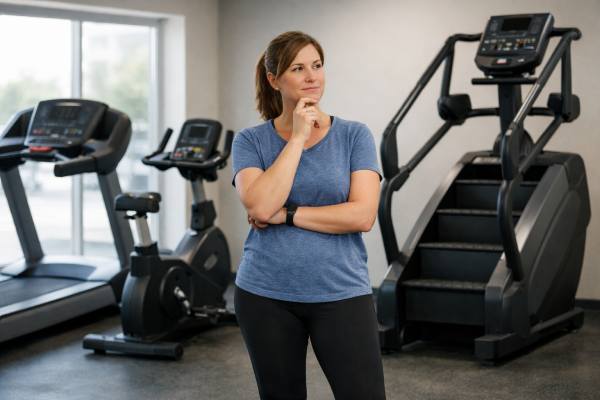
The best cardio machine for weight loss is usually the one you can use hard enough, often enough, and long enough to stay consistent. For most people, that makes the treadmill the best overall choice because it gives you the widest range of effort, from easy walking to steep inclines to running. But that does not make it the best choice for every body. If your knees hurt, you are carrying a lot of extra weight, or you hate impact, a bike or elliptical may help you train more consistently. If you want short, demanding sessions and already have a decent fitness base, the StairMaster can be incredibly effective.
Below, you will see how each machine compares, who each one suits best, and how to turn your choice into real fat-loss progress.
Table of Contents
- Which machine is best overall?
- How the four machines compare
- Treadmill: best for the widest range
- Bike: best for joint-friendly intensity
- Elliptical: best for low-impact full-body cardio
- StairMaster: best for hard, short sessions
- How to pick the right machine
- How to make any machine work
Which machine is best overall?
If you want one simple answer, the treadmill is the best cardio machine for weight loss for most people. It has the highest performance ceiling, the most obvious progression path, and the most real-world transfer. You can start with slow flat walking, move to brisk walking, then incline walking, then intervals, then jogging or running if your joints and fitness allow it. That makes it easier to keep challenging your body as you improve.
That said, “best overall” is not the same as “best for you.”
A bike may beat a treadmill for fat loss if the treadmill aggravates your knees or shins and makes you dread workouts. An elliptical may beat both if you want smoother motion and lower impact without feeling stuck in a chair. A StairMaster may burn through your legs and lungs fast, but it is also the hardest of the four to sustain if you are a beginner, significantly deconditioned, or heavier.
The better way to think about this is not “Which machine burns the most fat?” but “Which machine lets me accumulate the most good work each week without getting hurt or burned out?” Weight loss comes from a sustained calorie deficit, and cardio helps most when it is repeatable. A machine that looks powerful on paper but leaves you sore, discouraged, or skipping sessions is rarely the winner.
A useful ranking for most readers looks like this:
- Best overall for most people: treadmill
- Best for beginners and sensitive joints: bike
- Best low-impact option that still feels athletic: elliptical
- Best for short, very challenging sessions: StairMaster
That ranking changes fast once you factor in pain, balance, confidence, and enjoyment. If you can do three to five good sessions per week on one machine, that machine is already a stronger candidate than the machine you “should” use but keep avoiding.
If you want to make the choice even more practical, do not focus only on a single workout. Focus on what helps you hit your weekly target of consistent cardio. A realistic weekly dose matters far more than one heroic session, especially when paired with sensible nutrition and enough activity across the rest of the day. For a bigger picture on weekly targets, see how much cardio per week for weight loss.
How the four machines compare
The differences between these machines are real, but they are often overstated. At the same body size and the same honest effort, the gap in calorie burn is usually smaller than people think. What changes results more is whether a machine lets you train at the right intensity, for the right duration, with enough frequency to stack up weekly work.
| Machine | Best for | Impact on joints | Effort ceiling | Ease for beginners | Main downside |
|---|---|---|---|---|---|
| Treadmill | Walking to running progression, incline work, highest long-term flexibility | Low to high, depending on speed and incline | Very high | Good if walking; harder if running | Impact can bother joints and shins |
| Bike | Joint-friendly intervals, beginner confidence, seated cardio | Low | High | Very good | Seat discomfort and less full-body loading |
| Elliptical | Low-impact cardio that feels smoother and more full-body | Low | Moderate to high | Good after a short learning period | Can feel awkward or too easy if resistance stays low |
| StairMaster | Short, intense sessions and lower-body challenge | Moderate | High | Usually not ideal for true beginners | Local leg fatigue arrives fast |
A few decision points matter more than the machine name on the console:
- Impact tolerance: If impact flares up feet, ankles, knees, hips, or low back, treadmill running may not be your best starting point.
- Session tolerance: Some machines are easier to stay on for 30 to 45 minutes. Others are better for 10 to 20 harder minutes.
- Confidence and safety: Balance matters. A machine that feels unstable or intimidating tends to reduce adherence.
- Progression: The best machine gives you obvious ways to advance without guessing, such as more minutes, more resistance, more incline, or more interval rounds.
- Enjoyment: This sounds soft, but it is not. Bored people quit.
There is also a hidden difference people miss: the type of fatigue each machine creates. Treadmills often challenge the whole system and can create more impact fatigue. Bikes usually let your lungs and legs work hard with less pounding. Ellipticals often sit in the middle. StairMasters can torch your glutes, calves, and quads so fast that muscular fatigue ends the session before your heart and lungs are truly maxed out.
That matters because a “hard” machine is not automatically a “better” one. The best machine for weight loss is the one that lets you do enough total work this week, next week, and next month.
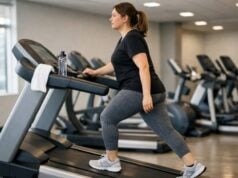
Treadmill: best for the widest range
The treadmill earns the top spot for one main reason: it has the broadest useful range. You can use it whether you are a beginner who needs flat walking, someone who wants brisk incline walks, or a fitter exerciser who prefers run-walk intervals or steady jogging. Few machines let you move that smoothly from entry level to advanced work.
For weight loss, the treadmill is especially strong because it makes progressive overload simple. You do not need to jump straight to running. Many people lose weight very effectively with brisk walking and incline work alone. Incline walking raises the challenge without the same pounding as faster running, and it is often easier to recover from. That makes it a strong option for people who want a higher calorie output without turning every session into a high-impact event.
The treadmill is usually the best choice if you:
- Like walking and want a machine that feels natural
- Want the option to train easy, moderate, or hard on the same day
- Enjoy measurable progress through speed, incline, distance, and time
- Need a machine that can grow with your fitness
Its biggest drawback is also obvious: impact. As speed rises, so does the pounding through the feet, shins, knees, and hips. Some people also grip the rails, lean too far forward, or overstride, which makes the workout less effective and less comfortable.
A few practical rules make treadmill training better for fat loss:
- Use incline before using speed as your only progression
- Keep posture tall and avoid hanging on to the rails
- Let most sessions feel sustainable, not punishing
- Save faster intervals for one or two sessions per week, not every workout
For many people, the sweet spot is not running at all. It is hard walking: brisk pace, purposeful arm swing, and enough incline to breathe noticeably harder while still being able to finish the session well. That style of training is easier to repeat than all-out running and often fits better into a calorie-deficit phase.
If the treadmill appeals to you, two useful next steps are 12-3-30 treadmill workout for weight loss and incline walking vs running for fat loss. Both show how to turn treadmill time into structured progress instead of random sweating.
Bike: best for joint-friendly intensity
If you want hard cardio without much impact, the bike is tough to beat. That is why it is often the best cardio machine for weight loss for beginners, people with sore knees, heavier individuals who do not enjoy pounding, and anyone returning to exercise after a long layoff.
A stationary bike lets you push cardiovascular intensity with much less stress on the joints than treadmill running. That lower impact can make a huge difference in consistency. You may be able to do more total weekly work on a bike simply because you recover better and dread it less.
The bike also shines for intervals. Short hard efforts are easy to control because you can raise resistance, increase cadence, or both. That makes it a practical option when you only have 15 to 25 minutes. Many people can also hold a moderate effort on the bike for longer than they expect, which helps with total energy expenditure across the week.
The main bike tradeoffs are comfort and engagement. Some people dislike the seat, the seated posture, or the feeling that the workout is too localized in the quads. Others find biking mentally dull unless they are following a workout. And because you are supported by the seat, it sometimes feels easier than it really is, which can tempt you to coast.
The bike is a particularly smart choice if:
- You have knee or shin issues with walking or running
- You want to build fitness before trying higher-impact cardio
- You prefer clear interval structure
- You feel safer seated than upright on a moving belt or step mill
Upright and recumbent bikes can both work. Upright bikes usually feel more athletic and give you a broader training range. Recumbent bikes can be excellent for people with substantial deconditioning, balance concerns, or larger bodies that make other machines feel awkward or unsafe. What matters most is not which version looks tougher. It is which version you will actually use.
One practical insight: biking hard can create less soreness than people expect, but it can still create a lot of fatigue. Do not confuse “low impact” with “free recovery.” If you go heavy on resistance every session, your legs will remind you.
For machine-based plans and joint-friendly options, see exercise bike for weight loss and low-impact cardio for bad knees.
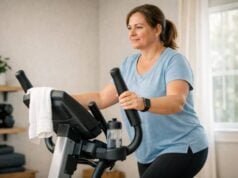
Elliptical: best for low-impact full-body cardio
The elliptical sits in a useful middle ground. It is lower impact than the treadmill, more upright and whole-body than the bike, and usually less intimidating than the StairMaster. For many people, that makes it the easiest machine to stick with once they learn the rhythm.
Its biggest advantage is smoothness. Because your feet stay in contact with the pedals, you avoid the repeated landing forces of running. At the same time, you are not sitting down. That gives the workout a more athletic feel than a bike and often makes it easier to feel like you are “doing cardio” rather than just pedaling.
The elliptical is often a strong choice if you:
- Want low-impact training without a seated position
- Like using both upper and lower body
- Need a machine that feels easier on knees and hips
- Want steady-state cardio that is not too jarring
The catch is that ellipticals are easy to underload. Plenty of people cruise with light resistance, shallow range of motion, and a death grip on the handles, then wonder why the workout feels ineffective. The elliptical works best when you drive the pedals with intent, use a full stride, keep your torso tall, and choose resistance that makes the session feel meaningfully challenging.
The moving handles are also a mixed bag. They can help some people stay engaged and slightly increase total work, but only if the arms assist rather than compensate for a lazy lower body effort. If adding the handles makes you shorten your stride and go easier with your legs, the benefit can disappear.
For weight loss, the elliptical is especially good for moderate sessions you can recover from well. That makes it useful for building weekly volume. It is not always the best machine for maximal effort, but it is often one of the best for staying consistent when impact is the limiting factor.
It also suits people in a calorie deficit who want cardio without feeling battered. That matters more than many realize. A good machine is not just one that can push you hard. It is one that leaves enough energy to train again, hit your step target, and maintain strength work.
If this is your best fit, elliptical workouts for weight loss can help you structure sessions so they stay productive instead of repetitive.
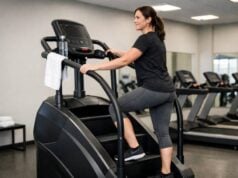
StairMaster: best for hard, short sessions
The StairMaster has a reputation as a fat-loss monster, and there is a reason for that. It is demanding. Few machines create that mix of breathlessness and deep lower-body fatigue so quickly. If you want short, tough sessions and you already have a base level of fitness, it can be extremely effective.
The StairMaster tends to light up the glutes, quads, calves, and lungs fast. That can make it feel efficient, especially when you only have 10 to 20 minutes. It also encourages you to work against gravity in a way that feels more substantial than easy cycling or casual elliptical use.
But it is not automatically the best cardio machine for weight loss. In fact, it is often a poor starting point for beginners.
Why? Because the very thing that makes it effective also makes it limiting. Local muscular fatigue can end the workout before you accumulate much time. Technique can also fall apart quickly. People lean on the rails, hunch over, or take tiny, choppy steps just to survive. That lowers the quality of the session and can make the movement feel worse on the knees or back.
The StairMaster is usually best if you:
- Already tolerate regular cardio well
- Want a shorter, tougher workout style
- Enjoy feeling challenged rather than cruising
- Have no major balance issues and decent lower-body endurance
It is usually not the best first choice if you are very deconditioned, have significant knee discomfort, or struggle with balance. It can also be rough during phases when recovery is already stretched thin.
A practical way to use the StairMaster is as a focused tool, not your entire strategy. One or two harder step-mill sessions each week can work well, especially when your other cardio is lower impact or easier to recover from. That gives you the benefit of intensity without asking the machine to solve everything.
If you like this style of training, 25-7-2 StairMaster workout for weight loss can show you how to approach it without turning every session into a rail-hanging grind.
How to pick the right machine
The fastest way to choose the right cardio machine is to stop asking which one is “best” in the abstract and start filtering by your body, experience, and constraints.
Use this simple framework:
- Start with joint tolerance.
If walking or running hurts, do not force the treadmill just because it seems superior. Start with the bike or elliptical. - Consider your current size and conditioning.
If you are significantly overweight, very out of shape, or both, low-impact options often let you accumulate more weekly work with less discomfort. - Match the machine to your preferred workout style.
Love zoning out for 30 to 45 minutes? Treadmill walking and elliptical work are often better. Prefer short, structured efforts? Bike intervals or StairMaster sessions may suit you. - Think about safety and confidence.
If a moving belt or step mill makes you feel unstable, that matters. Confidence is not a side issue. It directly affects adherence. - Look for the clearest progression.
The best machine lets you see improvement without guesswork.
A useful shortcut looks like this:
- Choose treadmill if you enjoy walking, want the most flexibility, and tolerate impact reasonably well.
- Choose bike if you need the most joint-friendly way to work hard.
- Choose elliptical if you want low-impact cardio that feels smoother and more full-body.
- Choose StairMaster if you already have some fitness and want shorter, demanding sessions.
One more important point: body weight changes the answer. People in larger bodies often do better with machines that reduce impact and increase confidence early on. That is not a compromise. It is smart programming. The goal is not to win the hardest-machine contest. The goal is to lose fat while keeping the process doable.
If you are starting from a higher body weight or a low fitness baseline, workout plan for obese beginners can help you build a safer starting structure around whichever machine you choose.
How to make any machine work
Once you pick your machine, results depend less on the brand of cardio and more on how you use it. The biggest mistake is doing the same comfortable session over and over while expecting a different outcome.
To make any cardio machine effective for weight loss, focus on four things: consistency, progression, recovery, and diet support.
| What to do | Practical target | Example |
|---|---|---|
| Train consistently | 3 to 5 sessions per week | Two moderate sessions, one longer easy session, one interval day |
| Progress gradually | Increase one variable every 1 to 2 weeks | Add 5 minutes, one interval round, or a small bump in incline or resistance |
| Keep most work sustainable | Mostly moderate effort, not all-out | You finish feeling worked, not wrecked |
| Support fat loss outside the gym | Pair cardio with a calorie deficit and enough protein | Use cardio to help create the deficit, not to excuse overeating |
A strong weekly setup for many people looks like this:
- 2 to 3 moderate cardio sessions
- 1 harder interval session
- 2 to 3 strength-training sessions
- Daily movement outside workouts, such as walking and standing more
That mix works better than endless hard cardio because it is easier to recover from and better for muscle retention. This is especially important during weight loss, when recovery resources are lower. Cardio helps create the energy deficit, but strength training helps you hold on to lean mass and performance.
A few rules improve results no matter what machine you choose:
- Do not trust console calorie numbers too much
- Do not make every session maximal
- Stop increasing duration, resistance, and intensity all at once
- Keep at least one session easy enough that you could do more if needed
- Reassess every few weeks based on fatigue, hunger, and consistency
Finally, remember that no cardio machine overrides diet. It can support the process, improve fitness, and make a calorie deficit easier to maintain, but it does not remove the need for one. If your food intake quietly rises with your cardio, progress slows fast. For the nutrition side, calorie deficit for weight loss and strength training for weight loss pair especially well with any machine-based plan.
The real winner is not treadmill versus bike versus elliptical versus StairMaster. It is the machine you can use well, recover from, and repeat often enough to matter.
References
- WHO guidelines on physical activity and sedentary behaviour 2020 (Guideline)
- Aerobic Exercise and Weight Loss in Adults: A Systematic Review and Dose-Response Meta-Analysis 2024 (Systematic Review)
- 2024 Adult Compendium of Physical Activities: A third update of the energy costs of human activities 2024 (Review)
- Exercise training in the management of overweight and obesity in adults: Synthesis of the evidence and recommendations from the European Association for the Study of Obesity Physical Activity Working Group 2021 (Review)
Disclaimer
This article is for general educational purposes only. Exercise tolerance, joint pain, cardiovascular risk, and mobility limits can change which cardio machine is safest and most effective for you, so speak with a qualified clinician or exercise professional if you have a medical condition, significant pain, dizziness, or concerns about starting harder training.
If you found this article helpful, please share it on Facebook, X, or your preferred platform to help someone else choose the right cardio machine for weight loss.