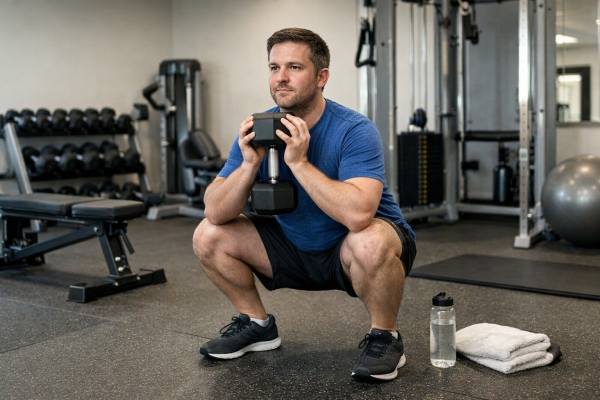
A good beginner gym workout for weight loss does not need to be extreme, confusing, or punishing. It needs to be repeatable. The most effective starting point for most beginners is a simple full-body strength plan done three days per week, plus some easy cardio and more daily steps. That combination helps you burn calories, keep or build muscle, and improve fitness without living in the gym.
This guide gives you a practical weekly plan, the exercises to use, how hard to train, how to add cardio, and how to progress over your first 8 weeks so the routine keeps working after the first burst of motivation fades.
Table of Contents
- Why this beginner plan works
- 3-day full-body gym plan
- How to do the workouts well
- Cardio, steps and rest days
- How to progress for 8 weeks
- Mistakes that slow fat loss
- When to modify the plan
Why this beginner plan works
Beginners often assume weight loss workouts should leave them wrecked, drenched, and sore every day. In reality, the best gym plan for fat loss is one you can recover from and repeat for months. That is why a full-body routine works so well at the start.
Each session trains your legs, upper body push muscles, upper body pull muscles, and core. That gives you enough practice to improve form quickly, enough weekly training volume to make progress, and enough recovery time between sessions. You do not need a bodybuilder split or a six-day routine when you are still learning the basics.
This approach also matches what most people actually need from the gym:
- More muscle retention while losing weight
- Better strength and work capacity
- Higher daily calorie burn from training and movement
- Less overwhelm
- More consistency
Strength training matters during weight loss because it helps protect lean mass. When people lose weight with diet alone, they often lose a mix of body fat and muscle. A beginner resistance plan helps shift that outcome in a better direction. You may not lose weight faster on the scale every single week, but you improve the quality of the weight you lose.
A simple gym plan also makes decision-making easier. You show up knowing exactly what to do instead of wandering between random machines, copying advanced lifters, or chasing whichever social media workout looked hardest that morning. If you want a broader look at the best exercises for weight loss, you will notice the same pattern appears again and again: big muscle groups, repeatable movements, and sustainable effort.
For most beginners, three strength sessions per week is the sweet spot. Two can work. Four can work. But three gives you a strong middle ground between results and recovery. If you are unsure about how many days a week to work out, start with the lowest amount you can realistically sustain, then build from there.
The final reason this plan works is that it leaves room for the other parts of fat loss that matter: a calorie deficit, enough protein, sleep, steps, and stress management. Your workout should support those habits, not crush them.
3-day full-body gym plan
This plan is built for beginners using common gym equipment: machines, dumbbells, cables, and a few bodyweight movements. It is intentionally simple. You do not need the perfect exercise selection. You need a plan you can perform with decent technique and gradually improve.
Aim for 45 to 60 minutes per workout.
| Day | What to do | Goal |
|---|---|---|
| Monday | Workout A | Full-body strength |
| Tuesday | Easy walk or light cardio | Recovery and extra calorie burn |
| Wednesday | Workout B | Full-body strength |
| Thursday | Rest or easy walk | Recovery and steps |
| Friday | Workout C | Full-body strength |
| Saturday | Optional easy cardio or longer walk | Fitness and movement |
| Sunday | Rest | Recovery |
Workout A
- Leg press — 3 sets of 8 to 10 reps
- Machine chest press — 3 sets of 8 to 10 reps
- Lat pulldown — 3 sets of 8 to 10 reps
- Dumbbell Romanian deadlift — 2 sets of 8 to 10 reps
- Seated cable row — 2 sets of 10 to 12 reps
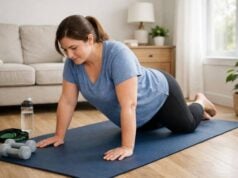
- Plank — 2 sets of 20 to 40 seconds
This first workout is a strong starting point because the leg press and chest press are easy to learn, the pulldown and row teach you how to pull well, and the Romanian deadlift introduces the hip hinge without demanding advanced barbell skill.
Workout B
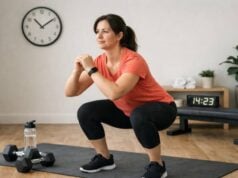
- Goblet squat to a box or bench — 3 sets of 8 to 10 reps
- Seated dumbbell or machine shoulder press — 3 sets of 8 to 10 reps
- Chest-supported row or seated row — 3 sets of 8 to 10 reps
- Hip thrust machine or glute bridge — 2 to 3 sets of 10 to 12 reps
- Incline dumbbell press — 2 sets of 8 to 10 reps
- Dead bug — 2 sets of 6 to 8 reps per side
This day adds more coordination and balance without becoming too technical. The goblet squat teaches posture, bracing, and depth control. The shoulder press develops upper-body pushing strength and makes many daily tasks feel easier.
Workout C
- Step-up or split squat while holding support — 2 sets of 8 reps per leg
- Close-grip lat pulldown or assisted pull-up machine — 3 sets of 8 to 10 reps
- Machine chest press or incline push-up on a bench — 2 to 3 sets of 8 to 10 reps
- Seated hamstring curl — 3 sets of 10 to 12 reps
- Cable face pull — 2 sets of 12 to 15 reps
- Pallof press — 2 sets of 10 reps per side
The third workout rounds out the week with single-leg work, more pulling, hamstring work, shoulder-friendly upper-back work, and core stability. It is not glamorous, but it covers what beginners usually need.
A few rules make this program work better:
- Start lighter than you think you need.
- Leave 1 to 3 good reps in reserve on most sets.
- Stop each set when form clearly starts to break down.
- Rest about 60 to 90 seconds between most sets, and closer to 90 to 120 seconds for harder lower-body exercises.
- Repeat the same plan long enough to improve it.
If your gym does not have a specific machine, use a close substitute. A dumbbell bench press can replace a chest press. A cable row can replace a chest-supported row. A bodyweight glute bridge can replace a hip thrust machine. The point is not perfect equipment matching. The point is keeping the movement pattern.
If three days feels like too much at first, start with two days for 2 to 3 weeks by alternating the sessions. For example, do A and B in week one, then C and A in week two. Once that feels manageable, move to the full three-day setup.
How to do the workouts well
A beginner plan succeeds or fails on execution more than exercise variety. The same six movements can be effective or useless depending on whether you rush, guess at the load, and let fatigue destroy technique.
Start each session with 5 to 8 minutes of easy movement. A treadmill walk, bike, or elliptical is enough. Then do one or two lighter practice sets before your first big lower-body and upper-body exercises. You do not need a complicated warm-up, but you should not jump straight into your working weight either. A simple and consistent preparation routine is usually enough, and more detailed guidance on warm-up, mobility and recovery can help if you feel stiff or unsure where to begin.
Use these basic technique standards:
- Move through a controlled range of motion you can own
- Keep your ribs down and core braced on squats, presses, and hinges
- Lower the weight with control instead of dropping it
- Avoid bouncing, jerking, or using momentum to finish reps
- Exhale through the hardest part of the lift
Your effort should feel challenging, but not like survival. A helpful beginner target is this: by the end of a set, you should feel you could maybe do 1 to 3 more clean reps if absolutely necessary. That is hard enough to stimulate progress and safe enough to recover from.
Do not chase muscle failure on every set. Beginners often think harder always means better. Usually it just means poorer form, more soreness, and worse performance later in the workout. Consistent moderate-hard effort beats occasional all-out chaos.
Tempo matters too. A useful rhythm is:
- Lift with control
- Pause briefly if needed
- Lower in about 2 to 3 seconds
That alone can make light-to-moderate weights much more effective.
You should also track your sessions. Write down the exercise, weight, reps, and how it felt. Without that, many people repeat the same effort for months and wonder why nothing changes. A notebook or phone note is enough.
Finally, know what a good workout feels like. You should leave with a sense that you trained productively, not that you barely survived. Some days will feel stronger than others. That is normal. The goal is not to win every session. The goal is to stack enough solid sessions that your body composition, strength, and fitness trend in the right direction.
Cardio, steps and rest days
Strength training is the backbone of this beginner plan, but it works even better when you pair it with sensible cardio and more daily movement.
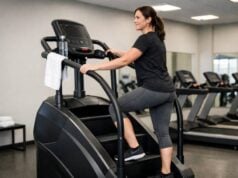
For most beginners trying to lose weight, the easiest add-on is low- to moderate-intensity cardio 2 to 3 times per week for 15 to 30 minutes. Good options include:
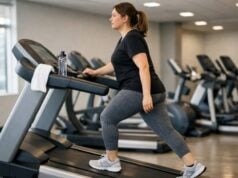
- Incline treadmill walking
- Stationary bike
- Elliptical
- Rowing machine at an easy pace
- Brisk outdoor walking
This kind of cardio is effective because it adds calorie burn without crushing recovery. It also improves fitness, which makes your strength sessions feel easier over time. If you are unsure about combining modalities, the simplest answer for beginners is usually weights first and cardio after, or cardio on separate days. There is more nuance to cardio before or after weights, but you do not need to overthink it at the start.
Steps matter more than many beginners realize. A hard 50-minute gym session does not erase the effect of sitting for the other 23 hours. Daily walking helps keep overall activity higher and is often easier to recover from than adding more intense cardio. If structured exercise is new for you, walking for weight loss can be one of the most useful habits to build alongside gym training.
A good beginner target is to increase your current average steps rather than jumping straight to an arbitrary number. If you average 4,000 steps now, move toward 6,000. Then 7,000. Then 8,000 or more if your schedule and joints allow it. A consistent increase beats one huge target you abandon after four days.
Rest days are part of the plan, not a sign that you are slacking. Use them to recover, sleep more, walk, stretch lightly, and get back to the next session feeling better. Beginners often sabotage progress by turning every rest day into another hard workout. Unless you enjoy that pace and recover well from it, it usually backfires.
The best mix for many people looks like this:
- 3 strength sessions per week
- 2 to 3 easy cardio sessions
- Daily step goals
- 1 to 2 true lower-stress days
That is enough structure to drive results and enough flexibility to keep doing it next month.
How to progress for 8 weeks
The reason beginner workouts stop working is usually not that the plan is bad. It is that the person never progresses it. They keep using the same weights, same reps, same effort, and same casual approach.
Your first 8 weeks should focus on doing a little more over time while keeping technique solid. That is the heart of progressive overload while losing weight.
| Weeks | Main focus | How hard to train |
|---|---|---|
| 1 to 2 | Learn form, find starting weights, leave reps in reserve | Moderate effort |
| 3 to 4 | Add reps where possible, then small weight increases | Moderate to moderately hard |
| 5 to 6 | Bring more sets to the top of the rep range | Hard but controlled |
| 7 to 8 | Add small load increases on main lifts while protecting form | Hard, not all-out |
Use this rule for most exercises: when you can complete all planned sets at the top of the rep range with clean form, increase the load next time by the smallest jump available. That might be 2.5 to 5 pounds on upper-body exercises and 5 to 10 pounds on lower-body exercises.
Example:
- Week 1 leg press: 3 sets of 8 with 80 pounds
- Week 2 leg press: 10, 9, 8 reps with 80 pounds
- Week 3 leg press: 10, 10, 10 reps with 80 pounds
- Week 4 leg press: increase to 90 pounds and build back up
That is enough progression for a beginner. You do not need fancy periodization.
If a weight increase wrecks your form, keep the new weight only if the reps are still controlled. If not, go back down and earn the jump more gradually.
Also remember that progress is not just more load. It can be:
- Better form
- More reps with the same weight
- Less rest between sets while maintaining performance
- More range of motion
- Better workout consistency
- Less soreness between sessions
During weight loss, recovery can be slightly tighter, especially if your calorie deficit is aggressive. That is one reason protein matters. Adequate protein intake for weight loss supports muscle retention and recovery, which makes your gym plan more productive.
If you feel run down for more than a week, do not panic and slash calories lower. First check sleep, stress, protein, hydration, and whether you have been pushing every set too hard. Most beginner stalls come from recovery issues, not a lack of suffering.
Mistakes that slow fat loss
A beginner gym routine can absolutely help with weight loss, but some common mistakes make people feel busy without moving the needle much.
The first is treating workouts like a permission slip to eat more. Many people finish a session, feel virtuous, and then accidentally wipe out the calorie deficit with snacks, drinks, or oversized meals. This is one reason overestimating exercise calories is such a common problem. Most gym machines also overstate calories burned.
The second mistake is adding too much too fast. Beginners often go from almost no activity to six workouts a week, daily cardio, and soreness that makes ordinary life harder. That usually leads to skipped sessions, frustration, or minor injuries.
The third mistake is chasing only sweat and exhaustion. A workout can feel brutal and still be poorly structured. Good training is not random burpees, endless ab circuits, and whatever machine happens to be open. It is repeatable work that you can measure and improve.
Other common problems include:
- Changing exercises every week before you learn them
- Resting too little and turning strength work into sloppy cardio
- Going to failure on every set
- Ignoring steps outside the gym
- Skipping sleep and recovery
- Expecting the scale to drop immediately even while strength improves
Another subtle mistake is relying on the scale alone. In the first weeks, your body weight may bounce around because of hydration, sodium, soreness, glycogen, and digestive changes. You may still be making progress in strength, waist size, energy, and consistency. Use more than one measure.
The final mistake is assuming the gym should do all the work. It helps, but weight loss still depends heavily on your overall eating pattern. Exercise is powerful, but it is not a free pass around the basics.
When to modify the plan
A beginner plan should challenge you, but it should still fit your body, schedule, and starting point. Modify the routine when needed instead of quitting because the default version feels too hard.
If you are very deconditioned, carrying a lot of extra body weight, or returning after years away from exercise, start with fewer sets. Two sets per exercise may be enough for the first couple of weeks. You can also lengthen rest periods and keep cardio short and easy. A more specialized workout plan for obese beginners may feel more realistic if basic gym sessions still leave you wiped out.
If you have knee pain, back pain, or impact sensitivity, swap in joint-friendlier options. Good examples include:
- Bike instead of jogging
- Leg press instead of jump-based work
- Supported split squats instead of free-standing lunges
- Glute bridges instead of painful hinging variations
- Elliptical instead of stair sprints
If your joints need gentler conditioning, low-impact cardio for bad knees can be a better starting point than forcing high-impact exercise you dread.
You should also scale back if you notice these signs repeatedly:
- Sharp pain during lifts
- Dizziness or nausea that is not just normal effort
- Soreness that lasts so long you miss the next session
- Rapid form breakdown on nearly every set
- Constant fatigue and declining performance
- A growing sense that the plan is impossible to recover from
Some people should check with a clinician before starting or progressing a gym plan aggressively, especially if they have heart disease, uncontrolled blood pressure, uncontrolled diabetes, recent surgery, major joint problems, or are pregnant or newly postpartum.
The smart approach is not to search for the hardest plan you can survive. It is to find the hardest plan you can recover from consistently. For beginners, that usually looks simpler than expected and works better than expected.
References
- WHO guidelines on physical activity and sedentary behaviour 2020 (Guideline)
- Effect of exercise training on weight loss, body composition changes, and weight maintenance in adults with overweight or obesity: An overview of 12 systematic reviews and 149 studies 2021 (Review)
- Resistance training effectiveness on body composition and body weight outcomes in individuals with overweight and obesity across the lifespan: A systematic review and meta-analysis 2022 (Systematic Review)
- Aerobic Exercise and Weight Loss in Adults: A Systematic Review and Dose-Response Meta-Analysis 2024 (Meta-Analysis)
Disclaimer
This article is for general educational purposes only and is not a substitute for medical advice, diagnosis, or treatment. If you have a medical condition, significant joint pain, chest symptoms, recent surgery, or concerns about starting exercise, speak with a qualified healthcare professional before beginning a new workout plan.
If this guide helped you, share it on Facebook, X, or your preferred platform so more beginners can start with a plan that is simple, realistic, and easier to stick with.