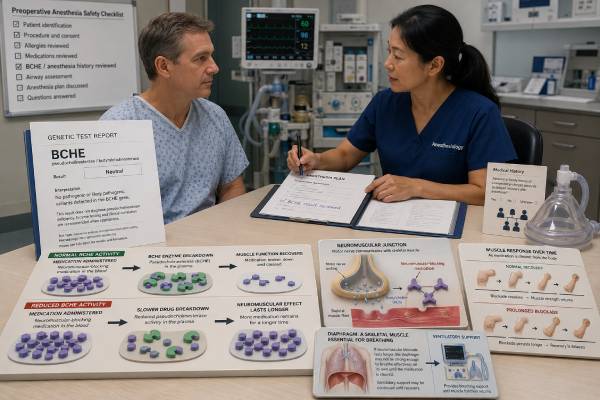
A BCHE genetic test looks for inherited changes that reduce the activity of butyrylcholinesterase, an enzyme also called pseudocholinesterase or plasma cholinesterase. Low or abnormal enzyme activity can make the muscle relaxants succinylcholine and mivacurium last far longer than expected. A person may remain unable to move or breathe independently for hours after anesthesia, even though the operation is over and other anesthetic drugs are wearing off. Most affected people feel well in daily life and learn about the condition only after an unexpected anesthetic reaction or testing prompted by family history. Genetic testing can confirm an inherited cause, clarify risk for relatives, and support a safer anesthesia plan. It is usually interpreted with a plasma enzyme activity level, a dibucaine number, the details of any prior reaction, and conditions such as pregnancy, liver disease, malnutrition, burns, or medication use that can temporarily lower enzyme activity.
- A pathogenic BCHE result can confirm inherited pseudocholinesterase deficiency and supports avoiding succinylcholine and mivacurium in future anesthesia.
- A low enzyme activity level alone does not prove a genetic disorder because pregnancy, liver or kidney disease, major burns, cancer, malnutrition, and some medicines can lower activity.
- A normal dibucaine number is usually around 80, while many heterozygotes are near 50–60 and people with two atypical alleles may be near 20–30.
- The condition does not usually cause breathing problems unless a susceptible drug is given; the danger is prolonged drug-induced paralysis, not spontaneous respiratory failure.
- Relatives should not assume they share the same genotype, but first-degree family members may benefit from enzyme or genetic testing before surgery.
Table of Contents
- Why BCHE Matters in Anesthesia
- When Testing Is Considered
- Inherited and Acquired Deficiency
- Enzyme Activity, Dibucaine, and Genetic Tests
- How to Read BCHE Results
- Anesthesia Planning and Emergency Care
- Family Testing and Long-Term Precautions
Why BCHE Matters in Anesthesia
The BCHE gene provides instructions for making butyrylcholinesterase, an enzyme produced mainly in the liver and released into the bloodstream. The enzyme breaks down several ester-containing substances. Its most important anesthetic role is the rapid inactivation of succinylcholine and mivacurium, two neuromuscular blocking drugs used to produce temporary muscle paralysis.
Succinylcholine acts quickly and usually wears off within minutes, which can make it useful for rapid airway control. Mivacurium is a short-acting nondepolarizing blocker. Neither drug makes a person unconscious or relieves pain. They only prevent muscles from contracting, including the diaphragm and other breathing muscles. Anesthesia teams therefore give them with adequate sedation or general anesthesia and provide ventilation while paralysis is present.
When butyrylcholinesterase activity is severely reduced or the enzyme has abnormal substrate binding, the drug remains active much longer. The patient may wake mentally before muscle strength returns if sedation is not continued. Awareness while unable to move can be terrifying, so ongoing sedation, reassurance, neuromuscular monitoring, and mechanical ventilation are central parts of care.
Pseudocholinesterase deficiency is different from malignant hyperthermia. BCHE deficiency causes unexpectedly prolonged paralysis after particular drugs. Malignant hyperthermia is a hypermetabolic crisis involving rapid carbon dioxide rise, muscle rigidity, acidosis, and possible high temperature, often linked to RYR1 or CACNA1S variants. A malignant hyperthermia genetic test answers a different anesthesia-safety question.
The condition is also different from acetylcholinesterase inhibition. Butyrylcholinesterase circulates mainly in plasma, while acetylcholinesterase acts at nerve endings and neuromuscular junctions. The similar names can cause confusion, but routine BCHE testing is aimed at susceptibility to prolonged succinylcholine or mivacurium effect.
When Testing Is Considered
Testing is most commonly pursued after an abnormal anesthetic recovery. The classic history is that a patient received succinylcholine or mivacurium, remained weak or apneic well beyond the expected duration, and required prolonged ventilation. The anesthesia record is especially valuable because it can show the exact drug, dose, timing, nerve-stimulator findings, reversal attempts, temperature, blood gases, and duration until strength returned.
A clinician may also consider testing before surgery when there is:
- A first-degree relative with confirmed pseudocholinesterase deficiency
- A family story of “not waking up,” prolonged ventilation, or unexpected intensive care after anesthesia
- A previously documented low plasma cholinesterase level
- A prior prolonged response to succinylcholine during surgery, emergency intubation, or electroconvulsive therapy
- An unexplained need for several hours of ventilation after a short procedure
- A known familial BCHE variant suitable for targeted testing
Not every delayed awakening points to BCHE deficiency. Opioids, sedatives, residual nondepolarizing blockade, hypothermia, electrolyte abnormalities, neurologic disease, equipment problems, and organ dysfunction can delay recovery. A careful review helps determine whether the pattern was prolonged paralysis specifically or a broader delayed emergence.
Routine population-wide BCHE screening before every anesthetic is not standard in most health systems. The condition is uncommon, alternative paralytics are available, and emergency airway management may not allow time for testing. Preoperative screening becomes more attractive when the history is suggestive or the result will clearly change drug selection.
Direct-to-consumer genotyping is not a reliable substitute for clinical testing. Consumer arrays may examine only one or a few common variants, omit rare loss-of-function changes, and provide no enzyme activity measurement. A clinical single-gene test can sequence the BCHE coding region and, depending on the laboratory, assess selected deletions or duplications.
Inherited and Acquired Deficiency
Pseudocholinesterase deficiency can be inherited, acquired, or a combination of both. This distinction matters because a low enzyme level during illness or pregnancy may improve later, while a pathogenic BCHE genotype remains lifelong.
Inherited BCHE deficiency
The clinically significant inherited form usually follows an autosomal recessive inheritance pattern. A person has two copies of BCHE, one inherited from each biological parent. Two disease-causing or strongly reduced-function variants can produce marked deficiency. One variant may produce an intermediate phenotype, with a shorter but still clinically important prolongation after succinylcholine or mivacurium.
Many BCHE variants have been described. Historical names include the usual, atypical, fluoride-resistant, silent, and Kalow variants. Modern reports increasingly use standardized DNA notation, such as a nucleotide and protein change, along with a classification such as pathogenic, likely pathogenic, or uncertain significance.
The common “atypical” variant changes the enzyme’s response to dibucaine and is associated with a low dibucaine number. Silent variants may greatly reduce or eliminate enzyme production. Some combinations cause severe prolongation, while others produce only modest changes. Genotype–phenotype relationships are not perfect because enzyme concentration, health status, and additional variants also matter.
A person with two clinically important variants may remain completely asymptomatic until exposed to a relevant drug. There is usually no chronic muscle weakness, exercise intolerance, or daily shortness of breath. This silent baseline explains why family history and permanent documentation are so important.
Acquired low activity
Butyrylcholinesterase is produced in the liver, so conditions that reduce synthesis or increase physiologic stress can lower the measured level. Reported causes include:
- Pregnancy and the early postpartum period
- Advanced liver disease
- Kidney disease and dialysis
- Malnutrition or very low protein intake
- Major burns or severe infection
- Cancer and some forms of chemotherapy
- Advanced age or critical illness
- Organophosphate exposure
- Certain medicines that inhibit cholinesterase activity
Acquired deficiency often lowers enzyme quantity without changing the dibucaine number, because the enzyme that remains has normal structure. A person can also carry a BCHE variant and develop an acquired reduction, creating a larger-than-expected anesthetic effect. That is why enzyme activity and genotype can provide complementary information.
Testing during pregnancy, acute illness, or soon after major surgery may not reflect the person’s stable baseline. When the result is unexpectedly low and surgery is not urgent, a clinician may repeat enzyme activity after the temporary condition has resolved.
Enzyme Activity, Dibucaine, and Genetic Tests
Three related tests are commonly discussed: quantitative butyrylcholinesterase activity, the dibucaine number, and BCHE genetic analysis. They answer different questions.
| Test | What it measures | Main strength | Main limitation |
|---|---|---|---|
| Plasma or serum cholinesterase activity | How much substrate the patient’s circulating enzyme can break down under laboratory conditions | Detects low functional activity from genetic or acquired causes | Reference ranges vary and a low level does not identify the cause |
| Dibucaine number | Percentage inhibition of enzyme activity by dibucaine | Helps identify the classic atypical enzyme phenotype | Does not detect every clinically important BCHE variant |
| BCHE genetic test | Specific inherited variants in the BCHE gene | Confirms inherited susceptibility and supports family testing | May miss variants outside the assay and cannot measure temporary acquired suppression |
Quantitative enzyme activity
A blood sample is used to measure butyrylcholinesterase activity. Laboratories report different units and reference intervals, so a value should always be read against the range printed on that report. A very low result can support the diagnosis, but it should not be interpreted without current health conditions and medications.
Activity testing is most informative when the patient is no longer receiving interfering drugs and has recovered from acute illness. A sample drawn immediately after an anesthetic event may still help, but the timing and transfusions should be documented. Fresh frozen plasma contains butyrylcholinesterase and can alter subsequent testing.
Dibucaine number
Dibucaine inhibits normal butyrylcholinesterase strongly. The dibucaine number is the percentage of enzyme activity inhibited in the laboratory. Commonly cited patterns are:
- About 80: Typical enzyme response
- About 50–60: Often consistent with one atypical allele
- About 20–30: Often consistent with two atypical alleles
These are approximate interpretive ranges, not universal cutoffs. The result must be matched to the laboratory method. A person can have a normal or near-normal dibucaine number yet still have low enzyme activity from liver disease, pregnancy, or a different genetic variant.
Genetic analysis
A BCHE genetic test usually uses blood or a cheek swab. Fasting is unnecessary, and anesthesia medicines do not change DNA. A targeted test looks for a known familial variant. A broader assay may sequence the gene and sometimes evaluate copy-number changes.
The report should state which transcript was used, which regions were analyzed, whether deletions or duplications were assessed, and how variants were classified. A negative result does not rule out acquired deficiency or every rare genetic cause. If clinical and enzyme findings strongly suggest inherited deficiency, consultation with the laboratory or a genetics specialist may be appropriate.
How to Read BCHE Results
Interpretation begins by combining genotype, enzyme activity, dibucaine number, and the patient’s anesthetic history. No single result should be read in isolation.
| Result pattern | Likely interpretation | Usual follow-up |
|---|---|---|
| Two pathogenic or likely pathogenic BCHE variants with very low activity | Inherited deficiency is strongly supported | Avoid succinylcholine and mivacurium; document permanently; offer family testing |
| One pathogenic variant with moderately reduced activity | Carrier or intermediate phenotype; prolonged blockade remains possible | Discuss avoidance or cautious alternative planning with anesthesia |
| Low activity, normal dibucaine number, negative genetic panel | Acquired suppression or an untested variant is possible | Review illness and medicines; repeat when stable; consider broader testing |
| Low dibucaine number with an atypical BCHE variant | Abnormal substrate inhibition is confirmed | Use non-BCHE-dependent neuromuscular blockers |
| Variant of uncertain significance | The DNA change is not proven to cause deficiency | Rely on enzyme studies, family data, and clinical history; do not treat uncertainty as proof |
A pathogenic variant classification means evidence supports a disease-causing role. “Likely pathogenic” also carries strong evidence, though not absolute certainty. A variant of uncertain significance, or VUS, should not by itself label a person as affected. Over time, laboratories may reclassify a VUS as more evidence becomes available.
The phrase “carrier” can be misleading in pharmacogenetics. A person with one reduced-function BCHE allele may not meet the usual definition of severe recessive disease, yet the response to succinylcholine can still be longer than average. Anesthesia planning should reflect the observed phenotype and available alternatives rather than rely on the label alone.
A negative result also needs context. Targeted testing for one familial variant is highly informative only when that exact family variant is known. A negative targeted result means the tested variant was not found; it does not evaluate the rest of the gene. Full sequencing reduces this gap but still may not detect deep intronic, regulatory, structural, or technically difficult changes.
Anesthesia Planning and Emergency Care
A confirmed or strongly suspected BCHE deficiency should be communicated before any procedure requiring sedation, anesthesia, airway management, or electroconvulsive therapy. The anesthesia professional can choose drugs whose breakdown does not depend on butyrylcholinesterase. Rocuronium, vecuronium, atracurium, and cisatracurium are among the alternatives considered in appropriate clinical settings, although each has its own onset, duration, organ dependence, and reversal strategy.
The safest plan is individualized. A person may need rapid sequence intubation because of aspiration risk, trauma, or another emergency. In that setting, the team balances speed, airway difficulty, available reversal agents, and the patient’s known susceptibility. A medical alert entry can prevent clinicians from reaching for succinylcholine automatically when seconds matter.
When prolonged paralysis occurs unexpectedly, management is supportive:
- Maintain the airway and provide mechanical ventilation.
- Continue adequate sedation and amnesia while paralysis persists.
- Use quantitative neuromuscular monitoring when available.
- Exclude other causes of delayed recovery or weakness.
- Allow the drug effect to resolve as it is redistributed and cleared.
- Document the event and arrange confirmatory testing after recovery.
There is no routine antidote that reliably restores normal BCHE function immediately. Plasma transfusion can provide enzyme, but it carries transfusion risks and is generally unnecessary when safe ventilation and sedation are available. Conservative support until spontaneous recovery is usually preferred.
The duration of paralysis varies. People with one reduced-function allele may have a modest prolongation, while those with severe deficiency can require ventilation for several hours. The exact time depends on drug dose, variant combination, enzyme activity, concurrent illness, and other anesthetic factors.
An unexpected prolonged block is not evidence that the anesthesia team “gave too much” by itself. A standard dose can last abnormally long in a susceptible patient. A careful postoperative explanation can reduce fear and ensure that the event is not lost in an old hospital record.
Family Testing and Long-Term Precautions
BCHE results have lifelong value because the genotype does not change. The most important long-term action is making the information visible wherever anesthesia may be given.
Recommended precautions include:
- Add “BCHE deficiency/pseudocholinesterase deficiency—avoid succinylcholine and mivacurium” to the medical record.
- Carry a medical alert card, bracelet, or phone-based emergency record.
- Give the full report to the primary care clinician, dentist, anesthesiologist, surgeon, and any electroconvulsive therapy team.
- Keep copies of the genetic result, enzyme activity, dibucaine number, and prior anesthesia record.
- Discuss the condition during every preoperative assessment, even when the planned procedure seems minor.
- Avoid recreational cocaine because reduced butyrylcholinesterase activity may increase toxicity risk.
Family members may share a variant, but inheritance cannot be inferred from appearance or prior uneventful anesthesia. A relative may never have received succinylcholine, or may carry one rather than two variants. Testing can begin with the known familial variant when available. Enzyme activity and dibucaine testing may add useful functional information.
For a person with two pathogenic variants, each biological parent is often a carrier, and siblings may be affected, carriers, or unaffected. Children will inherit at least one variant if the parent has variants in both copies of BCHE; whether a child is affected depends on the other biological parent’s genotype. Genetic counseling can explain these probabilities without assuming that every family follows a simple pattern.
A prior normal anesthetic does not exclude the condition because the person may not have received succinylcholine or mivacurium. Ask for the anesthetic record rather than relying on the statement that “anesthesia was fine.” Likewise, regional anesthesia, local anesthesia with an amide agent, or general anesthesia using alternative paralytics may proceed normally.
The diagnosis should not create unnecessary avoidance of all anesthesia. People with BCHE deficiency can undergo surgery safely when the team knows the risk, selects suitable medicines, and monitors recovery. Clear documentation turns a frightening hidden susceptibility into a manageable anesthesia consideration.
A scheduled procedure offers time to resolve ambiguous results. The preoperative clinic can request old records, repeat an activity level when the patient is medically stable, and ask the testing laboratory whether a reported variant is known to alter succinylcholine hydrolysis. This preparation is particularly useful when the only family information is vague. Statements such as “my mother was ventilated overnight” may reflect BCHE deficiency, but they can also reflect lung disease, difficult surgery, heavy sedation, or another anesthetic complication.
Pregnancy deserves separate attention. Plasma cholinesterase activity commonly falls during pregnancy and can remain reduced for a period after delivery. Most pregnant patients still recover normally from standard anesthesia, but an inherited variant plus the physiologic reduction may produce a greater effect. When cesarean delivery or another procedure is planned, the anesthesia team should know about prior low values or family history before labor begins. A low value found during pregnancy may be repeated later to establish the person’s usual baseline.
Dental care can also create confusion because some ester local anesthetics are metabolized by plasma cholinesterase, while commonly used amide local anesthetics follow different pathways. The presence of BCHE deficiency does not mean all local anesthetics are prohibited. The dentist or anesthesiologist should review the exact agent rather than apply a blanket “all numbing medicine” warning. Precise documentation prevents both unsafe exposure and unnecessary avoidance.
Finally, patients who experienced awareness during prolonged paralysis may need emotional follow-up as well as laboratory testing. Being conscious while unable to signal can cause persistent anxiety, nightmares, or fear of future surgery. A clear explanation of what happened, reassurance that alternative drugs are available, and referral for psychological support when symptoms persist can be as important as the genetic diagnosis itself.
References
- Hereditary Pseudocholinesterase Deficiency and Succinylcholine: Historical Perspective, Therapeutic Implications, and Future Considerations 2025 (Review)
- A novel BCHE frameshift mutation in a Chinese woman with butyrylcholinesterase deficiency: A case report and literature review 2024 (Review)
- Pseudocholinesterase deficiency 2025 (Official Page)
- Pseudocholinesterase Deficiency 2023 (Review)
- Biochemistry, Pseudocholinesterase 2022 (Review)
Disclaimer
This article provides general education and is not a personal anesthesia plan. BCHE genetic findings, enzyme activity, and dibucaine results should be reviewed by an anesthesiologist, clinician, or genetics professional who has the full medical and medication history. Emergency airway and surgical decisions must be made by the treating team.