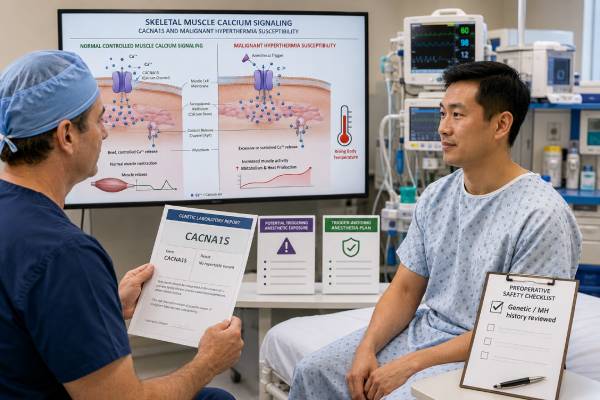
A CACNA1S genetic test looks for variants in a skeletal-muscle calcium-channel gene that can contribute to malignant hyperthermia susceptibility. Malignant hyperthermia is not an everyday fever or a predictable reaction to all anesthesia. It is a rare, potentially fatal hypermetabolic crisis triggered mainly by volatile inhaled anesthetics and the depolarizing muscle relaxant succinylcholine in susceptible people. A clearly pathogenic CACNA1S variant can establish inherited susceptibility and change anesthesia planning for the person tested and biologic relatives. However, CACNA1S accounts for only a small proportion of confirmed malignant hyperthermia susceptibility, and many test findings are uncertain. A negative result therefore cannot automatically exclude risk when the personal or family history is concerning. The safest interpretation combines the exact variant classification, the laboratory’s methods, clinical history, family findings, and—when indicated—evaluation by a malignant hyperthermia center, including specialized muscle contracture testing.
- A pathogenic CACNA1S variant can confirm malignant hyperthermia susceptibility and supports use of trigger-free anesthesia.
- A negative CACNA1S result does not rule out susceptibility because most genetically explained cases involve RYR1 and some remain genetically unresolved.
- A variant of uncertain significance is not a diagnosis and should not be used alone to label relatives as susceptible or unaffected.
- Prior uneventful anesthesia does not prove safety; malignant hyperthermia can occur after earlier exposures without a crisis.
- The most useful result is one interpreted with anesthesia history, family history, and specialist guidance rather than as an isolated DNA finding.
Table of Contents
- Why CACNA1S Matters in Malignant Hyperthermia
- Who May Benefit From CACNA1S Testing
- How the Test Is Performed and What It Can Detect
- Understanding Positive, Negative, and Uncertain Results
- Genetic Testing Versus Muscle Contracture Testing
- Planning Trigger-Free Anesthesia
- Recognizing and Responding to a Malignant Hyperthermia Crisis
- Family Implications and Long-Term Care
Why CACNA1S Matters in Malignant Hyperthermia
CACNA1S provides instructions for the alpha-1S subunit of the CaV1.1 voltage-gated calcium channel in skeletal muscle. This channel sits in the transverse-tubule membrane and acts as a voltage sensor during excitation-contraction coupling. When a nerve signal depolarizes the muscle membrane, CaV1.1 communicates with the RYR1 calcium-release channel in the sarcoplasmic reticulum. Calcium then enters the muscle-cell cytoplasm, allowing the contractile apparatus to generate force. Relaxation depends on bringing cytoplasmic calcium back under tight control.
In malignant hyperthermia susceptibility, this control system can become dangerously unstable in the presence of specific anesthetic triggers. Excess calcium remains available in the muscle-cell cytoplasm, producing sustained contraction and an extreme increase in metabolism. The body consumes oxygen rapidly, generates carbon dioxide and acid, releases potassium and muscle-cell contents, and produces heat. Without prompt treatment, the result can include arrhythmia, disseminated intravascular coagulation, kidney injury, compartment syndrome, cardiac arrest, and death.
Most molecularly confirmed cases are associated with pathogenic variants in RYR1. CACNA1S explains only about 1% of diagnosed susceptibility, while STAC3 accounts for an even smaller fraction. That distribution matters when choosing and interpreting testing. A single-gene CACNA1S assay may be appropriate when a known familial CACNA1S variant is being targeted, but a broader malignant hyperthermia genetic panel is usually more informative for an unexplained personal or family history.
Malignant hyperthermia susceptibility is generally inherited in an autosomal dominant manner. One pathogenic variant can be sufficient to increase risk, and each child of a person carrying that variant has a 50% chance of inheriting it. Yet penetrance is incomplete: not every carrier will experience a crisis, even after anesthesia. The absence of a previous reaction therefore cannot be used to show that a variant is harmless or that a carrier is clinically unaffected.
CACNA1S variants can also be associated with other skeletal-muscle disorders, particularly hypokalemic periodic paralysis and certain congenital myopathy phenotypes. These associations are variant specific. A result linked to periodic paralysis is not automatically a malignant hyperthermia result, and vice versa. Correct interpretation depends on the exact nucleotide and protein change, its classification for the relevant condition, and whether the person’s symptoms fit that condition.
Who May Benefit From CACNA1S Testing
Testing is most useful when there is a defined clinical reason rather than broad curiosity. Referral may follow a suspected malignant hyperthermia event during or shortly after anesthesia. Features that raise concern include an otherwise unexplained rapid rise in end-tidal carbon dioxide, tachycardia, generalized or masseter muscle rigidity, metabolic or respiratory acidosis, hyperkalemia, rhabdomyolysis, markedly elevated creatine kinase, myoglobinuria, or an unexpectedly rising core temperature. No single feature proves the diagnosis, and fever can be late rather than early.
A family history may be equally important. Testing should be considered when a close relative has:
- A confirmed pathogenic variant associated with malignant hyperthermia susceptibility.
- A positive caffeine-halothane contracture test or in vitro contracture test.
- A well-documented anesthetic crisis judged likely to represent malignant hyperthermia.
- An unexplained anesthesia-related death with features compatible with the disorder.
When a familial pathogenic CACNA1S variant is known, targeted testing for that exact variant is usually the clearest approach. A positive result identifies a relative who should be managed as susceptible. A negative targeted result may show that the relative did not inherit that particular familial variant, although the conclusion can be more complicated if the family’s clinical evidence is discordant or more than one genetic cause is plausible.
People with unexplained exertional rhabdomyolysis, recurrent heat illness, persistently elevated creatine kinase, muscle weakness, episodic paralysis, or a congenital myopathy may also be referred in selected circumstances. These findings are not synonymous with malignant hyperthermia susceptibility. They broaden the differential diagnosis and make consultation with neuromuscular genetics and an MH diagnostic center especially valuable.
Testing a person with no suggestive history and no affected relative can produce findings that are difficult to interpret. Rare variants are common across large genes, and many do not have enough evidence for a confident classification. Population screening may identify a pathogenic result that is clinically important, but it can also uncover uncertain findings without establishing anesthesia risk. Pretest counseling should address what a positive, negative, or uncertain result would change.
The ideal starting person in a family is usually the relative with the strongest documented phenotype: the individual who had the suspected crisis or a confirmed positive contracture test. Testing an unaffected relative first can generate an uninformative negative result because the family’s causal variant has not yet been identified. A genetics professional can help select the most informative person and obtain anesthesia records, laboratory results, and death records where relevant.
How the Test Is Performed and What It Can Detect
CACNA1S testing generally uses DNA from blood or saliva. The laboratory sequences coding regions and nearby splice boundaries to look for single-nucleotide variants and small insertions or deletions. Some assays also assess exon-level deletions or duplications, although copy-number analysis and coverage vary by laboratory. A test report should state which regions were analyzed, technical limitations, genome reference build, transcript, variant nomenclature, and classification system.
For a suspected malignant hyperthermia family without a known variant, a multigene panel typically includes RYR1, CACNA1S, and STAC3. Some laboratories add genes associated with overlapping myopathies, rhabdomyolysis, periodic paralysis, or calcium-handling disorders. Broader testing can increase the chance of finding a relevant cause, but it also increases the likelihood of secondary or uncertain findings. The ordering clinician should understand which genes are included and whether every gene has a well-established relationship to the clinical question.
A laboratory classifies variants as pathogenic, likely pathogenic, uncertain significance, likely benign, or benign. Classification draws on population frequency, published cases, segregation in families, functional studies, computational evidence, location in a critical protein region, and expert-curated criteria. “Rare” is not equivalent to “disease-causing.” A variant may be absent from population databases yet still lack evidence that it disrupts calcium regulation or causes clinical susceptibility.
The assay does not simulate an anesthetic exposure and does not measure muscle contraction. It also cannot predict the exact probability, age, severity, or trigger dose of a future crisis. Even among relatives with the same pathogenic variant, clinical expression can differ. Anesthesia type, exposure duration, temperature, illness, exercise, and other biological factors may modify what is observed.
Before ordering, ask whether the laboratory reports only established malignant-hyperthermia-associated variants or all rare CACNA1S changes. Also ask whether it participates in variant reclassification and how amended reports are communicated. Because evidence evolves, a result classified as uncertain today may later be upgraded or downgraded. Patients should keep the original report and update contact details with the ordering clinic.
A single-gene genetic test is not necessarily inferior to a panel; it is simply suited to a narrower question. Targeted CACNA1S analysis is efficient when a familial variant is already known. For an unexplained crisis, however, testing only CACNA1S leaves the much more common RYR1 contribution unexamined.
Understanding Positive, Negative, and Uncertain Results
A positive result means the laboratory identified a pathogenic or likely pathogenic CACNA1S variant associated with malignant hyperthermia susceptibility. In the right clinical context, this can establish susceptibility without a muscle biopsy. The person should inform anesthesia teams before every procedure, avoid triggering agents under professional guidance, and discuss cascade testing for biologic relatives. “Likely pathogenic” generally reflects strong evidence, but laboratories and specialist centers may have policies about which classifications are sufficient for predictive testing.
A result is not fully understood from the word “positive” alone. The report should specify the condition association. Some CACNA1S variants are established causes of hypokalemic periodic paralysis but have not been proven to confer malignant hyperthermia susceptibility. Others may be linked to a myopathy phenotype. The clinician should confirm that the classification applies specifically to malignant hyperthermia and not merely to CACNA1S-related disease in general.
A negative result means no reportable causative variant was detected by that assay. Its meaning depends on the reason for testing:
- In a relative tested specifically for a known familial CACNA1S variant, a true negative can be highly informative.
- In someone with a suspicious anesthetic event but no known familial variant, a negative CACNA1S result is not reassuring enough to end the evaluation.
- In a multigene panel, a negative result still cannot exclude an undiscovered gene, a variant outside the tested regions, a technically difficult variant, or susceptibility not identifiable by current DNA methods.
A variant of uncertain significance, or VUS, means the evidence is insufficient to classify the change as either disease-causing or benign. It should not be treated as a positive predictive result, and unaffected relatives generally should not be tested solely to determine who is “safe.” Family studies may still be useful when directed by a laboratory or specialist because segregation data can contribute evidence. The broader principles in understanding a VUS result apply: clinical decisions should rest on the person’s history and established evidence, not on uncertainty itself.
A benign or likely benign finding does not explain susceptibility. Such variants may appear in a technical appendix or may not be listed at all. Their presence does not offset a concerning phenotype.
Occasionally, the clinical and genetic evidence conflict. A person may carry a familial pathogenic variant but have a negative contracture test, or a family may show positive contracture tests without an identifiable pathogenic variant. Discordance requires specialist review rather than choosing whichever result feels more convenient. The report may need confirmation, family relationships may need verification, and the variant’s disease association may need re-evaluation under current criteria.
Genetic Testing Versus Muscle Contracture Testing
Genetic testing and muscle contracture testing answer related but different questions. DNA testing asks whether a recognized pathogenic variant is present. The in vitro contracture test used in Europe and the caffeine-halothane contracture test used in North America measure how freshly biopsied skeletal muscle responds to caffeine and halothane under controlled laboratory conditions.
Contracture testing is invasive because it requires an open muscle biopsy, must be performed at a specialized center, and usually requires travel. Its major advantage is higher sensitivity for detecting malignant hyperthermia susceptibility than current genetic testing. It can establish susceptibility even when no causative variant is found. Under specialist protocols, a negative contracture test is also the principal way to establish low-risk status in someone whose family or clinical history remains concerning after unrevealing genetic testing.
Genetic testing is less invasive and can be performed from blood or saliva. When it identifies a well-established familial pathogenic variant, it enables straightforward testing of relatives without repeating muscle biopsy in each person. Its limitation is incomplete diagnostic yield. A negative molecular result cannot exclude susceptibility because not all responsible variants or genes are known or detectable.
The sequence of tests is individualized. A specialist center may recommend contracture testing first after a strong clinical event, followed by genetic testing to identify a familial marker. In another family, a known pathogenic variant may make targeted DNA testing the first step. In children who are too young or small for biopsy under local protocols, genetic testing and trigger-free management may be used while definitive evaluation is deferred.
Clinical grading tools can estimate how compatible an anesthetic event was with malignant hyperthermia, but they do not replace diagnostic testing. Records should be reviewed for anesthetic drugs, timing, capnography, blood gases, potassium, creatine kinase, temperature, rigidity, treatment response, and alternative explanations such as sepsis, thyroid storm, pheochromocytoma, neuroleptic malignant syndrome, serotonin toxicity, equipment problems, or inadequate ventilation.
The practical lesson is that “genetic test negative” and “malignant hyperthermia negative” are not interchangeable. Anyone with a credible event or family history should obtain guidance from a recognized diagnostic center before accepting triggering anesthesia.
Planning Trigger-Free Anesthesia
A person known or suspected to be susceptible can still undergo surgery safely when the anesthesia team plans appropriately. Trigger-free anesthesia avoids all potent volatile inhaled anesthetics and succinylcholine. Intravenous anesthetic techniques, local or regional anesthesia, nondepolarizing neuromuscular blockers, opioids, and many other commonly used drugs are not malignant hyperthermia triggers. The exact plan remains the responsibility of the anesthesiologist and must account for the procedure and the patient’s other conditions.
The patient should disclose susceptibility as early as possible—ideally when surgery is scheduled, not on arrival in the operating room. The facility needs time to prepare an anesthesia machine according to current protocols, ensure immediate access to dantrolene where trigger agents are used, confirm monitoring, and plan postoperative observation. Activated charcoal filters may help reduce residual volatile anesthetic in appropriately prepared machines, but they are part of a protocol rather than a substitute for preparation.
Useful documentation includes the genetic laboratory report, contracture-test report, specialist letter, details of any prior crisis, and contact information for the evaluating center. A medical alert bracelet or wallet card can communicate the risk when the patient cannot speak. The chart should use precise language such as “malignant hyperthermia susceptible due to pathogenic CACNA1S variant” or “suspected susceptibility pending evaluation,” rather than a vague entry such as “allergic to anesthesia.”
An uneventful prior anesthetic does not remove precautions. Susceptible individuals may tolerate one or more trigger exposures before developing a recognized crisis. Conversely, postoperative fever by itself does not prove malignant hyperthermia. Accurate records prevent both dangerous reassurance and unnecessary alarm.
Pregnancy, labor, emergency surgery, dental procedures, and outpatient procedures require the same advance communication. Regional techniques are not triggers, but conversion to general anesthesia must be planned. When a fetus may be susceptible because a parent carries a pathogenic variant, obstetric and anesthesia teams can select a strategy that avoids preventable exposure without delaying necessary care.
The goal is not to avoid all healthcare or all anesthesia. It is to substitute safe agents, prepare the environment, and ensure a team can recognize and treat a crisis. Individuals should not change prescribed medicines or refuse urgent procedures based solely on an online interpretation of a CACNA1S result.
Recognizing and Responding to a Malignant Hyperthermia Crisis
Malignant hyperthermia is a clinical emergency. The earliest clue in a ventilated patient is often an unexplained, rapidly increasing end-tidal carbon dioxide level despite adequate ventilation. Tachycardia, mixed respiratory and metabolic acidosis, muscle rigidity, hyperkalemia, and rising oxygen consumption may follow. Core temperature can rise rapidly, but waiting for severe hyperthermia can delay lifesaving treatment.
When malignant hyperthermia is suspected, the anesthesia team stops trigger administration, calls for help, switches to high-flow 100% oxygen with increased ventilation, and gives intravenous dantrolene promptly according to emergency guidelines. The team also treats hyperkalemia and arrhythmias, corrects acidosis, cools the patient when indicated, monitors urine output and muscle breakdown, and obtains serial laboratory studies. Calcium-channel blockers should not be combined with dantrolene because dangerous hyperkalemia and cardiovascular collapse can occur.
Treatment continues until the metabolic response is controlled. Recurrent signs can occur after initial stabilization, so patients need monitored critical care and repeated assessment. Complications may include rhabdomyolysis, acute kidney injury, disseminated intravascular coagulation, pulmonary edema, neurologic injury, or compartment syndrome. Dantrolene itself can cause weakness, phlebitis, gastrointestinal effects, or respiratory compromise, but these risks do not justify withholding it during a suspected crisis.
After recovery, the event should be documented in detail while information is available. The patient and family should receive written instructions, and the episode should be referred to an MH diagnostic center or registry where available. Evaluation is best delayed until acute muscle injury has resolved, because creatine kinase and other findings immediately after a crisis do not determine inherited susceptibility by themselves.
A CACNA1S result obtained after the event may clarify the cause, but emergency treatment never waits for genetic confirmation. Likewise, a previous negative panel should not prevent treatment when the clinical pattern strongly suggests malignant hyperthermia. Crisis recognition and immediate dantrolene remain clinical decisions.
Family Implications and Long-Term Care
A pathogenic CACNA1S result has implications beyond the person tested. Because susceptibility is usually autosomal dominant, parents, siblings, and children may be at risk. Cascade testing starts with the exact familial variant and should be accompanied by enough counseling to explain what a positive or negative result means. The general inheritance pattern is described in autosomal dominant genetic testing, but the family’s actual risk can be affected by de novo variation, uncertain parentage, mosaicism, or incomplete clinical information.
Relatives who test positive should use trigger-free anesthesia and inform healthcare teams. Relatives who test negative for a clearly established familial variant may often be released from variant-specific precautions, but only after the specialist confirms that the familial variant fully explains the risk. If an affected family member also had unexplained positive contracture testing or another suspicious variant, a negative targeted test may not settle the question.
When the proband has only a VUS, predictive testing should not divide relatives into “safe” and “at risk” groups. A genetics team may arrange targeted family studies to help classify the variant, but anesthesia recommendations continue to depend on clinical history and formal diagnostic evaluation. Reanalysis should be considered periodically, especially before major surgery or when new affected relatives are identified.
People with CACNA1S variants should also report symptoms such as episodic weakness, attacks associated with low potassium or carbohydrate loads, fixed muscle weakness, delayed motor development, or congenital muscle features. These may prompt a neuromuscular assessment because CACNA1S has phenotypes beyond malignant hyperthermia. Not every carrier needs extensive neurologic testing; evaluation should be driven by the exact variant and symptoms.
Every family should maintain a durable record. Electronic health records do not always transfer between hospitals, and a childhood result may be unavailable decades later. Keep digital and paper copies of the report, specialist interpretation, safe-anesthesia letter, and emergency contact information. Inform adult children directly rather than assuming the diagnosis will remain visible in family charts.
Reproductive options can be discussed when a pathogenic variant is established, including prenatal diagnosis or preimplantation genetic testing. These are personal choices, not requirements. Counseling should explain that inherited susceptibility is preventable at the level of anesthetic exposure: a carrier can live normally and receive necessary operations when trigger-free precautions are used.
The best outcome of testing is an actionable, accurately documented plan. A CACNA1S result should connect molecular evidence to safe anesthesia, family communication, and appropriate specialist follow-up—not create a permanent label without context.
References
- European Malignant Hyperthermia Group 2025 guidelines for the investigation of malignant hyperthermia susceptibility 2026
- Recognition and management of a malignant hyperthermia crisis: updated 2024 guideline from the European Malignant Hyperthermia Group 2025
- Nonsyndromic Malignant Hyperthermia Susceptibility 2025 (GeneReviews)
- Testing for MH susceptibility 2025 (European Malignant Hyperthermia Group)
- Genetic epidemiology of malignant hyperthermia in the UK 2018
Disclaimer
This article provides general educational information and is not a substitute for diagnosis, genetic counseling, or an individualized anesthesia plan. Anyone with a suspected malignant hyperthermia history or a clinically significant CACNA1S result should consult an anesthesiologist, genetics professional, or recognized malignant hyperthermia center before a procedure. In an acute suspected crisis, clinicians should follow emergency malignant hyperthermia protocols immediately rather than wait for genetic testing.