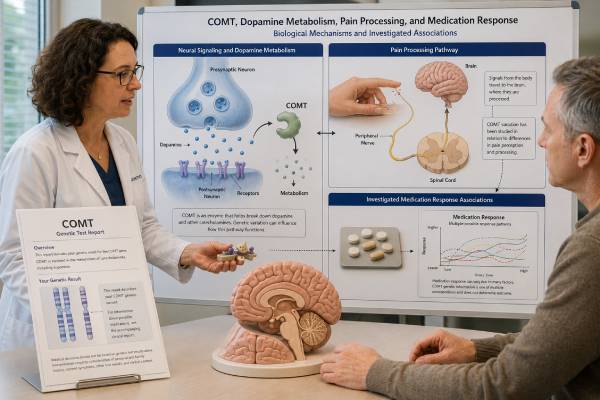
A COMT genetic test usually examines rs4680, also called Val158Met, a common variant that changes the activity of catechol-O-methyltransferase. This enzyme helps inactivate dopamine, norepinephrine, epinephrine, and catechol-containing compounds. The variant has plausible effects on dopamine signaling, especially in the prefrontal cortex, and has been studied in pain sensitivity, cognition, psychiatric traits, and medication response. Its clinical usefulness, however, is much narrower than many commercial reports imply. Val/Val, Val/Met, and Met/Met results do not diagnose a “high-dopamine” or “low-dopamine” brain, define personality, or reliably select an antidepressant, stimulant, antipsychotic, or opioid. Major pharmacogenetic guidance finds insufficient evidence to use COMT alone for opioid prescribing, and most other proposed drug associations remain inconsistent or exploratory. The best interpretation explains the biology without turning a small, context-dependent effect into a deterministic medical conclusion.
- COMT Val158Met changes enzyme activity, but it does not directly measure dopamine levels in the brain or blood.
- Val/Val, Val/Met, and Met/Met are common genotypes, not diagnoses of pain sensitivity, personality, or psychiatric disease.
- Current evidence does not support choosing or dosing an opioid solely from a COMT result.
- Antidepressant, stimulant, antipsychotic, and Parkinson’s-drug associations are not sufficiently consistent for routine COMT-guided prescribing.
- A commercial “warrior,” “worrier,” or “stress resilience” label is an oversimplification rather than a validated clinical phenotype.
Table of Contents
- What COMT Does in the Body and Brain
- Reading Val158Met Test Results
- Dopamine, Cognition, Stress, and Personality Claims
- What COMT Can and Cannot Say About Pain
- Evidence for Opioids and Other Medications
- How COMT Testing Is Done and Reported
- Why Research Findings and Commercial Reports Conflict
- Using a COMT Result Safely
What COMT Does in the Body and Brain
COMT encodes catechol-O-methyltransferase, an enzyme that transfers a methyl group to catechol compounds. Its substrates include the catecholamine neurotransmitters dopamine, norepinephrine, and epinephrine, as well as catechol estrogens and some medications. COMT works alongside other clearance systems rather than controlling these molecules by itself.
Two major protein forms are produced from the gene. Membrane-bound COMT is prominent in the brain, while soluble COMT is abundant in tissues such as the liver, blood, and kidneys. In the prefrontal cortex, dopamine-transporter expression is relatively low, so enzymatic degradation by COMT has a meaningful role in clearing dopamine outside synapses. In other brain regions, transporters and monoamine oxidase may contribute more strongly. That regional difference is one reason a single COMT genotype cannot be translated into one whole-brain dopamine level.
The widely tested rs4680 variant changes the amino acid at position 158 of membrane-bound COMT from valine to methionine. The Met-containing enzyme is less thermally stable and generally has lower activity in laboratory and tissue studies. The Val-containing enzyme has higher activity. This functional effect is real, but its consequences are moderated by gene expression, sex hormones, age, stress, other genetic variants, medicines, illness, sleep, and the specific tissue being considered.
Dopamine signaling is also nonlinear. More is not always better, and less is not always worse. Many prefrontal tasks appear to follow an “inverted U,” in which performance may decline when dopamine activity is either too low or too high for that person and situation. A genotype associated with a small average advantage under one experimental condition may be neutral or disadvantageous under another.
COMT is therefore a biological contributor, not a master switch. It does not determine how much dopamine is produced, how many receptors are present, how neurons release dopamine, or how a person experiences reward. Tests that describe rs4680 as a complete “dopamine gene” omit most of the pathway.
The distinction matters clinically. A functional variant can be scientifically interesting without being sufficiently predictive to guide treatment. Pharmacogenetic testing is most useful when a reproducible gene-drug relationship leads to a validated prescribing action. For COMT, that threshold has generally not been met.
Reading Val158Met Test Results
Each person usually inherits one rs4680 allele from each parent. Reports may use amino-acid labels, nucleotide labels, or DNA letters, creating avoidable confusion. Depending on the strand and transcript convention, the same result can appear as Val/Val, Val/Met, or Met/Met; as GG, AG, or AA; or with older numbering such as Val108/158Met. The laboratory’s allele legend should be used rather than assuming that a letter always means the same thing across reports.
Val/Val generally predicts higher COMT enzyme activity relative to the other common genotypes. Some commercial interpretations call this “lower prefrontal dopamine,” “fast COMT,” or a “warrior” pattern. Those phrases are not standardized medical phenotypes. They do not show that the person has globally low dopamine, performs better under stress, needs dopamine-enhancing treatment, or will feel more pain.
Val/Met predicts intermediate average activity. It is sometimes described as “balanced,” but that is also an editorial label rather than a clinical category. Heterozygosity does not guarantee an optimal cognitive or emotional state. The effects of both alleles occur within a much larger biological system.
Met/Met generally predicts lower COMT activity. Commercial reports may call it “higher dopamine,” “slow COMT,” or a “worrier” pattern. It does not diagnose anxiety, rumination, estrogen problems, impaired detoxification, or heightened pain. Many healthy people have this common genotype, and most will never need a medical intervention because of it.
A test may also report a COMT haplotype composed of rs4680 and nearby variants such as rs4633, rs4818, or rs6269. Haplotypes can influence messenger RNA structure, expression, or enzyme activity more than rs4680 alone in some studies. However, haplotype definitions vary, and clinical dosing guidelines do not generally assign actionable medication recommendations from them.
A “normal” result is not a useful concept for rs4680 because all three common genotypes occur in the population and none is inherently diseased. Likewise, a “positive” COMT result often means only that a common allele was found. The report should state the exact variant and genotype, not imply a pathogenic mutation.
Rare COMT variants are a separate issue. Full-gene sequencing may identify changes that are uncommon or uncertain, but most have no established relationship to medication response. A variant of uncertain significance should not be converted into a prediction about dopamine or used to direct treatment without condition-specific evidence.
Dopamine, Cognition, Stress, and Personality Claims
COMT Val158Met has been studied in working memory, executive function, attention, reward learning, impulsivity, emotional processing, stress reactivity, and psychiatric symptoms. Some experiments find genotype differences; others find no association or an effect only in a particular sex, diagnosis, stress condition, or cognitive task. Average effects are usually small and overlap substantially among genotypes.
A person’s performance on executive-function tasks cannot be inferred from rs4680. Education, fatigue, anxiety, sleep, motivation, neurological health, medication, testing environment, and thousands of other genetic variants have larger combined effects. Even when a group-level association is statistically significant, it may be far too weak to predict an individual score.
The popular “warrior versus worrier” framing arose from attempts to connect higher-activity Val alleles with performance under stress and lower-activity Met alleles with greater cognitive performance in calmer conditions. It is memorable but scientifically reductive. Studies do not support sorting people into stable personality types from one nucleotide. The labels also invite value judgments: neither vigilance nor stress tolerance is universally beneficial, and neither genotype is superior.
COMT is not a diagnostic test for attention-deficit/hyperactivity disorder, schizophrenia, bipolar disorder, depression, anxiety, addiction, or post-traumatic stress disorder. These conditions are clinically heterogeneous and highly polygenic. An association study can identify a small difference in risk or symptom pattern without providing enough discrimination for diagnosis. A person with Val/Val is not protected from one disorder, and a person with Met/Met is not destined to develop another.
Dopamine-related lifestyle recommendations are similarly overextended. Claims that a genotype proves a need to avoid coffee, take methyl donors, use magnesium, alter estrogen metabolism, practice a particular type of exercise, or take a dopamine supplement generally go beyond validated evidence. COMT uses S-adenosylmethionine as a methyl donor, but that biochemical fact does not establish that genotype-guided supplementation improves clinical outcomes. Excessive supplements can cause adverse effects or interact with treatment.
Cognition or stress symptoms deserve ordinary clinical evaluation. Thyroid disease, anemia, sleep disorders, substance use, medication effects, mood disorders, pain, menopause, neurological disease, and situational stress may be more relevant and treatable than COMT status. A genotype can be discussed as one research-informed detail, but it should not displace assessment of the person in front of the clinician.
What COMT Can and Cannot Say About Pain
COMT became a pain candidate gene because catecholamine signaling can influence nociception, stress responses, inflammation, and endogenous pain modulation. Researchers have examined rs4680 in experimental pain thresholds, temporomandibular disorders, fibromyalgia, migraine, postoperative pain, cancer pain, low-back pain, and chronic widespread pain.
The literature is mixed. Some studies associate the Met allele or lower-activity haplotypes with greater pain sensitivity, higher chronic-pain risk, or different opioid requirements. Other studies find the opposite direction, no effect, or an effect only when pain-modulation systems are strongly challenged. A 2023 systematic review concluded that COMT polymorphisms may act as markers of pain sensitivity under some experimental conditions but emphasized important limitations and context dependence.
Pain is not one phenotype. Heat pain, pressure pain, postoperative pain, neuropathic pain, inflammatory pain, and the lived experience of chronic pain involve different mechanisms. Studies also measure different outcomes: threshold, tolerance, intensity rating, disability, opioid consumption, or risk of developing persistent pain. Combining them can produce apparent inconsistency even before ancestry, sex, sample size, and treatment differences are considered.
Psychological and social factors are not “nonbiological noise.” Attention, fear, expectations, previous trauma, sleep, depression, occupational demands, and access to care alter pain processing and disability. COMT may interact with some of these factors, which makes a simple high-pain versus low-pain genotype especially unreliable.
No COMT result can confirm that pain is real or fabricated. It cannot establish the cause, distinguish tissue injury from central sensitization, quantify disability, or determine whether opioids are appropriate. Using a genotype to discount a patient’s report would be medically unsound; using it to promise unusually strong pain medication would be equally unjustified.
Pain management should be based on diagnosis, function, treatment goals, prior response, comorbidities, and safety. Physical rehabilitation, nonopioid medicines, procedural options, psychological treatment, sleep care, and social support can matter regardless of genotype. When opioids are considered, genes with better-established pharmacokinetic effects—particularly CYP2D6 for codeine and tramadol—are more actionable than COMT in selected situations.
A COMT result may be relevant in a research study or as part of a multivariable model that has been prospectively validated. On its own, it is not a clinical pain-severity score and should not determine access to analgesia.
Evidence for Opioids and Other Medications
The strongest formal evaluation of COMT in prescribing has involved opioids. The Clinical Pharmacogenetics Implementation Consortium reviewed rs4680 and other COMT findings alongside CYP2D6 and OPRM1. It found mixed evidence for analgesia and opioid-dose requirements and no convincing association with opioid adverse events. CPIC therefore issued no COMT-based therapeutic recommendation.
That conclusion is easy to misread. “No recommendation” does not prove that COMT has zero biological effect. It means the evidence is not consistent and clinically predictive enough to justify changing an opioid from the genotype. For codeine and tramadol, CYP2D6 phenotype can change formation of active metabolites and has specific recommendations; COMT does not. The distinctions are explained in CYP2D6 opioid pharmacogenetic testing.
Antidepressant research has produced associations between rs4680 and response to selective serotonin reuptake inhibitors, serotonin-norepinephrine reuptake inhibitors, tricyclic antidepressants, bupropion, mirtazapine, and electroconvulsive therapy. Directions differ across studies and populations. Recent systematic reviews of antidepressant pharmacogenetics continue to identify heterogeneous evidence and much stronger clinical implementation for metabolic genes such as CYP2C19 and CYP2D6. Routine COMT-guided antidepressant selection is not supported.
For antipsychotics, COMT has been studied as a predictor of cognition, negative symptoms, treatment response, tardive dyskinesia, and metabolic effects. Results vary by drug, diagnosis, ancestry, and outcome. No widely accepted dosing guideline uses rs4680 to choose an antipsychotic. Established clinical variables and, for selected drugs, other pharmacogenes or therapeutic drug monitoring are more relevant.
Stimulant and atomoxetine response in ADHD has also been investigated. COMT’s role is plausible because stimulant therapy affects catecholamines, but replication is inadequate for prescribing. CYP2D6 can influence atomoxetine exposure and has guideline-based recommendations; COMT does not determine whether a person “needs more dopamine” or should receive a stimulant.
In Parkinson’s disease, COMT inhibitors such as entacapone, opicapone, and tolcapone prolong levodopa effects by blocking COMT activity. It may seem intuitive that rs4680 should predict benefit or adverse effects, yet pharmacologic inhibition is much larger and more complex than the common inherited activity difference. Evidence has not established routine rs4680-guided selection or dosing of levodopa or COMT inhibitors.
Other reported associations involve methylphenidate, modafinil, nicotine-replacement treatment, anesthetic analgesia, triptans, beta blockers, and placebo response. These findings are hypothesis-generating, not a menu of genotype-directed prescriptions. A medication should not be started, stopped, or dose-adjusted because a consumer report lists a COMT interaction.
How COMT Testing Is Done and Reported
COMT testing can be performed from blood, saliva, or a cheek swab. Targeted assays usually genotype rs4680 alone or as part of a mental-health, pain, wellness, or nutrition panel. Broader sequencing may cover the coding region and nearby splice sites. Raw data from consumer genotyping arrays may contain rs4680 but often lack clinical interpretation, confirmatory quality controls, and comprehensive coverage.
Analytical validity asks whether the laboratory accurately identified the DNA letters. Clinical validity asks whether the genotype predicts the claimed trait or medication outcome. Clinical utility asks whether acting on it improves health. A test can be analytically accurate while its “stress type,” pain score, or medication recommendation has poor clinical validity and no demonstrated utility.
Before relying on a report, review:
- The exact rs number, alleles, and strand convention.
- Whether the result was generated in an accredited clinical laboratory.
- Whether medication claims cite a recognized guideline rather than individual association studies.
- Whether the report separates established findings from preliminary or wellness interpretations.
- Whether the company updates conclusions as evidence changes.
Panel algorithms can obscure the contribution of COMT. A proprietary psychiatric report may combine COMT with CYP2D6, CYP2C19, SLC6A4, HTR2A, MTHFR, and other markers, then place drugs into color-coded bins. The same medication may be categorized differently by different companies because algorithms, evidence thresholds, and variant coverage differ. The color is not a standardized regulatory phenotype.
Testing laboratories should not call rs4680 pathogenic or likely pathogenic merely because it changes enzyme activity. Those terms are usually reserved for variants that cause or strongly predispose to disease. For common pharmacogenetic variants, functional or evidence-level terminology is more appropriate.
Repeat testing is usually unnecessary when the original genotype is reliable, but reinterpretation may be useful. DNA does not change, while claims and guidelines can. Keep the full report, not just a screenshot of a commercial summary, so a clinician can identify what was actually tested.
Why Research Findings and Commercial Reports Conflict
COMT research is vulnerable to small-study effects. Early candidate-gene studies often enrolled modest samples, tested multiple outcomes, and reported positive associations that later studies could not reproduce. Publication bias makes striking findings easier to find than null results. Large modern genetic studies show that complex traits are usually influenced by thousands of variants, each with a very small effect.
Ancestry can change allele frequencies and linkage patterns. rs4680 may tag a functional haplotype in one population less effectively in another. Studies that use broad racial labels without genetic ancestry or that underrepresent populations may produce results that do not generalize. A commercially universal interpretation can therefore conceal population-specific uncertainty.
Sex and hormone status may matter because estrogen can regulate COMT expression and COMT metabolizes catechol estrogens. Yet findings involving sex, menstrual phase, contraceptives, pregnancy, or menopause are inconsistent and not sufficient for routine genotype-based treatment. They illustrate why the effect of one variant may depend on biological context.
Phenotype definitions also differ. “Stress response” may mean cortisol, self-reported anxiety, laboratory performance, heart rate, or psychiatric symptoms. “Medication response” may mean symptom improvement, adverse effects, dose, adherence, or discontinuation. Two studies can appear contradictory while measuring different things.
Gene-gene and gene-environment interactions are frequently proposed but difficult to validate. Combining COMT with OPRM1, dopamine-receptor variants, childhood adversity, or stress exposure can fit one dataset and fail in another. A model must be independently replicated and shown to improve clinical outcomes before it becomes a useful test.
Commercial reports often translate relative biological differences into absolute language. “Lower activity” becomes “poor methylation”; “association with a group average” becomes “you are sensitive to pain”; and “exploratory drug study” becomes “use with caution.” Reading the source level—mechanistic experiment, association study, meta-analysis, guideline, or drug label—helps reveal how far the conclusion has traveled from the evidence.
Using a COMT Result Safely
A safe interpretation begins with the clinical question. If the goal is opioid prescribing, note that current CPIC guidance provides no COMT-based recommendation and look instead at the drug, CYP2D6 where relevant, organ function, respiratory risk, concurrent sedatives, opioid tolerance, and treatment goals. If the goal is antidepressant selection, prioritize diagnosis, previous response, side effects, interactions, CYP2C19/CYP2D6 evidence, and patient preference rather than a COMT category.
For pain or cognitive concerns, avoid turning the result into an identity. A Val/Val person can have severe chronic pain or anxiety; a Met/Met person can be highly stress tolerant and pain free. Genotype should never override symptoms, physical findings, or response to carefully monitored treatment.
A clinician or pharmacist can help separate three levels of information: the functional effect of Val158Met is established; associations with some intermediate traits are plausible but variable; and medication changes based solely on COMT are generally not validated. That layered explanation is more accurate than either dismissing all research or treating every association as actionable.
Do not use the result to self-prescribe methyl donors, dopamine precursors, stimulants, COMT inhibitors, or high-dose supplements. Dopaminergic and methylation-related products can worsen anxiety, insomnia, blood pressure, mania, psychosis, or medication interactions. Supplements are not a harmless way to “correct” a common genotype.
A result may become more useful in the future if prospectively validated algorithms combine genetics with clinical variables and demonstrate better outcomes. Until then, its greatest value is educational: it shows one mechanism by which common genetic variation can subtly influence biology, while also demonstrating why biological plausibility is not enough for precision prescribing.
The most accurate bottom line is neither “COMT means nothing” nor “COMT explains everything.” Val158Met changes average enzyme activity. Its individual effects on dopamine-related traits, pain, and medication response are modest, context dependent, and usually not clinically actionable on their own.
References
- Guideline for CYP2D6, OPRM1, COMT, and Opioids 2021 (Clinical Pharmacogenetics Implementation Consortium)
- Are catechol-O-methyltransferase gene polymorphisms genetic markers of pain sensitivity? A systematic review and meta-analysis 2023
- The polymorphism Val158Met in the COMT gene: association with pain perception and opioid consumption 2024
- Pharmacogenetics of Antidepressant Response: A Systematic Review of Studies in Major Depressive Disorder 2025
- Table of Pharmacogenetic Associations 2026 (U.S. Food and Drug Administration)
Disclaimer
This article provides general education and is not a diagnosis or a recommendation to start, stop, or change medication. COMT results should be interpreted with the exact test method, clinical history, and current drug-specific evidence by a qualified clinician or pharmacist. Pain, cognitive, or psychiatric symptoms require appropriate clinical evaluation regardless of genotype.