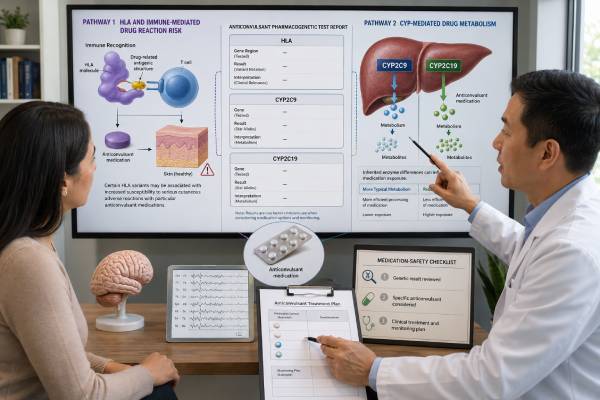
An anticonvulsant pharmacogenetic test looks for inherited variants that can affect the safety or handling of certain antiseizure medicines. The most clinically established findings involve HLA alleles linked to severe immune-mediated skin reactions and CYP2C9 variants that slow phenytoin metabolism. CYP2C19 can also influence exposure to phenytoin, clobazam, and selected related drugs, although its usefulness depends more heavily on the medicine, the laboratory report, and the clinical situation. Testing does not identify the best seizure medicine for every person, predict whether seizures will stop, or replace careful dose adjustment. It is most useful before starting a medication with a recognized gene–drug relationship, when a prior result is already available, or when unexplained toxicity raises concern. Results should be interpreted alongside ancestry, seizure type, age, organ function, interacting medicines, pregnancy status, and—when appropriate—blood drug concentrations.
- HLA-B*15:02 positivity usually leads clinicians to avoid carbamazepine and often other implicated aromatic antiseizure medicines because of Stevens–Johnson syndrome and toxic epidermal necrolysis risk.
- HLA-A*31:01 positivity raises the risk of several carbamazepine hypersensitivity reactions, including serious skin disease and drug reaction with eosinophilia and systemic symptoms.
- CYP2C9 intermediate or poor metabolizer results can require a lower initial or maintenance phenytoin dose and closer concentration monitoring.
- CYP2C19 results may help interpret unusually high phenytoin or active clobazam-metabolite exposure, but recommendations are less uniform than for HLA and CYP2C9.
- A negative panel does not eliminate the possibility of rash, liver injury, sedation, blood-count changes, or poor seizure control.
Table of Contents
- What the Test Evaluates
- Genes and Antiseizure Medicines
- HLA Results and Skin-Reaction Risk
- CYP2C9 and CYP2C19 Results
- How Testing Is Performed
- How Results Can Change Treatment
- Limits and Common Misunderstandings
- Next Steps and Urgent Warning Signs
What the Test Evaluates
Anticonvulsant pharmacogenetic testing examines DNA variants that may change a person’s risk of a medication reaction or the speed at which the body processes a drug. “Anticonvulsant” and “antiseizure medication” are often used interchangeably, although some of these medicines also treat bipolar disorder, trigeminal neuralgia, migraine, or other conditions.
The panel name can be misleading because there is no single universal anticonvulsant test. One laboratory may test HLA-B15:02, HLA-A31:01, and common CYP2C9 alleles. Another may add CYP2C19, HLA-B*15:11, CYP2B6, UGT genes, or research markers. A broad commercial panel may include genes that have little or no guideline-supported role for antiseizure prescribing. The exact variants, medicines, and evidence level therefore matter more than the panel’s marketing name.
The strongest uses generally fall into two categories:
- Preventing severe hypersensitivity: HLA results can identify people at substantially increased risk from carbamazepine, oxcarbazepine, phenytoin, or related aromatic medicines.
- Adjusting drug exposure: CYP2C9 results can identify reduced phenytoin metabolism, which may increase the chance of concentration-dependent toxicity at standard doses.
A broad pharmacogenetic test can be ordered before treatment, after a medicine has caused toxicity, or as part of a preemptive panel kept in the medical record. Pre-treatment testing is especially valuable when the result can prevent a rare but catastrophic reaction that may occur soon after therapy begins.
Testing is not usually needed for every antiseizure medicine. Levetiracetam, gabapentin, pregabalin, and several newer medicines do not currently have routine HLA, CYP2C9, or CYP2C19 prescribing recommendations. A clinician should match the test to the specific drug under consideration rather than assume that a larger panel automatically provides more useful information.
Genes and Antiseizure Medicines
The genes on the report affect medicines in different ways. HLA genes shape immune recognition, while CYP genes encode liver enzymes that metabolize drugs. A positive HLA risk allele is not the same kind of result as a reduced-metabolism CYP phenotype.
| Gene or allele | Main medicines | What the result may predict | Typical clinical response |
|---|---|---|---|
| HLA-B*15:02 | Carbamazepine, oxcarbazepine, phenytoin/fosphenytoin; possible concern with some related aromatic drugs | Markedly increased risk of Stevens–Johnson syndrome or toxic epidermal necrolysis with implicated medicines | Avoid the high-risk medicine when the patient is treatment-naive; choose a non-cross-reactive alternative |
| HLA-A*31:01 | Carbamazepine | Increased risk of a broader range of carbamazepine hypersensitivity reactions | Consider an alternative unless benefits clearly outweigh risks |
| HLA-B*15:11 | Most clearly carbamazepine; included in some regional guidance for aromatic antiseizure drugs | Higher risk of severe cutaneous adverse reactions in certain populations | Use population-appropriate guidance and consider an alternative |
| CYP2C9 | Phenytoin and fosphenytoin | Reduced metabolic clearance and higher drug concentrations | Use a reduced dose for some phenotypes and guide further changes with clinical response and levels |
| CYP2C19 | Phenytoin, clobazam, phenobarbital, and selected other drugs | Altered parent-drug or active-metabolite exposure | Interpret medicine by medicine; consider level monitoring or dose modification when supported |
A single medicine may involve more than one mechanism. Phenytoin is the clearest example: HLA-B*15:02 addresses immune-mediated skin risk, while CYP2C9 addresses dose-related exposure. A person can be negative for the HLA risk allele but still be a CYP2C9 poor metabolizer, or the reverse. Each finding must be acted on separately.
Genes also do not operate in isolation. Valproate can inhibit metabolism, carbamazepine can induce several enzymes, and other medicines may raise or lower antiseizure drug concentrations. Kidney and liver function, albumin concentration, age, and adherence can outweigh a modest genetic effect. This is why a genotype is best viewed as one durable input into prescribing, not a full prediction of drug response.
HLA Results and Skin-Reaction Risk
HLA proteins present small protein fragments to immune cells. Certain antiseizure medicines can interact with particular HLA molecules and trigger an abnormal immune response. The feared outcomes are Stevens–Johnson syndrome (SJS) and toxic epidermal necrolysis (TEN), which cause painful skin detachment and injury to mucous membranes. These are medical emergencies.
HLA-B*15:02
HLA-B*15:02 has the strongest established association with carbamazepine-induced SJS/TEN. It is more frequent in many Southeast Asian populations and in parts of South Asia, but ancestry labels are imperfect. People may have mixed or unknown ancestry, and the allele can occur outside commonly cited groups. Testing decisions should reflect the person’s actual family background, local guidance, and the medicine being considered.
A positive HLA-B*15:02 result generally means carbamazepine should not be started in a person who has never taken it. Guidelines also connect this allele with SJS/TEN risk from oxcarbazepine and phenytoin. Evidence for lamotrigine and other aromatic medicines is less consistent, but some guidance recommends heightened caution or an alternative because severe cross-reactive reactions are biologically plausible.
A negative result greatly lowers the allele-specific risk but does not make the medicine risk-free. Severe rashes can occur through other genetic and non-genetic pathways. Routine clinical counseling about early symptoms remains necessary.
HLA-A*31:01
HLA-A*31:01 is associated with a wider carbamazepine hypersensitivity spectrum. This includes SJS/TEN, maculopapular rash, and drug reaction with eosinophilia and systemic symptoms, often shortened to DRESS. DRESS may involve fever, facial swelling, enlarged lymph nodes, abnormal blood counts, hepatitis, kidney injury, or lung inflammation.
The allele occurs across several ancestral groups, including people with European, Japanese, Korean, and some Latin American backgrounds. A positive HLA-A*31:01 test often supports choosing another medicine when a reasonable alternative exists. If carbamazepine is still considered essential, the clinician must weigh the expected benefit, prior treatment history, and ability to stop the medicine immediately if symptoms develop.
Prior tolerance changes interpretation
Most severe cutaneous reactions occur during the first weeks to months of treatment. Someone who has taken carbamazepine or phenytoin continuously for months without hypersensitivity is less likely to develop a new HLA-associated reaction solely because testing later shows a risk allele. That does not justify restarting a medicine after a prior serious reaction, and it does not remove other toxicities. Treatment history must accompany the laboratory result.
CYP2C9 and CYP2C19 Results
CYP2C9 and CYP2C19 are enzymes that help clear many medicines. Laboratories usually translate pairs of inherited star alleles, such as *1, *2, or *3, into a predicted phenotype: normal, intermediate, poor, rapid, or ultrarapid metabolizer. The available phenotype categories differ by gene.
CYP2C9 and phenytoin
Phenytoin has a narrow therapeutic range and nonlinear pharmacokinetics. Once its main metabolic pathway approaches saturation, a small dose increase can cause a disproportionately large rise in blood concentration. Common reduced-function CYP2C9 alleles therefore matter clinically.
A CYP2C9 test result may be reported as:
- Normal metabolizer: Two normal-function alleles; standard initial dosing is generally used when HLA findings permit phenytoin.
- Intermediate metabolizer: One reduced- or no-function allele, or another combination that lowers activity; some guidelines recommend a reduced maintenance dose, followed by level-guided adjustment.
- Poor metabolizer: Markedly reduced activity; a larger dose reduction or a different medicine may be appropriate because toxicity can develop at conventional doses.
Phenytoin toxicity can cause horizontal nystagmus, unsteady walking, slurred speech, confusion, drowsiness, nausea, or worsening coordination. Very high exposure can lead to severe neurologic or cardiac effects. Because phenytoin is highly protein-bound, clinicians may need a free phenytoin concentration or an albumin-adjusted interpretation in patients with low albumin, pregnancy, kidney failure, critical illness, or interacting drugs.
Genotype can guide an initial estimate, but serum concentration and clinical response guide ongoing care. A dose suitable at the start may become unsuitable after another medicine is added, liver function changes, or adherence improves.
CYP2C19 and phenytoin or clobazam
CYP2C19 contributes less than CYP2C9 to phenytoin clearance, yet reduced CYP2C19 activity can add to high exposure, especially when CYP2C9 activity is also low. Recent pooled evidence has found higher phenytoin concentrations in CYP2C19 intermediate and poor metabolizers. Even so, major prescribing guidelines place greater weight on CYP2C9 for phenytoin dose recommendations.
Clobazam is converted to an active metabolite, N-desmethylclobazam, which CYP2C19 then clears. CYP2C19 poor metabolizers may accumulate much more of this active metabolite and develop excessive sleepiness, slowed thinking, drooling, or poor coordination. The drug label and some clinical resources recommend slower titration or lower dosing in known poor metabolizers.
A CYP2C19 result should therefore be interpreted against the exact medicine. “Poor metabolizer” does not mean every anticonvulsant will accumulate, and “ultrarapid metabolizer” does not mean every medicine will fail.
How Testing Is Performed
Most tests use a blood sample or cheek swab. Fasting is not required, and antiseizure medicines usually do not need to be stopped because DNA does not change with current treatment. The sample is analyzed for selected variants or HLA alleles, and results commonly return within several days to a few weeks.
Before ordering, confirm these details:
- Which medicine is being considered? A focused test may be faster and easier to interpret than a broad panel.
- Which variants does the laboratory detect? A CYP test that covers only a few alleles may miss reduced-function variants more common in some populations.
- Does the method accurately type HLA alleles? HLA nomenclature is highly specific; a generic “HLA-B positive” result is not enough.
- Will the report include phenotype translation and prescribing guidance? Raw genotypes without an interpretation can be difficult to use safely.
- Can the result enter the electronic medical record as a permanent alert? HLA and CYP genotypes remain relevant throughout life.
A report may use “detected/not detected” for HLA and star-allele diplotypes for CYP genes. For example, CYP2C9 1/3 may translate to an intermediate metabolizer phenotype. The report should state any limitations, including alleles not tested, copy-number limitations, uncertain phasing, or inability to detect rare variants.
A cheek swab that fails quality checks may need repeating. Bone marrow transplant recipients and people with certain blood cancers can require special sampling considerations because blood-derived DNA may not reflect the person’s original germline genotype. The laboratory or genetics team can advise whether a buccal sample, cultured skin cells, or another specimen is appropriate.
Results may remain useful for decades, but the report should not be treated as permanently self-interpreting. Laboratories can revise allele function, add newly recognized variants, or change phenotype translation. When an old result is used for a new prescription, the clinician should confirm that the tested allele set and interpretation still meet current standards. Retesting is not always necessary; sometimes reinterpretation of the original genotype is enough.
How Results Can Change Treatment
A clinically useful result changes a specific prescription, dose, monitoring plan, or counseling message. It should not simply add a colored “use with caution” box without explaining what to do.
Choosing a different medicine
A treatment-naive patient who carries HLA-B*15:02 will usually receive an alternative to carbamazepine. The choice depends on seizure type and indication. A substitute suitable for focal epilepsy may be inappropriate for absence or myoclonic seizures, so the genetic result cannot select the replacement by itself.
Cross-reactivity also deserves attention. Carbamazepine, oxcarbazepine, phenytoin, phenobarbital, and lamotrigine are structurally or immunologically related to varying degrees. A previous SJS/TEN episode from one aromatic antiseizure medicine is a major clinical warning regardless of genotype. Rechallenge is generally unsafe.
Starting phenytoin more cautiously
For a CYP2C9 intermediate or poor metabolizer, the clinician may select a lower maintenance dose, increase more slowly, and check a concentration after an appropriate interval. Some guidance recommends reassessment after roughly 7–10 days, but timing varies with loading doses, clinical urgency, formulation, and whether free or total phenytoin is measured.
Genotype-based dosing is not a substitute for acute seizure management. In status epilepticus, immediate treatment takes priority, and clinicians may use an alternative medicine when a high-risk genotype is known or when there is no time to obtain a result.
Clarifying an adverse effect
Testing after toxicity can support an explanation, but it rarely proves causation. A CYP2C9 poor-metabolizer result may explain unexpectedly high phenytoin levels. A positive HLA risk allele may support the suspected relationship between a medicine and a severe skin reaction. Still, the timing, symptoms, laboratory findings, drug concentrations, and other medicines remain essential.
The result should be added to medication-allergy or pharmacogenetic records in a precise form. “Carbamazepine allergy” and “HLA-B*15:02 positive—avoid carbamazepine because of SJS/TEN risk” convey different levels of detail. Both may be appropriate when an actual reaction occurred.
Limits and Common Misunderstandings
Pharmacogenetics answers narrower questions than many patients expect. It cannot diagnose epilepsy, determine seizure type, show whether a brain lesion is present, or predict all treatment response. An epilepsy genetic panel looks for disease-causing variants related to the origin of epilepsy; an anticonvulsant pharmacogenetic panel looks for variants related to medication handling or adverse reactions. The two tests serve different purposes.
Common interpretation errors include:
- Treating “negative” as “safe.” A negative HLA result only means the tested risk allele was not found. It does not exclude every severe rash or other adverse effect.
- Treating “positive” as proof that harm will occur. A risk allele raises probability; many carriers would not react if exposed. Because SJS/TEN can be devastating, avoidance may still be justified.
- Applying one gene to an entire drug class. CYP2C19 poor metabolism may matter for clobazam but has little relevance to levetiracetam.
- Ignoring incomplete allele coverage. A limited test may misclassify people whose ancestry includes variants not represented on the assay.
- Using a consumer report to change treatment alone. Clinical confirmation may be needed, and seizure medicines should never be stopped abruptly without medical direction.
- Assuming genetics replaces therapeutic drug monitoring. Blood concentrations capture genetics plus adherence, interactions, organ function, formulation, and current physiology.
Population frequency affects who is most likely to test positive, but race is not a reliable genetic test. Self-identified categories can miss mixed ancestry and do not perfectly predict HLA alleles. Conversely, universal testing policies may be reasonable where ancestry information is incomplete and the consequence of missing a carrier is severe.
Evidence also evolves. Allele-function assignments, phenotype translation rules, and prescribing recommendations can change. A result generated years ago may still be biologically valid, but its interpretation should be checked against current guidelines before a new medicine is prescribed.
Another limitation is that many panels mix high-evidence markers with exploratory ones. A laboratory may report variants in transporters, receptors, sodium channels, or glucuronidation genes whose associations have not been reproduced well enough to guide routine care. These findings should not be given the same weight as HLA-B*15:02 for carbamazepine or CYP2C9 for phenytoin. The report’s evidence grading and the presence of an independent prescribing guideline are more informative than whether a result is shown in red, yellow, or green.
Next Steps and Urgent Warning Signs
After receiving results, review them with the prescribing clinician, pharmacist, or a genetics professional familiar with pharmacogenetics. Bring the complete report rather than a screenshot of the colored summary. Ask which exact medicine–gene pair is actionable, whether the proposed dose differs from standard dosing, and what monitoring is planned.
Useful next steps include:
- Add the genotype and phenotype to the permanent medical record.
- Give the result to neurology, psychiatry, pain, primary care, and anesthesia teams when relevant.
- Keep a copy in a secure patient portal or health record for emergency care.
- Ask whether family members need testing; HLA and CYP variants are inherited, but relatives should be tested rather than assumed to share the same result.
- Confirm that any alternative medicine is appropriate for the seizure syndrome and other health conditions.
- Continue prescribed treatment unless the clinician directs a change; abrupt withdrawal can trigger seizures.
Seek urgent medical assessment for a new rash after starting carbamazepine, oxcarbazepine, phenytoin, lamotrigine, phenobarbital, or another antiseizure medicine—especially when accompanied by fever, facial swelling, mouth sores, eye pain, blistering, skin tenderness, peeling, swollen lymph nodes, or breathing difficulty. Do not wait for a genetic result if SJS/TEN or DRESS is suspected.
Contact the prescriber promptly for marked sleepiness, confusion, new unsteadiness, slurred speech, uncontrolled eye movements, repeated vomiting, jaundice, unusual bruising, or worsening seizures. These symptoms can reflect excessive drug exposure or another serious adverse effect. Pharmacogenetic information can sharpen the response, but immediate clinical evaluation remains the priority.
References
- Dutch Pharmacogenetics Working Group (DPWG) guideline for the gene-drug interaction of CYP2C9, HLA-A and HLA-B with anti-epileptic drugs 2024 (Guideline)
- Pharmacogenetic Variants and Plasma Concentrations of Antiseizure Drugs: A Systematic Review and Meta-Analysis 2024 (Systematic Review)
- Review of pharmacogenetics of antiseizure medications: focusing on genetic variants of mechanistic targets 2024 (Review)
- Role of pharmacogenomics for prevention of hypersensitivity reactions induced by aromatic antiseizure medications 2025 (Review)
- Clinical Pharmacogenetics Implementation Consortium (CPIC) Guideline for CYP2C9 and HLA‐B Genotypes and Phenytoin Dosing: 2020 Update 2021 (Guideline)
Disclaimer
This information is educational and does not replace individualized care from a qualified clinician. Pharmacogenetic results must be interpreted with the prescribed medicine, treatment history, seizure diagnosis, other drugs, and laboratory monitoring. Never start, stop, or rapidly change an antiseizure medicine based only on a genetic report.