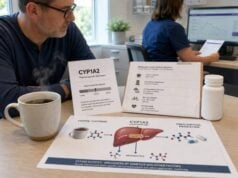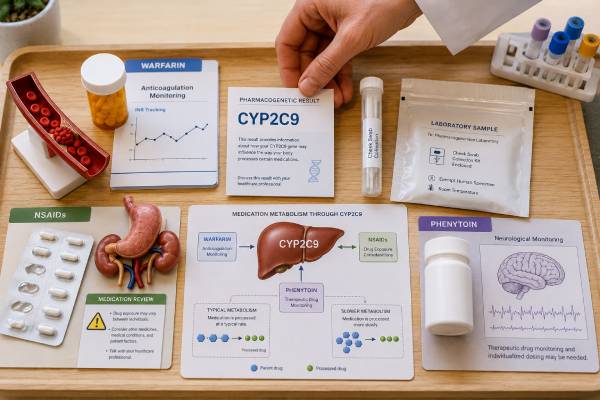
A CYP2C9 genetic test predicts how efficiently the CYP2C9 enzyme clears several medicines, including warfarin, selected nonsteroidal anti-inflammatory drugs, and phenytoin. Reduced-function variants can slow drug removal, raise blood concentrations, and increase the chance of bleeding or dose-related toxicity. The result is usually reported as two star alleles and translated into an activity score or a metabolizer phenotype. That label is only the beginning of interpretation. Warfarin dosing also depends heavily on VKORC1, CYP4F2, age, body size, diet, interacting drugs, and the measured INR. Phenytoin decisions require both CYP2C9 and, in relevant patients, HLA-B*15:02 because the two genes address different dangers. NSAID recommendations vary by the specific drug, duration, kidney function, ulcer risk, and cardiovascular history. A CYP2C9 result can make prescribing safer, but it does not replace laboratory monitoring, symptom review, or the clinical reasons for using the medicine.
- Reduced CYP2C9 activity usually means slower clearance, so standard doses can produce higher or longer-lasting drug exposure.
- Warfarin cannot be dosed from CYP2C9 alone; genotype-guided algorithms and repeated INR measurements are still required.
- CYP2C9 poor metabolizers may need a different NSAID or a lower starting dose, especially for drugs with long half-lives.
- Phenytoin intermediate metabolizers often need a lower maintenance dose, and poor metabolizers may need a much larger reduction.
- HLA-B*15:02 and CYP2C9 answer separate phenytoin questions: severe skin-reaction risk versus dose-related accumulation.
Table of Contents
- What the CYP2C9 test measures
- Allele coverage and activity scores
- Why warfarin needs more than one gene
- NSAID risk depends on the specific drug
- Phenytoin combines metabolism and HLA risk
- Clinical factors can override the prediction
- How to read and use the result
What the CYP2C9 test measures
CYP2C9 is one of the cytochrome P450 enzymes in the liver. It helps convert many medicines into forms that the body can eliminate. A genetic test looks for inherited variants that change how much functional CYP2C9 enzyme a person is expected to have.
The test is usually performed on blood, saliva, or a cheek-swab sample. Because the variants are inherited and present throughout life, the underlying result should not change with age, diet, illness, or medication use. What can change is the observed drug response. A strong inhibitor, liver disease, acute illness, or another interacting medicine can make a genetically normal metabolizer behave as though clearance were slower.
Laboratories commonly report a diplotype, such as 1/1, 1/2, 1/3, or 2/3. Each allele receives a functional value, and the two values are added into an activity score. The score is then translated into a phenotype. Typical categories are normal, intermediate, and poor metabolizer.
A normal metabolizer generally has two alleles with normal function. An intermediate metabolizer has reduced overall activity, often because one allele has decreased or no function. A poor metabolizer has very low predicted activity because both alleles substantially reduce function. The exact translation depends on the allele pair; not all reduced-function alleles have the same effect.
CYP2C9 does not have one universal clinical meaning. Slow clearance of warfarin can increase anticoagulant exposure. Slow clearance of an NSAID can prolong pain-relieving and toxic effects. Slow clearance of phenytoin can be especially important because phenytoin follows nonlinear pharmacokinetics: a small dose increase can produce a disproportionate rise in concentration once metabolic capacity begins to saturate.
The result also does not directly measure a drug level. It predicts one contributor to metabolism. Warfarin has the INR, phenytoin has serum concentration testing and neurologic examination, and NSAIDs are monitored through symptoms, kidney function, blood pressure, bleeding signs, and treatment duration. Pharmacogenetics adds information to those tools rather than replacing them.
Allele coverage and activity scores
The quality of a CYP2C9 interpretation depends on which alleles the laboratory tested. Many older or limited panels focused on *2 and *3 because these variants are common and well studied in people of European ancestry. That approach can miss clinically important alleles found more often in other populations.
Reduced-function alleles such as *5, *6, *8, and *11 occur more frequently in people with African ancestry. If a panel does not test them, a person may be incorrectly reported as 1/1 and classified as a normal metabolizer. The problem is not that ancestry determines genotype; people from any background can carry uncommon alleles. Ancestry signals where incomplete testing is more likely to create a blind spot.
Common examples include:
| Allele | Usual functional classification | Why it matters |
|---|---|---|
| *1 | Normal function | Often assigned when no tested variant is detected |
| *2 | Decreased function | Can lower clearance of warfarin, NSAIDs, and phenytoin |
| *3 | No or markedly decreased function | Often has a larger effect than *2 |
| *5, *6, *8, *11 | Decreased or no function | Important for inclusive testing, especially in African-ancestry populations |
The activity score helps combine alleles, but readers should retain the original diplotype. A simple label such as “intermediate metabolizer” may hide meaningful differences between 1/2, 1/3, and 2/2. Drug-specific guidelines sometimes use the score rather than the broad phenotype because the expected reduction in clearance differs.
For warfarin, allele coverage is only one layer. A complete pharmacogenetic evaluation may also include VKORC1, CYP4F2, and, for people with African ancestry, rs12777823. A result limited to CYP2C9 should not be presented as a complete warfarin sensitivity test.
For phenytoin, a panel may include HLA-B15:02. That result should be listed separately, not blended into the CYP2C9 activity score. CYP2C9 predicts clearance and dose-related toxicity; HLA-B15:02 predicts a much higher risk of severe immune-mediated skin reactions with phenytoin and several related antiseizure medicines.
A report should state the method, tested alleles, diplotype, activity score, phenotype, and guideline version. When any of those are missing, a pharmacist or laboratory professional may need to clarify the interpretation before a prescription is changed.
Why warfarin needs more than one gene
Warfarin prevents harmful blood clots by interfering with vitamin K recycling. It is highly effective but has a narrow therapeutic window: too little can allow clotting, while too much can cause serious bleeding. CYP2C9 metabolizes S-warfarin, the more potent form of the drug. Reduced CYP2C9 activity generally lowers the maintenance dose needed and can delay the time required to reach a stable dose.
CYP2C9 alone cannot calculate that dose. VKORC1 influences how sensitive the drug target is to warfarin. CYP4F2 can contribute a smaller effect. Age, weight, height, ancestry, liver function, smoking, amiodarone use, enzyme inducers, diet, and the clinical indication also matter. Validated pharmacogenetic algorithms combine these variables rather than using a fixed reduction for every carrier.
When genotype is available before or early in treatment, clinicians can enter the information into an established dosing algorithm. The calculated dose is an estimate, not a final prescription for the entire course. The international normalized ratio, or INR, remains the direct measure used to adjust therapy. Most common indications target an INR of 2.0 to 3.0, though some mechanical heart valves and special situations use a different range.
Reduced-function CYP2C9 alleles can make the early treatment period more difficult. A patient may require fewer milligrams per week, take longer to reach a stable INR, and have greater risk of an INR above 4 if standard empirical doses are used. Poor metabolizers can also take longer to reverse excessive anticoagulation after a dose reduction because warfarin clearance is slow.
Why ancestry-aware algorithms matter
Warfarin algorithms built mainly from *2 and *3 data may perform poorly in some patients of African ancestry. Clinical guidance therefore emphasizes testing *5, *6, *8, and *11 when possible and considering rs12777823 in African American patients. If those variants are unavailable, an algorithm may overestimate the dose.
This is one reason a generic statement such as “CYP2C9 positive” is inadequate. The exact allele, the other tested genes, and the population in which the dosing model was validated all affect accuracy.
Genotype does not replace routine warfarin care
Warfarin requirements can change after the genetic estimate. Antibiotics, amiodarone, antifungals, seizure medicines, major dietary changes, acute illness, heart failure, liver dysfunction, alcohol intake, and missed doses can alter the INR. Patients still need scheduled INR checks, consistent communication about medication changes, and prompt evaluation of bleeding or clotting symptoms.
Urgent warning signs include vomiting blood, black stools, severe headache after a fall, uncontrolled bleeding, sudden weakness, chest pain, shortness of breath, or a painful swollen leg. A genetic result should never delay emergency assessment.
The test may be less useful after a patient has already reached a stable dose through repeated INR adjustment. At that point, the observed dose requirement contains much of the same information. The result can still explain unusual sensitivity and may be useful if therapy is interrupted and restarted, but it should not override a stable, well-monitored regimen.
NSAID risk depends on the specific drug
Nonsteroidal anti-inflammatory drugs reduce pain, fever, and inflammation. CYP2C9 contributes to the clearance of several commonly used NSAIDs, including celecoxib, flurbiprofen, ibuprofen, meloxicam, piroxicam, and others. Reduced activity can increase drug exposure, but the magnitude differs by medicine.
The most clinically concerning combinations involve an NSAID that depends strongly on CYP2C9 and has a long half-life. Piroxicam and meloxicam can accumulate over repeated dosing. A poor metabolizer may remain exposed long after each dose, increasing the chance of gastrointestinal bleeding, kidney injury, fluid retention, or blood-pressure elevation. Celecoxib is also substantially influenced by CYP2C9, and product labeling recognizes lower starting doses in poor metabolizers.
Guideline recommendations generally follow three strategies:
- Use the usual starting dose for normal metabolizers.
- For some intermediate metabolizers, start conservatively, use the lowest effective dose, and allow enough time to reach steady state before increasing.
- For poor metabolizers, consider an alternative NSAID not primarily cleared by CYP2C9 or reduce the starting dose substantially, depending on the specific drug.
A percentage reduction cannot be copied across the whole class. Some drugs have stronger evidence than others, and each has its own half-life and alternate metabolic pathways. For a poor metabolizer, a short course of low-dose ibuprofen is not equivalent to chronic piroxicam treatment.
Genotype also does not erase the class-wide risks of NSAIDs. A normal metabolizer can still develop an ulcer, gastrointestinal bleeding, kidney injury, edema, high blood pressure, heart failure worsening, or a cardiovascular event. Risk rises with older age, prior ulcer or bleeding, kidney disease, anticoagulants, antiplatelet medicines, corticosteroids, high doses, and prolonged use.
Conversely, a poor metabolizer result does not mean that every NSAID is forbidden. Topical NSAIDs can produce lower systemic exposure for localized pain. Acetaminophen may be an option for some conditions, though it lacks the same anti-inflammatory effect and has its own liver-dose limits. Non-drug measures, physical therapy, injections, or a different prescription may be more appropriate depending on the cause of pain.
Patients taking warfarin and an NSAID have a separate, important bleeding interaction. Even if the CYP2C9 genotype is normal, combining the medicines can injure the stomach lining and impair platelet function. The decision requires a strong indication, the shortest possible duration, and careful monitoring.
The anticonvulsant pharmacogenetic test guide discusses how CYP2C9 findings differ from HLA-based severe skin-reaction risk. That distinction is especially relevant when a panel includes both pain and seizure medications.
Phenytoin combines metabolism and HLA risk
Phenytoin and its intravenous prodrug fosphenytoin are used for certain seizure disorders and acute seizure management. CYP2C9 is the main enzyme responsible for phenytoin clearance. Reduced activity can raise concentrations and increase dose-related toxicity.
Phenytoin is unusually sensitive to dose changes because its metabolism can become saturated. At lower concentrations, an increase may produce a predictable change. Near saturation, the same increase can cause a much larger rise in blood level. That is why genotype-guided maintenance dosing, serum concentrations, and clinical examination must be used together.
For a CYP2C9 intermediate metabolizer, current guidance generally recommends reducing the typical maintenance dose by about 25% for a substantial reduction in activity. For a poor metabolizer, a reduction of about 50% is commonly recommended. Loading doses used to control seizures are generally based on body weight and urgency rather than CYP2C9, because the loading dose fills the body’s distribution space; the genotype has greater influence on maintenance clearance.
Dose changes should be followed by concentration monitoring. Total phenytoin is often interpreted against a typical therapeutic range of approximately 10 to 20 mcg/mL, while free phenytoin is often about 1 to 2 mcg/mL. These ranges are guides, not absolute rules. Some patients achieve seizure control below them, and toxicity can occur within them, especially when protein binding is altered.
Low albumin, kidney failure, pregnancy, critical illness, and interacting drugs can change the relationship between total and free concentration. In those settings, a free phenytoin level may be more informative than a corrected total level. Symptoms of excessive exposure include nystagmus, unsteady walking, slurred speech, confusion, lethargy, nausea, and, at very high levels, severe neurologic or cardiac toxicity.
HLA-B*15:02 addresses a different hazard
HLA-B*15:02 is associated with a markedly increased risk of Stevens–Johnson syndrome and toxic epidermal necrolysis from phenytoin in susceptible populations. These reactions cause painful skin blistering and mucous-membrane injury and require emergency care.
A positive HLA-B15:02 result generally supports avoiding phenytoin in a treatment-naive patient when a reasonable alternative exists. Lowering the dose does not remove this immune risk. A normal CYP2C9 phenotype also does not make phenytoin safe for an HLA-B15:02 carrier.
The reverse is also true: a negative HLA-B*15:02 result does not prevent dose-related toxicity in a CYP2C9 poor metabolizer, and it does not eliminate every possible severe rash. Any new rash, blistering, facial swelling, fever, mouth sores, or eye irritation after starting phenytoin needs urgent medical evaluation.
For someone who has taken phenytoin continuously for months without a severe skin reaction, HLA information is less useful for predicting a newly emerging early hypersensitivity reaction. CYP2C9 can still matter for maintenance dose, interactions, and future toxicity.
Clinical factors can override the prediction
Genotype is fixed, but exposure is dynamic. CYP2C9 inhibitors can slow clearance beyond what the inherited phenotype predicts. Fluconazole, amiodarone, and several other medicines can raise concentrations of CYP2C9 substrates. Enzyme inducers can lower concentrations or complicate interpretation. Phenytoin itself induces several enzymes and can alter the effects of many other drugs.
Warfarin is especially interaction prone. Antibiotics can change vitamin K production or metabolism; amiodarone can increase anticoagulant effect; rifampin and some antiseizure drugs can lower it. A stable genotype-based estimate can become wrong within days of a medication change.
NSAID toxicity also depends on physiology. Dehydration, vomiting, diuretics, an angiotensin-converting enzyme inhibitor, or an angiotensin receptor blocker can combine with an NSAID to reduce kidney blood flow. CYP2C9 may increase exposure, but the acute kidney risk comes from the whole clinical situation.
Phenytoin levels can shift when tube feeding, albumin, kidney function, or interacting drugs change. Valproate can displace phenytoin from protein binding and affect metabolism, making total concentrations hard to interpret. A patient can have toxicity even when the reported total level appears acceptable.
These examples illustrate phenoconversion: observed metabolism no longer matches the genotype-based category because another factor alters enzyme activity or drug handling. A medication list should therefore be reviewed every time a CYP2C9 result is applied. Over-the-counter ibuprofen, aspirin, herbal products, and short courses of antifungals or antibiotics belong on that list.
The genetic test cannot identify an active bleed, a high INR, kidney injury, phenytoin toxicity, or an allergic rash. Symptoms and laboratory findings take priority. A patient who is ill now needs clinical assessment, not reinterpretation of a historical genotype alone.
How to read and use the result
Start with the original data, not the report color. Locate the diplotype, activity score, phenotype, tested allele list, and test method. Then match the result to the exact drug.
For warfarin, confirm whether VKORC1, CYP4F2, *5, *6, *8, *11, and rs12777823 were assessed. Use a validated algorithm suited to the available genetic information and patient population. Continue INR-guided dosing regardless of the predicted maintenance dose.
For an NSAID, identify the individual medicine, expected treatment duration, route, and half-life. Review kidney function, ulcer history, cardiovascular disease, anticoagulants, and other bleeding risks before deciding whether a lower dose or alternative is appropriate.
For phenytoin, keep CYP2C9 and HLA-B results separate. Use CYP2C9 to guide maintenance dosing and concentration monitoring. Use HLA-B*15:02 to evaluate severe skin-reaction risk before starting therapy in patients for whom the allele is relevant. Do not assume one negative result cancels the other risk.
A concise clinician checklist is:
- Verify the exact star alleles and assay coverage.
- Check the most recent drug-specific guideline or product label.
- Review all prescriptions, over-the-counter medicines, supplements, organ function, and current symptoms.
- Decide whether to adjust the starting dose, choose an alternative, or continue with enhanced monitoring.
- Define the follow-up measure: INR, phenytoin level, kidney function, blood pressure, pain relief, seizure control, or adverse effects.
- Record the result in a durable location in the medical record.
Because CYP2C9 is inherited, biological relatives may carry the same allele. The finding does not diagnose a clotting disorder, pain condition, or epilepsy, and family testing is not routinely needed without a medication-related reason.
Patients should keep a copy of the complete report. The genotype is lifelong, but recommendations can evolve as allele definitions, dosing algorithms, and evidence improve. Repeating the same limited test usually adds little; reanalysis or a broader assay may help when the original panel omitted important alleles.
The safest interpretation is specific rather than global. “Poor metabolizer” does not mean the liver is failing, and it does not require avoiding every CYP2C9 substrate. It means a particular drug may clear more slowly and deserves a drug-specific dose, alternative, or monitoring plan.
References
- Clinical Pharmacogenetics Implementation Consortium (CPIC) Guideline for Pharmacogenetics-Guided Warfarin Dosing: 2017 Update 2017 (Guideline)
- Clinical Pharmacogenetics Implementation Consortium Guideline (CPIC) for CYP2C9 and Nonsteroidal Anti-Inflammatory Drugs 2020 (Guideline)
- Clinical Pharmacogenetics Implementation Consortium (CPIC) Guideline for CYP2C9 and HLA-B Genotypes and Phenytoin Dosing: 2020 Update 2021 (Guideline)
- Dutch Pharmacogenetics Working Group (DPWG) guideline for the gene-drug interaction of CYP2C9, HLA-A and HLA-B with anti-epileptic drugs 2024 (Guideline)
- Pharmacogenetics and Pain Treatment with a Focus on Non-Steroidal Anti-Inflammatory Drugs (NSAIDs) and Antidepressants: A Systematic Review 2022 (Systematic Review)
- The Impact of CYP2C9*11 Allelic Variant on the Pharmacokinetics of Phenytoin and (S)-Warfarin 2022 (Clinical Study)
Disclaimer
CYP2C9 results should be interpreted with the exact medicine, other genes, laboratory values, interacting drugs, and the patient’s clinical condition. Do not change warfarin, an NSAID, phenytoin, or fosphenytoin without the prescribing clinician. Seek urgent care for serious bleeding, sudden clotting symptoms, severe neurologic toxicity, or a blistering rash with mouth or eye involvement.