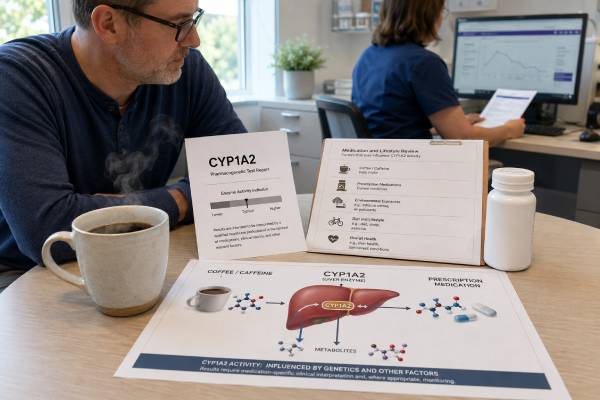
A CYP1A2 genetic test examines variants in an enzyme that metabolizes caffeine and several medicines, including clozapine, olanzapine, theophylline, tizanidine, and duloxetine. Commercial reports often reduce the result to “fast” or “slow” caffeine metabolism, usually from the common rs762551 variant. That label can be useful as a rough research description, but it does not reliably measure a person’s current CYP1A2 activity or determine a clozapine dose. Smoking, recent smoking cessation, infection and inflammation, pregnancy, oral contraceptives, caffeine intake, liver function, and interacting drugs can change enzyme activity more than the tested genotype. For clozapine, therapeutic drug monitoring and immediate attention to changes in smoking, illness, or co-medication are more clinically informative than CYP1A2 genotyping alone. A sound result interpretation separates inherited potential from the enzyme activity operating today and avoids turning one common variant into a universal prediction about coffee tolerance or medication safety.
- CYP1A2 genotype does not equal current enzyme activity because smoking, inflammation, medicines, and hormones can markedly change metabolism.
- The common CYP1A2*1F result mainly relates to inducibility and does not provide a validated clozapine dose by itself.
- Stopping cigarette smoking can raise clozapine concentrations even when the genetic result is unchanged.
- Caffeine response depends on dose, timing, tolerance, sleep, pregnancy, other genes, and medications—not only CYP1A2.
- For narrow-therapeutic-index drugs, blood concentrations and clinical monitoring are more actionable than a consumer “fast metabolizer” label.
Table of Contents
- CYP1A2 Metabolism in Context
- What Common CYP1A2 Genetic Results Mean
- Caffeine Metabolism, Tolerance, and Health Claims
- Why Clozapine Is More a Phenotype Than a Genotype Problem
- Smoking, Inflammation, and Drug Interactions
- Other Medicines Metabolized by CYP1A2
- Testing Methods, Phenotyping, and Limitations
- Interpreting Results in Practice
CYP1A2 Metabolism in Context
CYP1A2 is a cytochrome P450 enzyme expressed mainly in the liver. It oxidizes caffeine and a range of medicines and environmental compounds so they can be further processed and eliminated. The enzyme’s contribution differs by substrate: it performs most of caffeine’s initial metabolism but shares clozapine clearance with other pathways, including CYP3A4, CYP2D6, and conjugation reactions.
The amount of CYP1A2 activity in a person is highly variable. Genetics contributes, but the gene is inducible and suppressible. Polycyclic aromatic hydrocarbons produced by burning tobacco activate pathways that increase CYP1A2 expression. Inflammatory cytokines can suppress expression during infection. Some medicines inhibit the enzyme directly, while others change transcription. Hormonal states and liver function add further variation.
This distinction produces two related terms. Genotype describes inherited CYP1A2 variants and remains essentially constant. Phenotype describes the enzyme activity occurring at a particular time. Someone with a genotype associated with inducibility may have low activity while taking a strong inhibitor or during severe inflammation. Another person with the same genotype may have high activity while smoking cigarettes. A DNA test cannot observe those temporary influences.
Unlike CYP2D6 or CYP2C19, CYP1A2 does not have a widely implemented genotype-to-phenotype system that reliably assigns all patients to poor, intermediate, normal, rapid, or ultrarapid metabolizer categories for drug dosing. No current CPIC guideline provides CYP1A2-based clozapine dosing, and the Dutch Pharmacogenetics Working Group removed prior gene-based recommendations after concluding that established CYP1A2 alleles did not support a clinically actionable clozapine interaction.
That does not mean CYP1A2 is unimportant. It means direct measures—smoking status, interacting drugs, inflammation markers, symptoms, and drug concentrations—often predict exposure better than common variants. The difference between an important enzyme and an actionable genetic test is central to interpreting the report.
A useful pharmacogenetic test should connect a result to a reproducible clinical action. CYP1A2 genetics may add context, particularly in research or complex cases, but it rarely overrides observable environmental factors.
What Common CYP1A2 Genetic Results Mean
Most consumer CYP1A2 reports test rs762551, commonly used to define CYP1A2*1F. The variant lies in the gene’s first intron rather than changing an amino acid. It has been associated with differences in inducibility, especially among smokers or people exposed to other inducers. Its effect is not a simple permanently fast-versus-slow switch.
Depending on the reporting strand, a person may see AA, AC, or CC. Some reports label AA as a “fast caffeine metabolizer” and AC or CC as “slow.” That interpretation is too categorical. The A allele has often been associated with greater inducibility, meaning activity can rise more in response to smoking or other exposures. In nonsmokers under ordinary conditions, genotype differences may be smaller, inconsistent, or absent.
Star-allele reports can include CYP1A2*1A as the reference and *1F as an increased-inducibility allele. Other alleles—such as *1C, *1K, *3, *4, *6, or *7—have been described, but many are rare, population specific, or supported by limited functional and clinical data. Laboratories differ in which alleles they test and how they translate them.
A result labeled “rapid metabolizer” should therefore prompt four questions:
- Was the result based only on rs762551?
- Is the label intended for caffeine, clozapine, or all CYP1A2 substrates?
- Does the interpretation account for smoking and current inhibitors?
- Is a recognized prescribing guideline cited?
The same genotype can lead to different activity at different times. It is more accurate to describe rs762551 as one factor associated with CYP1A2 regulation than as a complete metabolic phenotype. A normal or reference result also does not guarantee normal drug clearance, because disease and interactions can create an acquired slow-metabolizer state, sometimes called phenoconversion.
Rare sequencing findings present another challenge. A laboratory may detect a change without enough evidence to know its functional effect. A rare variant should not be called a poor-metabolizer result simply because it is uncommon. Variant function must be demonstrated and linked to the drug in question.
The report’s limitations section is clinically important. An assay that tests one nucleotide has not evaluated the entire gene, copy number, regulatory regions, or other enzymes. It also has not measured caffeine, clozapine, or any metabolite in the person’s body.
Caffeine Metabolism, Tolerance, and Health Claims
CYP1A2 converts caffeine mainly to paraxanthine, with smaller amounts becoming theobromine and theophylline. Because this pathway is prominent, caffeine is often used as a probe of CYP1A2 activity. Researchers can administer a standardized caffeine dose and measure caffeine-to-metabolite ratios in blood, saliva, or urine. That phenotyping approach captures genetics plus current environmental influences.
A consumer DNA test is different. It estimates one inherited contribution without measuring clearance. Two people with the same rs762551 genotype may experience caffeine differently because of habitual intake, body size, pregnancy, age, sleep deprivation, anxiety, medications, liver disease, and adenosine-receptor variants such as ADORA2A. Habitual users also develop tolerance to some stimulant effects.
Subjective duration is not a precise metabolism test. A person may feel alert for hours because caffeine blocks adenosine receptors even as concentrations decline. Another may metabolize caffeine relatively slowly but report little stimulation because of tolerance. Insomnia can reflect dose timing and sleep vulnerability rather than an abnormal enzyme.
Pregnancy substantially slows caffeine clearance, particularly later in gestation. Oral contraceptives can also reduce clearance. Smoking increases it, while stopping smoking reverses that induction. These changes occur without any alteration in DNA. A person’s college-era ability to drink coffee at midnight may not predict response during pregnancy, illness, or treatment with an inhibitor.
Studies have examined whether rs762551 modifies associations between coffee and heart attack, hypertension, kidney outcomes, athletic performance, or pregnancy. Some report genotype interactions; others do not reproduce them. Coffee itself contains many compounds besides caffeine, and preparation methods, dose measurement, population selection, and lifestyle confounding complicate conclusions. No major clinical standard recommends using rs762551 as the sole basis for a coffee prescription.
Practical caffeine advice can usually be guided by direct response. People who develop palpitations, tremor, reflux, anxiety, or insomnia should reduce the amount, consume it earlier, or avoid it regardless of genotype. Those who tolerate caffeine should still consider total daily intake, pregnancy guidance, blood pressure, sleep, and interacting medications.
A “fast” result is not permission for unlimited caffeine. High doses can cause toxicity in any genotype, and concentrated powders or energy products can deliver dangerous amounts. A “slow” result does not require complete abstinence if modest intake is well tolerated and medically appropriate.
Why Clozapine Is More a Phenotype Than a Genotype Problem
Clozapine is highly effective for treatment-resistant schizophrenia and for reducing recurrent suicidal behavior in schizophrenia or schizoaffective disorder, but it has a narrow margin between insufficient exposure and concentration-related adverse effects. Sedation, hypersalivation, tachycardia, constipation, seizures, delirium, aspiration risk, and other toxicity can increase with high concentrations. Severe neutropenia, myocarditis, cardiomyopathy, gastrointestinal hypomotility, and metabolic complications require separate monitoring and are not predicted by CYP1A2 genotype.
CYP1A2 contributes substantially to conversion of clozapine to norclozapine, yet dose-normalized concentrations vary several-fold among patients. Smoking status, sex, age, ancestry, body composition, inflammation, adherence, dose timing, caffeine, and co-medications all matter. Recent evidence continues to show that smoking has a stronger and more consistent effect than common CYP1A2 variants such as *1F.
For this reason, clozapine therapeutic drug monitoring is often more informative than genotyping. A trough concentration—drawn at the correct time after a stable dose—shows the combined result of absorption, adherence, metabolism, interactions, and clearance. The clozapine-to-norclozapine relationship can add clues, although it must be interpreted carefully rather than used as a single diagnostic ratio.
Genotyping cannot predict all clozapine adverse effects. It does not replace absolute neutrophil count monitoring, assessment for myocarditis early in treatment, seizure risk review, bowel-function monitoring, metabolic screening, or evaluation of sedation and orthostasis. A normal CYP1A2 result offers no protection from these complications.
The 2025 U.S. prescribing information focuses on drug and smoking interactions rather than a CYP1A2 genotype dose table. Strong CYP1A2 inhibitors such as fluvoxamine and ciprofloxacin can markedly increase exposure; labeling recommends major dose adjustment with coadministration. Tobacco smoke induces CYP1A2 and can lower concentrations. When an inducer is stopped, the dose may need reduction based on clinical response.
A CYP1A2 result may be considered when concentrations remain unusual despite verified adherence and stable environmental factors, but it should be one part of a pharmacokinetic investigation. The most actionable question is often not “Which allele does the patient have?” but “What changed this week?”
Smoking, Inflammation, and Drug Interactions
Cigarette smoke—not nicotine itself—is the key CYP1A2 inducer. Polycyclic aromatic hydrocarbons from combustion increase enzyme expression. Nicotine replacement, nicotine pouches, and most vaping products do not reproduce that same combustion-related induction. A patient who switches from cigarettes to a noncombustible nicotine source may therefore lose CYP1A2 induction even while continuing nicotine.
When a regular smoker abruptly stops, CYP1A2 activity can fall over days, causing clozapine concentrations to rise. Hospital admission, respiratory illness, smoke-free housing, incarceration, pregnancy, or planned cessation can all trigger the change. Toxicity may appear as increasing sedation, confusion, hypersalivation, ataxia, myoclonus, seizures, or worsening constipation. The prescribing team should be told promptly and may use symptom review, dose adjustment, and serum concentrations.
Resuming smoking can have the opposite effect: clozapine exposure falls and psychotic symptoms may worsen. The dose should not be changed by the patient, because smoking quantity, inhalation, adherence, and metabolic induction are difficult to estimate. Cannabis smoke may also contain inducing combustion products, but exposure patterns and evidence are less standardized; all smoked substances should be disclosed.
Inflammation can suppress CYP1A2. Pneumonia, influenza, COVID-19, or another systemic infection may sharply increase clozapine concentration even if dose and smoking are unchanged. Fever and elevated C-reactive protein can be clues. Infection can simultaneously increase aspiration risk and complicate the interpretation of sedation. Urgent medical assessment is more important than awaiting genetic testing.
Medication inhibition can be profound. Fluvoxamine and ciprofloxacin are strong CYP1A2 inhibitors. Enoxacin is another. Oral contraceptives and caffeine are generally weaker inhibitors but may still matter in a patient on clozapine, especially when several factors occur together. Starting or stopping an inhibitor can be as important as the dose itself.
Inducers and inhibitors may affect other CYP1A2 substrates too. The clinical response depends on how much the drug relies on CYP1A2, whether active metabolites are formed, and how wide its therapeutic range is. Interaction databases and product labeling should be checked for the specific medicine.
Phenoconversion explains why genotype categories can fail. A genetically “fast” person taking fluvoxamine may function as a slow metabolizer. A genetically lower-activity person who smokes may have increased activity. Current exposure often wins over inherited tendency.
Other Medicines Metabolized by CYP1A2
Olanzapine is partly metabolized by CYP1A2, and smokers often have lower concentrations. Genotype associations are inconsistent, and routine CYP1A2-guided dosing is not established. Clinical response, adverse effects, smoking changes, and—in selected settings—therapeutic drug monitoring are more useful.
Theophylline has a narrow therapeutic index and is substantially metabolized by CYP1A2. Smoking can increase clearance, while inhibitors, liver disease, heart failure, age, and febrile illness can reduce it. Serum theophylline concentrations guide care. A DNA result cannot replace them, particularly during an acute illness when toxicity can cause nausea, tremor, tachyarrhythmia, or seizures.
Tizanidine is a sensitive CYP1A2 substrate. Strong inhibitors can cause excessive exposure, severe hypotension, bradycardia, and sedation. Combining tizanidine with ciprofloxacin or fluvoxamine is contraindicated in U.S. labeling. This is a direct drug-interaction issue, not a reason to use CYP1A2 genotyping to predict safety.
Duloxetine uses CYP1A2 and CYP2D6 pathways. Fluvoxamine and some other inhibitors can increase exposure. Agomelatine, ropinirole, ramelteon, pirfenidone, and certain older antidepressants or antipsychotics also involve CYP1A2 to varying degrees. A list of substrates does not mean every drug requires genetic testing; the fraction metabolized and clinical evidence determine relevance.
CYP1A2 also activates some environmental procarcinogens. That biology has prompted studies of genotype, smoking, diet, and cancer risk, but results are complex and are not used as a stand-alone cancer-risk test. The same allele can theoretically increase clearance of one substrate while increasing activation of another.
For any medicine, three questions improve interpretation: Is CYP1A2 a major pathway? Does altered exposure produce a clinically important effect? Is there a validated action based on genotype rather than on measured concentration or interactions? For most CYP1A2 substrates, the third answer remains no.
Patients should not infer that a “fast” result means every CYP1A2 drug will be ineffective or that a “slow” result means every dose will be toxic. Multiple enzymes, transporters, active metabolites, and pharmacodynamic targets shape response. A drug-specific approach prevents a broad enzyme label from becoming a series of unsupported medication changes.
Testing Methods, Phenotyping, and Limitations
Genotyping usually uses blood, saliva, or a cheek swab. Consumer tests often interrogate rs762551 on an array. Clinical panels may include several CYP1A2 alleles alongside CYP2D6, CYP2C19, CYP2C9, and other pharmacogenes. Sequencing can detect additional variants but creates uncertainty because many lack functional characterization.
Analytical coverage should be stated explicitly. A report may say “CYP1A2 tested” even when it evaluated only one nucleotide. Star-allele assignment requires the variants needed to distinguish alleles, and laboratories may use different versions of allele definitions. Direct comparison across reports can therefore be misleading.
CYP1A2 phenotyping uses a probe substrate, most commonly caffeine. After a controlled dose and timed sampling, laboratories measure caffeine and metabolites to estimate enzyme activity. Phenotyping captures the person’s current state but can be affected by recent caffeine abstinence, collection timing, kidney function, co-medications, smoking, diet, and assay method. It should be performed under a validated protocol.
For clozapine, therapeutic drug monitoring measures the drug of interest directly and is often more clinically relevant than a caffeine probe. Results still depend on correct trough timing, steady state, adherence, and laboratory quality. A random concentration without dose and timing information can mislead.
Genotyping has one durable advantage: it does not change with smoking or illness. That stability can help explain baseline predisposition and can be stored for future use. Its disadvantage is that CYP1A2 activity is so environmentally responsive that inherited common variants explain only part of observed clearance.
Direct-to-consumer results should not be used to alter clozapine or another prescription without clinical confirmation. Raw-data strand errors, imputation, incomplete allele coverage, and exaggerated interpretation can all occur. For a high-risk drug, the prescriber needs a validated report and current clinical information.
An uncertain or discordant result may warrant consultation with a clinical pharmacologist, psychiatric pharmacist, or laboratory specialist. The goal is not to force every person into a metabolizer box, but to identify why exposure is high or low and what can be changed safely.
Interpreting Results in Practice
For a caffeine question, start with amount, timing, symptoms, pregnancy status, sleep, and medication list. A common rs762551 result can be discussed as a modest inherited influence, not a prescription. The simplest safe experiment is often reducing dose or moving intake earlier while observing sleep and symptoms.
For clozapine, record cigarette use precisely and ask about any recent change. Review infection, fever, inflammation, caffeine, oral contraceptives, ciprofloxacin, fluvoxamine, and other inhibitors or inducers. Check adherence and the timing of the last dose. Obtain a properly timed concentration when clinically indicated. These steps are more actionable than assigning a dose from CYP1A2*1F.
The report should be preserved because future research may clarify some alleles, but the interpretation date matters. A company’s “fast metabolizer” label should not be copied into the medical record as a definitive phenotype without qualification. Better documentation is: “CYP1A2 rs762551 genotype reported; clinical activity strongly modified by smoking and interacting drugs; no validated genotype-only clozapine dose.”
Patients taking clozapine should urgently report severe sedation, confusion, seizure, fainting, chest pain, shortness of breath, persistent tachycardia, fever, signs of infection, or severe constipation and abdominal symptoms. These problems require clinical assessment regardless of genotype. Never stop clozapine abruptly or alter the dose without the prescribing team, because sudden discontinuation can cause relapse and cholinergic symptoms.
The central insight is that CYP1A2 is a dynamic enzyme. DNA describes potential, while everyday exposure and illness determine much of the actual activity. A good interpretation connects both levels and uses the measurement best suited to the question: genotype for inherited variation, caffeine phenotyping for current enzyme activity, and drug-level monitoring for the concentration of a high-risk substrate.
References
- CLOZARIL (clozapine) tablets, for oral use: Prescribing Information 2025 (U.S. Food and Drug Administration)
- Clozapine Therapy and CYP Genotype 2025 (Medical Genetics Summaries)
- Annotation of DPWG Guideline for clozapine and CYP1A2 2025 (ClinPGx)
- Dietary caffeine to assess CYP1A2 activity, tailor clozapine dosing and predict hospitalization risk in adult patients 2025
- Genetic susceptibility to caffeine intake and metabolism: a systematic review 2024
Disclaimer
This article is general educational information and does not provide a clozapine dose or individualized caffeine recommendation. Clozapine and other prescription medicines should be started, stopped, or adjusted only by the treating clinician using current smoking status, interactions, illness, drug levels, and clinical monitoring. Urgent symptoms or a sudden change in smoking or infection status should be reported promptly regardless of CYP1A2 genotype.