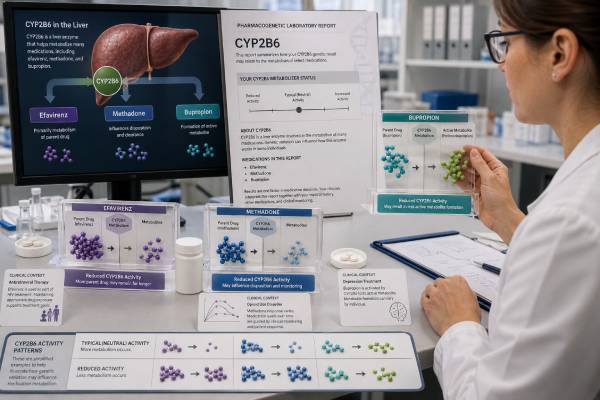
A CYP2B6 genetic test estimates inherited differences in an enzyme that metabolizes efavirenz, methadone, bupropion, and several other drugs. The result can be clinically actionable for efavirenz: reduced-function genotypes can raise concentrations and increase central nervous system adverse effects, allowing a clinician to consider a lower dose or another antiretroviral regimen. The same genotype has a different meaning for methadone. CYP2B6 clearly affects methadone pharmacokinetics, especially S-methadone, but current expert guidance recommends standard dosing, titration, and monitoring because genotype has not consistently predicted dose needs, effectiveness, or QT prolongation. Bupropion is converted by CYP2B6 to active hydroxybupropion, yet no validated genotype-based prescribing guideline exists. Interpreting the test therefore requires a drug-by-drug approach. A “poor metabolizer” label is not one universal medication instruction, and interactions, liver function, adherence, therapeutic monitoring, and clinical response remain essential.
- CYP2B6 poor and intermediate metabolizers can have higher efavirenz exposure and may benefit from a lower dose or alternative regimen.
- For methadone, CPIC recommends standard dosing and monitoring across defined CYP2B6 phenotypes despite pharmacokinetic differences.
- Bupropion genotype associations are not strong enough for routine CYP2B6-guided dose selection.
- CYP2B6*6 is a common decreased-function allele, but allele frequencies and test coverage vary substantially by ancestry.
- One CYP2B6 phenotype can lead to different clinical actions for different drugs because parent compounds and metabolites have different effects.
Table of Contents
- CYP2B6 Alleles and Metabolizer Phenotypes
- Efavirenz: The Most Actionable CYP2B6 Result
- Methadone: Pharmacokinetic Effect Without Genotype Dosing
- Bupropion: Active Metabolites and Limited Clinical Guidance
- Interactions, Induction, and Phenoconversion
- Laboratory Testing and Report Quality
- Using CYP2B6 Results Safely
CYP2B6 Alleles and Metabolizer Phenotypes
CYP2B6 is expressed mainly in the liver and accounts for a modest share of total hepatic cytochrome P450 protein, but it has an important role for selected drugs. The gene is highly polymorphic. Variants can alter messenger RNA splicing, protein expression, catalytic activity, or substrate-specific metabolism. As with other pharmacogenes, alleles are described using star nomenclature.
CYP2B61 is generally considered normal function. CYP2B66 and *9 are decreased-function alleles; *6 includes two linked variants, c.516G>T and c.785A>G, and is one of the most studied pharmacogenetic alleles. CYP2B618 is a no-function allele. CYP2B64 is generally classified as increased function, although effects can depend on the substrate. Other alleles have normal, decreased, no, increased, uncertain, or unknown function as evidence evolves.
A person inherits one allele from each parent. The pair, or diplotype, is translated into a predicted phenotype such as ultrarapid, rapid, normal, intermediate, poor, or indeterminate metabolizer. For example, two no-function alleles can produce poor-metabolizer status, while one normal and one decreased-function allele may produce an intermediate phenotype. The exact assignment must use a current allele-function table because older reports may classify an allele differently.
Ancestry affects which alleles are likely to be present, not how an identified allele should be valued. CYP2B6*6 is common across many populations, while *18 is more frequent in people with African ancestry than in many European or East Asian populations. A panel designed around variants common in one population can miss clinically important alleles in another. Self-identified race is not a substitute for comprehensive testing.
CYP2B6 is also inducible and inhibitable. Genotype predicts baseline capacity, but medications and disease can change the activity expressed at a given time. In addition, CYP2B6 shows substrate-dependent behavior: an allele’s measured effect with efavirenz may not be identical with bupropion or methadone. That is why a phenotype name must be linked to the guideline for the particular drug.
A pharmacogenetic result is most useful when it answers a specific prescribing question. “CYP2B6 poor metabolizer” is incomplete unless the report explains what this means for the medication being considered and how strong the evidence is.
Efavirenz: The Most Actionable CYP2B6 Result
Efavirenz is a non-nucleoside reverse transcriptase inhibitor used in combination treatment for HIV-1. Although many current regimens use integrase inhibitors, efavirenz remains important in some countries, fixed-dose combinations, and clinical settings. It is metabolized predominantly by CYP2B6 to inactive hydroxylated metabolites and can induce its own metabolism during continued therapy.
Reduced CYP2B6 function slows efavirenz clearance. Intermediate and poor metabolizers tend to have higher plasma concentrations and longer exposure. High exposure is associated with dizziness, impaired concentration, vivid dreams, insomnia, somnolence, mood symptoms, and other central nervous system effects. Some patients discontinue therapy because these effects are persistent or intolerable.
CPIC provides drug-specific recommendations. Normal, rapid, and ultrarapid metabolizers generally receive standard efavirenz dosing, with the usual clinical monitoring. Intermediate metabolizers have higher dose-adjusted concentrations and may be considered for a lower starting dose, commonly 400 mg daily, when a suitable formulation is available. Poor metabolizers have the greatest exposure; CPIC supports considering 400 mg or 200 mg daily, with careful attention to efficacy, toxicity, and regimen feasibility.
A lower dose is not an invitation to split an unsuitable fixed-dose tablet or create a regimen that undermines adherence. Efavirenz is usually given with other antiretrovirals, and available combination products may constrain dosing. If the appropriate strength is unavailable or a patient has significant neuropsychiatric risk, an alternative effective antiretroviral regimen may be preferable. HIV treatment decisions must preserve complete viral suppression and avoid functional monotherapy.
An intermediate or poor-metabolizer result does not mean efavirenz will fail. Reduced clearance tends to increase exposure, which may preserve antiviral activity while increasing adverse effects. Conversely, rapid metabolism does not automatically mean failure; adherence, resistance, drug interactions, food effects, and the complete regimen matter. Viral-load monitoring remains the definitive measure of treatment effectiveness.
The phenotype also should not be inferred from one variant alone when the laboratory lacks phasing. The c.516G>T variant can occur in more than one star allele, and the function of a diplotype may depend on linked changes. A report that states only “516 G/T” without a validated phenotype may require laboratory clarification.
Efavirenz can interact with tuberculosis therapies, anticonvulsants, hormonal contraceptives, and other medicines through induction or inhibition of multiple enzymes. Genotype-guided dosing does not eliminate interaction review. The HIV clinician or pharmacist should use a current antiretroviral interaction resource and consider therapeutic drug monitoring where available.
Methadone: Pharmacokinetic Effect Without Genotype Dosing
Methadone is used for opioid use disorder and for selected pain indications. It is usually administered as a racemic mixture containing R- and S-methadone. R-methadone has most of the opioid agonist activity, while S-methadone contributes more strongly to blockade of the cardiac hERG channel and QT prolongation. CYP2B6 metabolizes both enantiomers to inactive EDDP, with a particularly visible genetic effect on S-methadone.
Intermediate and poor metabolizers often have reduced S-methadone clearance and higher S-methadone concentrations. That pharmacokinetic relationship is reproducible enough to be biologically meaningful. However, clinical studies have not consistently shown corresponding differences in maintenance dose, treatment success, respiratory adverse effects, or QTc prolongation. R-methadone concentrations—the component most responsible for opioid effect—show smaller genotype differences.
The 2024 CPIC guideline therefore recommends standard methadone dosing, titration, and monitoring for rapid, normal, intermediate, and poor metabolizers. It does not recommend a slower titration schedule, a lower initial dose, or altered electrocardiogram monitoring solely from CYP2B6 genotype. Ultrarapid and indeterminate results lack sufficient evidence for a recommendation.
This is an important example of the difference between pharmacokinetics and clinical utility. A gene can change a blood concentration without changing the best clinical action. Methadone is titrated to withdrawal suppression, craving control, analgesia, sedation, respiratory status, and other observable outcomes. Its long and variable half-life requires cautious initiation in everyone because accumulation can continue after the apparent effect of the first doses.
Genotype also does not replace established QT-risk assessment. Clinicians consider baseline cardiac disease, electrolyte abnormalities, dose, other QT-prolonging drugs, inhibitors, syncope history, and applicable electrocardiogram guidance. A poor-metabolizer result should not be used to predict a specific QT interval, while a normal result should not be used to waive monitoring.
Methadone drug interactions are complex. Earlier assumptions emphasized CYP3A4, but human evidence identifies CYP2B6 as the predominant enzyme for systemic N-demethylation. Strong induction can lower concentrations and precipitate withdrawal; inhibition or stopping an inducer can increase exposure. Yet the degree of change varies, and methadone should be managed clinically rather than from a static genotype alone.
Patients should never alter methadone doses or skip treatment because of a genetic report. In opioid use disorder, destabilizing effective therapy can increase overdose and relapse risk. The result is best documented as pharmacokinetically relevant but not currently dose directing.
Bupropion: Active Metabolites and Limited Clinical Guidance
Bupropion is used for major depressive disorder, seasonal affective disorder, and smoking cessation, and it is included in combination products for other indications. CYP2B6 converts bupropion to hydroxybupropion, an active metabolite that can reach higher concentrations than the parent drug and contributes substantially to clinical effects. Carbonyl reductases produce additional active metabolites.
This parent-metabolite relationship makes genotype interpretation less intuitive. Reduced CYP2B6 activity can increase parent bupropion while decreasing hydroxybupropion formation. The total pharmacologic effect does not necessarily move in the same direction as the parent concentration. Studies have linked CYP2B6*6 and other variants to altered hydroxybupropion exposure, smoking-cessation outcomes, antidepressant response, or adverse effects, but findings are not consistent enough for a standard dosing guideline.
No CPIC recommendation instructs clinicians to raise or lower bupropion from CYP2B6 phenotype. FDA prescribing information identifies CYP2B6 as the main pathway to hydroxybupropion and provides interaction information, but it does not give a genotype-specific dose table. Clinical response, tolerability, formulation, seizure risk, blood pressure, liver and kidney function, and interacting drugs remain the basis for prescribing.
Bupropion has dose-related seizure risk. A predicted rapid metabolizer should not exceed the product’s maximum dose in an attempt to overcome reduced exposure, and a poor metabolizer should not self-reduce treatment. Eating disorders, abrupt alcohol or sedative withdrawal, seizure disorders, interacting medications, and formulation-specific dosing intervals can be more important than genotype.
CYP2B6 inhibitors such as ticlopidine and clopidogrel can increase bupropion exposure while reducing hydroxybupropion exposure. Inducers such as carbamazepine, phenobarbital, phenytoin, ritonavir-containing regimens, and efavirenz can alter parent and metabolite concentrations. Because the metabolite is active, interaction effects require clinical interpretation rather than a simple “higher is worse” rule.
Bupropion and its metabolites also inhibit CYP2D6. This is a separate direction of interaction: other drugs can affect bupropion through CYP2B6, while bupropion can raise concentrations of CYP2D6 substrates. A CYP2B6 result does not capture that inhibitory effect. Medication reconciliation is therefore essential when bupropion is combined with antidepressants, antipsychotics, beta blockers, antiarrhythmics, or tamoxifen.
For smoking cessation, nicotine dependence, adherence, counseling, treatment duration, and tobacco exposure strongly influence outcomes. CYP2B6 testing may be informative in research, but it is not required to choose bupropion, varenicline, or nicotine replacement.
Interactions, Induction, and Phenoconversion
CYP2B6 activity can be increased through activation of nuclear receptors such as the constitutive androstane receptor and pregnane X receptor. Rifampin, carbamazepine, phenobarbital, phenytoin, and efavirenz can induce CYP2B6, although each has additional enzyme and transporter effects. Induction develops over days and can persist after the drug is stopped while enzyme expression returns toward baseline.
Inhibitors include ticlopidine and clopidogrel for bupropion hydroxylation, as well as other agents with substrate- and concentration-dependent effects. A drug may inhibit one pathway while inducing another. In vitro lists should not be treated as equivalent to clinically proven interactions.
Phenoconversion occurs when environmental factors make observed metabolism differ from the genotype-predicted phenotype. A normal metabolizer taking a potent inhibitor may temporarily function more like a slow metabolizer. A decreased-function carrier exposed to a strong inducer may show greater activity than expected, though induction may be limited by the residual function of the alleles.
Liver disease can reduce clearance independently of genotype. Pregnancy can alter enzyme expression and blood volume. Age, inflammation, kidney function, adherence, and co-medications can change parent and metabolite exposure. For methadone, opioid tolerance and pharmacodynamic sensitivity add another layer that genotype cannot measure.
The result should therefore be interpreted at the time of prescribing, not stored as an unconditional warning. Electronic decision support is most useful when it combines genotype with the active medication list. A static portal entry that says “avoid CYP2B6 substrates” is inaccurate and may deprive a patient of effective treatment.
The exact direction of a genetic or drug interaction also depends on whether metabolism inactivates the parent drug or creates an active metabolite. Slower efavirenz metabolism raises active parent exposure. Slower bupropion hydroxylation reduces one active metabolite while raising the active parent. Slower methadone metabolism raises enantiomer exposure but has not yielded a genotype-specific clinical dose rule. These differences explain why reusable one-line interpretations fail.
Laboratory Testing and Report Quality
CYP2B6 testing uses DNA from blood, saliva, or a cheek swab. Targeted panels identify selected single-nucleotide variants and assign star alleles. Some laboratories use sequencing, deletion-duplication methods, or long-range approaches to improve coverage. The report should list the alleles tested, the diplotype, predicted phenotype, translation source, and assay limitations.
CYP2B6 star-allele calling can be technically challenging because multiple variants form haplotypes and some positions may be shared among alleles. When two heterozygous variants are present, their phase—whether they sit on the same chromosome or opposite chromosomes—can change the diplotype. Targeted assays may use assumptions based on frequency, while more advanced methods can resolve phase directly.
A limited assay can miss rare alleles, particularly in ancestrally diverse populations. “No variant detected” means none of the interrogated variants was found, not that CYP2B6 was fully sequenced or that metabolism is guaranteed to be normal. Conversely, detecting a rare variant does not prove decreased function if its classification is uncertain.
The phenotype may differ by guideline. Efavirenz and methadone use current CPIC allele-function assignments, but a commercial laboratory might apply an older system or simplify categories. The result should be reinterpreted against the current drug-specific guideline rather than copied from a generic panel comment.
Direct-to-consumer raw data can contain c.516G>T or c.785A>G but may not establish the haplotype. Looking up one SNP and calling oneself 6/6 can be wrong because *6 requires a defined combination. Clinical decisions—especially HIV therapy or methadone management—need a validated laboratory report.
Genotype is lifelong, but interpretation changes. Patients should retain the original alleles and report date. If the phenotype label changes after expert reclassification, the DNA result remains the same while the clinical annotation is updated.
Using CYP2B6 Results Safely
For efavirenz, the prescriber should confirm the diplotype and phenotype, review central nervous system symptoms and psychiatric history, check the available formulation, and ensure that any dose change preserves a complete suppressive HIV regimen. Viral load and adherence remain essential. A person already stable on efavirenz should not change a successful regimen based solely on a newly discovered genotype without specialist review.
For methadone, current guidance is straightforward: use standard initiation, titration, clinical monitoring, and applicable ECG practices. The genotype can explain part of pharmacokinetic variability, especially S-methadone exposure, but it should not be used to force a lower dose, deny opioid-use-disorder treatment, or predict treatment failure. The principles in opioid pharmacogenetic testing do not transfer automatically to methadone because the relevant gene-drug evidence differs.
For bupropion, treatment should follow product labeling and clinical response. Review seizure-risk factors, blood pressure, liver and kidney function, alcohol or sedative withdrawal, and interacting drugs. A genotype result can be documented, but there is no validated routine dose change for poor, intermediate, rapid, or normal CYP2B6 status.
Any report should be read at three levels: analytical validity, phenotype assignment, and drug-specific actionability. A technically correct diplotype can still have no prescribing implication for one drug and a meaningful recommendation for another. That distinction is the central safeguard against overinterpretation.
Patients should seek urgent help for severe efavirenz neuropsychiatric symptoms, methadone-related excessive sedation or breathing difficulty, or bupropion-associated seizure, severe agitation, or allergic reaction. Genetic testing does not replace emergency assessment.
The best CYP2B6 interpretation is precise rather than dramatic: actionable for selected efavirenz decisions, pharmacokinetically informative but not dose changing for methadone, and not yet guideline directing for bupropion.
A practical interpretation can also be organized by the type of drug effect. For an active parent drug that is inactivated by CYP2B6, reduced metabolism tends to increase parent exposure. Efavirenz is the clearest example. For a drug whose CYP2B6 product remains active, as with hydroxybupropion, reduced metabolism changes the balance between active compounds rather than simply reducing or increasing all activity. For a racemic medicine such as methadone, genotype can affect one enantiomer more than the other, weakening any simple link between total concentration and clinical outcome.
CYP2B6 also participates in the metabolism or bioactivation of medications not highlighted in the test title, including cyclophosphamide, ifosfamide, ketamine, selegiline, and some antiretroviral or anesthetic agents. Evidence for genotype-guided use varies and is often insufficient. A laboratory may list these drugs because a metabolic pathway exists, but pathway involvement is not the same as a dosing recommendation. Oncology prodrugs are especially complex because multiple enzymes activate and deactivate them, tumor factors affect response, and combination regimens create competing influences.
When a result is discordant with clinical experience, the clinician should verify the sample and diplotype, review whether the relevant alleles were included, and examine co-medications. Therapeutic drug monitoring may be available for efavirenz or methadone in selected centers, while hydroxybupropion concentrations are mainly used in specialized settings. A measured concentration should still be interpreted with dose timing, adherence, steady state, and the clinical target.
The report should avoid implying that poor metabolism is always dangerous or rapid metabolism is always ineffective. The direction of risk follows the drug’s pharmacology. It should also avoid recommending an entire class change when only one gene-drug pair has strong evidence. A clear report distinguishes “actionable,” “pharmacokinetically associated but no dose change recommended,” and “insufficient evidence.” Those three categories accurately describe efavirenz, methadone, and bupropion, respectively, and make the result more useful to future prescribers.
References
- Clinical Pharmacogenetics Implementation Consortium Guideline for CYP2B6 Genotype and Methadone Therapy 2024
- Guideline for CYP2B6 and efavirenz 2026 (ClinPGx)
- Clinical Pharmacogenetics Implementation Consortium Guideline for CYP2B6 and Efavirenz-Containing Antiretroviral Therapy 2019
- WELLBUTRIN (bupropion hydrochloride) tablets, for oral use: Prescribing Information 2025 (U.S. Food and Drug Administration)
- General background text Pharmacogenetics – CYP2B6 2024 (Royal Dutch Pharmacists Association)
Disclaimer
This article is general education and does not provide an HIV regimen, methadone dose, or bupropion prescription. Medication changes should be made only by the treating clinician using the complete genotype, current guideline, interactions, clinical response, and required monitoring. Severe psychiatric, respiratory, cardiac, or neurologic symptoms require prompt medical evaluation regardless of CYP2B6 results.