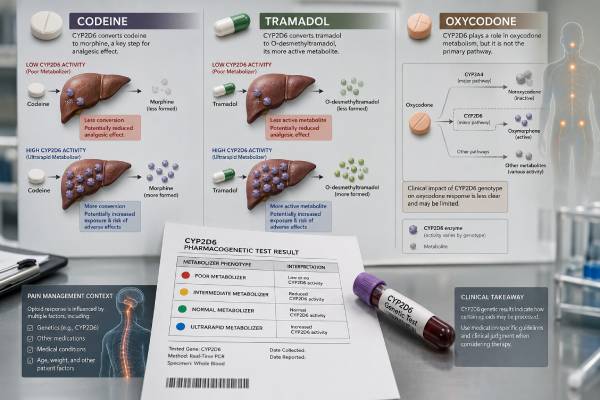
A CYP2D6 opioid pharmacogenetic test predicts how efficiently the body converts certain opioids into more active metabolites. The result is most clinically useful for codeine and tramadol. Poor metabolizers may receive little pain relief because they form too little morphine from codeine or too little O-desmethyltramadol from tramadol. Ultrarapid metabolizers can form these active metabolites quickly, increasing the risk of profound sedation and dangerous breathing suppression even at prescribed doses. Oxycodone is different: the parent drug is active, and current evidence does not support changing routine oxycodone prescribing from CYP2D6 genotype alone. Strong CYP2D6 inhibitors can also reduce opioid activation, creating a temporary poor-metabolizer effect regardless of genotype. A result should therefore be matched to the exact opioid, current medication list, age, breathing risk, kidney and liver function, pain type, and treatment duration. Testing can guide safer selection, but it does not determine the right opioid dose by itself or remove the need for overdose precautions.
- Poor metabolizers should generally avoid codeine and tramadol, because reduced activation can cause inadequate pain relief.
- Ultrarapid metabolizers should generally avoid codeine and tramadol, because rapid active-metabolite formation can cause severe toxicity.
- Normal and intermediate metabolizers usually start with labeled doses, but inadequate response still requires reassessment rather than unsupervised dose escalation.
- CYP2D6 evidence is insufficient for genotype-based oxycodone dosing, because oxycodone itself is active and study results are inconsistent.
- Bupropion, fluoxetine, and paroxetine can inhibit CYP2D6, reducing activation of codeine and tramadol even in genetically normal metabolizers.
Table of Contents
- Why codeine and tramadol are most affected
- Metabolizer results and opioid meaning
- Codeine response and safety
- Tramadol response and safety
- Oxycodone and hydrocodone have weaker guidance
- Inhibitors can create functional poor metabolism
- Age, breastfeeding, and overdose risk
- Using the test with a pain treatment plan
Why codeine and tramadol are most affected
CYP2D6 is a liver enzyme that changes the chemical form of many medications. Its effect on an opioid depends on whether the parent drug already provides strong analgesia or must be converted into a more active metabolite.
Codeine has relatively weak opioid activity on its own. CYP2D6 converts a portion of each dose to morphine, which provides much of the pain-relieving effect. Tramadol has some parent-drug activity through serotonin and norepinephrine pathways, but CYP2D6 converts it to O-desmethyltramadol, often called M1, which binds the mu-opioid receptor much more strongly.
That conversion creates two opposite risks. Too little CYP2D6 activity can produce inadequate analgesia. Too much activity can create high active-metabolite exposure and opioid toxicity. This is why poor and ultrarapid metabolizers can both be poor candidates for codeine or tramadol, but for different reasons.
Oxycodone does not fit the same model. CYP2D6 converts a small portion to oxymorphone, a potent metabolite, but oxycodone itself is an active analgesic. Most oxycodone is handled through CYP3A pathways and other routes. Studies have not consistently shown that CYP2D6 phenotype predicts a clinically important difference in pain relief or toxicity that justifies routine genotype-based dose changes.
Hydrocodone is converted to hydromorphone by CYP2D6, but the parent drug is also active. Reduced conversion may contribute to poor response in some people, yet the evidence is weaker than for codeine and tramadol. Current guidance focuses on monitoring response and considering an alternative if pain control is inadequate rather than automatically avoiding hydrocodone for every non-normal phenotype.
This drug-by-drug distinction is essential. A test report that groups all four opioids under one “CYP2D6 interaction” category can exaggerate the evidence for oxycodone and hydrocodone or understate the stronger guidance for codeine and tramadol.
CYP2D6 is only one part of opioid response. Pain mechanism, dose, tolerance, previous opioid exposure, kidney function, liver function, sleep apnea, lung disease, age, other sedatives, and substance-use history can have greater immediate effects on safety. Pharmacogenetics can improve selection, but it cannot make an opioid risk free.
Metabolizer results and opioid meaning
A CYP2D6 report usually lists two star alleles, gene copy number, an activity score, and a predicted phenotype. The main phenotypes are poor, intermediate, normal, and ultrarapid metabolizer.
| Phenotype | Expected CYP2D6 activity | Likely effect on codeine and tramadol |
|---|---|---|
| Poor metabolizer | Little or no activity | Very low active-metabolite formation and likely inadequate analgesia |
| Intermediate metabolizer | Reduced activity | Somewhat reduced activation; response may be lower in some patients |
| Normal metabolizer | Expected activity | Typical activation at labeled doses, though response still varies |
| Ultrarapid metabolizer | Greater-than-expected activity | Rapid active-metabolite formation and increased toxicity risk |
Poor metabolizers often carry two no-function alleles. Ultrarapid metabolizers usually have extra copies of a functional allele, but copy number must be interpreted carefully. An extra copy of a no-function allele does not increase activity. The report should therefore identify which allele is duplicated, not only state that three or more copies are present.
Intermediate metabolizers deserve nuance. Current guidance generally allows a labeled starting dose of codeine or tramadol, followed by ordinary monitoring. If pain relief is inadequate, the next step is not simply to increase the dose repeatedly. A non-CYP2D6-dependent analgesic may be safer and more effective.
Normal metabolizer status also does not guarantee good pain control or protect against overdose. A normal metabolizer can become dangerously sedated from a high dose, a dosing error, kidney or liver impairment, or combination with alcohol, benzodiazepines, gabapentinoids, sleep medicines, or other central nervous system depressants.
The genetic result is lifelong, but the working phenotype can change when an inhibitor is present. A person with a normal genotype who takes a strong CYP2D6 inhibitor may activate codeine or tramadol poorly and function more like a poor metabolizer.
The test does not measure opioid tolerance, addiction risk, pain severity, or whether a person is taking the medicine as directed. OPRM1 and COMT variants have been studied in opioid response, but current evidence does not support using them to select or dose routine opioid therapy. Their presence on a commercial panel should not be treated as equivalent to CYP2D6 guidance for codeine and tramadol.
Codeine response and safety
Codeine is used in some pain medicines and cough products. Its analgesic effect depends substantially on conversion to morphine. The CYP2D6 phenotype changes both effectiveness and toxicity risk.
Poor metabolizers
A poor metabolizer produces little morphine from codeine. Pain relief is likely to be inadequate, even when the dose is taken correctly. Increasing the codeine dose can raise exposure to the parent drug and other metabolites without reliably producing enough morphine. Clinical guidelines therefore recommend choosing an analgesic that does not depend on CYP2D6 activation.
Morphine, hydromorphone, and non-opioid options are not activated by CYP2D6, but the best alternative depends on the pain condition, organ function, allergy history, and treatment setting. Oxycodone is not a direct one-for-one substitute and still carries full opioid risks.
Ultrarapid metabolizers
An ultrarapid metabolizer can convert codeine to morphine quickly. Standard doses may produce unexpectedly high morphine concentrations, leading to extreme sleepiness, confusion, pinpoint pupils, slow or shallow breathing, and death. Avoiding codeine is generally recommended because a reliably safe dose cannot be predicted from the genotype.
The risk is not limited to the first dose. Morphine and its metabolites can accumulate, particularly with repeated dosing or impaired kidney function. A person who initially seems comfortable can become progressively sedated.
Intermediate and normal metabolizers
Intermediate and normal metabolizers can usually receive a labeled starting dose when codeine is otherwise appropriate. The prescription should still use the lowest effective dose for the shortest necessary duration. If an intermediate metabolizer has little relief, switching to an alternative is usually more rational than escalating without limits.
Codeine should not be assumed to be a mild or low-risk opioid. It can cause constipation, nausea, impaired driving, dependence, withdrawal, and respiratory depression. Combination products can also contain acetaminophen, and exceeding the total daily acetaminophen limit can cause severe liver injury even when the codeine amount seems modest.
Cough suppression is another use, but pharmacogenetic differences remain. A poor metabolizer may get less opioid effect, while an ultrarapid metabolizer may face toxicity. Many cough illnesses do not benefit enough from codeine to justify the risk, especially in children.
Tramadol response and safety
Tramadol is often described as an atypical opioid because the parent drug inhibits serotonin and norepinephrine reuptake while the M1 metabolite provides stronger mu-opioid receptor activity. CYP2D6 therefore influences analgesia, but tramadol has additional risks that are not solved by genotype.
Poor metabolizers
Poor metabolizers form little M1 and may have reduced pain relief. The parent drug can still produce nausea, dizziness, sedation, and serotonergic effects, so raising the dose may increase adverse reactions without providing adequate opioid analgesia. Guidelines generally recommend an alternative not dependent on CYP2D6 activation.
Ultrarapid metabolizers
Ultrarapid metabolizers can form M1 quickly and face a higher risk of opioid toxicity. Avoiding tramadol is generally recommended. The danger increases with high doses, repeated dosing, kidney impairment, older age, sleep apnea, lung disease, or other sedatives.
Intermediate and normal metabolizers
A labeled starting dose can generally be used, with close assessment of pain relief and adverse effects. If an intermediate metabolizer has inadequate response, another analgesic is preferable to uncontrolled dose escalation.
Tramadol lowers the seizure threshold. Seizures can occur at recommended doses but are more likely with overdose, a seizure disorder, head injury, metabolic disturbances, or medicines that also lower the threshold. CYP2D6 testing does not predict this risk.
Tramadol can also contribute to serotonin syndrome, particularly when combined with selective serotonin reuptake inhibitors, serotonin–norepinephrine reuptake inhibitors, monoamine oxidase inhibitors, some migraine medicines, linezolid, or other serotonergic drugs. Symptoms can include agitation, sweating, diarrhea, tremor, muscle rigidity, fever, and confusion. Genotype does not make a risky serotonergic combination safe.
Stopping tramadol abruptly after regular use can cause both opioid withdrawal and symptoms related to serotonin and norepinephrine effects. A taper may be needed. Pharmacogenetic testing should guide drug choice, not encourage abrupt self-directed discontinuation.
Oxycodone and hydrocodone have weaker guidance
Oxycodone is converted partly to oxymorphone by CYP2D6 and largely to noroxycodone through CYP3A. Because oxycodone itself is active, reduced oxymorphone formation does not necessarily eliminate analgesia. Studies have reported mixed relationships among genotype, metabolite concentrations, pain relief, and adverse effects.
Current clinical guidance finds insufficient evidence to recommend changing standard oxycodone use solely from CYP2D6 phenotype. A poor metabolizer result should not automatically trigger a higher oxycodone dose. An ultrarapid result should not automatically make oxycodone contraindicated. The clinician should use ordinary opioid principles and monitor the actual response.
This does not mean CYP2D6 has no biological effect. Poor metabolizers often form less oxymorphone, while ultrarapid metabolizers may form more. The unresolved issue is how much that difference changes meaningful outcomes in typical clinical use, given the active parent drug, CYP3A metabolism, variable pain conditions, tolerance, and other factors.
CYP3A interactions can be more important for oxycodone exposure. Strong CYP3A inhibitors can raise oxycodone concentrations and increase respiratory-depression risk. Strong inducers can lower concentrations and then create toxicity if the inducer is stopped without adjusting the opioid. A CYP2D6-only report will not capture this.
Hydrocodone is converted to hydromorphone by CYP2D6, but hydrocodone itself is active. For intermediate and poor metabolizers, guidelines generally support using the labeled dose and monitoring. If pain control is inadequate, an opioid or non-opioid analgesic not affected by CYP2D6 may be considered. Evidence is insufficient for strong genotype-based action in ultrarapid metabolizers.
Commercial reports sometimes place oxycodone or hydrocodone in the same high-risk category as codeine. That presentation can be misleading. The strength of evidence is substantially greater for avoiding codeine and tramadol in poor and ultrarapid metabolizers.
A patient who has failed codeine because of poor activation may still respond to oxycodone, but that does not prove oxycodone is the best alternative. Non-opioid treatments, regional anesthesia, anti-inflammatory medicines, acetaminophen, physical therapy, or another opioid may be more appropriate depending on the cause and expected duration of pain.
Inhibitors can create functional poor metabolism
Strong CYP2D6 inhibitors can markedly reduce enzyme activity. This medication-driven change is called phenoconversion. It can make a normal or intermediate metabolizer function like a poor metabolizer while the inhibitor is present.
Common strong inhibitors include:
- bupropion;
- fluoxetine;
- paroxetine;
- quinidine.
Duloxetine is a moderate inhibitor, and several other medicines can contribute. The effect depends on inhibitor strength, dose, duration, the patient’s starting genotype, and the opioid.
For codeine and tramadol, inhibition usually reduces active-metabolite formation. The patient may report little pain relief despite taking the prescribed dose. Escalating the opioid without recognizing the interaction can increase parent-drug adverse effects and create risk if the inhibitor is later stopped.
An observational study found that patients using CYP2D6-dependent opioids with CYP2D6 inhibitors had more emergency-department visits for pain, supporting the clinical importance of impaired bioactivation. The association does not prove that every visit was caused by the interaction, but it reinforces the need to review the whole medication list.
Fluoxetine deserves special attention because it and its active metabolite remain in the body for a long time. CYP2D6 inhibition can persist for weeks after the last dose. A codeine or tramadol prescription started soon after fluoxetine discontinuation may still have reduced effect.
Paroxetine is both an antidepressant and a strong inhibitor. Bupropion is used for depression and smoking cessation. Patients may not realize that either medicine can change opioid response, and the opioid prescriber may not know about treatment from another clinician.
Phenoconversion can also alter hydrocodone and oxycodone metabolite formation, though the clinical consequences are less certain because the parent drugs are active. It does not eliminate the usual overdose risk from those opioids.
A medication review should include prescriptions, over-the-counter products, recently stopped drugs, alcohol, cannabis, benzodiazepines, gabapentin or pregabalin, sleep medicines, muscle relaxants, and sedating antihistamines. Some of these do not inhibit CYP2D6 but still increase sedation or breathing risk.
Age, breastfeeding, and overdose risk
Children have had fatal respiratory depression after codeine or tramadol, particularly after tonsil or adenoid surgery and in suspected ultrarapid metabolizers. In the United States, codeine and tramadol are contraindicated in children younger than 12 years. They are also contraindicated for postoperative pain after tonsillectomy or adenoidectomy in patients younger than 18 years. Additional caution applies to adolescents with obesity, obstructive sleep apnea, severe lung disease, or other breathing risk factors.
Genetic testing should not be used to bypass these age restrictions. A normal-metabolizer result does not make codeine or tramadol acceptable where the label contraindicates use. Pediatric physiology, dosing error, sleep-disordered breathing, and other factors can still cause toxicity.
Breastfeeding is another high-risk setting. Codeine can be converted to morphine and transferred through breast milk. An ultrarapid-metabolizing mother may produce high morphine exposure, and a nursing infant has limited ability to handle opioids. Tramadol and its active metabolite can also enter milk. Breastfeeding is not recommended during treatment with codeine or tramadol under current U.S. labeling.
All patients and caregivers should know overdose warning signs:
- unusual difficulty waking;
- extreme sleepiness or confusion;
- slow, shallow, irregular, or stopped breathing;
- blue or gray lips or fingertips;
- pinpoint pupils;
- limpness, gurgling, or inability to respond.
Call emergency services immediately if opioid overdose is suspected. Give naloxone when available and repeat it according to product instructions if the person does not respond or symptoms return. Naloxone can wear off before the opioid, so emergency evaluation is still required.
Risk increases when opioids are combined with alcohol, benzodiazepines, sedative sleep medicines, gabapentinoids, muscle relaxants, or other central nervous system depressants. CYP2D6 testing does not measure this combined risk.
People with obstructive sleep apnea, chronic lung disease, kidney or liver impairment, older age, frailty, or no prior opioid exposure may need lower doses, closer follow-up, or non-opioid strategies regardless of genotype. A previous period of abstinence reduces tolerance and increases overdose risk if an old dose is resumed.
Safe storage and disposal matter. Keep opioids locked away from children and others, never share them, and use an authorized take-back program for leftovers. Pharmacogenetic information cannot prevent accidental ingestion or diversion.
Using the test with a pain treatment plan
A CYP2D6 result should support a broader pain plan rather than act as a prescription generator. Start with the pain diagnosis, expected duration, functional goal, and non-opioid options. Acute surgical pain, kidney-stone pain, cancer pain, neuropathic pain, and chronic low-back pain do not have the same treatment needs.
For a patient who may receive codeine or tramadol, a practical sequence is:
- Confirm the exact CYP2D6 diplotype, copy number, activity score, and phenotype.
- Review strong and moderate CYP2D6 inhibitors and recently stopped medicines.
- Avoid codeine or tramadol in poor and ultrarapid metabolizers.
- For intermediate or normal metabolizers, use labeled dosing only when the drug is otherwise appropriate.
- Set a short follow-up window to assess pain relief, alertness, breathing, constipation, nausea, and function.
- Switch strategies rather than repeatedly increasing a poorly effective prodrug.
For oxycodone or hydrocodone, do not infer a precise dose from CYP2D6. Use the lowest effective dose, consider CYP3A interactions, assess sedation and respiratory risk, and base changes on observed response. The broader CYP2D6 genetic test guide explains assay quality, gene duplications, and activity scores in more detail.
The result may be especially useful when a patient reports that codeine or tramadol “never works,” experienced severe toxicity at a low dose, has a strong family history of unusual response, or already has panel testing available. It is less useful as an explanation for every chronic pain problem or every opioid side effect.
Do not use genotype to justify a higher opioid dose, long-term opioid therapy, or combination with sedatives. Tolerance, dependence, opioid use disorder, hyperalgesia, and overdose can occur in any phenotype. A poor response may indicate the wrong drug, the wrong diagnosis, tolerance, an interaction, or a need for non-opioid treatment—not simply a need for more opioid.
Patients taking opioids regularly should not stop suddenly without guidance because withdrawal and uncontrolled pain can occur. A taper should be individualized. Anyone worried about loss of control, cravings, unsafe use, or withdrawal deserves confidential medical support rather than judgment.
Keep the complete report in the medical record. CYP2D6 genotype is lifelong, while pain conditions and medications change. The safest interpretation remains narrow and specific: strong guidance for codeine and tramadol, limited guidance for hydrocodone, and insufficient evidence for routine genotype-based oxycodone dosing.
References
- Clinical Pharmacogenetics Implementation Consortium Guideline for CYP2D6, OPRM1, and COMT Genotypes and Select Opioid Therapy 2021 (Guideline)
- Dutch Pharmacogenetics Working Group (DPWG) guideline for the gene-drug interaction between CYP2D6 and opioids (codeine, tramadol and oxycodone) 2022 (Guideline)
- Use of CYP2D6 Inhibitors with CYP2D6 Opioids: Association with Emergency Department Visits for Pain 2024 (Clinical Study)
- Codeine Therapy and CYP2D6 Genotype 2025 (Review)
- Tramadol Therapy and CYP2D6 Genotype 2025 (Review)
- Oxycodone Therapy and CYP2D6 Genotype 2025 (Review)
Disclaimer
CYP2D6 opioid results must be interpreted with the exact drug, current inhibitors, age, organ function, breathing risk, other sedatives, and the reason for treatment. Do not start, stop, switch, or increase an opioid based only on a genetic report. Extreme sleepiness, inability to wake, or slow or stopped breathing is an emergency; call emergency services and give naloxone if available.