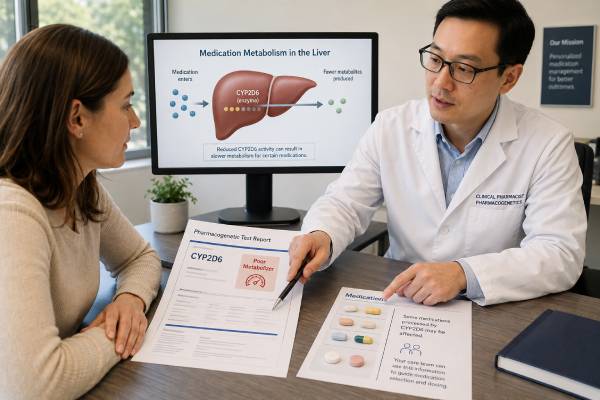
A CYP2D6 genetic test predicts how much functional CYP2D6 enzyme a person is likely to produce. This enzyme affects many antidepressants, opioids, antipsychotics, attention-deficit medicines, anti-nausea drugs, beta-blockers, and other prescriptions. A poor metabolizer has little or no inherited CYP2D6 activity, but that finding does not mean the liver is unhealthy. It means certain drugs may clear slowly, while prodrugs such as codeine and tramadol may not be activated well enough. CYP2D6 is unusually difficult to test because the gene can be deleted, duplicated, multiplied, or rearranged with a nearby pseudogene. Results therefore depend on both the laboratory method and the alleles included. Medication inhibitors can also make a genetically normal metabolizer function like a poor metabolizer. The report is most useful when it lists the exact star alleles, copy number, activity score, and phenotype and is interpreted for one specific medicine rather than as a universal drug-safety label.
- A CYP2D6 poor metabolizer has little or no predicted enzyme activity, usually because two no-function alleles were found.
- Poor metabolism can raise levels of active CYP2D6 substrates, increasing side effects at standard doses.
- Poor metabolism can weaken prodrugs such as codeine and tramadol, because less active pain-relieving metabolite is formed.
- Gene duplications can create an ultrarapid phenotype, but only when the extra copies are functional.
- Strong inhibitors such as bupropion, fluoxetine, and paroxetine can cause phenoconversion, temporarily reducing actual CYP2D6 activity.
Table of Contents
- What “poor metabolizer” really means
- Why CYP2D6 is hard to test
- From star alleles to activity score
- Active drugs and prodrugs behave differently
- Medications with actionable CYP2D6 guidance
- Phenoconversion can change the working phenotype
- Test limitations and result discrepancies
- How to apply a lifelong result
What “poor metabolizer” really means
CYP2D6 is a drug-metabolizing enzyme produced mainly in the liver. The gene is inherited, with one copy normally received from each biological parent. Variants can change whether those copies make a functional enzyme.
A poor metabolizer phenotype means the combined genetic result predicts little or no CYP2D6 activity. It is not liver failure, a disease, or a sign that all medication metabolism is slow. The liver contains many other enzymes, and each drug uses its own combination of pathways.
For an active drug that CYP2D6 helps clear, poor metabolism can increase exposure. A standard dose may last longer, produce a higher peak or average concentration, and increase dose-related adverse effects. Examples include metoprolol, paroxetine, vortioxetine, atomoxetine, and several tricyclic antidepressants.
For a prodrug, the direction can reverse. Codeine and tramadol require CYP2D6 to form metabolites that provide much of their opioid effect. A poor metabolizer may get little pain relief even though the parent drug is present. An ultrarapid metabolizer can form active metabolite quickly and may face greater toxicity.
Intermediate metabolizers have reduced but not absent activity. Normal metabolizers fall within the expected population range. Ultrarapid metabolizers generally have extra functional gene copies or another combination that produces high activity. These categories predict average tendencies; they do not determine an individual concentration with certainty.
The phenotype is drug specific in its consequences. A poor metabolizer may need a lower dose of one medicine, a different medicine for another, and no change for a third because CYP2D6 contributes only a minor pathway. “Avoid all CYP2D6 drugs” is therefore not a valid interpretation.
Symptoms also take priority over the label. A poor metabolizer who is stable on a low dose may not need a change. A normal metabolizer with severe side effects still needs evaluation. Genotype helps explain and anticipate response, but it does not overrule what is happening clinically.
Why CYP2D6 is hard to test
CYP2D6 sits next to highly similar pseudogenes, especially CYP2D7. The region is prone to deletions, duplications, conversions, and hybrid genes. This makes CYP2D6 more difficult to analyze than a gene where the main task is identifying one or two single-letter variants.
A person may have:
- a complete CYP2D6 gene deletion;
- one or more duplicated copies;
- several copies of a functional or nonfunctional allele;
- a CYP2D6–CYP2D7 hybrid;
- multiple variants that must be assigned to the correct chromosome;
- a rare allele that a targeted panel does not test.
Copy number alone is not enough. Three gene copies do not automatically mean ultrarapid metabolism. The laboratory must determine which allele was duplicated. An extra copy of a no-function allele adds no activity, while extra copies of a normal-function allele can increase activity substantially.
This is why a strong clinical assay needs more than a short single-variant panel. It should detect common no-function, decreased-function, and normal-function alleles; assess deletion and duplication; and resolve important structural variants. The exact recommended allele set includes variants that are common in different ancestral populations rather than focusing only on alleles frequent in Europeans.
The report should describe whether copy number and structural variation were assessed. If it lists a result such as 1/4 but says nothing about copy number, the laboratory may have assumed two total gene copies. That assumption can be wrong in someone with a duplication.
Long-read sequencing and other advanced methods can resolve complex alleles that older assays leave ambiguous. They are not necessary for every routine sample, but they can clarify discordant results, unusual copy numbers, or a phenotype that does not fit the observed medication response.
The CYP2D6 genotype remains stable for life. The interpretation may change as laboratories improve allele definitions or as professional groups update the activity assigned to an allele. Keeping the original report allows later reanalysis without necessarily collecting another sample.
From star alleles to activity score
CYP2D6 results use star-allele names such as *1, *2, *4, *5, *10, *17, *29, and *41. Each star allele represents a defined pattern of variants on one chromosome. The laboratory assigns a function category and numerical value to each allele, then adds the values to create an activity score.
Common functional examples include:
| Allele example | Usual function | General effect on activity score |
|---|---|---|
| *1, *2 | Normal function | Full activity value per copy |
| *10, *17, *29, *41 | Decreased function | Partial activity value |
| *3, *4, *5, *6 | No function | Zero activity value |
| *1xN or *2xN | Multiple normal-function copies | Can raise the score into the ultrarapid range |
The same allele may be uncommon in one population and common in another. CYP2D6*10 is frequent in many East Asian populations, while *17 and *29 are more common in people with African ancestry. Inclusive allele coverage helps prevent a decreased-function allele from being misread as *1.
The activity score is translated into a phenotype using consensus thresholds. A score of zero is poor metabolizer. Low nonzero scores are intermediate. Scores in the expected range are normal. Higher scores can be ultrarapid. The exact thresholds have changed over time, so older reports may classify the same diplotype differently.
The report should preserve both the diplotype and the activity score. “Intermediate metabolizer” is easier to read, but the score gives more detail and can be important for drug-specific recommendations. It also helps explain why two people with the same broad phenotype may not have identical clearance.
An indeterminate result means the laboratory could not confidently assign the allele structure or phenotype. That is different from normal. An indeterminate result should not be converted into a reassuring green category. The laboratory may recommend family testing, another method, or cautious clinical interpretation.
A test can be performed from blood, saliva, or a cheek swab. The specimen type usually does not change the inherited result, although sample quality and contamination can affect technical success. Blood transfusion or stem-cell transplantation can complicate some genetic samples and should be disclosed to the laboratory.
Active drugs and prodrugs behave differently
The most useful way to interpret CYP2D6 is to ask what the enzyme does to the exact medicine.
When CYP2D6 clears an active drug
For active substrates, reduced metabolism usually increases exposure. Poor metabolizers can experience more pronounced effects or adverse reactions at standard doses. Examples include excessive heart-rate slowing with metoprolol, higher vortioxetine levels, more atomoxetine exposure, or increased concentrations of certain tricyclic antidepressants.
A lower starting dose may help, but the recommended action varies. Some guidelines favor a specific reduction. Others recommend slower titration, close monitoring, or a drug less dependent on CYP2D6. For medicines with blood-level monitoring, measured concentration can refine the genetic prediction.
Ultrarapid metabolism can lower active-drug exposure and reduce effect. Increasing the dose is not always safe or supported. An alternative pathway may be more predictable, especially when the drug has a narrow therapeutic range or a labeled maximum.
When CYP2D6 activates a prodrug
Codeine is converted to morphine, and tramadol is converted to O-desmethyltramadol. Poor metabolizers form little active metabolite and may have inadequate analgesia. Ultrarapid metabolizers can form active metabolite rapidly, increasing the risk of sedation and respiratory depression.
Hydrocodone and oxycodone also have CYP2D6-generated metabolites, but current evidence does not support treating them exactly like codeine or tramadol. Oxycodone has substantial activity as the parent drug, and genotype-based prescribing recommendations are limited. The CYP2D6 opioid test guide covers those differences.
When active metabolites complicate the picture
Venlafaxine is converted by CYP2D6 to desvenlafaxine, which is also active. Poor metabolizers may have a high parent-to-metabolite ratio rather than a simple loss of total activity. Some patients experience adverse effects or poor tolerability, and an alternative not primarily dependent on CYP2D6 may be considered.
Tamoxifen is converted to active metabolites including endoxifen. CYP2D6 poor metabolism can reduce endoxifen formation, but oncology decisions involve cancer stage, menopausal status, alternative endocrine therapy, inhibitors, and guideline differences. A CYP2D6 report should not be used to stop tamoxifen without the oncology team.
This active-drug-versus-prodrug distinction prevents the common mistake of assuming that poor metabolism always means “too much drug.” Sometimes it means too little active treatment.
Medications with actionable CYP2D6 guidance
CYP2D6 affects many drugs, but only some have strong enough evidence for a clear prescribing action. The action also depends on indication and current response.
| Drug or group | Important phenotype | Typical implication |
|---|---|---|
| Codeine and tramadol | Poor or ultrarapid | Use an alternative not dependent on CYP2D6 activation |
| Vortioxetine | Poor | Higher exposure; FDA maximum is 10 mg/day |
| Paroxetine and fluvoxamine | Poor or ultrarapid | Consider lower/slower dosing or an alternative, depending on phenotype |
| Atomoxetine | Poor | Higher exposure and slower attainment of steady state; dosing and monitoring differ |
| Tricyclic antidepressants | Poor or ultrarapid | Alternative drug or major dose adjustment with therapeutic drug monitoring |
| Metoprolol | Poor | Greater exposure and heart-rate reduction; start lower, titrate carefully, or choose another beta-blocker |
| Ondansetron and tropisetron | Ultrarapid | Potentially reduced anti-nausea effect; consider an alternative not mainly cleared by CYP2D6 |
For metoprolol, current guidance recognizes substantially higher exposure and greater heart-rate lowering in poor metabolizers. A clinician may use a lower starting dose, slower titration, closer pulse and blood-pressure monitoring, or a beta-blocker such as atenolol or bisoprolol that is less dependent on CYP2D6. The best choice depends on heart failure, arrhythmia, blood pressure, kidney function, and other indications.
For atomoxetine, poor metabolizers can have much higher exposure and may respond at lower doses but also experience more side effects, such as increased heart rate, blood pressure, appetite loss, or insomnia. Pediatric and adult dosing recommendations differ, and response should be assessed before escalating.
For tricyclic antidepressants, CYP2D6 often works together with CYP2C19. Therapeutic drug monitoring can be especially useful because the medicines have narrow safety margins and can affect cardiac conduction. A single-gene panel may be incomplete.
For antipsychotics, CYP2D6 can influence exposure to drugs such as aripiprazole, brexpiprazole, risperidone, and others, but recommendations differ across product labels and guideline groups. Dose changes should be drug specific and account for inhibitors.
The presence of a gene–drug relationship does not mean testing is mandatory before every prescription. It means that when a result is already available, or when testing is clinically justified, it can inform selection, dose, and monitoring.
Phenoconversion can change the working phenotype
Phenoconversion occurs when a medication or physiologic condition changes enzyme activity enough that the observed phenotype differs from the genetic prediction. CYP2D6 is especially vulnerable because several common drugs strongly inhibit it.
Bupropion, fluoxetine, and paroxetine are strong inhibitors. Duloxetine is a moderate inhibitor. Quinidine is a powerful inhibitor used in some drug combinations. When a normal metabolizer takes a strong inhibitor, CYP2D6 activity may fall into the poor-metabolizer range. An intermediate metabolizer can also become functionally poor.
This matters in both directions:
- An active CYP2D6 substrate may accumulate and cause adverse effects.
- A prodrug such as codeine or tramadol may lose effectiveness because activation falls.
For example, a person with a normal genotype who takes bupropion and codeine may get little analgesia. Another person taking fluoxetine and metoprolol may experience more heart-rate slowing than the genotype alone predicts.
Inhibition can outlast the last dose. Fluoxetine and norfluoxetine have long half-lives, so the interaction may persist for weeks. A new CYP2D6 substrate started soon after fluoxetine discontinuation can still be affected.
Multiple inhibitors, liver disease, age, frailty, and inflammation can further alter exposure. CYP2D6 is generally not strongly inducible in the way some other enzymes are, so medication effects are dominated by inhibition rather than classic induction.
A useful interpretation therefore has two phenotypes: the genotype-predicted phenotype and the current working phenotype after inhibitors are considered. Electronic records and commercial reports do not always make this distinction clear.
Medication reconciliation should include prescriptions, over-the-counter products, and recent changes. The clinician should also ask whether an inhibitor is temporary. A dose reduced during bupropion treatment may need reassessment if bupropion is stopped.
Phenoconversion does not invalidate genetic testing. It explains why genotype must be placed in the current medication context. The inherited result remains useful for future prescribing when the inhibitor is absent.
Test limitations and result discrepancies
Different laboratories can report different CYP2D6 results from the same person. Causes include variant coverage, copy-number methods, structural-variant detection, phasing, allele-definition updates, and phenotype translation rules.
Targeted genotyping may miss a rare allele. Short-read sequencing can detect many variants but struggle to assign them within duplicated or hybrid genes. Copy-number assays can identify extra copies without always determining which allele was multiplied. A report may therefore be accurate within its technical limits yet incomplete.
Commercial panels also vary in ancestry coverage. A panel designed around *3, *4, *5, and *6 may perform reasonably for common European alleles but miss decreased-function variants such as *17 or *29 that are more frequent in people with African ancestry, or *10 in East Asian populations. A missing variant can be mistaken for *1 and inflate the activity score.
Check the report for:
- the exact diplotype and any “xN” copy-number notation;
- whether deletion, duplication, and hybrid alleles were assessed;
- the tested-allele list;
- the activity score and translation standard;
- any ambiguity or alternative diplotype calls;
- the drug-specific source used for recommendations.
A direct-to-consumer result may not be sufficient for prescribing. Raw-array data can contain errors, and many consumer products do not fully resolve CYP2D6 structure. Clinically important findings should be confirmed in an appropriately validated laboratory.
A “normal metabolizer” result is not a guarantee of normal drug levels. The test may have missed an allele, another pathway may dominate, or an inhibitor may reduce activity. Similarly, a poor metabolizer result does not prove that current symptoms are medication toxicity.
Blood concentration testing can help for selected drugs, especially tricyclic antidepressants and some antipsychotics. Pulse, blood pressure, pain response, sedation, nausea control, and psychiatric symptoms provide additional real-world evidence. Discordance between genotype and response should trigger a broader review rather than an assumption that one source must be wrong.
How to apply a lifelong result
Keep the complete CYP2D6 report, not only a wallet-card label. The most durable elements are the star alleles, copy number, activity score, test method, and laboratory. Store them in a place clinicians can find during future prescribing.
When a CYP2D6-related medicine is considered, use a structured sequence:
- Confirm that the drug has meaningful CYP2D6 evidence and identify whether it is an active drug, prodrug, or active-metabolite system.
- Verify the genotype, copy number, activity score, and phenotype.
- Review strong and moderate CYP2D6 inhibitors and recent discontinuations.
- Check the current guideline or product label for that exact medicine and indication.
- Decide whether to use a lower dose, slower titration, alternative drug, therapeutic drug monitoring, or ordinary dosing with follow-up.
- Define the clinical outcome that will show success or harm.
Do not make stable treatment worse simply to make the prescription match the genotype. A patient doing well without adverse effects may not need a change. The result is often most valuable before a new medicine, after an unexplained adverse reaction, or when repeated treatment failure suggests a metabolism problem.
Biological relatives may share CYP2D6 alleles, including deletions or duplications. The result does not diagnose a familial disease, and relatives generally need testing only when a medication decision makes it useful.
Patients should not stop opioids, antidepressants, beta-blockers, antipsychotics, or other prescriptions without clinical guidance. Withdrawal, rebound symptoms, heart-rate changes, uncontrolled pain, or psychiatric relapse can occur. Urgent symptoms such as severe sedation, slowed breathing, fainting, very slow pulse, suicidal intent, or a serious allergic reaction require immediate medical attention.
A well-interpreted CYP2D6 result is a reusable medication tool. Its value comes from matching a technically sound lifelong genotype to the drug being used today, the inhibitors present today, and the outcome that needs to be monitored today.
References
- Recommendations for Clinical CYP2D6 Genotyping Allele Selection: A Joint Consensus Recommendation of the Association for Molecular Pathology, College of American Pathologists, Dutch Pharmacogenetics Working Group of the Royal Dutch Pharmacists Association, and the European Society for Pharmacogenomics and Personalized Therapy 2021 (Position Statement)
- PharmVar Tutorial on CYP2D6 Structural Variation Testing and Recommendations on Reporting 2023 (Review)
- CYP2D6 pharmacogenetics and phenoconversion in personalized medicine 2023 (Review)
- Clinical Pharmacogenetics Implementation Consortium Guideline for CYP2D6, ADRB1, ADRB2, ADRA2C, GRK4, and GRK5 Genotypes and Beta-Blocker Therapy 2024 (Guideline)
- Clinical Pharmacogenetics Implementation Consortium (CPIC) Guideline for CYP2D6, CYP2C19, CYP2B6, SLC6A4, and HTR2A Genotypes and Serotonin Reuptake Inhibitor Antidepressants 2023 (Guideline)
- Clinical Pharmacogenetics Implementation Consortium Guideline for CYP2D6, OPRM1, and COMT Genotypes and Select Opioid Therapy 2021 (Guideline)
Disclaimer
CYP2D6 results must be interpreted with the exact medication, gene copy number, current inhibitors, health conditions, and current prescribing guidance. Do not start, stop, or change a prescription based only on a pharmacogenetic report. Seek urgent care for severe sedation, slowed breathing, fainting, a dangerously slow pulse, suicidal intent, or other serious symptoms.