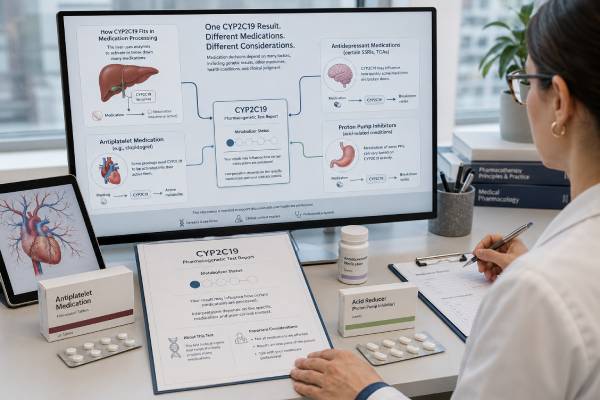
A CYP2C19 genetic test estimates how actively your body makes the CYP2C19 enzyme, which helps process several widely used medicines. The same result can point in opposite directions depending on the drug. Low enzyme activity can reduce activation of clopidogrel, leaving less protection against blood clots, yet it can increase exposure to citalopram, escitalopram, sertraline, and many proton pump inhibitors. High activity may improve clopidogrel activation but clear certain antidepressants or acid-suppressing drugs faster. Results are commonly reported as star alleles, a diplotype, and a metabolizer phenotype such as poor, intermediate, normal, rapid, or ultrarapid. Those labels are useful only when matched to a specific medicine, dose, diagnosis, and treatment goal. A CYP2C19 report does not prove that a drug caused symptoms, predict every response, or replace monitoring. It gives clinicians one durable piece of information for choosing or adjusting therapy more precisely.
- A poor metabolizer has little or no CYP2C19 activity, usually because two no-function alleles were detected.
- A loss-of-function result can weaken clopidogrel, especially after acute coronary syndrome or coronary stent placement.
- The same low-activity result can raise levels of some antidepressants and PPIs, increasing side effects or changing dose needs.
- CYP2C19*17 usually increases activity, but a *2/*17 result is still classified as intermediate because the no-function allele remains important.
- The result usually lasts for life, although interacting drugs, illness, adherence, age, and organ function can change the response seen in practice.
Table of Contents
- Why one CYP2C19 result has different drug effects
- Alleles, phenotypes, and laboratory reports
- Clopidogrel and blood-clot protection
- Antidepressants affected by CYP2C19
- Proton pump inhibitors and acid control
- How other medicines can change the observed phenotype
- Test limits and commercial report issues
- Using CYP2C19 results safely over time
Why one CYP2C19 result has different drug effects
CYP2C19 is a liver enzyme that changes the chemical form of many medications. What that change accomplishes depends on the drug. For some medicines, metabolism turns an inactive compound into an active one. For others, metabolism mainly clears active drug from the body. That difference explains why a single phenotype cannot be labeled simply “good” or “bad.”
Clopidogrel is a prodrug. It must be converted into an active metabolite that blocks platelets from forming clots. A person with reduced CYP2C19 activity forms less active metabolite, so the usual dose may produce weaker platelet inhibition. In this setting, faster activation is generally more favorable than slower activation, although bleeding risk still matters.
Citalopram, escitalopram, sertraline, omeprazole, lansoprazole, and pantoprazole work differently. CYP2C19 helps remove active drug from circulation. Reduced activity can therefore increase exposure, prolong effects, or increase adverse reactions. Rapid activity can lower exposure and sometimes reduce effectiveness. The direction is almost the reverse of clopidogrel.
This drug-specific logic prevents a common error: applying one color-coded category to every medication on a panel. A laboratory may mark a phenotype as “increased risk,” but the actual issue could be too little active clopidogrel, too much antidepressant exposure, or too little acid suppression. Each gene–drug pair needs its own interpretation.
The clinical goal also changes the recommendation. A modest difference in exposure may be acceptable for short-term reflux treatment but more important during eradication treatment for Helicobacter pylori, when strong acid suppression helps antibiotics work. A clopidogrel difference is more urgent after placement of a coronary stent than it may be in a setting where alternative antiplatelet strategies are less clearly established. CYP2C19 information becomes actionable only after the prescriber identifies the exact drug, indication, treatment phase, and competing risks.
Alleles, phenotypes, and laboratory reports
A clinical CYP2C19 report usually lists two star alleles, one inherited from each biological parent. The pair is called a diplotype. The laboratory then translates that diplotype into a predicted metabolizer phenotype.
Common allele categories include:
| Allele or diplotype example | Usual function | Common phenotype interpretation |
|---|---|---|
| *1 | Normal function | Depends on the second allele |
| *2, *3, and several rarer alleles | No function | Reduced activity when one or two copies are present |
| *17 | Increased function | Rapid or ultrarapid activity when paired with *1 or *17 |
| *1/*1 | Two normal-function alleles | Normal metabolizer |
| *1/*2 | One normal and one no-function allele | Intermediate metabolizer |
| *2/*2 | Two no-function alleles | Poor metabolizer |
| *1/*17 | Normal plus increased function | Rapid metabolizer |
| *17/*17 | Two increased-function alleles | Ultrarapid metabolizer |
| *2/*17 | No function plus increased function | Intermediate metabolizer |
The 2/17 example is especially important. Increased function on one chromosome does not reliably cancel a no-function allele on the other. Current translation systems generally classify this combination as intermediate, not normal or rapid.
A “negative” result can be misleading without the test’s allele list. Targeted tests look only for selected variants. If no tested variant is found, the report may infer *1, even though an untested rare allele could be present. Broader assays can detect more variants, but laboratories may still differ in allele coverage and interpretation. Testing that includes common no-function alleles across diverse ancestry groups reduces the chance of misclassification.
The phenotype predicts enzyme activity, not a measured blood concentration. It does not show whether the patient took the medicine, whether absorption was normal, or whether another drug inhibited the enzyme. For antidepressants and PPIs, therapeutic drug monitoring or clinical response can sometimes add information. For clopidogrel, platelet-function testing measures a different endpoint: how strongly platelets remain reactive during therapy.
Results from blood, saliva, or a cheek swab should agree because CYP2C19 is inherited. Repeat testing is usually unnecessary unless the first assay had limited coverage, the result is internally inconsistent, or updated technology is needed to resolve an uncertain allele.
Clopidogrel and blood-clot protection
Clopidogrel, sold under the brand name Plavix and as generics, reduces platelet activation. It is used after acute coronary syndrome, percutaneous coronary intervention, coronary stent placement, some strokes or transient ischemic attacks, and in selected peripheral artery disease settings. Because CYP2C19 helps activate clopidogrel, intermediate and poor metabolizers can have less active metabolite and higher residual platelet reactivity.
The clearest genotype-guided recommendations apply to acute coronary syndrome and coronary intervention. For a CYP2C19 intermediate or poor metabolizer, clinical guidelines generally favor an alternative P2Y12 inhibitor that does not depend substantially on CYP2C19, when that alternative is suitable. Ticagrelor and prasugrel are common options, but they are not interchangeable for every patient. Prasugrel should not be used in someone with a history of stroke or transient ischemic attack, and both alternatives can increase bleeding or have other contraindications and tolerability concerns.
Normal, rapid, and ultrarapid metabolizers can generally receive the standard clopidogrel regimen when clopidogrel is otherwise appropriate. A *17 allele should not be used alone to justify a higher dose or to assume that bleeding will occur. Clinical bleeding risk depends on age, body size, kidney function, other antithrombotic drugs, procedure timing, and prior bleeding, not just CYP2C19.
Evidence and recommendations are less uniform outside coronary intervention. Stroke and neurovascular practice involves different disease mechanisms, treatment windows, and alternative-drug evidence. A result that clearly changes therapy after coronary stenting may require more individualized interpretation after a stroke. The dedicated CYP2C19 clopidogrel test guide explains those setting-specific tradeoffs in greater detail.
Genotype is also not the only reason clopidogrel can underperform. Missed doses, poor absorption, drug interactions, high platelet turnover, diabetes, inflammation, and other genetic factors can contribute. Conversely, a loss-of-function genotype does not prove that a clotting event was caused by clopidogrel failure. It raises the probability of reduced activation and helps guide future treatment; it does not reconstruct a single event with certainty.
Patients should never stop clopidogrel or switch antiplatelet drugs on their own. Abrupt interruption soon after stent placement can cause a dangerous stent clot. Any change needs coordination with the clinician managing the stent, heart attack, stroke, or vascular disease.
Antidepressants affected by CYP2C19
CYP2C19 has its strongest antidepressant guidance for citalopram, escitalopram, and sertraline. These medicines are active when swallowed, and CYP2C19 contributes to their clearance. Reduced activity tends to increase exposure; rapid activity tends to lower exposure. The result can influence starting dose, titration, side-effect risk, or choice of another antidepressant.
Citalopram and escitalopram
Poor metabolizers may have higher concentrations and a greater chance of adverse effects. For citalopram, this is especially relevant because higher exposure can lengthen the heart’s QT interval and increase the risk of an abnormal rhythm in susceptible people. A common guideline approach is to choose an antidepressant less dependent on CYP2C19 or begin at about half the usual starting dose, titrate more slowly, and use a lower maintenance dose. The FDA limits citalopram to 20 mg per day in CYP2C19 poor metabolizers.
Intermediate metabolizers may also have higher exposure, but recommendations are usually less drastic. A standard starting dose may be reasonable with slower titration and closer attention to nausea, sleep changes, sexual side effects, agitation, tremor, or QT-related risk factors. Rapid and ultrarapid metabolizers may clear citalopram or escitalopram faster. If treatment fails despite adequate dose, duration, and adherence, an alternative not predominantly metabolized by CYP2C19 may be preferable to repeatedly increasing the dose.
Sertraline
Poor metabolizers can also have increased sertraline exposure. Guidelines commonly advise considering a lower starting dose, slower titration, a roughly 50% lower maintenance dose, or another antidepressant. Intermediate metabolizers may need slower titration or a reduced maintenance dose if adverse effects emerge. For rapid and ultrarapid metabolizers, evidence does not support an automatic dose increase; standard dosing with clinical monitoring is generally used.
CYP2C19 does not explain every antidepressant response. Depression and anxiety outcomes are influenced by diagnosis, dose, duration, adherence, other medicines, sleep, substance use, psychosocial stress, and genes beyond CYP2C19. A favorable genotype cannot guarantee remission, while a nonstandard phenotype does not mean the drug will fail. Many people tolerate and benefit from a medication despite a predicted exposure difference.
Commercial psychiatric panels may include SLC6A4, HTR2A, CYP2D6, CYP2B6, and other genes. Their evidence and recommendations are not equivalent. CYP2C19 guidance for selected antidepressants is drug-specific and guideline based; it should not be expanded into claims about which antidepressant will “match” a person’s personality or brain chemistry. The CYP2D6 and CYP2C19 antidepressant test guide covers the two major metabolic pathways together.
Medication changes should also account for discontinuation symptoms. Citalopram, escitalopram, and sertraline are usually tapered rather than stopped suddenly. Genotype may influence the next prescribing choice, but it does not remove the need for a safe transition plan.
Proton pump inhibitors and acid control
Proton pump inhibitors, or PPIs, reduce stomach-acid production. CYP2C19 affects omeprazole, lansoprazole, pantoprazole, and dexlansoprazole to varying degrees. Esomeprazole is also influenced, while rabeprazole relies less heavily on CYP2C19. The clinical effect depends on whether treatment is short or chronic and whether the goal is symptom relief, healing erosive disease, preventing bleeding, or supporting H. pylori eradication.
Rapid and ultrarapid metabolizers may clear some PPIs quickly, producing less sustained acid suppression. When standard therapy does not work, a clinician may increase the dose, divide dosing, or choose a PPI less affected by CYP2C19. More intensive therapy can be particularly important during H. pylori treatment or erosive esophagitis, where inadequate acid control can reduce the chance of success.
Normal metabolizers usually begin with standard dosing. Intermediate and poor metabolizers tend to have greater PPI exposure and stronger acid suppression at the same dose. During a short course, that may improve effectiveness without requiring any change. For chronic therapy lasting more than about 12 weeks, once symptoms and healing are controlled, guidelines support considering a lower daily dose in intermediate or poor metabolizers. The aim is not to withhold needed treatment but to use the lowest effective long-term dose.
Genotype should not distract from basic PPI use. Many products work best when taken 30 to 60 minutes before a meal, usually breakfast, because active proton pumps are then available for inhibition. Poor timing and inconsistent dosing can mimic rapid metabolism. Persistent symptoms may also reflect a nonacid cause, functional heartburn, bile reflux, eosinophilic esophagitis, delayed gastric emptying, or an incorrect diagnosis.
The benefit of reducing long-term exposure must be balanced against the indication. A person with severe erosive disease, Barrett esophagus, recurrent ulcer bleeding, or ongoing high-risk anti-inflammatory therapy may need continued suppression regardless of phenotype. On the other hand, a poor metabolizer taking a high dose indefinitely for mild symptoms may be a good candidate for reassessment and step-down treatment.
PPIs can also interact with clopidogrel. Omeprazole and esomeprazole inhibit CYP2C19 and can reduce formation of clopidogrel’s active metabolite. When a patient needs both acid protection and clopidogrel, clinicians often select an acid-suppressing strategy with less CYP2C19 inhibition, while considering the reason for gastroprotection and the patient’s bleeding risk.
How other medicines can change the observed phenotype
Genotype predicts the enzyme a person can make, but other medicines can suppress or increase actual enzyme activity. When the observed drug response resembles a different genetic phenotype, the change is called phenoconversion.
CYP2C19 inhibitors can make a normal or rapid metabolizer function more like an intermediate or poor metabolizer for a period of time. Examples include fluvoxamine and fluconazole; omeprazole and esomeprazole can also inhibit CYP2C19. This may increase exposure to CYP2C19-cleared medicines while reducing activation of clopidogrel. The size of the effect depends on inhibitor strength, dose, timing, and the other pathways available to clear the drug.
Inducers can increase enzyme production and lower concentrations of some CYP2C19 substrates. Rifampin is a strong example, while certain antiseizure medicines can induce multiple metabolic pathways. Induction develops over days and may persist after the inducer is stopped. A previously effective antidepressant or PPI may appear to fail even though the inherited CYP2C19 result has not changed.
Several other factors can blur genotype predictions:
- Liver disease can reduce metabolism across several enzymes.
- Older age, frailty, kidney disease, and inflammation can alter drug exposure or sensitivity.
- Smoking has a much larger effect on CYP1A2 than CYP2C19, so it should not be assumed to explain every cytochrome P450 result.
- Adherence, dose timing, and absorption often have a larger immediate effect than genotype.
- Drugs may use several pathways, so another enzyme can partly compensate for CYP2C19 differences.
A medication review is therefore part of every useful interpretation. The review should include prescriptions, over-the-counter acid reducers, antifungals, seizure medicines, supplements, and recent medication changes. A report generated years earlier remains genetically valid, but its medication recommendations must be recalculated against the current regimen.
Test limits and commercial report issues
CYP2C19 testing is most reliable when the laboratory clearly states which alleles it examined, how diplotypes were translated, and which professional guideline supports each drug recommendation. A polished report can still be incomplete or inconsistent.
Studies comparing commercial pharmacogenetic reports have found differences in both genotype-to-phenotype translation and medication advice. Two laboratories can receive the same underlying allele result yet assign different colors or recommendations. Proprietary “traffic light” systems may combine genetic evidence with drug interactions, product labeling, and vendor rules without showing how each component was weighted.
Before acting on a result, check these details:
- Was the test performed in a clinical laboratory? Direct-to-consumer raw data may not cover all relevant variants and may need confirmation.
- Which alleles were included? A limited panel can miss uncommon no-function variants, especially across diverse ancestry groups.
- What is the actual diplotype? The star-allele pair is more durable than a vendor’s color category.
- Which phenotype translation was used? Updated consensus tables may change how certain combinations are classified.
- Is the recommendation tied to the exact drug and indication? Advice for clopidogrel after coronary stenting should not be generalized to every antiplatelet setting.
- Were drug interactions considered? Genotype alone cannot capture inhibition or induction.
CYP2C19 testing also has no universal “normal range.” It is not a blood test reported in units. A normal metabolizer result means the diplotype predicts typical enzyme activity relative to the reference population; it does not mean every drug level will fall in range. Poor and ultrarapid are phenotype categories, not diagnoses or diseases.
The test does not determine whether someone has depression, reflux, ulcers, coronary disease, or a clotting disorder. It does not measure platelet function, stomach acid, electrocardiogram intervals, or antidepressant blood levels. Those questions require clinical evaluation or separate tests.
An uncertain or unusual result may warrant review by a pharmacist, clinical pharmacologist, genetic counselor familiar with pharmacogenetics, or the testing laboratory. Reanalysis can be useful when allele definitions or guideline translations have changed, but patients should not assume that every updated commercial report reflects stronger evidence.
Using CYP2C19 results safely over time
A CYP2C19 result is most valuable when it follows the patient rather than remaining buried in a one-time report. Keep the complete document, including the gene, star alleles, phenotype, test method, date, and laboratory. Add the result to the medication record and share it during hospital admission, cardiac procedures, psychiatric treatment, and long-term acid-suppression reviews.
When a CYP2C19-affected drug is prescribed, a useful discussion covers five questions:
- What is the exact diplotype and predicted phenotype?
- Does a current guideline give a recommendation for this specific drug and indication?
- Are inhibitors, inducers, organ dysfunction, or adherence likely to change the expected effect?
- What clinical outcome will be monitored, and over what timeframe?
- Is changing the dose safer than choosing a different medicine?
For clopidogrel, the immediate concern may be preventing stent thrombosis without causing major bleeding. For an antidepressant, monitoring may include symptom improvement, activation, nausea, sleep, sexual effects, suicidality, and QT risk over several weeks. For a PPI, the outcome may be symptom relief, healing, prevention of bleeding, or successful H. pylori eradication.
Family members can share CYP2C19 alleles, but relatives do not need testing merely because one person has a poor or rapid phenotype. Testing is most relevant when a relative is likely to use an affected medication or when a clinician is choosing among treatments. The result predicts drug metabolism, not inherited heart disease, depression, or ulcer risk.
Do not change a prescription from a report alone. The safest action may be an alternative drug, a lower starting dose, slower titration, closer monitoring, or no change at all. The decision depends on the medicine’s purpose, the strength of the gene–drug evidence, the patient’s current response, and the risks of switching. Used this way, CYP2C19 testing can reduce avoidable trial and error without pretending to replace clinical judgment.
References
- Clinical Pharmacogenetics Implementation Consortium Guideline for CYP2C19 Genotype and Clopidogrel Therapy: 2022 Update 2022 (Guideline)
- Clinical Pharmacogenetics Implementation Consortium (CPIC) Guideline for CYP2D6, CYP2C19, CYP2B6, SLC6A4, and HTR2A Genotypes and Serotonin Reuptake Inhibitor Antidepressants 2023 (Guideline)
- Clinical Pharmacogenetics Implementation Consortium (CPIC) Guideline for CYP2C19 and Proton Pump Inhibitor Dosing 2021 (Guideline)
- CELEXA (citalopram) tablets, for oral use 2024 (Official Label)
- Comparing commercial pharmacogenetic testing results and recommendations for antidepressants with established CPIC guidelines 2024 (Review)
- International Consensus Statement on Platelet Function and Genetic Testing in Percutaneous Coronary Intervention: 2024 Update 2024 (Position Statement)
Disclaimer
CYP2C19 results must be interpreted with the exact medication, diagnosis, other drugs, and current clinical guidelines. Do not stop clopidogrel, an antidepressant, a proton pump inhibitor, or any other prescribed medicine based only on a genetic report. A qualified clinician or pharmacist should direct dose changes and monitor effectiveness and adverse effects.