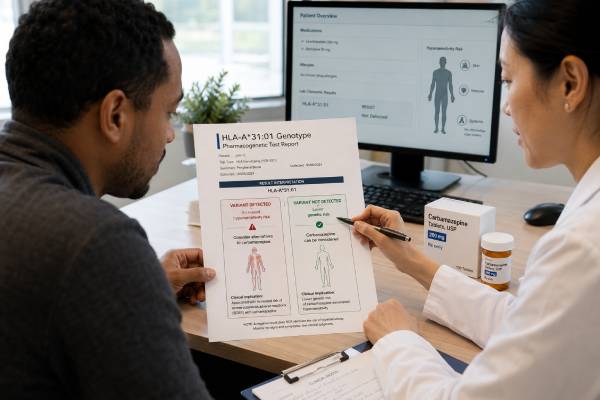
An HLA-A31:01 genetic test estimates whether a person has a higher-than-average risk of immune-mediated hypersensitivity from carbamazepine. The allele is associated with several reaction patterns, ranging from a widespread maculopapular rash to drug reaction with eosinophilia and systemic symptoms, also called DRESS, and in some populations Stevens–Johnson syndrome or toxic epidermal necrolysis. A positive result does not mean a reaction is certain, and a negative result does not make carbamazepine risk-free. Its main value is before the first dose, when a prescriber can compare carbamazepine with effective alternatives. Interpretation must also consider HLA-B15:02, which is a separate marker with a particularly strong relationship to carbamazepine-associated SJS/TEN in susceptible ancestry groups. Testing is not a substitute for prompt recognition of fever, facial swelling, rash, mouth sores, blistering, or organ symptoms. This article explains what HLA-A*31:01 means, who may be tested, how prescribing decisions change, and how to understand positive, negative, and inconclusive results.
- HLA-A*31:01 is a risk marker for multiple carbamazepine hypersensitivity phenotypes, not a diagnosis by itself.
- Testing is most useful before carbamazepine is started.
- A positive patient who is carbamazepine-naive is usually offered another suitable medicine when one exists.
- HLA-A31:01 and HLA-B15:02 answer different but overlapping safety questions.
- A negative result lowers genetic risk but cannot exclude every serious skin or systemic reaction.
- Any new rash with fever, mucosal pain, facial swelling, or illness after starting carbamazepine needs urgent assessment.
Table of Contents
- The role of HLA-A*31:01 in carbamazepine hypersensitivity
- Reaction patterns the test is intended to prevent
- When testing is considered
- What a positive result means
- Negative, indeterminate, and unexpected results
- How results affect prescribing decisions
- Test process, accuracy, and limitations
- Safety plan after testing or treatment begins
The role of HLA-A*31:01 in carbamazepine hypersensitivity
Human leukocyte antigen proteins help the immune system distinguish the body’s own cells from potentially harmful material. HLA-A is one of the highly variable genes that encode these antigen-presenting proteins. HLA-A*31:01 is a specific allele, or version, of the HLA-A gene. In some people, carbamazepine or a carbamazepine-related antigen appears to be presented in a way that activates drug-specific T cells. The resulting immune response can injure skin and, in more systemic reactions, internal organs.
HLA-A*31:01 has been associated with carbamazepine-induced maculopapular exanthema, DRESS or hypersensitivity syndrome, and SJS/TEN. The strength of association differs by phenotype and population. The allele is found in several ancestry groups, including people with European, Japanese, Korean, Latin American, and some Indigenous American ancestry. Frequency estimates vary, and mixed ancestry is common. Testing decisions should therefore not rely only on appearance or a broad racial label.
The result is usually reported simply as positive or negative. Positive means at least one copy of HLA-A31:01 was detected. Because one copy is enough to increase risk, laboratories generally do not create intermediate metabolizer-style categories. Negative means the allele was not detected by the method used. High-resolution HLA typing may report both HLA-A alleles, while a focused pharmacogenetic assay may report only whether HLA-A31:01 is present.
HLA-A31:01 should not be confused with HLA-B15:02. HLA-B15:02 is most strongly linked to carbamazepine-induced SJS/TEN and is especially relevant in people with ancestry from parts of East, South, and Southeast Asia. HLA-A31:01 has a broader relationship with carbamazepine hypersensitivity phenotypes and a different geographic distribution. Some patients need both results before treatment. One negative marker cannot stand in for the other.
The marker has high clinical usefulness because the event being prevented may be severe and alternatives often exist. Nevertheless, its positive predictive value is limited: many carriers can take carbamazepine without developing hypersensitivity. The test identifies increased susceptibility, not destiny. The prescribing decision balances that increased risk against the reason carbamazepine is being considered, the effectiveness and safety of alternatives, prior treatment history, and how closely a patient can be monitored.
Reaction patterns the test is intended to prevent
Carbamazepine hypersensitivity is not one uniform condition. A maculopapular exanthema usually presents as a widespread red, measles-like eruption. It may be itchy and can occur with or without mild systemic symptoms. Although many uncomplicated rashes resolve after the medicine is stopped, a new eruption cannot safely be assumed to be minor at first. Early severe cutaneous adverse reactions can initially resemble a routine drug rash.
DRESS is a delayed, potentially life-threatening reaction involving skin and internal organs. Features can include fever, extensive rash, facial edema, swollen lymph nodes, eosinophilia or other blood-count abnormalities, and inflammation of the liver, kidneys, lungs, heart, or other organs. Symptoms often develop two to eight weeks after a drug is started, but timing is variable. The illness may continue or flare after carbamazepine is withdrawn because immune activation does not stop immediately when the last dose is taken.
SJS and TEN are characterized by painful skin, blistering or detachment, and injury to mucous membranes such as the mouth, eyes, or genitals. Fever and flu-like symptoms may precede visible skin loss. SJS and TEN are medical emergencies requiring immediate drug withdrawal and hospital-level care. HLA-A31:01 is not as population-specific or as strongly predictive of carbamazepine SJS/TEN as HLA-B15:02, but it is included in the broader HLA-A*31:01 hypersensitivity association.
Warning signs should be explained before the first dose. Urgent same-day evaluation is appropriate for a new rash accompanied by fever, facial swelling, swollen glands, mouth ulcers, eye pain, genital soreness, blistering, skin tenderness, purple spots, jaundice, dark urine, breathing difficulty, or marked malaise. Patients should not take another dose while waiting for routine advice when a severe reaction is suspected. Emergency clinicians need the exact drug name, start date, last dose, and a complete list of other recently introduced medicines.
HLA testing cannot tell whether an active rash is DRESS or SJS/TEN. It can support causality, but a negative result must never delay treatment. The immediate priorities are stopping the suspected drug when clinically appropriate, assessing organ involvement, providing supportive care, and documenting the reaction accurately. Genetic testing is primarily preventive; emergency management depends on symptoms, not on waiting for a genotype.
When testing is considered
The ideal time to test is before a carbamazepine-naive patient receives the first dose. Pre-treatment testing creates an opportunity to choose a different antiseizure medicine, mood stabilizer, or neuralgia treatment without exposing the patient. The result can be particularly valuable when carbamazepine is one of several reasonable options and when treatment can wait for laboratory turnaround.
A clinician may consider HLA-A31:01 testing for any patient before carbamazepine, especially where guidelines, local policy, the product label, or ancestry-associated prevalence support it. Unlike HLA-B15:02 screening, which is often targeted strongly toward certain Asian ancestry groups, HLA-A*31:01 has clinically relevant distribution across several populations. A detailed family ancestry can inform the discussion, but uncertainty about ancestry should not be used to dismiss testing when the result would change prescribing.
Testing can also be ordered through a preemptive pharmacogenetic panel before a drug is needed. A stored result may shorten future treatment decisions, provided the assay is clinically validated and the result is visible in the health record. Broad panels require careful interpretation because an allele found incidentally should not be applied to unrelated medications without evidence. The principles in a general pharmacogenetic medication-response test apply: each gene–drug pair needs its own guideline.
Testing after carbamazepine has already been tolerated requires context. Most immunologically mediated cutaneous reactions occur within the first weeks to three months of continuous treatment. A patient who has taken carbamazepine consistently for longer than three months without a reaction has already provided clinically meaningful tolerance information. Guidelines allow cautious consideration of continued use in an HLA-A*31:01-positive patient with established tolerance. This does not make late reactions impossible, and it does not justify an unsupervised restart after a long interruption.
The start date and continuity of exposure matter. A person who filled a prescription months ago but took only a few doses is not equivalent to someone with three months of uninterrupted treatment. Re-exposure after discontinuation may carry a different risk, especially if a previous rash or unexplained fever occurred. The prescriber should reconstruct the timeline before relying on “prior tolerance.”
Testing may be less useful when carbamazepine must be stopped regardless of genotype because the patient has already had a convincing hypersensitivity reaction. In that setting, the allele may contribute to causality assessment or family research, but a negative result does not authorize rechallenge. Conversely, a positive result discovered after a severe reaction should be documented permanently, along with the clinical diagnosis and culprit drug.
What a positive result means
A positive result means that HLA-A*31:01 was detected in one or both copies of HLA-A. One copy is sufficient to be categorized as positive. The result indicates a higher risk of carbamazepine hypersensitivity than in a person without the allele, including increased risk of DRESS, maculopapular eruption, and possibly SJS/TEN depending on the population studied. It does not show that the immune system is currently reacting and does not estimate the exact probability for one individual.
For a patient who has never taken carbamazepine, clinical pharmacogenetic guidance generally recommends avoiding carbamazepine when a suitable alternative is available. If no acceptable alternative exists, the potential benefit must clearly outweigh the increased risk. That decision should be made by the prescribing specialist with informed patient participation. Simply lowering the starting dose has not been shown to remove the HLA-mediated risk.
The alternative must be selected thoughtfully. Oxcarbazepine is chemically related to carbamazepine, but evidence for HLA-A31:01 and oxcarbazepine is less definitive than for carbamazepine. Other aromatic antiseizure medicines can also cause severe cutaneous reactions through different genetic and non-genetic mechanisms. A positive HLA-A31:01 result is not a universal prohibition against every antiseizure medicine, yet choosing a replacement solely because it “looks different” on a list is unsafe. The treatment indication, prior drug reactions, HLA-B*15:02 status, comorbidities, pregnancy considerations, interactions, and seizure type all matter.
For an established carbamazepine user who has taken the medicine continuously for more than three months without a cutaneous reaction, a positive result does not automatically require abrupt discontinuation. Stopping carbamazepine suddenly can provoke seizures or destabilize a psychiatric condition. The prescriber may cautiously continue treatment after reviewing the exposure history and warning signs. The result should still be documented for future restarts and for any change in therapy.
A positive result has limited implications outside carbamazepine. It is not a diagnosis of an immune disorder and does not imply that the person will react to antibiotics, foods, vaccines, or all HLA-associated medicines. Drug–HLA associations are specific. The allele should be entered in the medical record as “HLA-A*31:01 positive—higher carbamazepine hypersensitivity risk,” not as a vague allergy to all anticonvulsants.
Negative, indeterminate, and unexpected results
A negative HLA-A31:01 result means the laboratory did not detect that allele. It reduces the portion of carbamazepine hypersensitivity risk attributable to HLA-A31:01, but it does not mean “no risk.” Patients without the allele can still develop ordinary rashes, DRESS, SJS/TEN, liver injury, blood dyscrasias, hyponatremia, drug interactions, or other adverse effects. Clinical monitoring and patient education remain necessary.
HLA-B15:02 status must be considered separately. A patient can be negative for HLA-A31:01 and positive for HLA-B15:02. If ancestry or local practice indicates HLA-B15:02 testing, the absence of HLA-A*31:01 cannot justify carbamazepine before the second result is known. Some high-resolution reports list both alleles; focused assays may not.
An indeterminate or no-call result means the laboratory could not make a reliable assignment. Reasons include inadequate DNA, sample contamination, uncommon allele patterns, assay interference, or insufficient resolution. The safest response is usually repeat collection or confirmation with a different validated method, not treating the result as negative. When treatment is urgent, the clinician should choose an interim therapy that does not depend on the unresolved result if possible.
Occasionally, a broad HLA report uses unfamiliar nomenclature. HLA alleles contain gene names, asterisks, and colon-separated fields. HLA-A31:01 is not identical to every allele beginning with HLA-A31. A laboratory may report a lower-resolution HLA-A*31 group that cannot establish the exact *31:01 allele. The laboratory should clarify whether the reported resolution is adequate for the drug association.
A negative test obtained after a previous convincing carbamazepine reaction does not erase the clinical allergy. The reaction may have been mediated by another genetic factor, a non-HLA mechanism, or another drug. Rechallenge can produce a faster and more severe response. The medical record should preserve both the laboratory result and the reaction history rather than allowing one to overwrite the other.
How results affect prescribing decisions
The prescribing pathway begins with the indication. Carbamazepine may be used for focal seizures, trigeminal neuralgia, and selected psychiatric conditions, but alternatives differ for each. The clinician first asks whether carbamazepine has a special expected benefit. The HLA result then modifies the safety side of that decision rather than choosing a replacement automatically.
For a carbamazepine-naive HLA-A*31:01-positive patient, avoid carbamazepine when an effective alternative can reasonably be used. This recommendation reflects the availability of other treatments and the potential severity of hypersensitivity. If carbamazepine is uniquely appropriate, informed consent should cover the increased risk, uncertainty of individual prediction, early symptom recognition, and the need to stop and seek care if warning signs occur. A specialist may define extra follow-up, but monitoring cannot guarantee prevention.
For an HLA-A31:01-negative and HLA-B15:02-negative patient, standard prescribing may proceed if carbamazepine is otherwise appropriate. “Standard” still includes baseline and follow-up measures required for carbamazepine, such as blood counts, liver function, sodium, pregnancy considerations, interactions, and serum concentrations when indicated. Genetic testing addresses only a fraction of carbamazepine safety.
When HLA-B15:02 is positive, carbamazepine avoidance is generally stronger because of the marked SJS/TEN association. The HLA-A31:01 result does not dilute that recommendation. Conversely, a positive HLA-A31:01 result remains clinically relevant when HLA-B15:02 is negative because it captures a broader range of hypersensitivity phenotypes.
Prior tolerance changes the conversation but must be verified. Continuous use beyond three months without a rash makes a new early-onset HLA-associated reaction less likely. A prescriber may continue carbamazepine cautiously, especially if it is controlling a serious condition. Abrupt cessation should be avoided unless a reaction is suspected or another urgent safety issue exists. If treatment was interrupted, the restart decision should be reviewed rather than assuming the previous low-risk period continues indefinitely.
Patients should receive the result in plain language. A useful statement is: “You carry HLA-A*31:01, which increases the chance of carbamazepine hypersensitivity; ask the prescriber to review alternatives before any new or restarted carbamazepine.” This is more accurate than “allergic to carbamazepine” in a person never exposed, while still communicating the importance of avoidance.
Test process, accuracy, and limitations
Testing typically uses a blood sample, saliva, or a cheek swab. Fasting is not required. The sample is analyzed with allele-specific genotyping, sequencing, or HLA typing technology. Turnaround may range from a few days to several weeks, so the order should be placed early enough to affect treatment. An urgent clinical problem may require a temporary alternative while results are pending.
The report should identify the method, resolution, allele detected or not detected, and limitations. Direct typing of HLA-A*31:01 is preferable for clinical decisions. Some platforms infer HLA alleles from nearby DNA markers. Imputation can work well in a population represented by the reference data but less well in people with different or mixed ancestry. A proxy result may need direct confirmation.
Preanalytic errors are possible. Incorrect labeling, insufficient DNA, a recent allogeneic stem-cell transplant, or testing blood after donor marrow engraftment can produce a result that does not represent the patient’s original genotype. Patients with a transplant history should alert the laboratory; a non-blood source may be needed. Blood transfusion generally does not permanently change germline DNA testing, but unusual sample circumstances should still be disclosed.
The allele frequency and the background rate of hypersensitivity influence predictive values. Even a strong relative association may have a modest positive predictive value when the reaction is uncommon. Many positive patients will not react, while a small number of negative patients will. This is why the test supports risk reduction rather than certifying safety or inevitability.
Testing has narrower scope than many commercial panel descriptions suggest. It does not determine the correct carbamazepine dose, forecast efficacy, diagnose a previous rash, or assess all severe cutaneous adverse reaction genes. It should not be used to reassure a patient who is already developing symptoms. The result also does not replace HLA-B*15:02 testing when that marker is clinically indicated.
Interpretation can evolve. New studies may refine the risk in specific populations, update recommendations for related drugs, or clarify lower-resolution allele groups. A report that is many years old remains genetically valid, but its clinical annotation may need review. Keeping the original laboratory document allows a pharmacist, geneticist, or prescribing specialist to reinterpret it using current guidance.
Safety plan after testing or treatment begins
After testing, the result should be entered in the prescribing record with the exact allele name and laboratory date. Positive patients should also keep a copy accessible outside a single clinic. A pharmacogenetic result is lifelong, but health systems do not always exchange structured data. A wallet card, patient portal copy, or verified digital record can prevent repeat testing and accidental exposure.
A person who is positive and has not used carbamazepine should not start leftover tablets or accept a prescription from another clinician without disclosing the result. The prescriber should select a condition-appropriate alternative. If carbamazepine is chosen because alternatives are unsuitable, treatment should begin only with a documented plan for symptom education and rapid access to medical care.
A person who is negative should still receive standard counseling. Most serious cutaneous reactions develop early, often within the first several weeks, so vigilance is highest after initiation and dose changes. Patients should examine symptoms rather than trying to interpret every minor skin sensation. Fever, spreading rash, mucosal involvement, facial swelling, skin pain, blistering, or signs of liver or kidney injury warrant urgent contact.
When a reaction is suspected, carbamazepine should not be restarted unless a specialist has determined that the original event was unrelated and that rechallenge is justified. After confirmed SJS/TEN or DRESS, re-exposure is generally contraindicated. The allergy record should name carbamazepine and describe the phenotype and date. A generic entry such as “side effect” is not enough for future clinicians to understand the severity.
Alternative medicines also need independent safety review. Some aromatic antiseizure drugs share structural or immunologic features, and HLA-B15:02 can influence choices among carbamazepine, oxcarbazepine, phenytoin, and related agents. The HLA-A31:01 result alone does not define cross-reactivity. Neurology, psychiatry, pain medicine, pharmacy, dermatology, or allergy specialists may collaborate when treatment options are limited.
The most useful final plan combines four elements: the exact genotype, the patient’s prior exposure history, the selected drug strategy, and a clearly written emergency response. Understanding HLA testing for medication hypersensitivity can help patients recognize why one HLA result should be applied to one evidence-supported drug association. With that specificity, HLA-A*31:01 testing can reduce avoidable harm without turning a risk marker into an overly broad medication ban.
References
- Carbamazepine Therapy and HLA Genotype 2025 (Clinical pharmacogenetics review)
- Carbamazepine cutaneous adverse reactions and HLA genotypes in Southern Han Chinese 2023 (Association study)
- Associations of HLA genetic variants with carbamazepine-induced cutaneous adverse drug reactions: A systematic review and meta-analysis 2022 (Systematic review and meta-analysis)
- Dutch Pharmacogenetics Working Group (DPWG) guideline for the gene–drug interaction of HLA and anti-epileptic drugs 2024 (Clinical guideline)
- Association of HLA-A*31:01 Screening With the Incidence of Carbamazepine-Induced Cutaneous Adverse Reactions in a Japanese Population 2018 (Prospective implementation study)
- Clinical Pharmacogenetics Implementation Consortium Guideline for HLA Genotype and Use of Carbamazepine and Oxcarbazepine: 2017 Update 2018 (Clinical guideline)
Disclaimer
This article provides general education and is not a substitute for individual medical advice. Do not start, stop, or restart carbamazepine based only on an online explanation; a qualified prescriber must interpret the full HLA report, treatment history, and clinical need. Seek urgent medical care for rash with fever, mucosal sores, facial swelling, blistering, skin pain, or systemic illness.