
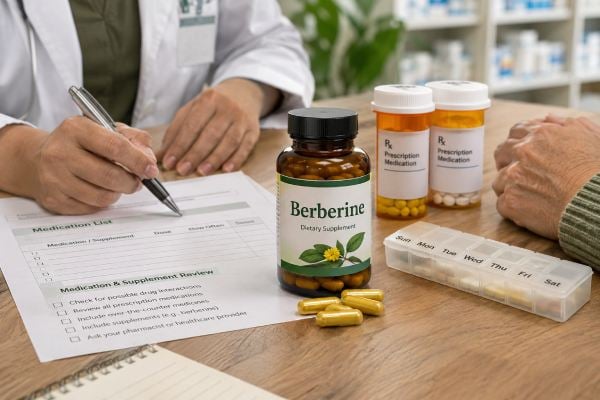
Berberine can modestly lower LDL cholesterol and triglycerides in some adults, but it is not a proven replacement for statins or other prescription cholesterol medicines. Meta-analyses of randomized trials generally show LDL reductions in the range of about 10–20 mg/dL on average, with triglyceride reductions that may be larger. The response varies, and the evidence is much stronger for short-term laboratory changes than for preventing heart attacks or strokes.
Most trials use around 900–1,500 mg of berberine per day, often split into two or three doses. Gastrointestinal side effects are common, and drug interactions deserve more attention than many supplement labels suggest. Berberine can affect CYP450 enzymes and transport proteins involved in medication metabolism. That matters if you take anticoagulants, diabetes drugs, transplant medicines, or other prescriptions with narrow safety margins. If you are considering berberine, the safest approach is to review the exact product and your medication list with a pharmacist or clinician before starting.
Table of Contents
- How Well Berberine Lowers Cholesterol
- How Berberine May Work
- Berberine Dosage and How to Take It
- Important Drug Interactions
- Side Effects and Who Should Avoid It
- Berberine vs Proven Cholesterol Treatments
- How to Use Berberine More Safely
How Well Berberine Lowers Cholesterol
The best current evidence suggests a modest LDL-lowering effect. A meta-analysis of placebo-controlled trials using roughly 900–1,500 mg/day found an average LDL reduction of about 0.5 mmol/L, or 18 mg/dL, and a triglyceride reduction of about 0.3 mmol/L, or 30 mg/dL. Other meta-analyses report smaller LDL reductions, which shows how much results depend on the included studies.
Berberine also may lower total cholesterol and ApoB and raise HDL slightly. These changes are potentially useful, but they are not in the same evidence category as statin therapy. Statins have large cardiovascular outcome trials showing fewer heart attacks and strokes. Berberine does not have comparable long-term outcome evidence.
The supplement may be more appealing to people with mild dyslipidemia or those looking for an adjunct. It is less appropriate as a stand-alone strategy for someone with very high LDL, familial hypercholesterolemia, or established cardiovascular disease.
If you need to understand whether your LDL level is mildly or severely elevated, cholesterol ranges and targets can help frame the numbers before deciding what kind of intervention is strong enough.
How Berberine May Work
Berberine appears to influence several pathways involved in lipid metabolism. Experimental work suggests it may increase LDL receptor activity and affect PCSK9, the protein that helps regulate LDL receptor recycling. It may also influence AMPK signaling, liver lipid synthesis, bile-acid metabolism, and the gut microbiome.
These multiple mechanisms make berberine biologically interesting, but mechanistic evidence should not be confused with proof of clinical outcomes. A compound can lower LDL without necessarily showing that it prevents cardiovascular events to the same degree as a proven drug.
Another complication is bioavailability. Berberine is not absorbed efficiently, and different formulations may produce different blood levels. Two products labeled “500 mg berberine” are not necessarily pharmacologically identical if excipients, formulation, and manufacturing quality differ.
This variability is one reason to choose a transparent, third-party-tested product if you use it at all. It is also a reason not to compare supplement doses too literally with prescription-drug doses. The number of milligrams alone does not tell the full story.
Berberine Dosage and How to Take It
Most cholesterol trials use 900–1,500 mg per day. A common schedule is 500 mg two or three times daily, often with meals. Dividing the dose can improve tolerability because gastrointestinal effects become more likely when a large amount is taken at once.
There is no universally established “best” dose for cholesterol, and more is not necessarily better. Dose-response research suggests useful effects around 1 g/day for some lipid outcomes, but the certainty is limited and trial protocols vary.
If a clinician agrees that a trial is reasonable, set a defined monitoring period. Use the same product and dose for about 8–12 weeks, avoid starting several new supplements at once, and then repeat your lipid panel. That makes it easier to determine whether the change is meaningful.
Do not treat a supplement label as individualized medical advice. Older adults, people with liver or kidney disease, and those taking multiple prescriptions may need more conservative use or may be better off avoiding berberine entirely.
If you are hoping to avoid medication, review evidence-based ways to lower cholesterol without medication first. Food, weight management, and exercise have broader benefits and fewer interaction concerns.
Important Drug Interactions
Berberine can affect multiple cytochrome P450 enzymes, including CYP3A4/5, CYP2D6, CYP2C9, and others. It can also influence P-glycoprotein and other transporters. These systems help determine how quickly the body absorbs, metabolizes, and clears many medications.
The practical concern is that berberine could increase or decrease drug exposure. The exact effect varies by medication and cannot be summarized as a simple “safe” or “unsafe” list.
Use extra caution with:
- Anticoagulants and antiplatelet drugs, where altered exposure could affect bleeding or clotting risk.
- Diabetes medicines, because berberine can lower glucose and may add to medication effects.
- Cyclosporine, tacrolimus, and other transplant drugs, which have narrow therapeutic windows.
- Medications metabolized heavily by CYP3A4, CYP2D6, or CYP2C9, especially when small concentration changes can cause harm.
A pharmacist can check interactions more reliably than a generic supplement website because the answer depends on the exact drugs and doses. Bring the bottle or a photo of the full ingredient list. Combination products are especially important to review because other ingredients can add separate interaction risks.
Side Effects and Who Should Avoid It
The most common side effects are gastrointestinal: nausea, constipation, diarrhea, abdominal pain, gas, and cramping. These are usually mild but can make long-term use unpleasant. Reducing the dose or taking it with food may help some people.
Pregnancy and breastfeeding are situations where berberine is generally avoided because safety data are inadequate and there are concerns about newborn exposure. It should not be used in infants. People with significant liver or kidney disease should seek medical guidance because altered metabolism or clearance could increase risk.
Anyone taking several prescription drugs should consider interaction review mandatory rather than optional. This is especially true for medicines with narrow therapeutic ranges.
Short-term randomized trials have not shown a strong signal for serious adverse events, but the evidence base is too small and short to rule out uncommon long-term harms. Supplements also do not undergo the same premarket approval process as prescription medicines, so purity and dose accuracy can vary.
Choose products with third-party testing when possible and avoid proprietary blends that hide the exact berberine dose.
Berberine vs Proven Cholesterol Treatments
For a person at high cardiovascular risk, the question is not whether berberine lowers LDL at all; it is whether it lowers LDL enough and whether it has proven outcome benefits. Statins often reduce LDL by 30% to 50% or more depending on intensity and have robust evidence for reducing heart attack and stroke.
Ezetimibe can lower LDL by roughly 15%–20%, bempedoic acid by around 20% in many statin-intolerant patients, and PCSK9-targeting therapies by roughly 50% or more. These are regulated medicines with predictable dosing. Berberine’s average effect is smaller and more variable.
That does not make berberine useless. It may be an adjunct for selected adults with modest LDL elevation who prefer to try a supplement and have low interaction risk. But it should not delay therapies that are clearly indicated.
If statin side effects are the reason you are exploring supplements, see what to do about statin muscle pain. Many people can tolerate a different statin, lower dose, or alternative schedule, sometimes combined with a non-statin medicine.
How to Use Berberine More Safely
Before starting, write down your reason for using berberine and your baseline numbers. “Improve heart health” is too vague. A clearer goal is “reduce LDL from 145 mg/dL and recheck in 10 weeks.” This makes it easier to judge whether the supplement is doing enough to justify cost and risk.
Then review interactions, choose one product with a disclosed dose, and avoid adding multiple supplements at the same time. If you develop persistent diarrhea, severe constipation, dizziness, unusual bruising, hypoglycemia symptoms, or another concerning change, stop and seek medical advice.
Keep diet and exercise in the plan. Soluble fiber, legumes, nuts, and replacing saturated fat with unsaturated fat can lower LDL without the same interaction burden. If you want a concentrated food-based approach, oats, psyllium, and legumes for LDL can be combined systematically.
Finally, repeat the lipid panel. If LDL is still well above your target, do not keep escalating supplements blindly. Reassess the treatment strategy with a clinician and choose an option with enough LDL-lowering power for your actual risk level.
A useful way to think about supplement risk is to compare the size of the expected benefit with the complexity of your medication list. For a healthy adult taking no prescriptions, the interaction burden may be small. For someone taking anticoagulants, antiarrhythmics, transplant drugs, and diabetes medication, the same modest LDL benefit may not justify the uncertainty.
Do not use side effects as proof that a supplement is “working.” Diarrhea or abdominal cramping reflects gastrointestinal intolerance, not successful cholesterol lowering. Laboratory testing is the proper way to measure lipid response.
If your LDL does fall, keep perspective on the amount. A 10–20 mg/dL reduction can be useful, but a person starting at 220 mg/dL may still remain at a level that requires potent prescription therapy. Treatment intensity should match cardiovascular risk, not preference for a natural product.
Why Interaction Risk Is Hard to Predict
Drug interactions are not determined only by whether two substances share a liver enzyme. The dose, timing, route, genetics, kidney function, liver function, and therapeutic window of the prescription drug all matter. A modest change in drug concentration may be irrelevant for one medication and dangerous for another.
This is why broad statements such as “berberine inhibits CYP3A4, so never combine it with CYP3A4 drugs” are too simplistic. Some combinations may be manageable, while others should be avoided. A pharmacist can use interaction databases and the exact medication list to estimate clinical significance.
Transport proteins add another layer. P-glycoprotein and related systems influence absorption and excretion for many drugs. Berberine may affect these pathways, meaning that an interaction can occur even when a familiar CYP enzyme is not the main issue.
What About Statins?
People sometimes combine berberine with a statin hoping for extra LDL reduction. The concept is plausible, but the interaction picture depends on the statin. Some statins rely more heavily on CYP3A4 metabolism, while others use different pathways. Do not assume that every statin interacts in the same way.
If you already tolerate a statin, the simplest path to more LDL reduction may be adjusting the statin dose or adding a regulated non-statin medicine such as ezetimibe. If you have statin side effects, a clinician can help determine whether the symptoms are truly statin-related and whether a different statin or lower dose is feasible.
A supplement should not make an otherwise stable medication regimen harder to manage unless the expected benefit justifies that complexity.
How Product Formulation Changes the Decision
Some berberine products include cinnamon, chromium, alpha-lipoic acid, milk thistle, red yeast rice, or other botanicals. These combinations can make both benefits and risks harder to interpret. Red yeast rice, for example, may contain monacolin K, a statin-like compound, adding its own muscle, liver, and interaction considerations.
For a first trial, a single-ingredient berberine product is easier to evaluate. Choose one with a clear amount per capsule and independent testing if possible. Avoid products that hide the dose in a proprietary blend.
If you later change brands, remember that formulation and quality may differ. A response to one product does not guarantee the same response to another.
A Practical Decision Framework
Berberine makes the most sense when the expected benefit is modest but relevant, medication interactions are minimal, and you are willing to monitor labs. It makes less sense when LDL is extremely high, cardiovascular risk is high, or the medication list is complex.
Ask four questions: How far does my LDL need to fall? What average effect can berberine realistically provide? What interaction risk does my medication list create? What better-studied alternatives are available?
If those questions point toward a prescription medicine, choosing the regulated option is not a failure of “natural” care. It is matching treatment strength to risk. If they point toward a cautious supplement trial, make it measurable and time-limited rather than open-ended.
What to Do Before Surgery or a New Prescription
Always list berberine with your medications when you see a new clinician, visit urgent care, or prepare for surgery. Supplements are often omitted from medication lists, yet berberine can affect glucose and drug metabolism. A surgeon or anesthesiologist may want you to stop certain supplements before a procedure, depending on the operation and your other medicines.
The same rule applies when a new prescription is added. An interaction that was not relevant when you started berberine can become important later. Recheck the combination rather than assuming that months of previous safe use guarantees safety with a new drug.
Keep the supplement bottle until you have documented the exact brand, dose, and ingredient list. If a side effect or interaction occurs, those details help clinicians identify the likely cause. This simple habit is more useful than relying on memory or a generic product name.
Berberine is best treated as an active pharmacologic supplement, not as a food. That mindset leads to better decisions about dose, monitoring, interactions, and when to stop.
The most useful way to apply this information is to make one change, measure the result, and then decide whether it deserves a permanent place in your routine. Cardiovascular risk factors respond to the total pattern over time, so a modest intervention can still be worthwhile when it is safe, affordable, and easy to sustain. At the same time, do not let a modest food or supplement effect delay treatment that has stronger evidence when your risk is high.
Keep records simple: note the product or food amount, the dates you used it, relevant home measurements, and the next lab value or clinic reading. This prevents memory from exaggerating benefits or side effects. If the expected benefit does not appear after a reasonable trial, reassess rather than automatically increasing the dose. If it does help, keep the rest of the plan in place—diet quality, physical activity, sleep, smoking avoidance, and prescribed treatment remain the foundation of cardiovascular prevention.
A final caution is to separate a useful average effect from a guaranteed personal result. Research reports group averages, and individual responses can be smaller, larger, or absent. Genetics, baseline values, medication use, diet, training status, and measurement technique can all shift the response. That is why a short, structured trial with repeat measurements is more informative than assuming a product will work because a study was positive. Keep expectations proportional to the evidence and use objective follow-up to decide what belongs in your long-term plan.
References
- Impact of Berberine or Berberine Combination Products on Lipoprotein, Triglyceride and Biological Safety Marker Concentrations in Patients with Hyperlipidemia: A Systematic Review and Meta-Analysis 2024 (Systematic Review)
- Overall and Sex-Specific Effect of Berberine for the Treatment of Dyslipidemia in Adults: A Systematic Review and Meta-Analysis of Randomized Placebo-Controlled Trials. 2023 (Systematic Review)
- The effects of berberine supplementation on cardiovascular risk factors in adults: A systematic review and dose-response meta-analysis 2022 (Systematic Review)
- Effects of Berberis vulgaris, and its active constituent berberine on cytochrome P450: a review. 2024 (Review)
- Effects of administering berberine alone or in combination on type 2 diabetes mellitus: a systematic review and meta-analysis 2024 (Systematic Review)
Disclaimer
Berberine can interact with prescription medicines and should not be treated as a risk-free cholesterol supplement. Review your medication list with a pharmacist or clinician before use, and do not replace prescribed cholesterol therapy with berberine without medical guidance. Avoid use during pregnancy or breastfeeding unless specifically directed by a qualified clinician.





