Breathwork helps sleep and stress most when it slows the body down, steadies attention, and makes exhalation feel safe rather than forced. A few minutes of controlled breathing will not erase a hard day, cure insomnia, or replace medical care, but it gives the nervous system a clear physical cue: the threat has passed, breathing is steady, and recovery can begin. The most useful techniques are simple enough to repeat when tired, anxious, or awake at 3 a.m.
Three methods deserve special attention. 4-7-8 breathing uses a long exhale and brief breath hold to encourage relaxation before sleep. Box breathing uses a steady square rhythm to regain control during daytime stress. HRV biofeedback uses slow breathing with feedback from heart rhythm data to train autonomic flexibility. Each method works best for a different situation, so the smart approach is to match the technique to the moment.
Table of Contents
- How Breathwork Affects Sleep and Stress
- How to Choose the Right Breathing Technique
- 4-7-8 Breathing for Falling Asleep
- Box Breathing for Daytime Stress Control
- HRV Biofeedback for Recovery Training
- Daily Routines for Sleep, Stress, and Recovery
- Tracking Progress Without Obsessing Over Data
- Safety, Limitations, and Common Mistakes
How Breathwork Affects Sleep and Stress
Breathwork changes stress by giving the autonomic nervous system a slower rhythm to follow. The autonomic nervous system manages automatic functions such as heart rate, blood pressure, digestion, sweating, and pupil size. Its sympathetic branch prepares the body for effort and threat. Its parasympathetic branch supports digestion, recovery, social calm, and sleep readiness.
Slow breathing does not “turn off” stress like a switch. It shifts the body toward a calmer pattern through several linked mechanisms. Breathing more slowly changes pressure inside the chest, which affects blood return to the heart. That changes heart rate from beat to beat. The heart tends to speed slightly during inhalation and slow during exhalation, a pattern called respiratory sinus arrhythmia. A larger, smoother pattern often reflects stronger vagal influence, meaning the parasympathetic system has more room to regulate the heart.
The exhale matters because heart rate usually drops during the out-breath. Longer, smoother exhalation gives the body repeated practice moving into that downshift. This is why many calming breathing methods use an exhale longer than the inhale.
Breathwork also changes attention. Stress often locks attention onto worries, body symptoms, conflict, or unfinished tasks. Counting the breath gives the mind a neutral task. The count is not magic; it works because it gives anxious attention a simple track to follow. This matters at bedtime, when rumination often keeps the brain alert even after the body feels tired. A structured breathing pattern competes with mental rehearsal.
Carbon dioxide also plays a role. Breathing too fast or too deeply lowers carbon dioxide levels, which contributes to tingling, lightheadedness, chest tightness, and anxiety-like sensations. Good sleep-focused breathwork is slow, quiet, and comfortable. It should not feel like taking huge breaths. Smaller nasal breaths often work better than dramatic “deep” breaths because they avoid overbreathing.
Breathwork fits best as one part of recovery. It pairs well with a dark room, a regular wind-down schedule, light exposure in the morning, movement during the day, and a consistent wake time. It also pairs with mental skills such as mindfulness for stress regulation when thoughts, emotions, and body tension feed each other.
How to Choose the Right Breathing Technique
The best breathing technique is the one that matches the state you are in. A method that works well before a presentation might feel too structured when you are half-asleep. A slow bedtime pattern might feel too passive when you need to steady yourself during conflict.
Use the technique by job, not by popularity.
| Technique | Best use | Typical session length | Breathing rhythm | Watch for |
|---|---|---|---|---|
| 4-7-8 breathing | Bedtime, night waking, acute tension | 1–4 minutes | Inhale 4, hold 7, exhale 8 | Lightheadedness if the hold is too long |
| Box breathing | Daytime stress, focus, emotional control | 2–5 minutes | Inhale 4, hold 4, exhale 4, hold 4 | Too much alertness if used rigidly at bedtime |
| HRV biofeedback | Recovery training and autonomic regulation | 10–20 minutes | Usually about 4.5–6.5 breaths per minute | Chasing scores instead of learning the sensation |
Choose 4-7-8 breathing when the main problem is sleep onset, a racing mind, or a body that feels wired after a long day. The long exhale makes it well suited to the transition into sleep. Modify the pattern if breath holding feels uncomfortable.
Choose box breathing when you need steadiness without sleepiness. It works well before a difficult conversation, while waiting for medical results, after a stressful email, or during a work break. The equal count gives a sense of control. The holds create structure.
Choose HRV biofeedback when you want training rather than only a quick calming tool. It suits people who like data, wearables, coaching, or skill-building. It also helps people who struggle to feel whether they are actually relaxing, because the feedback shows whether breathing is producing a smoother heart rhythm.
A simple rule works for most adults: use 4-7-8 at night, box breathing during the day, and HRV biofeedback as practice. Once breathing becomes familiar, you will adjust counts naturally. Calm breathing should feel steady, quiet, and sustainable. Strain is a sign to shorten the count.
4-7-8 Breathing for Falling Asleep
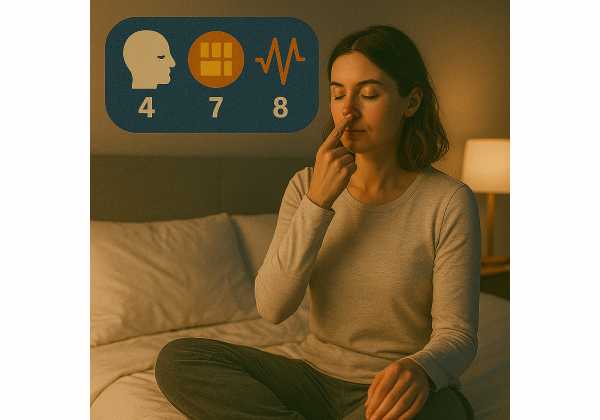
4-7-8 breathing is a short, structured pattern: inhale for 4 counts, hold for 7 counts, and exhale for 8 counts. The long exhale is the main feature. The hold adds a pause that focuses attention, but it is not required for everyone.
Use 4-7-8 breathing after lights out, during a wind-down routine, or after waking during the night. It works best when practiced before you desperately need it. Practice during calm moments for one week so the body learns the pattern without pressure.
How to do 4-7-8 breathing
Sit or lie comfortably. Rest the tongue lightly near the ridge behind the upper front teeth if that feels natural. Breathe through the nose for the inhale when possible. Exhale through the mouth or nose, whichever feels smoother.
- Inhale gently for 4 counts.
- Hold the breath for 7 counts without tightening the throat.
- Exhale slowly for 8 counts.
- Repeat for 2 to 4 rounds.
- Return to normal breathing and notice whether the body feels heavier, warmer, or quieter.
The count does not need to match seconds exactly. A slow internal count is enough. People with smaller lung capacity, nasal congestion, anxiety around breath holding, or respiratory illness often do better with a shorter version: inhale 3, hold 3, exhale 6. Another option is inhale 4, skip the hold, exhale 6 to 8.
The first week should feel almost too easy. Start with 2 rounds. Add rounds only when there is no air hunger, dizziness, or urge to gasp. More is not better at bedtime. The aim is to invite sleep, not complete a breathing workout.
4-7-8 breathing also gives the mind a clean replacement for rumination. Instead of reviewing tomorrow’s tasks, you count the next breath. When thoughts return, restart the count without frustration. That restart is part of the practice.
This technique works best when the sleep environment supports it. A cool, dark room, reduced evening light, and a consistent wake time make breathing practice more effective. For people who wake repeatedly, snore loudly, or feel unrefreshed despite enough time in bed, breathing exercises should not delay evaluation for possible sleep apnea.
Box Breathing for Daytime Stress Control
Box breathing uses four equal parts: inhale, hold, exhale, hold. The classic rhythm is 4-4-4-4. It is sometimes called square breathing because each side of the “box” has the same length.
This technique is best for daytime stress because it creates rhythm and control without requiring special equipment. It suits moments when stress narrows your focus and makes breathing shallow. The structure gives the brain a simple job and slows impulsive reactions.
How to do box breathing
Sit upright with both feet supported. Let the shoulders drop. Keep the breath smooth rather than large.
- Inhale through the nose for 4 counts.
- Hold gently for 4 counts.
- Exhale for 4 counts.
- Hold after the exhale for 4 counts.
- Repeat for 4 to 8 cycles.
The holds should feel calm. If the second hold creates panic or air hunger, remove it. Use inhale 4, exhale 6 instead. If the inhale hold feels tense, use 4-2-4-2. Box breathing is a tool, not a test of breath capacity.
Box breathing works well before stressful events because it adds a pause between trigger and response. Use it before opening a difficult message, entering a meeting, making a medical appointment, or responding to family tension. It also helps after stress, when the body remains activated even though the event has ended.
For sleep, box breathing is useful only when it feels soft. Some people find the holds too alerting at night. In that case, switch to a longer-exhale method. Bedtime breathing should reduce effort. Daytime breathing can include more structure.
Box breathing also fits inside a broader stress plan. It helps the immediate stress response, while habits such as movement, social connection, problem solving, and stress resilience skills reduce the number of times the body has to recover from overload.
HRV Biofeedback for Recovery Training
HRV biofeedback trains breathing by showing how the heart responds in real time. HRV stands for heart rate variability, the natural variation in time between heartbeats. Higher HRV is not always better in every moment, but a flexible heart rhythm often reflects better autonomic regulation.
In HRV biofeedback, you usually breathe at a slow pace that creates a smooth wave-like heart rhythm. Many adults land near 5 to 6 breaths per minute, though the best pace varies. This is often called resonance breathing because the breathing rhythm lines up with cardiovascular reflexes, especially the baroreflex, which helps regulate blood pressure.
The practice is simple in concept: breathe slowly, watch the feedback, and learn the pace that produces the smoothest rhythm without strain. Over time, the body learns that rhythm without needing the screen.
What equipment helps
A chest strap that records electrical heart activity often gives cleaner HRV biofeedback than a wrist optical sensor. Finger sensors and some camera-based tools also work for practice, but motion, cold hands, poor contact, and irregular rhythm reduce accuracy. A wearable sleep score is not the same as real-time HRV biofeedback.
Good HRV biofeedback shows a live breathing pacer and a heart rhythm wave. It should help you find a comfortable breathing pace rather than push one universal number. Many people start around 6 breaths per minute, then test slightly slower and faster paces.
A basic session looks like this:
- Sit comfortably with the spine supported.
- Breathe normally for 1 minute to settle.
- Start paced breathing near 6 breaths per minute.
- Use a gentle inhale and a longer, relaxed exhale.
- Watch for a smooth rise and fall in heart rhythm.
- Practice for 10 minutes.
- End with 1 minute of normal breathing.
Practice 3 to 5 days per week for several weeks. Short daily sessions beat occasional long sessions. The skill is not “getting a high HRV score.” The skill is learning what calm, efficient breathing feels like.
HRV biofeedback pairs naturally with tracking resting heart rate and HRV, but these are different uses. Real-time biofeedback trains a skill. Morning or overnight HRV trends help estimate recovery, illness, alcohol effects, hard training load, or poor sleep.
People with atrial fibrillation, frequent ectopic beats, pacemakers, or known rhythm disorders should ask a clinician how to interpret HRV tools. Irregular rhythms make many consumer HRV readings unreliable.
Daily Routines for Sleep, Stress, and Recovery
Breathwork works best when it has a clear place in the day. Random use still helps, but routine turns breathing into an automatic recovery cue. The body learns, “When this rhythm starts, we slow down.”
For sleep, attach breathwork to an existing habit. Do it after brushing teeth, after turning off the light, or after getting into bed. Keep the routine short enough that you will do it when tired. Two minutes nightly is better than a 20-minute plan that collapses after three days.
For daytime stress, use breathwork early. Waiting until stress peaks makes every technique harder. A 90-second breathing reset after the first signs of tension prevents a larger spiral.
A simple 7-day starter plan
| Day | Daytime practice | Evening practice | Focus |
|---|---|---|---|
| 1–2 | Box breathing for 2 minutes | 2 rounds of 4-7-8 | Learn the counts without forcing |
| 3–4 | Box breathing for 3 minutes | 3 rounds of 4-7-8 | Keep the breath quiet and smooth |
| 5 | Long-exhale breathing for 3 minutes | 4 rounds of 4-7-8 or a shorter version | Notice which pattern feels safest |
| 6 | HRV biofeedback for 10 minutes if available | 2–4 rounds of 4-7-8 | Practice without chasing performance |
| 7 | Choose the most useful daytime method | Choose the most useful bedtime method | Build the routine you will repeat |
After the first week, keep one daytime and one nighttime practice. A strong routine might look like this:
- Morning: 5 minutes of slow nasal breathing after waking.
- Midday: 2 minutes of box breathing before a stressful block of work.
- Evening: 3 rounds of 4-7-8 after lights out.
- Three times weekly: 10 to 15 minutes of HRV biofeedback.
Do not stack every method every day unless it feels natural. Breathwork should reduce load, not become another wellness obligation. If the routine feels like homework, shrink it. One minute done daily gives the nervous system a repeated signal.
Breathing also works better when paired with other recovery behaviors. Evening breathing after heavy alcohol, late caffeine, a huge meal, or bright screens has a harder job. People working on sleep often benefit from pairing breathwork with better timing for caffeine, alcohol, and late meals.
Tracking Progress Without Obsessing Over Data
Track breathwork by function first and numbers second. The main question is whether you fall asleep easier, recover faster after stress, and feel less trapped in rumination. A wearable score is helpful only when it improves decisions.
Use a simple 0–10 scale for two weeks:
- Sleep onset tension: 0 means calm, 10 means very wired.
- Night waking distress: 0 means relaxed, 10 means panicked or frustrated.
- Daytime stress recovery: 0 means quick recovery, 10 means stress lingers for hours.
- Practice consistency: count the number of days practiced, not minutes perfected.
Look for patterns after 14 days. If bedtime tension drops from 8 to 5, the method is helping even if sleep is not perfect. If you still take more than 45 minutes to fall asleep most nights, add stronger insomnia tools rather than simply doing more breathing. A structured CBT-I approach for insomnia has better evidence for chronic insomnia than breathing alone.
Wearables need careful interpretation. Overnight HRV changes with sleep stage, alcohol, illness, exercise, temperature, menstrual cycle, medications, and measurement error. A single low HRV night does not mean you failed. A single high HRV night does not prove a technique worked. Trends matter more than isolated numbers.
When using a wearable, track three things:
- Resting heart rate trend over several nights.
- HRV trend over several weeks.
- Sleep timing and consistency.
Breathwork often improves the transition into rest before it changes wearable sleep stages. Consumer devices estimate deep sleep and REM with limited accuracy. Use them as rough pattern tools, not lab-grade sleep studies. For more detail, focus on which sleep wearable metrics are worth trusting and which ones create unnecessary anxiety.
The best subjective signs are simple: warmer hands or feet, slower thoughts, softer jaw, easier swallowing, deeper sighs after the practice, and less urgency to check the clock. These signs show the body is leaving high-alert mode.
Safety, Limitations, and Common Mistakes
Breathwork should feel safe, steady, and reversible. Stop if you feel faint, confused, panicky, short of breath, or have chest pain. Sit or lie down if you become lightheaded. Avoid practicing while driving, in water, during heavy exercise, or anywhere a brief dizzy spell would create danger.
Breath holds deserve extra care. People who are pregnant, have significant heart or lung disease, have fainting episodes, have uncontrolled blood pressure, or feel panic during breath retention should skip long holds unless a qualified clinician advises otherwise. Use gentle long-exhale breathing instead.
Breathwork has limits. It will not fix untreated sleep apnea, restless legs, severe depression, trauma symptoms, medication side effects, chronic pain, or an unsafe life situation. It supports regulation; it does not remove every cause of dysregulation. Loud snoring, gasping, morning headaches, high blood pressure, and persistent daytime sleepiness need medical attention.
Common mistakes include:
- Breathing too deeply. Big breaths often cause overbreathing. Use quiet breaths.
- Forcing the exhale. A long exhale should feel controlled, not squeezed.
- Treating the count as mandatory. Shorten the count when needed.
- Practicing only during crisis. Calm practice teaches the skill faster.
- Chasing HRV scores. Biofeedback is training, not a competition.
- Using energizing breathwork at bedtime. Fast breathing and intense methods are poor choices for sleep.
- Staying in bed frustrated. If wakefulness becomes tense, get up briefly and return when sleepy.
The safest default is slow nasal breathing with a relaxed, longer exhale. Try inhaling for 4 and exhaling for 6 for 3 minutes. This pattern suits more people than long breath holds and works in bed, at a desk, or during travel.
Mouth breathing, nasal congestion, and snoring also change how breathing feels at night. If nasal airflow is poor, bedtime breathwork becomes harder and less relaxing. Addressing allergies, congestion, bedroom humidity, or nasal obstruction often improves comfort; persistent mouth breathing deserves a closer look at nasal health and sleep breathing.
Breathwork is most useful when it becomes boring in the best way: familiar, simple, and easy to repeat. The body trusts repetition. A steady pattern practiced for a few minutes each day often beats a complex method done only when stress is already overwhelming.
References
- Breathing Practices for Stress and Anxiety Reduction: Conceptual Framework of Implementation Guidelines Based on a Systematic Review of the Published Literature 2023 (Systematic Review)
- Effects of voluntary slow breathing on heart rate and heart rate variability: A systematic review and a meta-analysis 2022 (Systematic Review and Meta-Analysis)
- Slow breathing for reducing stress: The effect of extending exhale 2023 (Randomized Controlled Trial)
- Methods for Heart Rate Variability Biofeedback (HRVB): A Systematic Review and Guidelines 2023 (Systematic Review)
- Effects of sleep deprivation and 4-7-8 breathing control on heart rate variability, blood pressure, blood glucose, and endothelial function in healthy young adults 2022 (Experimental Study)
- The Effect of 4-7-8 Breathing Exercise Technique on Tinnitus Handicap, Psychological Factors, and Sleep Quality in Tinnitus Patients: A Randomized Controlled Study 2026 (Randomized Controlled Trial)
Disclaimer
This article is educational and does not replace care from a qualified health professional. Speak with a clinician before using breath holds or HRV biofeedback if you have heart rhythm problems, significant lung disease, fainting episodes, uncontrolled blood pressure, pregnancy-related concerns, or severe anxiety symptoms. Seek medical care for chest pain, unexplained shortness of breath, loud snoring with gasping, or persistent daytime sleepiness.