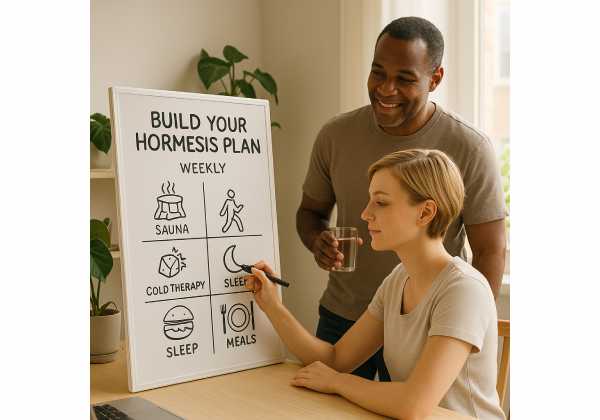
Hormesis is the useful stress your body adapts to after the challenge ends. A brisk walk up a hill, a hard set of squats, a short sauna session, a cool shower, and an overnight break from food all send mild stress signals. With enough recovery, cells respond by improving energy production, repair, antioxidant defenses, temperature tolerance, and metabolic flexibility.
The longevity value comes from repetition, not heroics. A hormesis plan should feel like training: measured, progressive, and recoverable. The right dose leaves you more capable over weeks. The wrong dose leaves you wired, sore, hungry, sleep-deprived, or less consistent. Start with the smallest dose that produces a clear training effect, then build slowly. Use sleep, mood, soreness, resting heart rate, appetite, and performance as your feedback. Cellular resilience grows best when stress and recovery take turns.
Table of Contents
- Hormesis Is a Dose, Not a Challenge
- Safety Comes Before Adaptation
- Choose the Core Stressors That Fit Your Life
- Build a Weekly Rhythm: Build, Signal, Recover
- Find Your Minimum Effective Dose
- Track Recovery Signals Before Adding More
- A Four-Week Starter Hormesis Plan
- Common Mistakes That Turn Hormesis Into Strain
Hormesis Is a Dose, Not a Challenge
Hormesis means a low or moderate stress improves resilience, while too much of the same stress damages performance and recovery. The dose decides the outcome. Ten minutes of heat after an easy training day differs from a long sauna session after hard intervals, poor sleep, and dehydration. A short cool shower differs from an icy plunge that triggers panic breathing.
The body treats these signals as information. Muscle contractions, heat, cold, temporary energy shortage, and mechanical loading all disturb normal balance for a short time. Cells respond by activating repair pathways, making energy systems more efficient, and preparing for the next challenge.
This is why hormesis works best as a plan. Random intensity creates random recovery. A repeatable plan lets you build tolerance without guessing.
At the cellular level, several systems help explain the benefits:
- AMPK rises when cells sense low energy. It supports fuel use, mitochondrial maintenance, and repair-oriented signaling.
- mTOR supports growth, muscle protein synthesis, and rebuilding after training and protein-rich meals.
- Autophagy helps cells break down and recycle worn parts, including damaged proteins and organelles.
- Mitophagy is the cleanup and renewal process for mitochondria, the energy-producing structures in cells.
- Heat shock proteins help protect and refold stressed proteins after heat exposure.
- NRF2 helps regulate antioxidant and detoxification defenses after mild oxidative stress.
These pathways do not work like on/off switches. They pulse in response to meals, movement, sleep, temperature, and stress. Healthy aging requires both repair and rebuilding. Spending every day in “repair mode” through excessive fasting, cold, or endurance work often backfires. Spending every day in “build mode” without enough movement, sleep, or metabolic challenge also limits resilience.
A strong plan alternates the two. Strength training and protein support mTOR-driven rebuilding. Aerobic training, meal timing, heat, and some forms of metabolic stress support AMPK, mitochondrial adaptation, and cellular cleanup. For a deeper primer on repair signaling, autophagy for healthy aging explains the recycling side in plain language. For the build-repair balance, mTOR and AMPK timing gives a helpful framework.
Safety Comes Before Adaptation
Safe hormesis starts with one rule: never use stress to override a warning signal. Dizziness, chest pressure, faintness, confusion, severe headache, wheezing, irregular heartbeat, sharp pain, or loss of coordination means the session ends.
Some people need medical guidance before using heat, cold, fasting, breath work, altitude-style training, or intense exercise. This includes anyone with unstable heart disease, uncontrolled blood pressure, fainting episodes, seizure history, serious rhythm problems, advanced kidney disease, pregnancy complications, active eating disorder, poorly controlled diabetes, or medicines that raise dehydration, low blood pressure, low blood sugar, or heat illness risk.
Cold exposure deserves special caution. Sudden cold water triggers a cold-shock response: gasping, fast breathing, blood pressure rise, and a strong stress surge. That response creates real drowning risk in open water. Start with cool showers on land before cold plunges. Never combine breath holds with water. Never plunge alone in natural water.
Heat also needs respect. Sauna, hot tubs, and hot baths raise heart rate and shift blood toward the skin. Avoid heat exposure after alcohol, during fever, after heavy dehydration, or when already lightheaded. Leave before you feel forced to leave. A useful heat session ends with control, not escape.
Fasting and time-restricted eating also require context. A 12-hour overnight fast suits most healthy adults. Longer fasting needs more caution in people who take glucose-lowering medicines, have low body weight, train hard, have a history of disordered eating, or struggle with sleep. Cellular stress from food timing should never cost muscle, menstrual health, mood, or daily function.
Use this simple safety filter before adding any new hormetic stressor:
- Do I feel well today, with no fever, chest symptoms, faintness, or unusual shortness of breath?
- Did I sleep enough to handle extra stress?
- Have I eaten, hydrated, and recovered enough for the session I planned?
- Is this stressor familiar, or am I trying something new?
- Will I stop early if my body gives a clear warning?
The safest plan builds one variable at a time. Increase duration, intensity, frequency, or temperature challenge, but not all at once. Safe self-experimentation works best with clear start points, pauses, and check-ins.
Choose the Core Stressors That Fit Your Life
The best hormesis plan uses a few reliable stressors instead of chasing every trend. Movement should form the base because it improves muscle, cardiovascular fitness, glucose handling, balance, bone loading, mood, and mitochondrial function. Heat, cold, and meal timing are add-ons. They should support the base, not compete with it.
| Stressor | Main signal | Beginner dose | Good response | Back off when |
|---|---|---|---|---|
| Zone 2 cardio | Mitochondrial efficiency, fat oxidation, aerobic base | 20–30 minutes, 2 times weekly | You finish calm and could repeat tomorrow | Fatigue lingers or sleep worsens |
| Strength training | Mechanical loading, mTOR, bone and muscle remodeling | 2 sessions weekly, 4–6 basic lifts | Mild soreness, steady progress | Joint pain or strength drops for a week |
| Intervals | High energy demand, VO₂max, lactate handling | 4 rounds of 30 seconds hard, 2 minutes easy | You recover breathing within a few minutes | You feel wired, nauseated, or flat for days |
| Heat | Heat shock proteins, plasma volume, vascular stress | 5–10 minutes sauna or 10 minutes hot bath | Warm, relaxed, clear-headed after cooling | Dizziness, headache, pounding heart |
| Cold | Cold tolerance, alertness, sympathetic control | 30–60 seconds cool shower | Breathing stays controlled | Panic breathing, numbness, chest discomfort |
| Overnight food break | Metabolic flexibility, lower late-night glucose load | 12 hours between dinner and breakfast | Stable energy and normal appetite | Bingeing, poor sleep, irritability, over-restriction |
Movement is the foundation
Aerobic training creates repeated energy demand. Cells adapt by improving oxygen use, capillary support, mitochondrial enzymes, and fuel flexibility. Zone 2 work should feel sustainable: you breathe more deeply but still speak in short sentences. Many adults do well with 2–4 sessions weekly, often 30–45 minutes per session after a gradual build.
Strength training gives cells a different signal. Muscle fibers, tendons, bones, and connective tissue respond to load. The plan does not need complicated exercises. Squats or sit-to-stands, hip hinges, rows, presses, carries, step-ups, and calf raises cover most needs. Use 2–3 sets of 6–12 repetitions for major movements, leaving 1–3 good repetitions “in reserve” most of the time. Strength training for longevity gives a practical weekly structure if you want a deeper lifting plan.
Intervals are powerful but easy to overuse. One weekly interval session is enough for many beginners and intermediates. Hard efforts should stay short at first. The purpose is a clean signal, not exhaustion.
Heat builds tolerance through controlled thermal stress
Heat exposure works best when it feels challenging but calm. A beginner sauna dose is 5–10 minutes at a comfortable temperature, followed by a full cool-down. Over time, some people build toward 15–20 minutes, 2–4 times weekly. Hot baths at 39–40°C offer a more accessible option, often starting at 10 minutes.
Heat should not replace exercise, but it pairs well with easy days, mobility work, and relaxed evenings. It also demands hydration. Sweat loss varies widely, so use thirst, urine color, body weight changes, and how you feel after cooling as guides. sauna dosing and safety covers more detail for people using sauna regularly.
Cold should train composure, not toughness
Cold exposure is useful only when you control your breathing and exit safely. Start with cool water at the end of a normal shower. Breathe through the nose or use slow exhales. Keep the first sessions short: 30 seconds is enough. Progress to 1–2 minutes before considering colder water.
Cold immediately after strength training is not ideal when muscle growth is the priority. Use cold on separate days, after easy cardio, or at least several hours away from lifting. This spacing protects the growth signal from training. gradual cold acclimation is the right approach for most adults.
Meal timing should support energy, not become punishment
A consistent overnight food break gives the digestive system rest and reduces late-night glucose exposure. Start with 12 hours. For example, finish dinner at 7:30 p.m. and eat breakfast at 7:30 a.m. Some people extend to 13–14 hours on low-stress days.
Do not use long fasting to compensate for overeating or to force faster results. Protein, fiber, colorful plants, healthy fats, and enough total energy matter more than a longer fasting window. If fasting increases cravings, sleep disruption, or low energy, shorten the window.
Build a Weekly Rhythm: Build, Signal, Recover
A hormesis week should alternate harder cellular signals with easier recovery windows. The body adapts between sessions. That means the week needs light days on purpose.
A simple rhythm works well:
- Two strength days for muscle, bone, insulin sensitivity, and mTOR-supported rebuilding.
- Two Zone 2 days for mitochondrial and cardiovascular adaptation.
- One optional interval day after a base of consistent movement.
- One to three heat sessions placed after easy training or on non-lifting days.
- Two short cold exposures kept brief and separated from key strength sessions.
- One full low-stress day with walking, mobility, sunlight, social time, and early sleep.
Here is a beginner-friendly weekly layout:
| Day | Main session | Optional add-on | Recovery focus |
|---|---|---|---|
| Monday | Strength training, full body | 10-minute walk after dinner | Protein at meals, early bedtime |
| Tuesday | Zone 2 cardio, 25–35 minutes | 5–10 minutes sauna or hot bath | Hydration and relaxed evening |
| Wednesday | Mobility and easy walking | 30–60 seconds cool shower | Lower stress load |
| Thursday | Strength training, full body | Short post-meal walk | Carbs around training if needed |
| Friday | Zone 2 cardio or gentle hills | Heat session if well recovered | Stop before fatigue piles up |
| Saturday | Optional intervals or longer walk | Cool shower later in the day | Outdoor light and social time |
| Sunday | Rest, walking, mobility | None needed | Plan the next week |
This rhythm does not need to be perfect. It needs to be repeatable. Move sessions around for work, family, travel, and sleep. The main rule is simple: do not place every intense stressor on the same day unless you already tolerate each one well.
Stacking requires extra caution. A hard workout plus sauna plus cold plus fasting creates a much larger total stress than any single item. stacking stressors smartly helps when you are ready to combine heat, cold, and training without burnout.
Find Your Minimum Effective Dose
The minimum effective dose is the smallest amount that produces a useful adaptation while preserving recovery. It is the most important idea in a long-term hormesis plan.
More stress does not equal more longevity. More recoverable stress builds capacity. The body adapts to a signal it survives cleanly and repeatedly. If the signal forces skipped workouts, poor sleep, cravings, or nagging pain, the dose is too high.
Use these dose rules:
- Start below your ego. The first week should feel almost too easy.
- Add only one change per week. Increase time, intensity, frequency, or temperature challenge, not all four.
- Progress by 10–20% at most. A 10-minute heat session becomes 11–12 minutes, not 25 minutes.
- Keep two easy days weekly. Easy days protect consistency.
- Deload every fourth to sixth week. Reduce volume by about one-third when fatigue accumulates.
A practical progression looks like this:
- Zone 2: add 5 minutes to one session each week until you reach 30–45 minutes.
- Strength: add 1–2 repetitions per set before adding weight.
- Intervals: add one round before making the hard efforts longer.
- Heat: add 2–3 minutes only after you finish sessions clear-headed.
- Cold: add 15–30 seconds only while breathing stays controlled.
- Meal timing: extend overnight fasting by 30 minutes, then hold for a week.
The easiest way to calibrate dose is to score each session from 1 to 10:
- 1–3: easy, restorative, no special recovery needed.
- 4–6: useful training signal, repeatable.
- 7–8: hard, limit to occasional use.
- 9–10: maximal, rarely useful for longevity planning.
Most hormesis work belongs in the 4–6 range. Save 7–8 efforts for intervals, testing weeks, hikes, races, or planned challenges. A plan filled with 8s usually collapses under normal life stress.
The body also adapts by season and context. Heat tolerance improves during summer and drops after long breaks. Cold tolerance improves with repeated mild exposure. Training tolerance rises when sleep, protein, and calories are steady. Stress at work lowers the dose you recover from. That is not weakness; it is physiology.
For a deeper dose framework, hormesis dose-response explains why the sweet spot matters more than intensity.
Track Recovery Signals Before Adding More
Recovery determines whether hormesis becomes adaptation. Track a few simple signals before adding volume. You do not need a lab or expensive device, although wearables help some people notice patterns.
Use a 30-second morning check:
- Sleep: Did you sleep enough, and did you wake reasonably refreshed?
- Resting heart rate: Is it near your normal range, or clearly elevated?
- Mood: Do you feel steady, or unusually irritable and flat?
- Soreness: Is it mild and local, or heavy and whole-body?
- Performance: Are normal stairs, walking pace, or warm-up sets harder than usual?
- Appetite: Is hunger normal, or are cravings and late-night snacking rising?
One bad signal does not require alarm. Three bad signals mean reduce the day’s stress. Choose walking, mobility, light Zone 2, or rest. Delay heat, intervals, long fasting, and cold plunges until your baseline returns.
Wearables add context when used correctly. Resting heart rate, heart rate variability, sleep duration, and training load trends reveal patterns over weeks. Do not let a device dictate every decision. Let it start a conversation with your body. If HRV drops after late sauna sessions, move heat earlier. If resting heart rate rises after intervals plus fasting, eat more around training or separate those stressors.
A useful hormesis log fits on one line per day:
| Item | What to record | Why it matters |
|---|---|---|
| Stressors | Training, heat, cold, fasting window | Shows total load |
| Sleep | Hours and quality, 1–5 | Best recovery marker |
| Energy | Morning and afternoon, 1–5 | Reveals under-recovery |
| Soreness | None, mild, moderate, high | Guides strength progression |
| Notes | Stress, travel, illness, alcohol, late meals | Explains outliers |
Recovery basics are not optional. Sleep, fluids, electrolytes, protein, carbohydrates around harder training, and low-stress time make cellular adaptation possible. Heat and cold do not compensate for poor recovery. They add load. recovery after hormetic stress is where many plans succeed or fail.
A Four-Week Starter Hormesis Plan
A good starter plan builds confidence before intensity. The first month should teach your body the pattern: train, signal, recover, repeat.
Week 1: Establish your baseline
Keep every stressor mild. Do two full-body strength sessions, two Zone 2 walks, bike rides, or easy cardio sessions, and one brief heat exposure if you tolerate heat well. Add cool water only at the end of one shower.
Use a 12-hour overnight food break most nights. Do not add long fasting. The point is rhythm.
Week 1 targets:
- Strength: 2 sessions, 30–45 minutes each.
- Zone 2: 2 sessions, 20–30 minutes each.
- Heat: 1 session, 5–10 minutes sauna or 10 minutes hot bath.
- Cold: 1 cool shower finish, 30 seconds.
- Food timing: 12-hour overnight break.
Week 2: Add small volume
Increase one aerobic session by 5 minutes. Add a second heat session only if Week 1 felt easy. Keep cold brief. Strength sessions stay the same, with slightly smoother technique or one extra repetition on selected exercises.
Week 2 targets:
- Strength: 2 sessions, same exercises.
- Zone 2: 2 sessions, one extended by 5 minutes.
- Heat: 1–2 sessions.
- Cold: 1–2 cool shower finishes, 30–45 seconds.
- Food timing: 12–13 hours if sleep and appetite stay normal.
Week 3: Add one sharper signal
Add a small interval session only if your joints, sleep, and energy are stable. Keep it short: 4 rounds of 30 seconds hard with 2 minutes easy between rounds. This session should feel challenging but controlled.
Do not add more heat or longer fasting in the same week. The interval session is the new stressor.
Week 3 targets:
- Strength: 2 sessions.
- Zone 2: 2 sessions.
- Intervals: 1 short session, optional.
- Heat: 1–2 sessions, no increase.
- Cold: 1–2 brief exposures.
- Food timing: Hold steady.
Week 4: Consolidate and deload slightly
Week 4 should feel clean. Reduce strength volume by about one-third, such as doing 2 sets instead of 3. Keep Zone 2 easy. Skip intervals if fatigue is present. Use heat only if it improves relaxation and sleep.
This lighter week helps you absorb the first three weeks. It also shows which stressors helped and which ones cost too much.
Week 4 targets:
- Strength: 2 lighter sessions.
- Zone 2: 2 easy sessions.
- Intervals: Skip or keep very short.
- Heat: 1 relaxed session if desired.
- Cold: Optional cool shower only.
- Review: Check sleep, energy, soreness, mood, and consistency.
At the end of four weeks, keep what worked. Remove what created friction. A durable plan beats an impressive plan. Your next month might add a third Zone 2 session, a longer heat session, slightly heavier strength work, or a second brief cold exposure. Choose one priority at a time.
Common Mistakes That Turn Hormesis Into Strain
Most hormesis mistakes come from adding stress faster than recovery improves. The body does not care whether the stress came from training, cold, heat, fasting, travel, emotional strain, or poor sleep. It adds the load together.
The most common mistakes are easy to fix.
Mistake 1: Starting with extremes. Ice baths, long fasts, maximal intervals, and long sauna sessions look efficient, but they leave little room to progress. Start mild. Adaptation compounds.
Mistake 2: Treating soreness as proof. Muscle soreness is not the target. Strength, aerobic capacity, better sleep, stable energy, and consistency are better signs.
Mistake 3: Combining hard stressors while under-recovered. Hard lifting, intervals, sauna, cold plunge, and a long fasting window on the same day overload many people. Stack only after each piece is familiar.
Mistake 4: Using cold at the wrong time. Cold right after lifting blunts some of the local inflammation and signaling involved in muscle growth. Use cold away from strength training when building muscle matters.
Mistake 5: Ignoring protein and total energy. Cellular cleanup is useful, but the body also needs raw materials. Aim for protein at each meal, especially on training days. Many adults benefit from roughly 25–40 g protein per meal, adjusted for body size, appetite, and medical needs.
Mistake 6: Chasing autophagy while losing muscle. Muscle is a longevity organ. A plan that causes strength loss, low energy, or poor training quality needs more food, better sleep, or less fasting. mitochondrial renewal works best alongside movement, not instead of it.
Mistake 7: Confusing acute stress with long-term adaptation. A single cold plunge feels dramatic. Repeated, well-tolerated exposure builds skill and tolerance. The same applies to heat and exercise.
Mistake 8: Forgetting the nervous system. Hormesis should not keep you in a constant fight-or-flight state. If your plan leaves you tense at night, shorten the session, move it earlier, eat more, or take a recovery day.
A successful hormesis plan feels almost boring after a while. You train regularly. You use heat or cold in small, controlled doses. You eat in a rhythm that supports sleep and muscle. You recover before pushing again. Over months, this boring consistency becomes resilience: better work capacity, steadier energy, stronger temperature tolerance, improved metabolic health, and a body that handles normal stress with less disruption.
References
- WHO guidelines on physical activity and sedentary behaviour 2020 (Guideline)
- Leveraging mitochondrial stress to improve healthy aging 2025 (Review)
- The multifaceted benefits of passive heat therapies for extending the healthspan: A comprehensive review with a focus on Finnish sauna 2024 (Review)
- Effects of cold-water immersion on health and wellbeing: A systematic review and meta-analysis 2025 (Systematic Review and Meta-analysis)
- American College of Sports Medicine Position Stand. Resistance Training Prescription for Muscle Function, Hypertrophy, and Physical Performance in Healthy Adults: An Overview of Reviews 2026 (Position Statement)
- Links between autophagy and healthy aging 2026 (Review)
Disclaimer
This article is educational and does not replace care from a qualified health professional. Heat, cold, fasting, breath work, and intense exercise carry extra risk for some medical conditions and medications. Speak with a clinician before starting a hormesis plan if you have heart disease, blood pressure problems, fainting, seizures, diabetes treated with medication, pregnancy-related concerns, an eating disorder history, or any condition that affects temperature regulation or exercise safety.