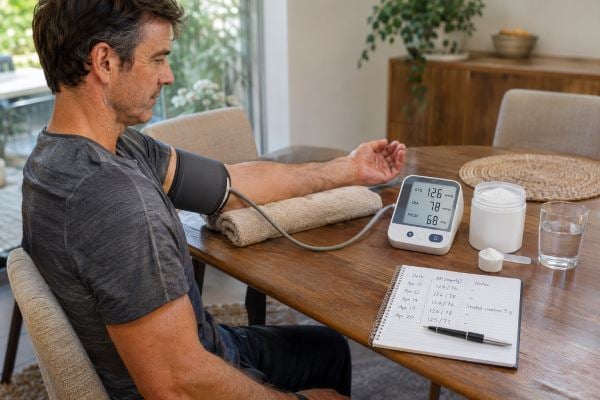
Creatine monohydrate does not appear to raise blood pressure in healthy adults at standard doses, and current evidence does not show a consistent hypertensive effect. For people who already have high blood pressure, however, the evidence is thinner because many creatine trials enroll younger, healthier participants rather than patients with treated hypertension. That means creatine is not automatically unsafe, but it deserves a little more care. The biggest practical issues are your kidney function, the medicines you take, whether your blood pressure is controlled, and whether a supplement contains stimulants or large amounts of sodium in addition to creatine. Plain creatine monohydrate is the best-studied form. A typical maintenance dose is 3–5 g per day, and a loading phase is optional rather than required. If you have hypertension, chronic kidney disease, heart failure, uncontrolled readings, or take several blood-pressure or kidney-affecting medicines, discuss creatine with your clinician before starting it and monitor your numbers rather than guessing how you respond.
Table of Contents
- Does Creatine Raise Blood Pressure?
- Why Creatine Can Cause Confusion
- Who With Hypertension Should Be Cautious
- How to Use Creatine More Safely
- Creatine, Kidneys, and Blood Tests
- Creatine, Exercise, and Heart Health
- When to Stop and Call a Clinician
Does Creatine Raise Blood Pressure?
The best available evidence does not show that standard creatine monohydrate supplementation consistently raises resting blood pressure. Recent reviews that specifically examine common creatine safety questions conclude that a blood-pressure increase is not supported by the limited human data available. Small trials have also failed to show a meaningful rise in systolic or diastolic pressure.
That answer needs two qualifications. First, the absence of a consistent increase is not the same as proof that every person with hypertension will respond identically. People with established high blood pressure, chronic kidney disease, heart failure, or complex medication regimens are underrepresented in many sports-nutrition trials.
Second, many products marketed as “creatine” are actually pre-workout blends. A scoop may contain caffeine, yohimbine, synephrine, sodium, or other stimulants that can raise heart rate or blood pressure even though creatine itself does not. If you are testing whether creatine is safe for you, use a single-ingredient creatine monohydrate product so you are not studying five ingredients at once.
A small randomized trial in older men found no significant blood-pressure worsening after short-term creatine supplementation; systolic pressure actually trended downward, although the study was not large enough to prove a blood-pressure benefit. Creatine therefore should not be treated as a blood-pressure supplement, either. Its main evidence-based use remains improving high-intensity exercise capacity, strength, and gains in lean mass when combined with resistance training.
The evidence base is stronger for what creatine does not seem to do in healthy people than for what it does in hypertension specifically. Hundreds of trials include safety data, but many were designed around sports performance, body composition, or strength rather than blood pressure as the primary endpoint. Study periods are also often measured in weeks or months instead of years. That is why a cautious answer is more accurate than saying creatine is universally “blood-pressure neutral.” The current signal is reassuring, but the evidence in older adults with multiple cardiovascular conditions is not as deep.
It also helps to separate resting blood pressure from the temporary rise that happens during exercise. Resistance training itself can briefly increase pressure while a set is being performed, especially with heavy loads and breath-holding. Creatine may let a person train harder, but that does not mean the supplement directly caused the exercise-related pressure rise. If you have hypertension, your training plan and lifting technique matter alongside supplement choice.
If your readings are often high, first make sure the measurement itself is reliable. Good technique matters more than many people realize. Review how to measure blood pressure at home before judging whether a new supplement changed your numbers.
Why Creatine Can Cause Confusion
Several common effects of creatine are easy to misinterpret as cardiovascular problems even when they are not.
Water weight is not the same as fluid overload
Creatine increases water stored inside muscle cells, especially during the first days or weeks of supplementation. People may gain about 1–3 lb (roughly 0.5–1.5 kg), sometimes more during a loading phase. This is largely intracellular water and increased muscle creatine storage.
That is different from edema caused by heart or kidney failure, where fluid collects in tissues and may cause ankle swelling, rapid weight gain, shortness of breath, or abdominal bloating. Healthy people using standard creatine doses generally do not develop this kind of pathologic fluid retention.
Still, if you have heart failure, advanced kidney disease, or a medical reason to track daily weight and fluid balance, any supplement that changes body weight can complicate monitoring. In that situation, clinician guidance matters more than general sports-nutrition advice.
Creatine and creatine kinase are different
Creatine is a nutrient-like compound stored mainly in muscle. Creatine kinase, or CK, is an enzyme that helps move energy between creatine and phosphocreatine. A CK blood test can rise after hard exercise or muscle injury. Taking creatine does not mean you have an abnormal CK level, and an elevated CK does not automatically mean creatine caused it.
This distinction becomes especially important for people on statins, because statin-related muscle symptoms sometimes lead to CK testing. If that applies to you, see what elevated CK means during statin therapy.
Creatinine can rise without kidney damage
Creatine naturally breaks down into creatinine. Because serum creatinine is used to estimate kidney filtration, supplementation can make a creatinine-based eGFR look worse even when true kidney filtration has not changed. This does not mean creatine can never affect the kidneys; it means one lab marker can be misleading if the clinician does not know you are taking it.
Tell your clinician before kidney blood tests. In some situations, cystatin C or a directly measured filtration test can provide useful additional context.
Who With Hypertension Should Be Cautious
People with well-controlled uncomplicated hypertension may be able to use creatine safely, but the decision changes when other conditions raise the stakes.
Talk with a clinician before starting creatine if you have:
- Chronic kidney disease or a reduced eGFR
- Protein or albumin in the urine
- Heart failure or a history of significant fluid retention
- Uncontrolled hypertension
- Recent acute kidney injury
- A single functioning kidney or known structural kidney disease
- Diabetes with kidney complications
- A history of rhabdomyolysis
- Multiple medications that affect kidney function or fluid balance
The same applies if your clinician has told you to follow a fluid or sodium restriction.
Medication considerations
Creatine is not known for a long list of direct interactions with standard blood-pressure medicines, but hypertension often comes with medications that change kidney blood flow, sodium balance, or potassium. ACE inhibitors, angiotensin receptor blockers, diuretics, mineralocorticoid receptor antagonists, and other drugs may make kidney function and electrolyte monitoring more important.
The issue is less “creatine plus this drug is forbidden” and more “do not ignore the kidney context.” Someone taking an ACE inhibitor and a thiazide with normal kidney function is different from someone taking several blood-pressure drugs plus frequent NSAIDs while dehydrated.
NSAIDs such as ibuprofen and naproxen deserve special attention because heavy use can stress kidney function and raise blood pressure in some people. If you use them often for training soreness, mention that when discussing creatine.
Uncontrolled blood pressure
If home readings are repeatedly around or above 180/120 mm Hg, or if very high pressure comes with chest pain, severe headache, shortness of breath, weakness, vision changes, or neurologic symptoms, that is not a supplement-selection problem. It requires urgent medical assessment.
For less extreme but persistently elevated readings, get the hypertension under control first. Many people feel normal even when blood pressure is high, which is why hypertension is often called silent.
How to Use Creatine More Safely
If your blood pressure is controlled and a clinician has no specific concern, plain creatine monohydrate is the simplest choice.
Use a standard dose
A maintenance dose of 3–5 g per day is enough for most adults. You do not need a loading phase to get the benefits; it simply saturates muscle stores faster.
A common loading approach is about 20 g per day divided into four 5 g doses for 5–7 days, followed by 3–5 g per day. For a person with hypertension who wants to minimize sudden scale changes and gastrointestinal upset, skipping the loading phase is often a simpler approach.
Creatine timing is not critical. Taking it consistently matters more than taking it immediately before or after exercise, and taking it with food is fine if that feels easier on your stomach.
Choose creatine monohydrate
Creatine monohydrate has by far the most safety and efficacy data. Creatine hydrochloride, buffered creatine, nitrate forms, and other branded versions have not shown a clear safety or performance advantage that justifies treating them as superior.
Powder is usually the simplest format because the dose is easy to see. Gummies and flavored mixes may add sugar, sodium, or other active ingredients, so check the full Supplement Facts panel rather than relying on the product name.
Look for a product with minimal added ingredients and third-party testing when possible. Avoid blends that hide the creatine dose or combine it with strong stimulants if blood pressure is a concern.
Monitor blood pressure in a structured way
Do not measure ten times a day because you are anxious about a new supplement. Instead, use a consistent schedule. For example, record two readings in the morning and two in the evening for several days before starting, then repeat the same pattern during the first one to two weeks.
A simple self-check can make the trial easier to interpret:
- Keep your usual caffeine, exercise, and medication schedule as steady as practical for several days.
- Record a baseline average before taking creatine.
- Start with 3 g per day rather than using a loading phase.
- Keep the same blood-pressure measurement times for the next 7–14 days.
- Compare averages, not isolated readings.
- If the average rises clearly or symptoms appear, stop and discuss the change with your clinician.
This approach reduces noise. Blood pressure can swing from sleep loss, pain, stress, alcohol, caffeine, dehydration, a salty meal, or a recent workout. If several of those change at the same time you start creatine, you may not be able to tell what caused the difference.
Sit quietly for five minutes, keep your back supported and feet flat, support the arm at heart level, and use a validated upper-arm cuff that fits correctly. A consistent home blood-pressure routine makes small changes easier to interpret.
If your average rises meaningfully and stays up, stop the supplement and review the pattern with your clinician. A single reading after coffee, a hard workout, poor sleep, or stress is not enough to establish a trend.
Keep hydration normal
Creatine does not appear to cause dehydration in healthy users, but hypertension and exercise can both make fluid advice more individualized. Drink enough to replace normal losses, especially during heat and exercise, without forcing excessive water.
People taking diuretics, people with heart failure, and people with kidney disease may have specific fluid instructions. General advice such as “drink a gallon a day with creatine” is not appropriate for everyone. For more context, see hydration and blood pressure.
Creatine, Kidneys, and Blood Tests
Kidney safety is often the biggest concern for someone with hypertension because high blood pressure itself can damage the kidneys over time.
Recent systematic reviews of randomized trials generally find that creatine can cause a small increase in serum creatinine without a clear reduction in directly measured kidney filtration in healthy participants. This is biologically plausible because more creatine in the body can produce more creatinine.
The limitation is important: “safe in healthy adults” is not identical to “proven safe in people with chronic kidney disease.” If kidney function is already reduced, there are fewer strong long-term data, so a more conservative approach is appropriate.
Hypertension increases the importance of this distinction because kidney disease can be both a cause and a consequence of high blood pressure. Someone with years of hypertension may have early kidney damage even if they feel well. A urine albumin test can reveal kidney stress that a serum creatinine result alone may miss. If you have never had kidney function checked and your blood pressure has been difficult to control, it makes sense to discuss baseline testing before adding a daily supplement that can complicate creatinine interpretation.
People with normal kidney function do not usually need repeated kidney panels just because they take a standard creatine dose. Monitoring should match the person’s medical risk rather than the supplement’s reputation. The threshold for follow-up is lower when there is known kidney disease, diabetes, older age, frequent NSAID use, or a recent change in blood-pressure medication.
If you use creatine and need kidney testing, tell the clinician how much you take and when you started. Depending on the situation, they may look at:
- Serum creatinine and creatinine-based eGFR
- Cystatin C
- Urine albumin-to-creatinine ratio
- Electrolytes such as potassium
- Blood pressure trends
- Previous kidney results for comparison
A small creatinine rise after starting creatine is not something to ignore, but it also should not automatically be labeled kidney failure. The pattern, other kidney markers, and your baseline matter.
Be especially careful about combining dehydration, heavy exercise, heat exposure, frequent NSAID use, and supplements when kidney function is uncertain. Any one factor may be tolerated, but stacking several stressors can make interpretation and safety worse.
Creatine, Exercise, and Heart Health
Creatine’s most relevant cardiovascular benefit may be indirect: it can make resistance training more productive. Strength training supports blood-pressure control, insulin sensitivity, physical function, and long-term cardiovascular health.
Creatine is particularly useful for repeated high-intensity efforts such as sets of squats, presses, rows, or sprints. It may help you perform an extra repetition or maintain training quality, which can add up to more strength and lean mass over time.
That does not mean creatine is necessary for heart health. You can gain the cardiovascular benefits of exercise without taking it. The foundation remains a weekly activity plan that includes aerobic exercise and resistance training. If you want to build that side of the plan, see strength training for blood pressure and heart health.
People with hypertension should pay attention to lifting technique. Breath-holding during a maximal or near-maximal lift can cause large temporary blood-pressure spikes. For most recreational lifters, controlled breathing, moderate loads, and avoiding repeated all-out efforts are more sensible than chasing maximal lifts.
If your hypertension is well controlled, resistance exercise is generally beneficial. If it is severely uncontrolled, or if you develop exertional chest pain, fainting, or unusual shortness of breath, get medical clearance before pushing intensity.
When to Stop and Call a Clinician
Stop creatine and contact a clinician if you develop a persistent, unexplained rise in blood pressure, new ankle swelling, rapidly increasing body weight that does not look like normal early muscle water gain, reduced urination, severe muscle pain, dark urine, or significant gastrointestinal symptoms that do not improve with a lower dose.
Seek urgent care for chest pain, severe shortness of breath, fainting, stroke-like symptoms, or blood pressure at emergency levels with concerning symptoms. Do not assume a supplement is the only cause.
It is also worth checking the label before blaming creatine. If a “creatine” powder contains 250–350 mg of caffeine per serving, the stimulant may be a more plausible explanation for a temporary rise in heart rate or blood pressure. Pre-workout formulas can also contain multiple stimulants whose combined effects are harder to predict.
For most adults with controlled hypertension and normal kidney function, plain creatine monohydrate at 3–5 g per day is unlikely to meaningfully raise blood pressure based on current evidence. The main uncertainty is not a proven hypertensive effect; it is that long-term studies in people with established hypertension and kidney disease are more limited than studies in healthy users. A simple product, standard dose, reliable home measurements, and open communication with your clinician make the decision much safer.
A brief written log of dose, training, caffeine, sleep, and home readings can make patterns easier to interpret with your clinician.
If your readings rise after starting creatine, do not rely on one high number. Recheck under your usual resting conditions and compare several days with your earlier baseline. If the increase persists, review recent changes in caffeine, sodium, training load, sleep, pain, and medication adherence with your clinician before deciding what caused it.
References
- Part II. Common questions and misconceptions about creatine supplementation: what does the scientific evidence really show? 2025 (Review)
- Effects of acute creatine supplementation on cardiac and vascular responses in older men; a randomized controlled trial 2024 (RCT)
- The Effect of Creatine Supplementation on Kidney Function: A Systematic Review and Meta-Analysis of Randomized Controlled Trials 2026 (Systematic Review)
- Bioavailability, Efficacy, Safety, and Regulatory Status of Creatine and Related Compounds: A Critical Review 2022 (Review)
- Creatine Supplementation Dose and Duration Are Not Associated with Increased Side Effects: A Structured Review and Study-Level Dose-Response Analysis of Randomized Controlled Trials 2026 (Review)
Disclaimer
This article is for general education and does not replace personal medical advice. If you have hypertension, kidney disease, heart failure, or take medications that affect blood pressure, kidneys, or fluid balance, discuss creatine with a qualified clinician before starting it. Seek urgent care for severe hypertension with symptoms, chest pain, fainting, stroke-like symptoms, or severe shortness of breath.