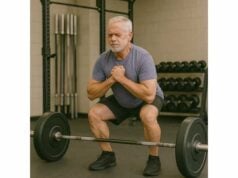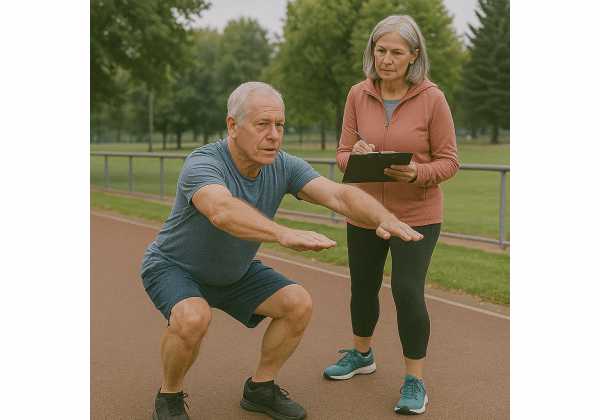
Fitness testing does not need a lab, a metabolic cart, or a complicated wearable dashboard. A small set of repeatable field tests shows whether your heart, lungs, muscles, balance, and everyday movement capacity are holding steady, improving, or slipping. The best tests are simple enough to repeat every few months and specific enough to guide training.
Longevity-focused fitness is not only about living longer. It is about keeping the physical reserve to climb stairs, carry groceries, recover from illness, get up from the floor, walk at a useful pace, and handle unexpected demands. Field tests help you see that reserve in action. They also reveal weak links before they turn into daily limitations.
Use these benchmarks as trend markers, not as judgments of worth. A single result gives a snapshot. Repeated results, measured the same way, show whether your routine is building the capacity you want for the next decade.
Table of Contents
- Why Field Tests Belong in a Longevity Plan
- Test Safety and Setup
- Aerobic Capacity Tests
- Strength and Muscle Endurance Tests
- Balance, Gait, and Mobility Tests
- How to Score Your Results
- How Often to Test and What to Change
- Common Mistakes and Red Flags
Why Field Tests Belong in a Longevity Plan
Field tests turn fitness into observable function. Instead of guessing whether your training is working, you measure a few abilities that connect directly to healthy aging: walking capacity, cardiorespiratory fitness, lower-body strength, grip strength, balance, and speed of movement.
The most useful benchmarks share four traits. They are safe for your current level, easy to standardize, sensitive to change, and tied to real life. A six-minute walk test reflects the ability to move continuously. A chair-stand test reflects the leg strength needed to rise from chairs, toilets, cars, and the floor. A grip test reflects upper-body strength and general muscle function. A single-leg stance shows balance control. Gait speed shows how well multiple systems work together.
These tests do not replace medical evaluation, imaging, lab work, or a formal VO₂max test. They fill a different role. They help you notice physical drift. They also make training more concrete. If your six-minute walk distance improves while your chair-stand score falls, your aerobic work is helping but your strength plan needs attention.
For a fuller clinical-style set of measures, functional longevity tests often combine grip, gait speed, and sit-to-stand performance because each one captures a different part of physical reserve.
A good testing plan also prevents over-focusing on one number. VO₂max matters, but it does not tell you whether you can carry a suitcase, avoid a fall, or get off the ground. Strength matters, but it does not tell you whether your walking pace has slowed. Longevity fitness needs several signals because daily independence depends on several systems working together.
Test Safety and Setup
Test only when you feel well, rested, and free of unusual pain, dizziness, chest pressure, shortness of breath at rest, fever, or a recent illness flare. Skip maximal or near-maximal tests if you have unstable heart disease, uncontrolled blood pressure, unexplained fainting, severe balance problems, or a medical condition that limits exertion unless a qualified clinician clears the test.
Use the same setup every time. Fitness tests lose value when the route, chair height, shoes, warm-up, surface, or instructions change. Your aim is not to create the best possible score once. Your aim is to create a fair comparison across months and years.
Before testing, prepare:
- A phone stopwatch or timer
- A flat walking route, hallway, track, or measured loop
- A stable chair, ideally 43–45 cm high
- Comfortable shoes
- A notebook or spreadsheet
- Optional: heart rate monitor, blood pressure cuff, handgrip dynamometer
Warm up for five to ten minutes with easy walking, gentle joint circles, and a few practice movements. Do not stretch aggressively before strength or balance tests. Do not test hard aerobic capacity after a heavy leg workout, poor sleep, alcohol, dehydration, or a stressful travel day.
Record the conditions beside the result. Note the date, time of day, sleep quality, recent training, medication changes, pain level, and anything unusual. These notes explain outliers. A lower score after illness does not mean the plan failed. It means the body was not ready for peak performance that day.
Keep the first testing session conservative. Learn the tests, practice the timing, and establish your baseline. Stronger efforts make sense once you understand the procedure and know how your body responds.
Aerobic Capacity Tests
Aerobic capacity reflects how well your heart, lungs, blood vessels, and muscles deliver and use oxygen during sustained movement. Higher cardiorespiratory fitness is one of the strongest fitness signals linked with lower risk of chronic disease and premature mortality. Lab-based VO₂max testing gives the most precise measure, but field tests still show useful trends.
Use one aerobic test as your main benchmark. More is not better. Choose the test that fits your current fitness, orthopedic tolerance, and available space.
Six-minute walk test
The six-minute walk test is the best starting point for most adults. It measures how far you can walk in six minutes on a flat surface. It is simple, repeatable, and more forgiving than a run test.
Set up a measured route. A 20–30 m hallway or flat outdoor stretch works well. Mark both ends. Walk as far as possible in six minutes without running. You may slow down if needed, but keep moving unless you must stop for safety. Record total distance in meters.
Use the same route each time. Tight turns reduce distance, so do not compare a hallway test with a track test. If you use a phone GPS outdoors, choose a route with a clear signal and avoid crowded paths.
A meaningful improvement often looks like 30–50 m over several months, especially for people starting from a lower fitness level. Smaller gains still count when they occur alongside lower effort, lower recovery heart rate, or better breathing control.
Twelve-minute Cooper walk-run test
The Cooper test estimates aerobic capacity from the distance covered in 12 minutes. It suits people who already tolerate brisk walking, jogging, or running. It is not ideal for people with joint pain, fall risk, recent injury, or low current fitness.
Use a track or accurately measured flat route. Cover as much distance as possible in 12 minutes. Walking is allowed, but the effort is hard. Record distance in meters.
A common VO₂max estimate is:
VO₂max = (distance in meters − 504.9) ÷ 44.73
This estimate is imperfect, but it tracks change well when conditions stay consistent. If you improve from 2,000 m to 2,200 m, your aerobic performance clearly improved even if the exact VO₂max estimate is not lab-grade.
People training specifically for higher aerobic capacity often combine easier endurance work with intervals. A structured VO₂max interval plan builds the high-intensity side, while easy steady work supports recovery and consistency.
Step test with heart rate recovery
A step test measures how your heart responds to a fixed workload. It is useful when outdoor testing is inconvenient. It also gives a recovery signal: how quickly heart rate falls after exertion.
Choose a stable step, often 20–30 cm high. Step up and down at a steady rhythm for three minutes, then stop and record heart rate at one minute after finishing. Lower recovery heart rate over time usually means better fitness, assuming the step height, rhythm, caffeine intake, temperature, and medications stay the same.
Use caution with step tests if you have knee pain, hip pain, balance issues, neuropathy, dizziness, or a history of falls. A brisk walk test is safer for many people.
Talk-test pace
The talk test gives a practical aerobic marker without formulas. Walk, cycle, row, or use an elliptical at the fastest pace where you can speak in full sentences but do not want to sing. Track pace, distance, or power at that effort.
This test pairs well with steady training. If your “full sentence” pace becomes faster over time, your aerobic base improved. Many adults benefit from regular Zone 2 training, but the talk test keeps the concept practical when lactate testing and precise heart rate zones are unavailable.
Strength and Muscle Endurance Tests
Strength protects independence. It helps you rise, climb, carry, brace, catch yourself, and maintain muscle during weight loss or illness. Muscle strength also supports metabolic health because active muscle improves glucose disposal and daily energy use.
Use two or three strength tests. At minimum, test one lower-body movement and one upper-body or grip measure.
Grip strength
Grip strength is one of the simplest strength benchmarks. It reflects hand and forearm strength, but it also tracks broader muscle function surprisingly well.
Use a handgrip dynamometer if available. Stand or sit tall with the elbow by your side, usually bent around 90 degrees unless your device instructions specify otherwise. Squeeze as hard as you can for three seconds. Test each hand two or three times, resting 30–60 seconds between attempts. Record the best score for each hand.
Track both the stronger hand and the weaker hand. A large side-to-side gap matters if it is new, painful, or linked to numbness, neck symptoms, or previous injury. For dedicated testing details, grip strength tools and protocols help standardize hand position, trial number, and interpretation.
Without a dynamometer, use carries. Pick a safe load in each hand, walk 20–40 m with tall posture, and record the heaviest load you can carry without dropping, leaning, or losing form. Farmer carries are less precise than a dynamometer but highly practical.
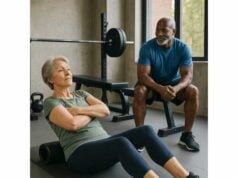
Thirty-second chair stand
The 30-second chair stand measures lower-body strength and muscle endurance. It is useful because standing up from a chair is a daily movement, not a gym trick.
Use a stable chair against a wall. Sit with feet flat, arms crossed over the chest, and back briefly touching the chair. Start the timer. Stand fully and sit back down as many times as possible in 30 seconds. Count only full stands.
Avoid bouncing off the chair. Keep knees tracking over feet. Stop if pain, dizziness, chest symptoms, or unsafe wobbling appears.
This test responds well to training. Squats, split squats, step-ups, leg presses, and progressive sit-to-stand variations all transfer. A simple weekly strength plan should raise this score over time, especially when training includes enough leg work and progressive overload.
Five-times sit-to-stand
The five-times sit-to-stand test measures how quickly you can stand up and sit down five times. It captures leg strength, power, coordination, and confidence.
Use the same chair setup as the 30-second test. Start seated with arms crossed. On “go,” stand fully and sit down five times as fast as safely possible. Stop the timer when you reach full standing on the fifth repetition.
This test is especially helpful when a 30-second effort feels too long. Faster times usually show better lower-body function, but safety and control matter more than speed. A shaky, collapsing, or painful fast score is not a good score.
Push-up or incline push-up test
Upper-body pushing strength supports getting up from the floor, catching yourself, pushing doors, and handling body weight. Floor push-ups work for some adults, but incline push-ups suit more people and reduce shoulder and wrist strain.
Choose a fixed surface: wall, kitchen counter, sturdy bench, or floor. Use the same height every time. Perform controlled repetitions with a straight body line and full range you can own. Stop when form breaks, not when you collapse.
Record the surface height and number of clean reps. A counter push-up score of 20 clean repetitions is not comparable with 20 floor push-ups, but it is valuable if you retest on the same counter.
Loaded carry
Loaded carries test grip, posture, trunk stiffness, gait control, and practical strength at the same time. They also reveal asymmetry. A suitcase carry, where weight sits on one side, challenges anti-lean control. A farmer carry, with weight in both hands, allows heavier loading.
Choose a fixed distance, such as 30 m. Record the load carried with safe posture, steady steps, and no grip failure. Stop before form breaks. For longevity training, carries often matter more than a one-repetition maximum because they resemble daily tasks.
Balance, Gait, and Mobility Tests
Balance and mobility determine how well strength and fitness translate into real-world movement. A strong person who cannot turn, walk quickly, or stand on one leg still has a gap in physical resilience.
These tests are especially useful after age 50, but younger adults benefit too. Balance starts declining before many people notice it.
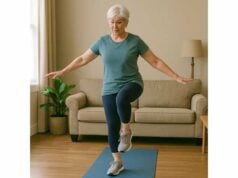
Single-leg stance
The single-leg stance test measures static balance. Stand near a wall or countertop without holding it. Lift one foot. Time how long you can stand on the other leg without touching down, gripping support, hopping, or pressing the raised foot into the standing leg.
Start with eyes open. Cap the test at 30 seconds per side for routine tracking. A 10-second minimum is a useful practical checkpoint in midlife and older age, but 30 seconds with quiet control gives a higher target for many active adults.
Test both sides. A major side-to-side difference matters. It often reflects ankle stiffness, hip weakness, vestibular issues, previous injury, or confidence differences.
Once 30 seconds is easy on both sides, progress training instead of chasing longer scores. Add head turns, uneven surfaces, slow marching, lateral stepping, and controlled reach drills. A daily balance and fall-prevention routine should include both stillness and movement.
Usual gait speed
Gait speed is one of the most practical aging benchmarks. It reflects leg strength, balance, nervous system function, pain, confidence, and aerobic reserve.
Mark a 4 m or 5 m walking zone with a short lead-in and lead-out. Walk at your normal comfortable pace. Time only the middle measured zone, not the acceleration and slowing phases. Divide distance by seconds to get meters per second.
Example: 4 m in 4 seconds = 1.0 m/s.
Usual walking speed below about 1.0 m/s deserves attention, especially if it is declining. Faster is not always better during a usual-pace test; the point is to measure natural walking, not sprint walking. You can also test fast gait speed separately if you want a challenge.
Walking capacity improves through consistent walking, hills, step-ups, loaded carries, and terrain practice. Longer routes and light loads can fit well when gait is stable; walking and rucking progressions help build endurance without turning every session into a run.
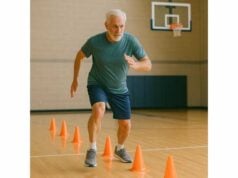
Timed Up and Go
Timed Up and Go, often called TUG, measures sit-to-stand ability, walking, turning, and sitting control. It is more dynamic than a simple gait speed test.
Place a chair against a wall. Mark a line 3 m away. Start seated. On “go,” stand up, walk to the line, turn around, return, and sit down. Time from “go” until you sit again.
Use your normal safe speed, not a reckless sprint. Record footwear, chair height, and whether you used arms. A slower time or a sudden decline deserves attention, especially with new unsteadiness, recent falls, or fear of turning.
Stair climb test
Stairs combine leg strength, power, balance, and aerobic demand. Choose a familiar staircase with a handrail. Count a fixed number of steps, such as one flight. Time how long it takes to climb safely at a brisk but controlled pace.
Use the same staircase each time. Record whether you used the rail. Holding the rail for light safety is different from pulling hard with the arms. Note that distinction.
Stair climbing is not suitable for everyone. Knee pain, hip pain, poor balance, dizziness, or unsafe breathlessness are reasons to choose chair stands and flat walking instead.
How to Score Your Results
The best scoring system is simple: compare yourself with your previous self, then use broad reference ranges to spot areas that deserve attention. Exact cutoffs vary by age, sex, height, body size, health status, testing method, and equipment. Trends matter more than a single category.
Use a three-level scorecard: strong, watch, and act.
| Test | Strong trend | Watch | Act |
|---|---|---|---|
| Six-minute walk | Distance rises or stays high with similar effort | Distance drops 5–10% without clear reason | Distance drops repeatedly or symptoms appear |
| Grip strength | Stable or improving best score on both sides | One side lags or both sides slowly decline | Sudden weakness, pain, numbness, or major asymmetry |
| Chair stand | More clean reps or same reps with better control | Reps decline despite normal effort | Unable to stand without arms if previously able |
| Single-leg stance | 10–30 seconds per side with quiet control | Large side-to-side difference | Frequent loss of balance or recent falls |
| Gait speed | Comfortable pace stays steady or improves | Walking feels slower or less confident | Clear decline, shuffling, freezing, or unsafe turning |
A useful benchmark should guide a change. If a number does not affect your decisions, stop measuring it. Your test battery should answer questions such as:
- Is my aerobic base improving?
- Do I have enough leg strength for daily independence?
- Is my grip declining?
- Do I move safely on one leg, during turns, and on stairs?
- Is my training balanced, or am I overbuilding one quality while neglecting another?
Look for patterns across tests. Low six-minute walk distance with decent strength points toward aerobic conditioning. Low chair-stand score with decent walking points toward leg strength. Poor single-leg stance with good strength points toward balance, ankle-foot control, vision, vestibular function, or confidence. A decline across every test often points to illness, under-recovery, medication changes, pain, sleep loss, or low overall activity.
Do not test only strengths. People naturally repeat the scores that make them feel capable. Longevity testing works better when it includes at least one test you do not enjoy. That result often carries the most useful training information.
How Often to Test and What to Change
Retest every eight to twelve weeks for most benchmarks. That gives enough time for training adaptations while avoiding constant self-auditing. Retest sooner only after a specific change, such as returning from illness, rebuilding after injury, or checking whether a new walking plan is working.
Do not test everything on one exhausting day. A simple schedule works better:
| Frequency | Tests | Purpose |
|---|---|---|
| Monthly | Gait speed, single-leg stance, optional grip | Catch early movement changes |
| Every 8–12 weeks | Six-minute walk, chair stand, grip, TUG | Track training response |
| Every 3–6 months | Cooper test, stair climb, loaded carry | Assess higher-effort capacity |
| After illness or injury | Reduced version of usual tests | Guide safe return |
When a result improves, identify what likely worked. Better walking distance may come from more weekly steps, hills, intervals, weight loss, improved sleep, or better pacing. Better chair stands may come from progressive squats and step-ups. Better balance may come from daily practice rather than longer workouts.
When a result declines, change one or two variables instead of overhauling everything. A clear response plan beats vague motivation.
If aerobic capacity is the weak link, add two to four weekly sessions of easy-to-moderate continuous movement. Start with 20–30 minutes and build gradually. Add one higher-intensity interval session only after the base feels comfortable and joints tolerate the work.
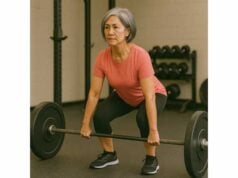
If lower-body strength is the weak link, train legs two or three times weekly. Use sit-to-stands, squats, step-ups, split squats, hip hinges, and loaded carries. Progress by adding reps, range of motion, load, or control. Avoid chasing soreness. Consistent loading works better than occasional punishment.
If balance is the weak link, practice briefly most days. Two to five minutes of balance work after brushing your teeth, during a warm-up, or after a walk beats one long session every two weeks.
If mobility limits the tests, address the joint that blocks clean movement. Ankles affect gait, balance, stairs, and squats. Hips affect stride length, chair stands, and turning. Shoulders and thoracic spine affect carries and push-ups. A targeted mobility routine helps when stiffness limits performance more than strength does.
If every score worsens, reduce intensity and examine recovery. Training does not build fitness during the stress itself; it builds fitness when the body adapts after the stress. Poor sleep, low energy intake, dehydration, pain, and high life stress can turn a good plan into a draining one.
Common Mistakes and Red Flags
The most common mistake is testing too hard too often. Field tests should guide training, not replace it. A six-minute walk every few days turns into a workout and stops being a clean benchmark. Maximal efforts also carry more injury risk when repeated casually.
Another mistake is changing the setup. A different chair height changes sit-to-stand scores. A different walking route changes six-minute walk distance. Different shoes can change gait and balance. A new dynamometer setting changes grip strength. Standardization is the difference between useful tracking and noise.
People also overreact to normal variation. One poor day does not prove decline. Retest once under better conditions before making conclusions. Look for repeated changes, especially when paired with symptoms or daily-life changes.
Do not ignore red flags. Stop testing and seek professional guidance if you notice:
- Chest pain, pressure, or unusual shortness of breath
- Fainting, near-fainting, or new dizziness during exertion
- New one-sided weakness, numbness, or coordination trouble
- Repeated falls or sudden fear of walking
- Rapid decline in walking speed or stair ability
- Severe joint pain, swelling, or giving way
- Resting blood pressure that is repeatedly very high
- Unexplained weight loss, fatigue, or exercise intolerance
Use extra caution after respiratory infections, surgery, long travel, medication changes, or a long inactive period. Returning to previous scores takes time. Start with easier versions and build back.
A useful longevity testing battery is small enough to keep. Choose one aerobic test, one leg strength test, one grip or carry test, one balance test, and one gait or mobility test. Record them honestly. Retest on a schedule. Train the weak links. Over years, that steady loop protects the physical abilities that make longer life feel usable, independent, and active.
References
- Cardiorespiratory fitness is a strong and consistent predictor of morbidity and mortality among adults: an overview of meta-analyses representing over 20.9 million observations from 199 unique cohort studies 2024 (Review)
- Thresholds of handgrip strength for all-cause, cancer, and cardiovascular mortality: A systematic review with dose-response meta-analysis 2022 (Systematic Review)
- World guidelines for falls prevention and management for older adults: a global initiative 2022 (Guideline)
- Six-Minute Walk Test 2025 (Review)
- Successful 10-second one-legged stance performance predicts survival in middle-aged and older individuals 2022 (Cohort Study)
- WHO guidelines on physical activity and sedentary behaviour 2020 (Guideline)
Disclaimer
This article is educational and does not replace medical care, physical therapy, or individualized exercise guidance. Speak with a qualified clinician before performing fitness tests if you have heart disease, uncontrolled blood pressure, recent surgery, unexplained symptoms, a history of falls, or a condition that affects safe movement. Stop any test that causes chest symptoms, faintness, severe pain, or unusual shortness of breath.