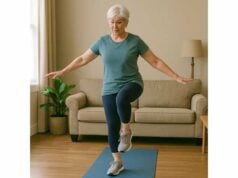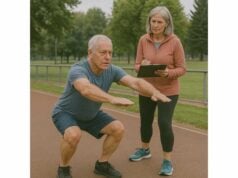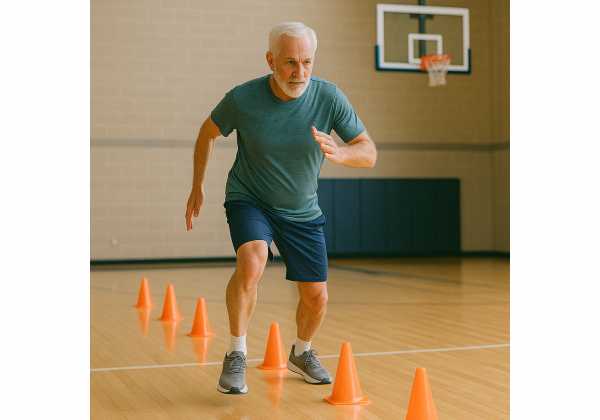
Agility keeps everyday movement smooth when life stops being predictable. A missed curb, a dog crossing your path, a grandchild running toward you, a slippery kitchen floor, or a fast change of direction in a crowded shop all ask the body to notice, decide, and move in a fraction of a second. Reaction time is the “notice and respond” part. Agility is the full-body follow-through: step, brake, turn, reach, recover, and keep balance.
These skills fade when they are ignored, but they also respond well to practice. The best drills for healthy aging are not frantic sports drills. They are short, safe, progressive exercises that train quick feet, visual attention, balance, braking strength, and confident direction changes. A few minutes of this work two or three times a week adds a missing layer to walking, strength training, balance practice, and everyday movement.
Table of Contents
- Why Agility and Reaction Time Matter After Midlife
- How Aging Changes Quick Movement
- Safety Setup Before Drills
- Warm-Up and Base Skills
- Reaction Time Drills You Can Do Anywhere
- Agility Drills for Real-Life Movement
- Dual-Task Drills for Brain and Body
- Weekly Plan, Progression, and Tracking
Why Agility and Reaction Time Matter After Midlife
Agility protects the split second between “something changed” and “I recovered.” Strength, endurance, and mobility all matter, but quick adjustment uses a different skill set. The body must read the environment, choose the right step, create force fast, stop force safely, and return to balance.
Reaction time is the delay between a signal and your first response. The signal might be visual, such as a light changing or a ball dropping. It might be sound, such as someone calling your name from behind. It might be touch or balance, such as feeling your foot slip. Fast reaction alone is not enough. The response must also be accurate. A rushed step in the wrong direction increases risk.
Agility includes several linked abilities:
- Starting: moving from stillness without stumbling.
- Stopping: slowing down without collapsing at the knees or hips.
- Turning: changing direction while keeping the trunk controlled.
- Reaching: moving the arms while the feet keep support.
- Recovering: taking a quick corrective step after a wobble.
- Scanning: using vision to find obstacles, openings, and moving people.
- Choosing: reacting to the right signal while ignoring distractions.
This is why agility training belongs beside strength, walking, and balance work. A solid strength training plan builds the engine. Agility teaches the engine to respond quickly and under control.
Daily life gives many examples. A person walking well on flat ground still needs agility when stepping around a puddle, turning in a narrow hallway, catching a toe on a rug, moving through a busy airport, or carrying groceries while opening a door. These situations blend balance, power, attention, and timing.
Agility also supports confidence. People who lose trust in quick movement often shrink their movement world. They avoid uneven paths, stairs, group activities, dancing, gardening, travel, and games. Less movement then weakens the exact systems that protect independence. Gentle agility practice breaks that cycle by making quick movement familiar again.
How Aging Changes Quick Movement
Quick movement changes with age because the nervous system, muscles, joints, vision, and balance systems all contribute. The change is not only “slower muscles.” It is slower information processing, weaker force production, less ankle stiffness, reduced foot sensation, more cautious stepping, and lower confidence under time pressure.
The nervous system has to detect a signal, process it, select a movement, and send the command to the muscles. With age, that chain often slows. Complex reactions slow more than simple ones. Pressing a button when a light appears is simple. Choosing whether to step left, step right, stop, or reach is complex. Everyday life mostly uses complex reactions.
Muscle power also declines faster than maximal strength. Strength is the amount of force you produce. Power is how quickly you produce it. Getting out of a chair slowly uses strength. Catching yourself after a trip requires power. That is why agility drills should include gentle starts, stops, and fast-but-small steps, not just slow balance holds.
Vision adds another layer. Depth perception, contrast sensitivity, and peripheral awareness influence how early you notice a curb edge, a pet, a wet floor, or a moving cyclist. Good lighting, updated lenses, and contrast-friendly environments help training carry into real life. If visual changes affect confidence, vision and contrast strategies deserve attention alongside exercise.
Balance also becomes more task-specific. Standing still on one leg is useful, but it does not fully prepare the body for turning, stepping over an object, or responding to a surprise. The vestibular system in the inner ear helps detect head position and motion. The feet and ankles report ground contact. The eyes guide direction. Agility training blends these systems at low risk.
The most useful training principle is simple: practice the response you want before you need it. A careful, repeated side step teaches the hips and ankles how to catch the body. A planned turn teaches the feet to reposition before the torso twists. A light cue teaches the eyes and brain to trigger movement without panic.
Safety Setup Before Drills
Safe agility training starts with a boring setup and a sharp mind. The drill should challenge attention and movement, not create danger. Start with small steps, clear space, and a support option nearby.
Use a flat, dry surface with good lighting. Remove rugs, cords, pets’ toys, clutter, and loose objects. Wear shoes that grip the floor without sticking. A shoe that catches too much during turns raises knee and hip strain. Barefoot work is fine only when the feet tolerate it and the floor is safe.
Keep a stable support within one step during early sessions. A counter, rail, heavy table, or wall gives a quick hand contact if needed. Avoid using a chair that slides. For outdoor work, choose a smooth path before adding grass, gravel, slopes, or curbs.
Use this starting checklist:
- You have at least a 2-by-2-meter space.
- The lighting lets you see edges, objects, and floor texture.
- You feel alert, hydrated, and steady before starting.
- Pain is 0–2 out of 10 and does not change your walking pattern.
- Dizziness, chest pain, unusual shortness of breath, or new weakness is absent.
- A hand support is close during new or faster drills.
- The first round is slow enough to feel easy.
Intensity should feel crisp, not exhausting. Use a 0–10 effort scale. Most agility work for healthy aging sits around 3–6 out of 10. A short burst might feel like 7, but technique should stay clean. Stop the set when steps get noisy, knees cave inward, feet cross by accident, or attention fades.
Fatigue changes reaction quality. Do agility early in a workout after the warm-up, or do it as a short stand-alone session. Placing fast direction changes after heavy leg training increases stumble risk. Longer conditioning belongs later.
People with recent falls, osteoporosis with fracture history, neuropathy, Parkinson’s disease, stroke history, vestibular disorders, severe arthritis, or heart symptoms should use a clinician or physical therapist to adapt drills. That does not mean agility is off-limits. It means the dose, support, and progressions need expert matching.
Warm-Up and Base Skills
Agility feels better when the ankles, hips, trunk, and eyes wake up first. A five- to eight-minute warm-up is enough for most short sessions. The body should feel warmer, taller, and more responsive before any quick drill starts.
Begin with easy movement:
- Walk around the room or yard for 60–90 seconds.
- March in place for 30 seconds.
- Roll through the feet with 10 slow heel raises.
- Do 10 small hip hinges with hands on hips.
- Step side to side for 30 seconds.
- Turn the head gently left and right while walking slowly for 20–30 seconds.
- Practice two slow sit-to-stands if the session includes starts or braking.
For a more complete preparation routine, use joint prep and activation before agility days. The warm-up should match the drills. If the session includes side steps, warm up side steps. If it includes turning, warm up slow turns.
Three base skills make most drills safer.
Athletic-ready stance
Stand with feet about hip-width apart, knees soft, ribs stacked over the pelvis, and weight spread through the whole foot. The heels stay down. The toes stay relaxed. This stance prepares the body to move in any direction.
Practice shifting weight forward, backward, left, and right without lifting the feet. Keep the head level. This teaches control before speed.
Quiet stepping
Quiet steps show good control. Loud, slapping feet often mean the body is rushing or landing stiffly. Practice stepping forward, backward, and sideways with soft knees and quiet feet. The foot should land under control, not crash into the floor.
Quiet stepping is especially helpful for people who feel heavy or uncertain during direction changes. It builds confidence without needing speed.
Braking
Braking is the ability to stop. It protects the knees, hips, back, and balance. Many people train starting but ignore stopping. In real life, stopping matters when someone crosses your path or a surface changes suddenly.
Practice taking two walking steps, then stopping with feet under hips. Hold the stop for two seconds. Keep the chest over the feet. Repeat 6–10 times. Progress by stopping after a slightly faster walk, then after a side step, then after a turn.
Braking links closely with balance and fall prevention. Slower controlled versions of these drills fit well with daily balance and fall prevention drills.
Reaction Time Drills You Can Do Anywhere
Reaction drills teach the body to respond to a signal. Start with simple signals, then add choices. Keep each set short. Twenty to thirty seconds of sharp practice beats two minutes of sloppy movement.
| Drill | How to Do It | Best Starting Dose | Progression |
|---|---|---|---|
| Ball drop | Hold a tennis ball at shoulder height, drop it, and catch it after one bounce. | 2 sets of 8 drops | Switch hands, stand farther away, or catch before the bounce. |
| Wall toss | Toss a soft ball to a wall and catch it with two hands. | 2 sets of 30 seconds | Alternate hands or call a color/number before each toss. |
| Phone timer step | Set a random timer. When it beeps, step to the side and return. | 6–10 beeps | Change the step direction after each beep. |
| Partner call | A partner calls “left,” “right,” “forward,” or “back.” Step once in that direction. | 2 sets of 10 calls | Add “freeze” or “turn.” |
| Card color step | Flip a playing card. Red means step right; black means step left. | 10–16 cards | Use suits for four directions. |
Ball drop is one of the easiest ways to train the eyes, hands, and timing. Use a tennis ball, reaction ball, or soft foam ball. A reaction ball with uneven edges bounces unpredictably, so use it only after regular ball work feels easy. Keep the knees soft and avoid lunging too far.
Wall toss trains tracking and hand speed. Stand close enough to catch cleanly. A soft ball is safer indoors. To make it more physical, catch the ball, take one side step, toss again, then step back.
Phone timer step works well for solo training. Several timer apps have random interval settings. Set the timer between 5 and 15 seconds. Stand in ready stance. When it beeps, step to the side, stop, and return. The point is not surprise panic. The point is a clean response.
Partner calls add choice. Choice reaction time matters more for everyday life than simple reaction time. A partner calling directions forces the brain to process meaning before moving. Keep the commands clear and slow at first.
Card color stepping is simple and surprisingly useful. Shuffle a deck. Flip one card at a time. Red means right, black means left. Later, hearts mean forward, diamonds mean back, clubs mean left, spades mean right. Stop before the drill turns messy.
Use reaction drills before agility drills, not after you are tired. The brain learns best when attention is fresh.
Agility Drills for Real-Life Movement
Agility drills should look like controlled versions of real movement: stepping around, turning, stopping, reaching, and changing direction. You do not need ladders, cones, or sports equipment, though they help. Tape on the floor, water bottles, books, or chalk marks work well.
The four-square step
Place tape on the floor in a plus sign to make four squares, or imagine the pattern. Step forward, side, back, and side to return to the start. Move slowly at first. Keep the eyes forward instead of staring at the feet the whole time.
Start with 2 rounds each direction. Rest 45–60 seconds. Progress by making the steps quicker, then by adding a partner call, then by carrying a light object.
This drill trains the foot repositioning needed for crowded rooms, kitchen turns, and avoiding obstacles. It also reveals asymmetry. If stepping left feels much harder than stepping right, spend extra slow practice on that side.
Cone clock
Imagine standing in the center of a clock. Place markers at 12, 3, 6, and 9 o’clock. Step to 12 and return. Step to 3 and return. Step to 6 and return. Step to 9 and return. Keep the return controlled.
Start with 1–2 rounds. Progress by adding diagonal points: 1:30, 4:30, 7:30, and 10:30. Diagonal stepping matters because trips and slips rarely happen in perfect straight lines.
Start-stop walk
Walk forward for three steps, stop quickly but softly, hold for two seconds, then walk again. Use a hallway or outdoor path. The stop should feel stable, not jarring.
Progress in this order:
- Slow walk and stop.
- Brisk walk and stop.
- Brisk walk, turn 90 degrees, and stop.
- Brisk walk, respond to a partner’s “stop” command.
- Brisk walk, carry a light grocery bag, and stop.
Start-stop work builds braking strength and attention. It pairs well with safe power training because both train fast force under control.
Step-around obstacle
Place a small object on the floor, such as a yoga block or folded towel. Walk toward it, step around it, and continue. Keep the object low at first. The purpose is not to jump over it. It is to notice, adjust, and keep moving.
Progress by approaching from different angles. Later, add a second object. Outdoors, use painted lines, leaves, or cracks as visual targets before using real uneven ground.
Low-impact bounce and stick
Stand tall, rise onto the balls of the feet, make a tiny bounce, and land quietly. Hold the landing for two seconds. The bounce should be small enough that it feels springy, not jarring.
This prepares the calves, ankles, and feet for quick adjustments. People who tolerate this well often enjoy low-impact plyometric progressions, but jumping is optional. Fast stepping gives many of the same practical benefits with less impact.
Dual-Task Drills for Brain and Body
Dual-task drills combine movement with thinking. They matter because daily life rarely asks the body to move in silence with full focus. People walk while talking, carry items while planning, cross streets while scanning traffic, and turn while answering a question.
The safest dual-task progressions start with steady movement, then add a light mental task. The movement should stay clean. If the mental task makes the feet shuffle, pause and lower the challenge.
Try these options:
- Walk and name animals from A to Z.
- Side step while counting backward by 2s.
- March in place while naming months backward.
- Step to a called direction while holding a light cup.
- Walk around cones while remembering three words.
- Toss a ball while naming a city, food, or color each catch.
A good dual-task drill creates mild mental pressure without embarrassment. The brain should work, but the body should not freeze. Keep the tone playful. Laughter is fine; rushing is not.
Use “priority rules.” During early practice, movement wins. If balance wobbles, stop speaking and regain control. Later, train flexible attention: sometimes prioritize walking smoothly, sometimes prioritize the mental task. This resembles real life, where attention shifts between the ground, traffic, conversation, and direction.
For deeper brain-body training ideas, dual-task training connects well with agility work. Walking quality also carries cognitive information, which is why gait speed, reaction time, and cognition are often discussed together in healthy aging.
A simple dual-task session might look like this:
- Warm up with 2 minutes of easy walking.
- Do 30 seconds of side steps.
- Rest 30 seconds.
- Do 30 seconds of side steps while naming foods.
- Rest 45 seconds.
- Do 6 partner direction calls.
- Finish with slow walking and relaxed breathing.
That is enough. Dual-task work does not need to be long. It needs to be clear, safe, and repeated.
Weekly Plan, Progression, and Tracking
Two or three short agility sessions per week work well for most healthy adults. Each session needs only 10–20 minutes. More is not automatically better. Quick movement quality drops when fatigue builds.
A balanced weekly plan includes reaction, agility, braking, and dual-task work. Use the drills like seasoning, not the main meal. Walking, strength training, mobility, and aerobic conditioning still form the base.
| Day | Focus | Session | Total Time |
|---|---|---|---|
| Day 1 | Reaction and stepping | Warm-up, ball drop, phone timer step, four-square step | 10–15 minutes |
| Day 2 | Braking and turning | Warm-up, start-stop walk, cone clock, slow turns | 12–18 minutes |
| Day 3 | Brain-body control | Warm-up, partner calls, side steps with counting, obstacle walk | 10–15 minutes |
Progress one variable at a time. This prevents a safe drill from becoming chaotic. Choose only one change every 1–2 weeks:
- Add 5–10 seconds to a set.
- Add one extra round.
- Reduce rest slightly.
- Increase step speed.
- Add a direction choice.
- Add a light carry.
- Add a gentle turn.
- Move from indoor flat ground to outdoor smooth ground.
- Add mild background distraction, such as music.
Avoid stacking progressions. Do not add speed, turns, obstacles, and a cognitive task on the same day. That turns training into a test.
Use simple tracking every four weeks. Record results, not judgments. Helpful options include:
- Time to complete a four-square step pattern.
- Number of clean ball catches out of 10.
- Number of accurate partner-call steps out of 12.
- Time for five sit-to-stands.
- Comfortable walking speed over a set distance.
- Confidence rating from 1–10 for turning, stepping around objects, or walking in busy places.
Functional tests give useful feedback when they are consistent and safe. The grip, gait speed, and sit-to-stand tests fit well with agility tracking because they show whether quick drills are supporting broader function.
Good progress feels like better control, not just faster times. You should notice quieter feet, fewer extra steps after stopping, easier turns, better confidence on uneven ground, and less hesitation when someone changes direction near you.
Pause agility work and get professional guidance if you notice new dizziness, faintness, chest pressure, sudden shortness of breath, new foot drop, new numbness, repeated near-falls, sharp joint pain, or swelling that changes your walking. Also pause if a drill creates fear that does not settle after simplifying it. Fear is useful information. The right adjustment keeps practice productive.
Agility training rewards patience. The first few sessions teach the drill. The next few weeks build rhythm. After that, the body starts to trust quick movement again. That trust is one of the most valuable fitness qualities for aging well.
References
- Effects of balance-based visual reaction time exercises on cognitive and physical performance in older adults: a randomized controlled trial 2025 (RCT)
- Effects of exercise intervention on falls and balance function in older adults: a systematic review and meta-analysis 2025 (Systematic Review)
- Agility training to integratively promote neuromuscular, cardiorespiratory and cognitive function in healthy older adults: a one-year randomized-controlled trial 2023 (RCT)
- The effect of different types of physical activity on cognitive reaction time in older adults in China 2022 (Original Research)
- World guidelines for falls prevention and management for older adults: a global initiative 2022 (Guideline)
- WHO Guidelines on Physical Activity and Sedentary Behaviour 2020 (Guideline)
Disclaimer
This article is educational and does not replace care from a qualified health professional. People with recent falls, dizziness, neurological symptoms, heart symptoms, major joint pain, osteoporosis with fracture history, or balance disorders should get individualized guidance before starting agility or reaction drills. Stop any drill that causes sharp pain, unusual breathlessness, chest discomfort, faintness, or loss of control.