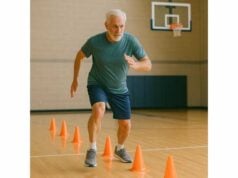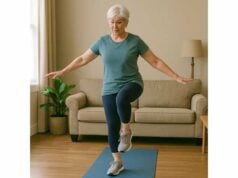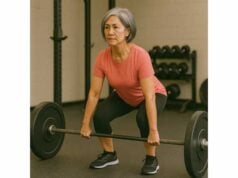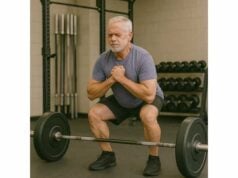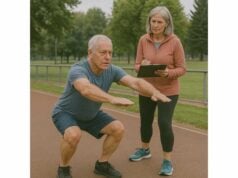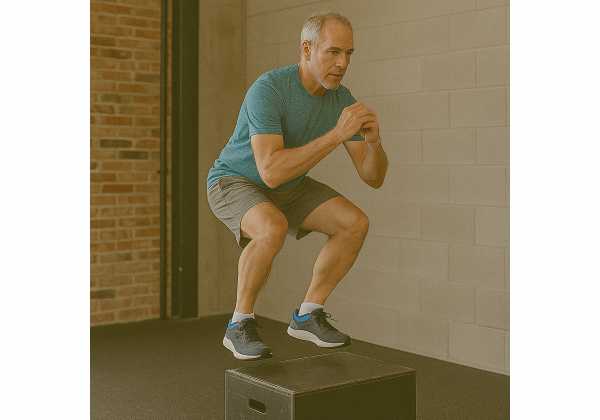
Low-impact plyometrics train the body to produce force quickly without turning every session into hard jumping. That matters with age because the ability to move fast often fades earlier than basic strength. A strong squat helps, but real life also asks for quick steps, fast balance corrections, stair power, and the ability to catch yourself when the ground changes under your feet.
The safest path is not box jumps on day one. It is a ladder: elastic heel raises, brisk step-ups, low pogo actions, small hops, quick medicine-ball throws, and controlled landings. The work should feel crisp, quiet, and repeatable. A few high-quality reps beat long, tiring sets. Done well, low-impact plyometrics add speed and spring to a training plan while respecting knees, hips, tendons, balance, and recovery.
Table of Contents
- Why Power Training Belongs in Healthy Aging
- What Low-Impact Plyometrics Are
- Safety Screen and Starting Point
- The Power Progression Ladder
- How to Build a Session
- Technique Cues for Joints and Balance
- Weekly Programs for Different Levels
- Common Mistakes and When to Stop
Why Power Training Belongs in Healthy Aging
Power is strength expressed quickly. It shows up when you climb stairs without grinding, rise from a chair with speed, step over a curb, catch your balance, or move your feet fast enough to avoid a trip. Strength gives you the force. Power helps you use it in time.
Muscle power tends to decline faster than maximal strength as adults age. This matters because daily tasks rarely happen at slow gym speed. A stumble gives you a fraction of a second. A stair climb asks for repeated bursts. A quick change of direction asks your ankles, knees, hips, and trunk to coordinate without delay.
Traditional strength training for longevity still belongs at the center of a healthy-aging plan. Squats, hinges, pushes, pulls, carries, and loaded step-ups build the tissue capacity that makes faster work safer. Low-impact plyometrics add a second layer: they train stiffness, timing, rhythm, tendon recoil, and fast force.
Plyometrics use the stretch-shortening cycle. A muscle-tendon unit lengthens briefly, stores elastic energy, then shortens. Think of a small bounce during a quick heel raise or the springy action of stepping up briskly. The aim is not reckless impact. The aim is a short, controlled “load and go” action.
For longevity training, the best plyometric drills share four traits:
- They use small ranges before larger ones.
- They keep landings quiet and controlled.
- They stop before fatigue changes form.
- They match the person’s current strength, balance, and joint tolerance.
Power training also supports confidence. Many adults gradually avoid quick movement because it feels risky. Avoidance makes the body slower and less prepared. A graded plan restores the skill in small bites: first fast intent, then rhythm, then small lift-off, then directional control.
Low-impact plyometrics fit especially well beside balance and fall prevention drills. Balance teaches position. Plyometrics add the missing speed.
What Low-Impact Plyometrics Are
Low-impact plyometrics are fast, spring-like movements that limit landing force. They use short contacts, small jumps, step-based power, medicine-ball throws, or assisted bouncing rather than high drop jumps or repeated maximal leaps.
The word “plyometric” often brings up images of athletes jumping onto tall boxes. That is only one narrow version. A healthier aging approach uses a wider toolbox.
A drill qualifies as low-impact when it keeps at least one of these safeguards in place:
- Both feet stay close to the floor.
- One foot stays on a step, floor, or support.
- The landing height is low.
- The movement uses the upper body instead of repeated lower-body landings.
- The drill uses a soft surface or an assisted position.
- The set ends while every rep still looks sharp.
A fast step-up, a quick heel pop, a low pogo, a wall-supported snap-down, and a light chest pass all train power. They simply do it without the joint load of aggressive jumps.
Low-impact does not mean easy. A well-done set of 5 crisp low pogos with perfect rhythm gives the calves, ankles, feet, and nervous system a clear signal. A fast step-up teaches hip and thigh power for stairs. A medicine-ball scoop toss teaches the hips and trunk to transfer force quickly without landing stress.
| Training effect | Lower-impact drill | Best use |
|---|---|---|
| Ankle spring | Fast heel raise, low pogo, jump-rope bounce without rope | Foot and calf stiffness for walking speed and quick steps |
| Stair power | Brisk step-up, step-up to knee drive, low step-up hop | Climbing stairs, hiking, curb confidence |
| Landing skill | Snap-down to athletic stance, small squat landing | Learning to absorb force quietly |
| Lateral control | Side step and stick, low lateral bound, skater step | Direction changes and fall-risk reduction |
| Upper-body power | Medicine-ball chest pass, slam, scoop toss | Power without lower-body impact |
Low-impact plyometrics work best when paired with strength. A person who cannot control a slow step-down usually should not start with hopping. A person who cannot land softly from a tiny heel pop needs landing practice before jump volume. The sequence protects joints and builds skill.
This is also where bone density and impact training overlap. Bones respond to mechanical loading, but impact dose needs care. A small number of controlled contacts, progressed slowly, often gives a better long-term path than occasional hard jumping that irritates knees, hips, or Achilles tendons.
Safety Screen and Starting Point
The right starting point is the easiest drill that looks athletic, quiet, and pain-free. Many adults start too high because they judge plyometrics by effort. Judge them by quality instead.
Before adding lower-body plyometrics, check four basics.
First, you should tolerate normal walking, stairs, and light strength work without next-day joint flare. Muscle effort is fine. Sharp joint pain, tendon pain that warms up then returns worse, or swelling means the drill is too much for now.
Second, you should control single-leg stance for 10 to 20 seconds per side near a wall or rail. Perfect stillness is not required, but you should avoid grabbing for support every second. Plyometrics do not replace balance work; they build on it.
Third, you should perform 8 to 10 slow bodyweight squats or sit-to-stands with steady knees and even foot pressure. You do not need a deep squat. You need control.
Fourth, you should complete 8 controlled step-ups per side on a low step, around 10 to 20 cm high, without knee collapse, hip shift, or breath holding. Step height should match your body, not your ego.
People with osteoporosis, recent fractures, joint replacement, symptomatic heart disease, uncontrolled blood pressure, neuropathy, active vertigo, severe balance impairment, or recent tendon injury need individualized guidance. Low-impact options still exist, but the entry point often shifts toward supported drills, aquatic work, machine-based power, or medicine-ball training.
Use this traffic-light guide during and after sessions:
| Signal | Meaning | Next step |
|---|---|---|
| Green | No sharp pain, quiet landings, normal movement the next day | Keep the same dose or add a small progression after 2–3 good sessions |
| Yellow | Mild stiffness under 24 hours, form gets noisy, balance feels rushed | Repeat the easier version, reduce contacts by 25–50%, or use more support |
| Red | Sharp pain, swelling, limping, tendon pain, chest symptoms, dizziness | Stop the drill and use professional guidance before resuming |
Good surfaces help. Use flat ground, a firm mat, rubber gym flooring, grass that is not slippery, or a track. Avoid slick tiles, uneven pavement, deep sand, thick foam, and cluttered spaces. Shoes should feel stable and secure. Barefoot bouncing requires strong feet and gradual exposure; it is not a beginner shortcut.
A simple readiness test is the “quiet five.” Hold a wall or rail lightly and do 5 quick heel raises. If you land quietly, keep the ribs stacked over the pelvis, and feel the work in calves rather than knees or low back, ankle-based drills fit. If those 5 reps feel jarring, stay with strength, mobility, and supported rhythm first.
The Power Progression Ladder
The safest plyometric plan moves from fast intent to small elastic contacts, then to direction and height. Each rung earns the next one. Most adults spend 2 to 4 weeks on a rung before moving up, but the body sets the schedule.
Rung 1: Fast strength without leaving the ground
Start with power intent. Move the lifting phase fast, then lower with control. Examples include fast sit-to-stands, brisk step-ups, band rows pulled quickly, and light kettlebell deadlifts lifted with speed. The load stays light to moderate. Form stays clean.
A useful dose is 2 to 4 sets of 3 to 6 reps. Rest 45 to 90 seconds. Each rep should feel snappy. Stop when speed drops. This rung builds the habit of moving fast without the complexity of landing.
This pairs well with squat, hinge, push, and pull technique, because cleaner patterns make faster patterns safer.
Rung 2: Elastic ankle and foot work
Now add small spring. Use wall-supported fast heel raises, low pogo holds, and tiny bounce rhythms. Keep knees soft but not deeply bent. The ankles do most of the work. Imagine the floor is hot and you want short, light contacts.
Start with 2 sets of 5 to 10 contacts. A contact is one landing. Beginners often need only 20 to 40 total contacts in a session. That is enough.
Good choices:
- Wall-supported fast heel raise: rise quickly, lower under control.
- Low pogo pulse: tiny two-foot bounce, barely leaving the floor.
- March-and-pop: alternate a brisk knee lift with a small push through the stance foot.
- Rope-free bounce: mimic easy jump rope without the rope.
The calves and feet adapt slowly. Increase contact volume gradually, especially if you have a history of plantar fascia, Achilles, calf, or shin irritation.
Rung 3: Step-based power
Step drills bring power into a daily-life pattern. Use a low step first. Drive through the full foot, stand tall, and step down quietly. The step-down matters as much as the drive up.
Progressions include:
- Brisk step-up.
- Step-up to knee drive.
- Step-up with fast arms.
- Low step-up hop, only after the first three are easy.
For most adults, a 10 to 20 cm step is plenty at first. Taller steps change the joint angles and often shift stress into the knee or hip. Increase speed before height.
Step-based plyometrics blend well with walking, terrain, and rucking work, especially for people who hike, travel, garden, or climb stairs often.
Rung 4: Landing and sticking
Landing is a skill. Practice it before you add repeated jumps. The landing position should look like a small athletic squat: feet grounded, knees tracking over toes, hips back slightly, ribs down, eyes forward.
Start with snap-downs. Rise onto toes with arms overhead, then quickly drop into a quarter squat and freeze for 2 seconds. Nothing leaves the floor. This teaches the body to absorb force.
Then try a small squat landing from a heel raise. Lift the heels, make a tiny drop, and stick the landing. Progress only when the landing is quiet.
Use 2 to 3 sets of 3 to 5 reps. The freeze matters. If you cannot hold the landing, you did not own it.
Rung 5: Small jumps and directional control
Small jumps come late, not first. Begin with low vertical jumps, line hops, or side step-and-stick drills. Keep the jump height small enough that the landing stays silent.
Good progressions:
- Tiny squat jump and stick.
- Forward line hop and stick.
- Side step-and-stick.
- Low lateral bound and stick.
- Low continuous pogos for 5 to 8 contacts.
Directional work protects real-world movement. Life is not only up and down. A lateral step to avoid a pet, a quick turn in a grocery aisle, or a recovery step on uneven ground all require sideways power. Add lateral work slowly and keep the landing width comfortable.
Rung 6: Reactive power
Reactive drills ask you to respond to a cue. Use them only after landings and small jumps are reliable. Examples include partner hand signals, gentle ball drops, color calls, or “go” commands for a fast step.
A simple drill: stand in a ready position. A partner points left or right. You take one quick step, stick the position, and reset. This blends power, reaction time, balance, and attention. It also fits well with agility and reaction time drills.
Keep reactive drills short: 4 to 8 total cues per set, 2 to 3 sets. The nervous system learns best when the reps are fresh.
How to Build a Session
Low-impact plyometrics belong near the start of a workout, after a warm-up and before tiring strength or conditioning. Power needs a fresh nervous system. Doing hops after a hard leg session turns a crisp skill into survival.
A complete session has four parts: warm-up, power block, strength block, and easy finish.
The warm-up should raise temperature and prepare the joints you will use. A good joint prep and activation warm-up takes 6 to 10 minutes. Include walking or cycling, ankle rocks, hip hinges, bodyweight squats, calf raises, and a few practice reps of the first power drill.
The power block is short. Use 1 to 3 drills, 2 to 4 sets each, and 3 to 8 reps or contacts per set. Rest enough to feel sharp again. This usually means 45 to 120 seconds. More rest is not laziness; it protects speed.
The strength block builds the tissue that supports power. Choose lower-body and trunk patterns that match the day: squat or step-up, hinge, row or press, carry, and anti-rotation core work. The power block should not exhaust you before this work.
The finish should calm the system. Use easy walking, breathing, or light mobility. Hard intervals after plyometrics are not wrong, but they raise total stress. Place them on a separate day or keep the plyometric dose lower.
| Part | Time | Example |
|---|---|---|
| Warm-up | 6–10 minutes | Brisk walk, ankle rocks, calf raises, bodyweight squats, practice landings |
| Power block | 6–12 minutes | 2 drills, 3 sets each, 3–6 crisp reps |
| Strength block | 20–35 minutes | Step-up, hinge, row, press, carry, trunk control |
| Finish | 3–8 minutes | Easy walk, relaxed breathing, light calf and hip mobility |
Most adults do well with 1 to 2 low-impact plyometric sessions per week. Active, well-trained adults sometimes use 3 short exposures, but each one should be modest. Tendons, feet, and joints prefer steady dosing.
For contact volume, start lower than you think:
- Beginner: 20 to 40 lower-body contacts per session.
- Intermediate: 40 to 70 contacts per session.
- Advanced recreational trainee: 60 to 100 contacts per session, only with excellent tolerance.
Medicine-ball throws are counted separately because they do not load the lower-body landing the same way. A good starting point is 12 to 24 total throws.
Progress one variable at a time. Add contacts, height, distance, speed, complexity, or reduced support—not all at once. A practical rule is the 10–20% ceiling: total contacts should not rise by more than about 10–20% from one week to the next.
Training notes help. Record the drill, sets, reps, surface, shoes, and next-day response. You can also use simple fitness benchmarks such as sit-to-stand speed, stair comfort, walking pace, or a controlled step-up test to track whether power work is transferring to daily life.
Technique Cues for Joints and Balance
Good plyometric technique is quiet, stacked, and springy. Loud landings are feedback. They usually mean the drill is too high, too fast, too tired, or poorly organized.
Start with the feet. Land through the midfoot with the heel allowed to kiss down when appropriate. Do not force a stiff toe-only landing. The foot should act like a tripod: big toe base, little toe base, and heel all connected. If the arch collapses hard or the ankle rolls, reduce the drill and use support.
The knees should track in the same general direction as the toes. They do not need to stay perfectly still, but they should not dive inward. A small knee bend absorbs force. A deep, slow squat after every landing changes the drill into conditioning and often increases fatigue.
The hips should share the load. On landings, sit slightly back and keep the pelvis level. On step-ups, drive through the working leg rather than pushing off the rear foot. On lateral drills, stick the landing with the hip over the foot instead of letting the torso drift outside the base of support.
The trunk should stay tall but not rigid. Ribs stacked over pelvis gives the legs a better platform. Breath holding, neck tension, and flared ribs often show that the drill is too intense. This connects naturally with bracing and breathing for lifting, because the same trunk control supports faster movement.
Arms matter. They help rhythm and balance. Use natural arm drive on step-ups and small jumps. For beginners, hands on a wall or rail create enough support to learn the pattern without fear. Support is not cheating. It is a bridge to better skill.
For joint comfort, match the drill to the person:
- Sensitive knees often prefer step-ups, supported pogos, and medicine-ball throws before squat jumps.
- Sensitive hips often prefer lower step heights and smaller lateral ranges.
- Sensitive Achilles tendons often need fewer contacts, more rest, and slower calf-strength progressions.
- Low-back sensitivity often improves when jump height drops and trunk stiffness improves.
People with knee or hip irritation should build the surrounding plan around joint-friendly training modifications. Plyometrics should never become the one drill that keeps reigniting symptoms.
A simple cue works for almost every drill: “Fast up, soft down, freeze.” Move with intent. Land quietly. Own the position before repeating.
Weekly Programs for Different Levels
The right weekly plan depends on training age, joint history, balance, and recovery. The examples below assume the person also does strength training, aerobic work, and daily walking. Plyometrics are a small addition, not the whole program.
Beginner plan: restore spring without jumping hard
Use this level if you are new to power training, returning after a layoff, or cautious about joints.
Day 1 power block:
- Wall-supported fast heel raise: 3 sets of 5 reps.
- Brisk low step-up: 3 sets of 4 reps per side.
- Medicine-ball chest pass or wall push throw: 2 sets of 6 reps.
Day 2 power block, 3 or 4 days later:
- Snap-down to quarter squat: 3 sets of 3 reps.
- March-and-pop: 2 sets of 5 per side.
- Medicine-ball scoop toss: 2 sets of 5 reps.
Keep every set fresh. If the calves feel tight the next day, reduce the ankle contacts and keep the medicine-ball work.
Intermediate plan: add low contacts and direction
Use this level after 4 to 8 weeks of smooth beginner work.
Day 1 power block:
- Low pogo: 3 sets of 8 contacts.
- Step-up to knee drive: 3 sets of 5 per side.
- Medicine-ball slam: 3 sets of 5 reps.
Day 2 power block:
- Snap-down and stick: 3 sets of 4 reps.
- Side step-and-stick: 3 sets of 4 per side.
- Tiny squat jump and stick: 3 sets of 3 reps.
This plan introduces more landing skill but keeps total contact volume moderate. If the tiny jumps become loud, return to snap-downs for another week.
Advanced recreational plan: controlled hops and reaction
Use this level if you already strength train, tolerate small jumps, and move confidently in multiple directions.
Day 1 power block:
- Low pogo: 4 sets of 10 contacts.
- Low step-up hop: 3 sets of 3 per side.
- Medicine-ball rotational scoop toss: 3 sets of 4 per side.
Day 2 power block:
- Forward line hop and stick: 3 sets of 4 per side.
- Low lateral bound and stick: 3 sets of 3 per side.
- Partner cue step: 3 sets of 6 cues.
Advanced does not mean maximal. It means more precise, more directional, and more reactive. Keep the height low enough to control.
A weekly layout often works best like this:
| Day | Training focus | Notes |
|---|---|---|
| Monday | Power plus lower-body strength | Short plyometric block before step-ups, squats, or hinges |
| Tuesday | Easy aerobic work | Walk, cycle, or Zone 2 pace |
| Wednesday | Upper body, trunk, mobility | Medicine-ball throws fit here if legs need rest |
| Thursday | Power plus full-body strength | Use different drills than Monday |
| Friday | Easy movement | Walk, light mobility, balance practice |
| Weekend | Outdoor activity or recovery | Hills, stairs, gardening, hiking, or relaxed rest |
Recovery determines progress. If sleep is poor, stress is high, or legs feel heavy, use fast strength or medicine-ball throws instead of hops. If tendons feel springy and joints feel calm, continue the planned rung. This is basic session design for healthspan: enough stimulus to adapt, not so much that training becomes a cycle of flare-ups.
Common Mistakes and When to Stop
The most common mistake is doing too much because the first session feels easy. Plyometrics often feel fine during the workout and announce themselves the next morning. Calves, Achilles tendons, feet, knees, and hips need gradual exposure. Start with less than you think you need.
The second mistake is chasing height. Higher jumps are not the point for most adults. Better landings, faster step-ups, cleaner rhythm, and sharper reactions transfer more directly to daily life. A 10 cm jump done well beats a 40 cm jump done with noise and fear.
The third mistake is using fatigue as proof of success. Plyometrics are skill and power work. They should not feel like a long conditioning circuit. When reps slow, landings get loud, or balance gets sloppy, the set is over.
The fourth mistake is ignoring strength. Low-impact plyometrics build spring, but they do not replace progressive loading. Hips, thighs, calves, trunk, and upper body still need strength work. The combination gives better durability than either method alone.
The fifth mistake is skipping regressions. A regression is not failure. It is precision. Wall support, lower steps, fewer contacts, lighter medicine balls, and longer rest all improve training quality.
Stop a plyometric drill immediately if you notice:
- Sharp pain in a joint, tendon, bone, or muscle.
- New swelling or warmth around a joint.
- Achilles or plantar fascia pain that changes your walking.
- Dizziness, chest pain, unusual breathlessness, or irregular heartbeat.
- Loss of balance that feels unsafe.
- Landings that stay loud after reducing height and speed.
Use a 24-hour rule. If a session creates soreness that changes your gait, makes stairs worse, or lingers beyond the next day, the dose was too high. Cut contact volume by 25–50% next time and choose the previous rung.
Low-impact plyometrics should leave you feeling more coordinated, not beaten up. Over months, the benefits should show up as quicker stairs, livelier walking, steadier balance reactions, and more trust in your body. The aim is not to train like a jumper. It is to keep enough spring, speed, and control to move through daily life with confidence.
References
- Older Adult Activity: An Overview 2025 (Guideline)
- Comparison of Power Training vs Traditional Strength Training on Physical Function in Older Adults: A Systematic Review and Meta-analysis 2022 (Systematic Review)
- Effects of plyometric training on health-related physical fitness in untrained participants: a systematic review and meta-analysis 2024 (Systematic Review)
- An age-adapted plyometric exercise program improves dynamic strength, jump performance and functional capacity in older men either similarly or more than traditional resistance training 2020 (RCT)
- Effects of Plyometric Training on Physical Performance: An Umbrella Review 2023 (Review)
- The Efficacy and Safety of Lower-Limb Plyometric Training in Older Adults: A Systematic Review 2019 (Systematic Review)
Disclaimer
This article is educational and does not replace care from a qualified clinician, physical therapist, or certified exercise professional. Get personal guidance before starting plyometrics if you have osteoporosis, recent fracture, joint replacement, tendon injury, balance problems, heart symptoms, uncontrolled blood pressure, neuropathy, or unexplained pain. Stop any drill that causes sharp pain, swelling, dizziness, chest symptoms, or unsafe loss of balance.