Grip strength, gait speed, and sit-to-stand performance give a fast, low-cost picture of how well the body turns muscle, balance, coordination, and energy into everyday movement. These tests do not replace blood work, imaging, or a clinician’s exam, but they reveal something many lab markers miss: whether strength and mobility are strong enough to support independence.
A weak grip, slower walking speed, or worsening chair-rise time often appears before a person feels “old” or disabled. The value comes from tracking the same tests over time, using the same setup, and acting early when scores drift in the wrong direction. A single result gives a snapshot. A trend shows whether training, recovery, nutrition, pain, medication effects, illness, or balance problems are changing real-world function.
Table of Contents
- Why Functional Tests Belong in Longevity Tracking
- Grip Strength Test
- Gait Speed Test
- Sit-to-Stand Tests
- How to Read the Three Tests Together
- Testing Schedule and Tracking Method
- How to Improve Your Scores
- When to Get Clinical Help
Why Functional Tests Belong in Longevity Tracking
Functional tests measure capacity, not just risk. Blood pressure, glucose, lipids, inflammation markers, and body composition describe important parts of health. Grip strength, walking speed, and chair-rise ability show whether the body still has enough reserve to carry groceries, climb stairs, recover from illness, avoid falls, and move confidently through daily life.
These tests are useful because they combine several systems at once:
- Muscle strength: the ability to produce force.
- Power: the ability to produce force quickly.
- Balance and coordination: the ability to move without hesitation or instability.
- Joint function: the ability to use hips, knees, ankles, spine, shoulders, and hands through practical ranges.
- Cardiovascular reserve: the ability to move without unusual breathlessness or fatigue.
- Nervous system control: the ability to react, sequence movement, and keep rhythm.
That makes them different from isolated gym numbers. A heavy deadlift or leg press shows strength under controlled conditions. A gait speed test shows how the whole body performs during the movement adults repeat most often. Sit-to-stand testing shows whether lower-body strength, power, trunk control, and balance work together. Grip strength gives a quick signal of overall strength and frailty risk, even though it measures the hand and forearm directly.
Functional tests also help separate “normal aging” from modifiable decline. Some decline with age is common, but rapid loss of strength or walking speed deserves attention. A person who loses grip strength after a period of inactivity, surgery, poor sleep, low protein intake, or illness often has a clear path back: progressive resistance training, better recovery, and enough energy and protein. A person whose gait speed drops because of dizziness, nerve symptoms, foot pain, vision changes, or medication side effects needs a different plan.
The strongest use is not comparison with strangers. It is comparison with your own previous results. A stable or improving trend suggests that your movement plan supports healthspan. A worsening trend asks for a closer look before disability, falls, or loss of confidence enter the picture. This is where functional testing fits naturally beside biomarkers and real-world outcomes: it connects measurement with daily capability.
Grip Strength Test
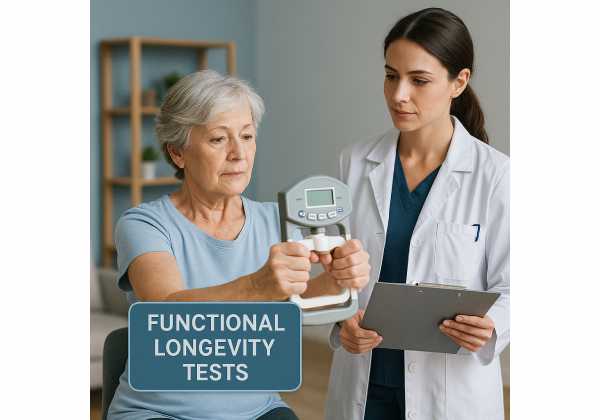
Grip strength is one of the simplest functional markers because it is quick, repeatable, inexpensive, and strongly linked with whole-body strength. It does not mean the hand controls longevity by itself. It means hand strength often reflects broader muscle quality, nervous system drive, nutrition status, physical activity, and illness burden.
A proper grip test needs a hand dynamometer. Spring devices and bathroom-scale-style tricks are less reliable. A basic hydraulic or digital dynamometer gives a result in kilograms or pounds. Use the same device each time because different models produce slightly different numbers.
How to do the test
Use a consistent setup:
- Sit upright in a chair with feet flat on the floor.
- Keep the shoulder relaxed and close to the body.
- Bend the elbow to about 90 degrees.
- Keep the wrist neutral, not flexed or bent back.
- Hold the dynamometer so the handle fits the hand comfortably.
- Squeeze as hard as possible for 3 to 5 seconds.
- Rest 30 to 60 seconds between attempts.
- Test each hand three times and record the best score for each hand.
Avoid testing after heavy lifting, long gardening, manual work, or a hard racquet sport session. Fatigue changes the result. Also avoid testing during hand, wrist, elbow, shoulder, or neck pain flares unless a clinician specifically asks you to monitor it.
Record both hands, not only the dominant hand. A large side-to-side difference sometimes reflects old injury, arthritis, nerve irritation, tendon pain, or underuse. A small difference is common. A sudden new difference is more important than a lifelong difference.
How to interpret grip strength
Grip strength rises through youth and early adulthood, then gradually declines with age. Men usually score higher than women because of differences in body size and muscle mass. Height, hand size, occupation, training history, and arthritis also influence the result.
Several clinical groups use low grip strength as one sign of possible sarcopenia, which means low muscle strength and impaired muscle function. Common European cut points for low grip strength are roughly below 27 kg for men and below 16 kg for women. These cut points are not personal targets for every adult. They are clinical warning lines. A 45-year-old man at 28 kg and a 78-year-old woman at 17 kg technically sit above those lines, but both still deserve attention if their scores are falling.
For personal tracking, use three layers:
| Grip result pattern | Likely meaning | Practical response |
|---|---|---|
| Stable or improving over several tests | Strength plan and recovery are likely adequate | Keep training and retest on schedule |
| Gradual decline over 6–12 months | Possible undertraining, low protein, poor recovery, pain, or illness effect | Review strength training, nutrition, sleep, and recent health changes |
| Sudden drop or new large side difference | Possible injury, nerve issue, medication effect, inflammatory flare, or acute illness | Pause heavy testing and consider clinical evaluation |
Grip improves best when the whole body gets stronger. Carries, rows, deadlift variations, pull-downs, farmer’s walks, hangs, and loaded household tasks often help more than squeezing a gripper alone. Direct grip tools still have a place, especially for people who need hand endurance for work, climbing, racquet sports, or daily tasks. A deeper training plan belongs in a dedicated grip strength and longevity routine, but the test itself stays simple: same device, same position, best of three, track the trend.
Gait Speed Test
Gait speed measures how quickly you walk over a short distance at your usual pace. It looks basic, but it captures a wide range of health information. Walking requires leg strength, balance, joint range, vision, sensation in the feet, heart and lung reserve, attention, and confidence. When walking slows, the cause is rarely “age” alone.
The usual test distance is 4 meters, though 5-meter, 6-meter, and 10-meter versions are also used. The most important rule is consistency. Use the same distance each time and write it down.
How to set up a gait speed test
Use a flat, clear walkway. A hallway works well. Mark the start and finish line with tape. For best accuracy, add a short acceleration zone before the start line and a short deceleration zone after the finish line. This prevents the first step and last step from distorting the score.
A simple home setup:
- 1 meter to start walking before timing begins
- 4 meters timed distance
- 1 meter to slow down after the finish line
Use comfortable shoes. Use the walking aid you normally use, such as a cane or walker, and record it. Do not test barefoot one month and in cushioned shoes the next unless you note the change.
To perform the test, stand before the start zone and walk at your normal everyday pace. Start timing when the first foot crosses the timed start line. Stop timing when the first foot crosses the finish line. Repeat twice and record the faster trial, or record both and average them.
Calculate speed:
Gait speed = distance ÷ time
For a 4-meter test:
- 4 meters in 4 seconds = 1.0 m/s
- 4 meters in 5 seconds = 0.8 m/s
- 4 meters in 6 seconds = 0.67 m/s
- 4 meters in 8 seconds = 0.5 m/s
How to interpret gait speed
A usual gait speed around 1.0 m/s or faster is often treated as a reassuring sign in older adults. Speeds below 1.0 m/s deserve attention, especially when the person previously walked faster. Speeds near or below 0.8 m/s often signal higher risk of mobility limitation, falls, hospitalization, or difficulty crossing streets safely. Very slow speeds, such as 0.6 m/s or below, deserve a fuller clinical look.
These numbers are not moral scores. They are prompts. A shorter adult with arthritis might walk differently from a taller adult with no joint pain. A person recovering from surgery will not match their usual baseline. The trend matters most.
Gait speed becomes even more useful when paired with observation. Watch for:
- Short steps or shuffling
- Wide stance
- Uneven stride length
- Limping
- Reduced arm swing
- Looking down constantly
- Needing walls or furniture
- Turning slowly or in many small steps
- Breathlessness out of proportion to effort
- Fear, freezing, or hesitation
Walking speed also connects to brain health. Slowing gait, especially when paired with slower thinking, balance changes, or dual-task difficulty, deserves attention because movement and cognition share planning, attention, and nervous system pathways. The connection is explored more deeply in gait speed, reaction time, and cognition.
For active adults, usual gait speed is only one layer. Also notice walking capacity: Can you walk 30 minutes comfortably? Can you climb stairs without pulling hard on the rail? Can you carry groceries while walking? Can you walk on uneven ground without fear? These everyday checks often explain why a short gait test has changed.
Sit-to-Stand Tests
Sit-to-stand testing measures the ability to rise from a chair without using the arms. This movement appears constantly in daily life: getting off the toilet, rising from a sofa, standing from a car seat, leaving a restaurant table, and recovering balance after a stumble. It reflects lower-body strength, power, hip and knee control, trunk stability, balance, and confidence.
The two most useful versions are the five-times sit-to-stand test and the 30-second chair stand test. They answer slightly different questions.
| Test | What you measure | Best use |
|---|---|---|
| Five-times sit-to-stand | Seconds needed to stand up and sit down 5 times | Speed, power, fall-risk screening, tracking mobility decline |
| 30-second chair stand | Number of full stands completed in 30 seconds | Lower-body endurance and repeat-effort capacity |
How to do the five-times sit-to-stand test
Use a stable chair, ideally about 43–45 cm high. Place it against a wall so it does not slide. Sit with your back against the chair, feet flat, and arms crossed over the chest. On “go,” stand fully upright and sit back down five times as quickly and safely as possible. Stop timing when you stand fully upright on the fifth repetition.
Use the same chair each time. Chair height changes the result a lot. A low sofa makes the test harder. A high dining chair makes it easier. Arm use also changes the result, so record whether arms were crossed, used lightly, or needed for support.
A time under 10–12 seconds is generally strong for many healthy adults, though age and body size matter. Times above 15 seconds often raise concern in older adults and are used in some sarcopenia screening approaches. Inability to complete five rises without the hands is also meaningful.
How to do the 30-second chair stand test
Use the same chair setup. Cross arms over the chest. Stand fully and sit fully as many times as possible in 30 seconds. Count only complete stands. If the timer ends while you are more than halfway to standing, some protocols count that final stand, but use one rule consistently.
This version suits people whose five-rep score is already fast enough that small timing errors matter. It also captures endurance. A person might complete five stands well but fade quickly by 20 or 30 seconds. That suggests limited muscular endurance or conditioning.
What changes the result
Sit-to-stand performance changes with:
- Chair height
- Foot placement
- Arm use
- Knee, hip, ankle, or back pain
- Body weight changes
- Balance confidence
- Leg strength
- Sleep and fatigue
- Recent hard training
- Illness or inflammation
- Medications that cause dizziness or sedation
Do not turn the test into a max-effort challenge if it feels unsafe. For people with poor balance, knee pain, dizziness, or recent falls, place the chair near a counter or have another person nearby. Safety beats precision.
Sit-to-stand ability often improves with squats, step-ups, split squats, hip hinges, loaded carries, and power work that matches the person’s level. Adults with cranky knees or hips still have options; range, tempo, chair height, and support level can be adjusted. A knee- and hip-friendly plan helps maintain the pattern without forcing painful depth.
How to Read the Three Tests Together
The three tests are most useful as a small dashboard. Each test stresses the body in a different way. Grip strength leans toward global strength and muscle quality. Gait speed leans toward integrated mobility. Sit-to-stand leans toward lower-body power, balance, and daily independence.
One weak score gives a clue. A pattern gives a better explanation.
| Pattern | Possible explanation | Next step |
|---|---|---|
| Grip low, gait and chair stands normal | Upper-body weakness, hand pain, prior injury, low overall strength reserve | Add progressive pulling, carries, and direct grip work; check hand pain if present |
| Grip normal, gait slow | Balance issue, pain, foot sensation problem, cardiovascular limitation, fear of falling | Assess walking mechanics, shoes, vision, balance, and exertional symptoms |
| Chair stands slow, gait normal | Low lower-body power, knee or hip pain, poor chair-rise technique | Train sit-to-stand, squats, step-ups, and hip strength progressively |
| All three declining | Deconditioning, illness, undernutrition, medication effect, inflammatory condition, frailty risk | Review health changes and consider clinician-guided evaluation |
| Good scores but frequent falls | Vestibular issue, vision problem, medication effect, environmental hazards, dual-task deficit | Use balance, vision, medication, and fall-risk assessment rather than strength testing alone |
Avoid overreading one test day. A poor night of sleep, stressful week, viral illness, sore knees, or a hard training session can lower performance. Retest when rested. If the result remains lower, treat it as a signal.
Also avoid chasing only the easiest score. Grip strength might improve quickly with practice and better effort. Chair stands might improve because you learned the rhythm. Gait speed might improve because you consciously walked faster during the test. Familiarity is not bad, but it is why repeatable technique matters.
Functional tests also belong beside body composition. Muscle mass helps, but muscle mass alone does not guarantee mobility. A person can have decent lean mass and still walk slowly because of pain, poor power, poor balance, or low confidence. A person with modest muscle mass can function well if strength, coordination, and conditioning are strong. For a fuller view, combine these tests with body composition and muscle tracking rather than relying on either one alone.
Testing Schedule and Tracking Method
Functional testing works best when it is boring and repeatable. You do not need daily scores. Daily testing adds noise and turns useful checks into performance anxiety. Monthly or quarterly testing gives cleaner trends for most healthy adults.
A practical schedule:
- Ages 30–49: test every 3–6 months if training regularly; every 2–3 months after injury, illness, or major routine change.
- Ages 50–69: test every 2–3 months, especially during changes in training, weight, medications, or pain.
- Ages 70 and older: test every 1–3 months if safe, with more frequent checks after falls, hospitalization, surgery, or new mobility concerns.
Use the same order each time: grip, gait speed, then sit-to-stand. Rest between tests. Do not test right after a hard workout. Morning or early afternoon often works well because late-day fatigue affects walking and chair rises.
Record:
- Date and time
- Body weight
- Recent illness or pain
- Sleep quality the night before
- Training in the prior 48 hours
- Grip score for each hand
- Gait distance and time
- Sit-to-stand version and result
- Chair height
- Shoes or walking aid
- Notes about pain, dizziness, or instability
A simple spreadsheet works. A notes app works. The best system is the one you will actually use.
Use the smallest meaningful changes as prompts, not panic buttons. A grip change of 1 kg might be device noise or effort variation. A gait speed change from 1.05 m/s to 0.95 m/s over several tests deserves attention. A five-times sit-to-stand change from 10 seconds to 14 seconds deserves a training and health review. A sudden inability to complete the test deserves more urgency.
For people who enjoy broader self-testing, these measures fit well with field checks such as step count, stair climb comfort, resting heart rate, and aerobic capacity. A broader fitness benchmark routine helps show whether strength, mobility, and conditioning are improving together.
How to Improve Your Scores
Functional scores improve when training matches the weak link. More walking helps gait speed when low conditioning or low walking volume is the problem. It helps less when the true limit is leg weakness, knee pain, poor balance, or foot numbness. More grip work helps grip strength when the hands and forearms are undertrained. It helps less when the wider issue is total-body muscle loss.
Start with the pattern.
For low grip strength
Train the hands, but also train the body. Good options include:
- Farmer’s carries
- Suitcase carries
- Deadlift or hip-hinge variations
- Rows and pull-downs
- Towel holds
- Dead hangs if shoulders tolerate them
- Loaded household carries
- Controlled gripper work
Use progressive loading. Two to four grip exposures per week is enough for most adults. Avoid daily max squeezing if you have tendon pain, thumb arthritis, carpal tunnel symptoms, or elbow irritation.
For slow gait speed
Build walking capacity first, then add speed. A useful week includes easy walking, some brisk intervals, and strength training. For example:
- Easy walking on most days
- 4–8 short brisk walking intervals once or twice weekly
- Lower-body strength training twice weekly
- Balance practice 3–5 days weekly
- Hill or stair exposure if joints tolerate it
Walking on varied ground also matters. Smooth treadmills do not fully prepare the body for curbs, grass, slopes, wet pavement, and crowded spaces. Progress gradually. A person who is unsure outdoors may start with indoor walking, then flat paths, then gentle terrain. More advanced walkers can use distance, hills, or light load through walking and rucking progressions.
For slow sit-to-stand time
Train the exact pattern first. Practice standing from a chair with good control. Adjust the chair height so the movement is challenging but smooth. Over time, lower the chair slightly, slow the descent, add a light weight, or increase repetitions.
Useful exercises include:
- Sit-to-stand practice
- Box squats
- Step-ups
- Split squats with support
- Hip bridges
- Romanian deadlifts
- Calf raises
- Sled pushes or stair climbing when appropriate
Power matters because daily life often requires quick force: catching yourself, rising quickly, climbing stairs, or stepping over obstacles. Once basic strength and balance are in place, add low-risk power work such as faster chair rises, light medicine ball throws, quick step-ups, or low-impact skipping drills. Older adults should build power, but they need the right entry point.
Recovery and nutrition shape the results
Strength and mobility decline when training outpaces recovery. Poor sleep, low energy intake, rapid weight loss, low protein, dehydration, and chronic pain all affect performance. Adults trying to lose fat should protect muscle with resistance training and enough protein. Many midlife and older adults do better when protein is spread across meals rather than saved for dinner.
A simple muscle-supportive pattern includes resistance training 2–4 days weekly, protein at each meal, daily walking, and at least one true recovery day after hard sessions. A structured strength training plan for longevity gives the clearest route because functional tests improve most reliably when the program has progression, not random effort.
When to Get Clinical Help
Functional test changes deserve medical attention when they are sudden, severe, unexplained, or paired with other symptoms. Do not assume every decline is deconditioning. Deconditioning is common, but it is not the only cause.
Seek prompt medical advice for:
- Sudden weakness on one side
- New trouble speaking, facial droop, severe dizziness, or confusion
- New foot drop or dragging one foot
- Chest pain, fainting, or unusual shortness of breath during walking
- Repeated falls
- New severe back pain with leg weakness or bladder changes
- Rapid unexplained weight loss
- Marked fatigue with fever, night sweats, or persistent illness symptoms
- A major drop in walking speed after a medication change
- New numbness, burning, or loss of sensation in the feet
- New tremor, freezing, or major change in movement rhythm
A clinician, physical therapist, or occupational therapist can test strength, sensation, reflexes, vestibular function, gait mechanics, fall risk, vision needs, medication effects, and cardiovascular limits. This is especially important when a person avoids activity because of fear. Fear of falling reduces movement, less movement reduces strength, and lower strength raises fall risk. That loop needs early interruption.
Home safety also matters. Good functional scores do not cancel out loose rugs, poor lighting, slippery bathrooms, unstable footwear, or cluttered stairs. Balance practice, strength training, and safer environments work together. For people with fall concerns, balance and fall-prevention drills belong beside strength work, not after it.
Functional tests are not a verdict. They are a conversation with your body. Grip strength shows whether force production is holding up. Gait speed shows whether mobility stays efficient and confident. Sit-to-stand performance shows whether lower-body strength and power still support independence. Track them consistently, respond early, and they become practical tools for protecting healthspan.
References
- Sarcopenia: revised European consensus on definition and diagnosis 2019 (Consensus)
- World guidelines for falls prevention and management for older adults: a global initiative 2022 (Guideline)
- Optimal procedure and characteristics in using five times sit to stand test among older adults: A systematic review 2023 (Systematic Review)
- Measurement properties of the usual and fast gait speed tests in community-dwelling older adults: a COSMIN-based systematic review 2024 (Systematic Review)
- A Scoping Review of the Predictive Qualities of Walking Speed in Older Adults 2024 (Review)
- Sarcopenia prevalence using handgrip strength or chair stand performance in adults living with type 2 diabetes mellitus 2024 (Clinical Study)
Disclaimer
This article is educational and does not replace evaluation, diagnosis, or treatment from a qualified health professional. Functional tests should be adapted for pain, disability, dizziness, fall risk, recent surgery, and medical conditions. Stop testing and seek professional guidance if a test causes chest pain, faintness, unusual shortness of breath, severe pain, or sudden weakness.