Grip strength is one of the simplest ways to check whether your muscles are aging well. A small handheld dynamometer gives a number in kilograms or pounds, but that number reflects more than hand strength. It often tracks whole-body strength, nervous system function, muscle quality, nutrition, injury history, and the ability to carry, lift, brace, climb, and catch yourself if you trip.
A weak grip does not diagnose a disease by itself. It is a signal. When grip strength is low for your age, sex, and body size, it tells you to look more closely at resistance training, protein intake, recovery, pain, nerve symptoms, and daily activity. When grip strength improves, it often means your training and daily habits are moving in the right direction.
Grip testing works best when you use the same tool, the same position, and the same tracking schedule each time.
Table of Contents
- Why Grip Strength Matters for Longevity
- What Grip Strength Actually Measures
- How to Test Grip Strength at Home or in a Clinic
- How to Read Your Results Without Overreacting
- Tools for Testing and Training Grip
- How to Improve Grip Strength Safely
- Common Mistakes That Skew Grip Results
- When Low Grip Strength Needs a Closer Look
Why Grip Strength Matters for Longevity
Grip strength is useful because it is quick, low-cost, repeatable, and strongly linked with later health outcomes. In large population studies, people with lower handgrip strength tend to have higher risks of disability, frailty, cardiovascular disease, and earlier death. That does not mean a stronger grip magically prevents those outcomes. It means grip strength captures several aging-related systems at once.
A strong grip usually travels with stronger legs, better trunk control, more lean mass, higher activity levels, and better physical reserve. Physical reserve is the extra capacity you draw on when life gets harder: carrying groceries, climbing stairs, recovering from illness, rising from the floor, or keeping balance on uneven ground.
Grip strength also gives a practical window into sarcopenia, the age-related decline in muscle mass and strength. Modern sarcopenia definitions include both muscle quantity and muscle strength. A person with low muscle mass but decent strength often functions better than a person with similar muscle mass and poor strength. Strength is the part you feel in daily life.
Low grip strength deserves attention because it often appears before obvious disability. A person might still walk, work, and live independently while losing the strength needed for harder tasks. Testing finds that trend early enough to act.
Grip strength also pairs well with other simple tests. A more complete picture comes from combining grip with gait speed, chair stands, balance, and body composition. For a broader set of movement checks, functional longevity tests add lower-body power and walking speed to the picture.
What Grip Strength Actually Measures
Grip strength measures the force your hand and forearm produce when you squeeze. In practice, it reflects much more than the fingers.
A strong squeeze requires the finger flexors, thumb muscles, wrist stabilizers, elbow position, shoulder position, trunk stiffness, breathing, coordination, and willingness to produce maximum effort. That is why test setup matters. A slouched posture, painful wrist, bent elbow, wrong handle setting, or poor instructions changes the result.
Grip strength has three main forms:
| Grip type | What it means | Daily examples | Training examples |
|---|---|---|---|
| Crush grip | Squeezing the fingers toward the palm | Opening jars, holding tools, shaking hands | Dynamometer squeezes, grippers, towel squeezes |
| Support grip | Holding something for time | Carrying shopping bags, holding luggage | Farmer carries, dead hangs, suitcase carries |
| Pinch grip | Using the thumb against the fingers | Holding keys, plates, books, small objects | Plate pinches, block holds, putty pinches |
A standard handgrip dynamometer mainly measures crush grip. That makes it excellent for tracking, but incomplete as a training target. Someone can score well on a squeeze test yet struggle with long carries or hanging because support grip requires endurance, skin tolerance, shoulder control, and trunk stability.
Grip also reflects side-to-side differences. The dominant hand usually scores slightly higher, but the gap should not be extreme. A large drop on one side, especially if it appears suddenly, points toward pain, nerve irritation, tendon injury, shoulder problems, or neurologic issues. Testing both hands gives more useful information than testing only the dominant side.
Grip strength is not a vanity metric. It is a practical signal for the tasks that help people stay independent: lifting a suitcase into a car, carrying laundry, holding a railing, pulling a door, using garden tools, moving furniture, and catching a slipping object before it falls.
How to Test Grip Strength at Home or in a Clinic
The best grip test is consistent. Changing position, handle size, instructions, or warm-up changes the result enough to make month-to-month comparisons less useful.
A hand dynamometer is the standard tool. The Jamar-style hydraulic dynamometer is common in clinics and research, while digital dynamometers are easier for home use. Both work when used consistently. The exact number from one device might not match another device, so keep using the same model once you start tracking.
Standard dynamometer setup
Use this setup for repeatable results:
- Sit upright in a firm chair with feet flat on the floor.
- Keep the shoulder relaxed and close to your side.
- Bend the elbow to about 90 degrees.
- Keep the wrist neutral, not bent forward or backward.
- Set the dynamometer handle so the middle finger sits comfortably around the grip.
- Squeeze as hard as possible for about 3 seconds.
- Rest 30 to 60 seconds between attempts.
- Test both hands.
- Record the best score from 2 or 3 attempts for each hand.
Use the same order every time. For example: right hand, left hand, right hand, left hand, right hand, left hand. Do not keep retesting until you get a better number. Fatigue and motivation will distort the result.
Home test without a dynamometer
A dynamometer is best for tracking numbers, but you can still check functional grip with simple tasks:
- Carry two moderately heavy shopping bags for 30 to 60 seconds with tall posture.
- Hang from a bar with feet lightly supported, then gradually reduce foot help.
- Hold a loaded suitcase on one side and walk 20 to 40 meters.
- Pinch a weight plate, thick book, or sturdy block for time.
- Open jars, carry laundry baskets, and note whether daily tasks feel easier or harder.
These tests are less precise than a dynamometer, but they show whether grip transfers to daily life. They also reveal asymmetry, pain, endurance limits, and shoulder control.
How often to test
Monthly testing is enough for most adults. Weekly testing creates noise because sleep, soreness, stress, hydration, hand pain, and recent training affect performance. Test every 4 weeks under the same conditions, ideally before training and at a similar time of day.
After illness, surgery, injury, or a long break from training, test again after 2 to 4 weeks of normal activity. Do not judge your long-term strength from a test taken during a stressful or painful week.
For people building a full training baseline, grip belongs next to push, pull, squat, hinge, walking, and balance measures. A structured set of fitness benchmarks helps separate one weak area from a wider decline in physical capacity.
How to Read Your Results Without Overreacting
Grip strength varies by sex, age, height, body size, occupation, sport history, hand size, and test method. A 35-year-old man, a 70-year-old woman, and a 60-year-old lifelong manual worker should not use the same target.
In broad terms, grip strength rises through young adulthood, peaks around midlife, and declines with age. International reference data show large differences between countries and populations, so percentiles work better than one universal “good” number.
Still, some clinical cutoffs help flag low strength. The European Working Group on Sarcopenia in Older People has used handgrip cut points below 27 kg for men and below 16 kg for women as low strength in the sarcopenia screening context. These are not performance goals. They are warning thresholds. Many healthy adults should aim well above them.
A better way to read your result is to use three layers:
| Layer | Question to ask | Why it matters |
|---|---|---|
| Absolute score | How many kg or lb can each hand produce? | Shows current maximum squeeze strength. |
| Comparison | How does the score compare with age- and sex-based norms? | Shows whether you are unusually low, average, or high for your group. |
| Trend | Is the score stable, improving, or declining over 3 to 12 months? | Shows whether your habits are preserving physical reserve. |
Trend matters most for personal use. A 5% change from one test to the next might reflect normal day-to-day variation. A repeated 10% to 15% decline over several months deserves attention, especially if it comes with slower walking, more fatigue, unplanned weight loss, or trouble rising from chairs.
Grip strength also needs context. A person recovering from wrist surgery should not compare the injured hand with population norms. A rock climber might have excellent support and pinch grip but only average dynamometer strength. Someone with arthritis might have strong legs and heart fitness but a painful squeeze test.
Use grip strength as a dashboard light, not a verdict. A low result asks for a closer look at training, nutrition, sleep, pain, nerve health, and overall function.
Tools for Testing and Training Grip
You do not need a large home gym to test and train grip. Choose tools that match your purpose: measurement, strength, endurance, dexterity, or pain-friendly hand work.
| Tool | Best use | Good choice for | Limitations |
|---|---|---|---|
| Digital hand dynamometer | Testing maximum squeeze strength | Home tracking, simple monthly checks | Device quality varies; numbers may differ from clinic tools. |
| Hydraulic dynamometer | More standardized testing | Clinics, research-style tracking | More expensive and less portable. |
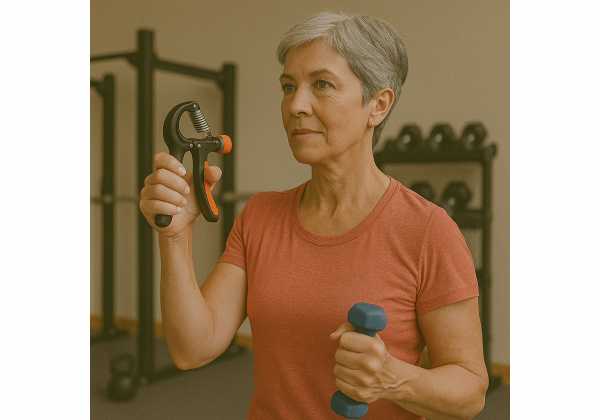
| Adjustable gripper | Crush-grip training | Progressive hand strengthening | Easy to overdo; does not train carries well. |
| Dumbbells or kettlebells | Carries, holds, suitcase walks | Support grip, posture, trunk strength | Requires space and safe loading. |
| Pull-up bar | Hangs and assisted hangs | Grip endurance and shoulder control | Not ideal for painful shoulders or elbows. |
| Therapy putty | Gentle squeezing and pinching | Beginners, arthritis-friendly work, rehab settings | Limited maximum strength challenge. |
| Towels | Thick-grip rows, towel carries, wringing drills | Low-cost home training | Can irritate elbows if volume rises too fast. |
A dynamometer is for measurement, not daily training. Maximal squeezes create fatigue in small tissues. Use it for testing, then train grip with carries, rows, hangs, and controlled hand work.
For most adults, the best grip tools are the same tools that build useful strength: dumbbells, kettlebells, resistance bands, cable handles, pull-up bars, and loaded bags. Grip improves when the whole body learns to create force and hold it.
A simple setup works well:
- One adjustable dumbbell or kettlebell for carries
- One resistance band for rows and pull-aparts
- One towel for thick-grip variations
- One hand dynamometer for monthly testing
- Therapy putty if hands feel stiff, painful, or deconditioned
Grip training fits naturally into a broader minimal home gym because the same equipment trains posture, pulling strength, trunk stiffness, and daily carrying capacity.
How to Improve Grip Strength Safely
The fastest reliable way to improve grip is to train the whole pulling and carrying system. Isolated hand squeezes help, but they should not replace rows, carries, hinges, and loaded movement.
Start with 2 or 3 grip exposures per week. That means you train grip directly or indirectly on nonconsecutive days. Hands, elbows, and tendons adapt more slowly than motivation. More is not always better.
Beginner plan
Use this plan for 4 to 6 weeks:
- Farmer carry: 3 rounds of 20 to 40 seconds
- Seated or standing row: 2 to 3 sets of 8 to 12 reps
- Therapy putty or soft ball squeeze: 2 sets of 10 slow squeezes per hand
- Pinch hold with a book or light plate: 2 rounds of 10 to 20 seconds per hand
The effort should feel moderate. Stop each set before your form breaks or your fingers peel open suddenly. Carries should look tall and controlled, not hunched and rushed.
Intermediate plan
When basic carries feel easy, progress by changing one variable at a time:
- Increase load by 5% to 10%.
- Extend carry time by 5 to 10 seconds.
- Use a thicker handle or towel.
- Carry weight on one side only for suitcase carries.
- Add assisted dead hangs for 10 to 30 seconds.
Suitcase carries are especially useful because they train grip and anti-side-bending trunk strength at the same time. Hold one weight at your side, stand tall, walk slowly, and resist leaning. Switch sides and repeat.
Rows also matter. Strong upper-back muscles give your hands a better platform. A grip that fails during every row set might limit back training, but straps are not always wrong. If your main goal is back strength, use straps on heavier sets and train grip separately with carries.
Advanced plan
Advanced grip training should still respect recovery. Good options include:
- Heavy farmer carries for 10 to 30 seconds
- Dead hangs with strict shoulder control
- Towel rows or towel hangs
- Plate pinches for 10 to 30 seconds
- Fat-grip holds
- Controlled gripper work for low-to-moderate volume
Avoid turning every pulling session into a grip max-out. Elbow tendons dislike sudden jumps in squeezing, hanging, and thick-grip volume. A smart plan leaves your hands ready for the next session.
For longevity, grip training should support full-body strength rather than compete with it. A weekly strength training plan that includes carries, hinges, rows, presses, squats, and balance work gives grip more meaningful transfer to daily life.
Progression that protects joints
Use the “two-good-weeks” rule. Increase load, duration, or difficulty only after two weeks with no increase in joint pain, numbness, tingling, or lingering tendon soreness.
A mild forearm pump during training is normal. Sharp pain, nerve-like tingling, night symptoms, or pain that changes your daily hand use is not normal training discomfort.
Warm hands often perform better. Before testing or training, spend 3 to 5 minutes on general movement, then open and close the hands, circle wrists, and do light rows or carries. Cold hands, stiff fingers, and rushed setup lower performance.
Common Mistakes That Skew Grip Results
Grip testing looks simple, which makes sloppy testing easy. Small changes create misleading results.
The most common mistake is changing body position. A standing test often produces a different number from a seated test. A straight elbow differs from a bent elbow. A wrist bent backward changes leverage. Pick one method and keep it.
Another mistake is using the wrong handle setting. If the handle is too wide or too narrow, the fingers cannot produce their best force. Set the handle so the middle joints of the fingers wrap comfortably around the grip.
Testing after a hard workout also distorts the number. Heavy deadlifts, rows, pull-ups, gardening, racket sports, climbing, or carrying luggage can reduce grip for 24 to 72 hours. Test before training or after an easy day.
Pain changes results too. Arthritis, trigger finger, carpal tunnel symptoms, tennis elbow, golfer’s elbow, thumb-base pain, and wrist irritation all reduce squeeze force. In that case, the low score reflects pain inhibition as much as muscle weakness.
Watch for these testing errors:
- Holding the breath aggressively during a simple test
- Letting the shoulder hike toward the ear
- Pressing the dynamometer against the body
- Bending the wrist during the squeeze
- Testing only the stronger hand
- Comparing scores from different devices
- Recording the average one month and the best score the next
- Retesting repeatedly until fatigue hides the real maximum
Training mistakes are just as common. Grippers are useful, but daily hard gripper sessions often irritate elbows and fingers. Dead hangs are useful, but jumping into long hangs can flare shoulders. Thick-grip training is useful, but it quickly overloads tendons.
A balanced approach uses grip as one part of training. Pull, carry, hinge, brace, and recover. Technique still matters, especially when grip work connects to lifting patterns. Strong hands work best with strong positions, and solid lifting technique keeps the load in the right places.
When Low Grip Strength Needs a Closer Look
Low grip strength after years of inactivity is common, and it often improves with progressive training. Sudden or unexplained weakness is different.
Get professional guidance if grip strength drops quickly, affects one side much more than the other, or appears with numbness, tingling, tremor, severe pain, balance changes, speech changes, or new difficulty using the hand. Those signs need medical assessment rather than more grip exercises.
A gradual decline also deserves attention when it appears with other changes:
- Unplanned weight loss
- Loss of appetite
- New fatigue
- Slower walking speed
- More difficulty rising from a chair
- Repeated falls or near-falls
- Trouble carrying normal household items
- New swelling, redness, or joint deformity
- Persistent neck, shoulder, elbow, wrist, or hand pain
Grip weakness sometimes points to local issues such as arthritis, tendon irritation, nerve compression, or previous injury. It can also reflect whole-body issues such as low physical activity, undernutrition, low protein intake, poor sleep, inflammatory disease, or prolonged illness.
Nutrition matters because muscles need building blocks. Many adults in midlife and later life benefit from distributing protein across meals rather than saving most of it for dinner. For muscle maintenance, daily protein targets and per-meal protein quality often matter as much as total calories.
Falls risk also deserves attention. Grip strength helps with railings, canes, walkers, and catching yourself, but balance and lower-body power drive much of fall prevention. If grip is low and balance feels uncertain, add daily balance drills rather than training the hands alone.
Grip strength is most valuable when it leads to action. Test it, track it, and use it as a prompt to build the body you need for the next decade: hands that hold, legs that climb, hips that hinge, lungs that recover, and enough strength reserve to handle real life.
References
- International norms for adult handgrip strength: a systematic review of data on 2.4 million adults aged 20 to 100+ years from 69 countries or territories 2025 (Systematic Review)
- Thresholds of handgrip strength for all-cause, cancer, and cardiovascular mortality: A systematic review with dose-response meta-analysis 2022 (Systematic Review)
- Handgrip strength measurement protocols for all-cause and cause-specific mortality outcomes in more than 3 million participants: A systematic review and meta-regression analysis 2022 (Systematic Review)
- The Conceptual Definition of Sarcopenia: Delphi Consensus from the Global Leadership Initiative in Sarcopenia (GLIS) 2024 (Consensus)
- Muscle-strengthening activities are associated with lower risk and mortality in major non-communicable diseases: a systematic review and meta-analysis of cohort studies 2022 (Systematic Review)
- Sarcopenia: revised European consensus on definition and diagnosis 2019 (Consensus)
Disclaimer
This article is educational and does not replace medical care, physical therapy, or individualized training advice. Speak with a qualified clinician if grip weakness appears suddenly, affects one side, follows an injury, or comes with pain, numbness, tingling, falls, unexplained weight loss, or major fatigue.