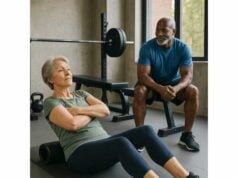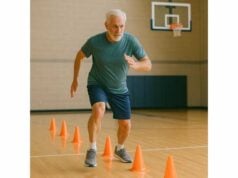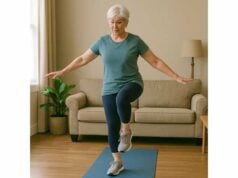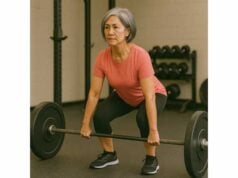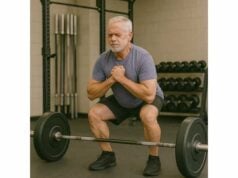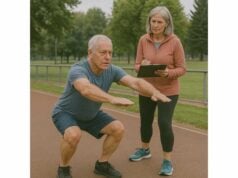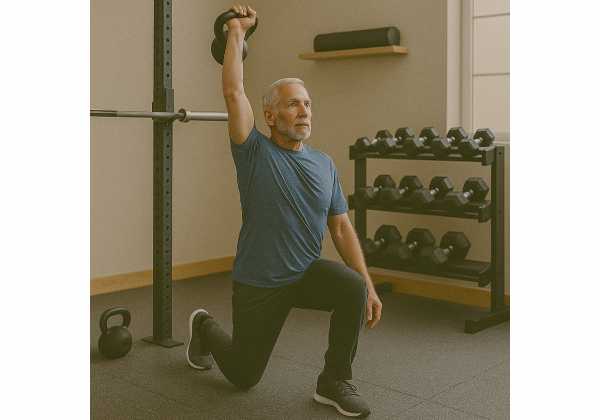
A home gym that supports longevity does not need rows of machines, a wall of mirrors, or a garage full of heavy steel. It needs a small set of tools that help you train the physical traits most tied to healthy aging: strength, muscle mass, aerobic fitness, balance, power, mobility, and the confidence to move every day. The best setup is simple enough to use on a Tuesday evening, safe enough to repeat for years, and flexible enough to grow with your body.
Minimal equipment works because the body responds to load, effort, range of motion, breathing, consistency, and progression. A pair of adjustable dumbbells, resistance bands, a stable step, floor space, and a way to track effort cover most needs. The real return comes from doing the basics often: lifting, carrying, stepping, squatting, pushing, pulling, walking, and breathing hard enough to challenge the heart.
Table of Contents
- Why a Small Home Gym Works
- The Minimal Equipment List
- How to Set Up the Space
- The Weekly Training Template
- Best Exercises for Longevity at Home
- How to Progress With Limited Equipment
- Safety, Joints, and Recovery
- What to Track Over Time
Why a Small Home Gym Works
A small home gym works because longevity training rewards consistency more than complexity. The most valuable exercises are simple patterns repeated with better control, slightly more load, or better conditioning over time. You do not need a leg press to train the legs. You need a safe way to squat, hinge, step up, split squat, bridge, and carry. You do not need a full cardio room to train aerobic fitness. You need walking, stairs, cycling, rowing, jogging, step-ups, or intervals that raise breathing and heart rate.
The biggest advantage is lower friction. A workout that starts in three minutes has a much higher chance of happening than one that requires driving, parking, changing rooms, waiting for equipment, and rebuilding focus. A home setup also helps you use small pockets of time. Ten minutes of mobility before breakfast, two sets of carries between meetings, or a 20-minute strength session after work adds up across months.
Longevity training has several jobs:
- Preserve muscle and strength, especially in the legs, hips, trunk, and grip.
- Improve cardiorespiratory fitness, including easy aerobic work and harder intervals.
- Maintain balance, gait, and reaction ability.
- Keep joints strong through controlled range of motion.
- Build enough power to climb stairs, recover from a stumble, and move quickly when needed.
- Support metabolic health by increasing muscle use and daily movement.
The home gym should serve these jobs, not entertain you with endless variety. Variety helps when it solves a problem, such as sore knees, limited space, boredom, or travel. It hurts when it prevents progression.
A useful rule: buy equipment for movement patterns, not body parts. A good home gym lets you squat, hinge, push, pull, carry, rotate or resist rotation, step, balance, and condition. Those patterns support daily life better than a machine for each muscle group.
The Minimal Equipment List
The strongest home gym setup starts with a clear priority order. Buy the items that unlock the most exercises first. Add equipment only when it solves a specific limit.
| Priority | Equipment | Why it earns space | Best uses |
|---|---|---|---|
| 1 | Clear floor space | The foundation for safe movement | Mobility, push-ups, dead bugs, get-ups, balance drills |
| 2 | Exercise mat | Improves comfort and reduces excuses | Floor strength, stretching, breathing, core work |
| 3 | Adjustable dumbbells or two to three fixed pairs | Provides progressive load without much space | Squats, hinges, presses, rows, carries, split squats |
| 4 | Long resistance bands and mini bands | Cheap, joint-friendly, portable resistance | Rows, pull-aparts, hip work, warm-ups, assisted mobility |
| 5 | Stable step, low box, or bench | Trains stairs, balance, single-leg strength, and power | Step-ups, sit-to-stands, incline push-ups, supported split squats |
| 6 | Door anchor or suspension trainer | Adds pulling options, which many home gyms lack | Rows, assisted squats, supported lunges, anti-rotation drills |
| 7 | Weighted vest, kettlebell, or sandbag | Adds load for carries, squats, hinges, and walking | Loaded carries, rucking, goblet squats, deadlifts |
| 8 | Cardio option | Useful when weather, safety, or joint comfort limits outdoor work | Zone 2, intervals, warm-ups, recovery sessions |
The smallest setup that still works
Start with a mat, one long resistance band, one mini band, a stable chair or step, and one pair of moderately challenging dumbbells. This setup supports full-body sessions for several months if you use tempo, pauses, single-leg work, higher reps, and carries.
A stronger long-term setup uses adjustable dumbbells, a step or bench, bands, and either a suspension trainer or door anchor. This combination covers push, pull, legs, hips, trunk, and conditioning without taking over a room.
Cardio equipment is optional, not essential
Walking outside, climbing stairs, hill repeats, rucking, cycling, and brisk step-ups all train the heart. A bike, rower, treadmill, or ski trainer becomes useful when outdoor exercise is unsafe, weather is harsh, joints need lower impact, or you enjoy the machine enough to use it often.
A cardio machine should match your body, not your fantasy routine. A treadmill helps people who like walking. A stationary bike works well for cranky knees or hips when seat height is set correctly. A rower trains a lot of muscle but requires good hinge mechanics. A compact step platform offers a low-cost way to build conditioning in small spaces.
For aerobic planning, pair your home gym with a clear Zone 2 training routine and one short interval session each week.
How to Set Up the Space
A safe home gym starts with the floor, lighting, storage, and exit paths. Most home training injuries come from preventable setup problems: slippery rugs, cluttered floors, unstable chairs, loose bands, poor lighting, pets underfoot, and rushed transitions.
Clear enough space to lie flat with arms overhead and to step sideways without hitting furniture. For most people, a rectangle about 2 by 3 meters is enough for strength, mobility, and band work. More space helps with carries, loaded walking, and agility drills, but a hallway works for many carries.
Place equipment where you see it. A dumbbell hidden in a closet becomes decoration. A mat rolled beside your desk becomes a cue. The best setup makes the first rep easy.
Use this safety scan before the first session:
- The floor does not slide under your feet.
- The step, bench, or chair does not wobble.
- Resistance bands have no cracks, tears, or chalky weak spots.
- Door anchors pull against the closed side of the door, not toward the opening.
- Weights have a clear landing zone.
- Pets and children stay out of the lifting area.
- Lighting is bright enough for foot placement.
- Shoes grip the floor, or bare feet grip safely on the surface.
Storage matters because clutter changes behavior. A wall rack, basket, or corner shelf keeps tools ready without making the room feel chaotic. Put heavier items low. Store bands away from sunlight and sharp edges. Keep a small notebook, pen, or phone stand near the space so tracking does not interrupt the session.
Noise also shapes consistency. Apartment-friendly training favors controlled lowering, step-ups instead of jumps, marches instead of running in place, and dumbbells placed down rather than dropped. Power training still works without pounding the floor. Fast sit-to-stands, medicine-ball-style band presses, quick step-ups, and brisk carries build speed with less impact.
The Weekly Training Template
A longevity-focused home gym week should cover strength, aerobic fitness, balance, mobility, and a small dose of intensity. The exact schedule depends on your training age, joints, sleep, and available time, but the structure stays simple.
A strong week for most adults includes:
- Two to three full-body strength sessions.
- Two to four easy aerobic sessions.
- One short interval or hill-style session.
- Two to five short mobility or balance sessions.
- Daily low-effort movement, especially walking and stairs.
The easiest plan is three strength days and two cardio days. The most time-efficient plan is two strength days, two aerobic days, and short balance drills added to warm-ups.
| Day | Main session | Short add-on |
|---|---|---|
| Monday | Full-body strength | 5 minutes balance |
| Tuesday | Easy aerobic work, 30–45 minutes | Hip and ankle mobility |
| Wednesday | Full-body strength | Loaded carries |
| Thursday | Walk, cycle, or stairs, 20–40 minutes | Breathing and trunk work |
| Friday | Full-body strength or power-focused session | Shoulder mobility |
| Saturday | Intervals, hills, brisk step-ups, or outdoor conditioning | Easy walk later in the day |
| Sunday | Recovery walk or rest | Gentle stretching |
Each strength session should include a lower-body pattern, an upper-body push, an upper-body pull, a hip hinge or bridge, trunk work, and a carry or grip drill. That sounds like a lot, but it fits into 35–50 minutes when you keep the exercise list tight.
A simple session:
- Warm up for 5–8 minutes.
- Train 4–6 main exercises.
- Finish with carries, balance, or easy conditioning.
- Record load, reps, and effort.
Use an effort scale from 1 to 10. Most strength work should land around 7–8 out of 10, meaning you finish a set with about 2–3 good reps left. Harder work has a place, but frequent maximum efforts are not needed for healthy aging. The body adapts well to repeated quality work.
For hard cardio, short intervals work well at home. After a warm-up, do 4–8 rounds of 30–60 seconds hard with 1–2 minutes easy. Step-ups, cycling, hill walking, brisk stair climbing, or low-impact marches work. Longer interval formats belong in a planned VO₂max interval session, not every workout.
Best Exercises for Longevity at Home
The best home exercises are easy to set up, hard to outgrow, and useful for daily life. Choose movements that train large muscle groups, challenge balance safely, and allow steady progression.
Lower body: squat, split squat, step, and hinge
Leg strength protects independence. Stairs, chairs, hills, carrying groceries, and getting off the floor all rely on hips and legs.
Use these movements often:
- Sit-to-stand from a chair
- Goblet squat
- Split squat with support
- Step-up
- Romanian deadlift with dumbbells
- Glute bridge or hip thrust
- Calf raise
- Lateral step-down from a low step
A chair sit-to-stand is not a beginner-only exercise. Slow the lowering phase to three seconds, pause lightly on the chair, stand tall, and add dumbbells when ready. Step-ups deserve a place in most home gyms because they train leg strength, balance, hip control, and stair confidence at the same time.
For technique, the squat and hinge need special attention. A good squat and hinge foundation helps you load the legs and hips without turning every set into a back exercise.
Upper body: push, pull, carry
Upper-body training should balance pressing with pulling. Home workouts often include push-ups and presses but skip rows. Over time, that imbalance irritates shoulders and posture.
Use these staples:
- Incline push-up on a bench or counter
- Floor press with dumbbells
- One-arm dumbbell row
- Band row
- Band pull-apart
- Overhead press, if shoulders tolerate it
- Suitcase carry
- Farmer carry
- Dead hang, if you have a safe bar and healthy shoulders
Rows are especially valuable at home. They train the upper back, grip, trunk, and shoulder control. A one-arm dumbbell row with one hand supported on a bench or chair works in almost any space. Band rows work well when anchored securely.
Carries provide a high return in little time. Pick up one or two weights, stand tall, walk slowly, and breathe. Carries train grip, ribs-over-pelvis posture, hips, feet, and trunk stiffness. A suitcase carry, with one weight held on one side, adds anti-leaning strength that transfers well to daily life.
Balance, power, and getting off the floor
Balance training should be specific enough to matter. Standing on one foot while brushing your teeth helps, but a complete plan also includes stepping, reaching, turning, and recovering position.
Useful home balance drills include:
- Tandem stance, heel-to-toe
- Single-leg stand near a wall
- Slow marching with a pause
- Step-over drills using a low object
- Clock reaches
- Controlled backward steps
- Lateral steps with a mini band
- Sit-to-stand with a fast but controlled rise
Power means producing force quickly. It fades faster than strength with age, so small doses matter. At home, train power with safe movements before fatigue: fast chair stands, brisk step-ups, light kettlebell deadlifts with speed, low pogo bounces if joints tolerate them, or medicine-ball-style band presses. Keep reps low and crisp.
The ability to get down to the floor and back up is practical strength. Practice kneeling transitions, half-kneeling stands, and supported get-ups. Use a chair or wall at first. The movement builds hip mobility, trunk control, leg strength, and confidence.
For a deeper daily balance plan, pair home strength sessions with fall-prevention drills that train feet, ankles, hips, vision, and reaction speed.
How to Progress With Limited Equipment
Limited equipment lasts much longer when you understand progression. More weight is useful, but it is not the only path. The body responds to increased challenge in several ways.
Use these progression levers:
- Add reps before adding load.
- Add sets when recovery is good.
- Slow the lowering phase to 3–5 seconds.
- Add a pause at the hardest position.
- Increase range of motion.
- Move from two-leg to one-leg variations.
- Reduce hand support.
- Shorten rest periods for conditioning.
- Add carries after main lifts.
- Improve technique at the same load.
A practical strength range is 6–15 reps for most movements. Heavy dumbbell goblet squats may sit near 6–10 reps. Band pull-aparts may work better at 12–25 reps. Carries are easier to track by distance, steps, or time, such as 30–60 seconds per side.
Progress one or two variables at a time. Adding load, reps, sets, tempo, and shorter rest in the same week creates noise. You will not know which change helped or which one caused soreness.
A simple four-week progression looks like this:
| Week | How to progress | Example |
|---|---|---|
| 1 | Learn the movement and leave 3 reps in reserve | Goblet squat, 3 sets of 8 |
| 2 | Add reps with the same load | Goblet squat, 3 sets of 10 |
| 3 | Add a set or small load increase | Goblet squat, 4 sets of 8–10 |
| 4 | Reduce volume and sharpen technique | Goblet squat, 2–3 sets of 8 |
This pattern builds skill and fitness without turning every month into a grind. After week 4, repeat with slightly heavier weights, a harder variation, or better range of motion.
For long-term planning, use a full strength training progression so your home sessions move through phases instead of repeating the same workout forever.
When the weights feel too light
Small home weights become useful again when you change the exercise. A 10 kg dumbbell may be too light for a deadlift but very challenging for a single-leg Romanian deadlift, slow split squat, overhead press, or suitcase carry.
Try these upgrades before buying more equipment:
- Goblet squat to split squat
- Two-leg bridge to single-leg bridge
- Dumbbell deadlift to Romanian deadlift
- Romanian deadlift to single-leg Romanian deadlift with support
- Regular push-up to feet-elevated push-up
- Band row to slower band row with a long pause
- Farmer carry to suitcase carry
- Step-up to higher step-up or slower lowering
The aim is not to make exercise awkward. The aim is to keep tension on the right tissues with clean movement.
Safety, Joints, and Recovery
The safest home gym plan respects warm-ups, pain signals, balance, medication effects, and recovery. Longevity training should build capacity over years. A session that leaves you unable to move well for four days has poor return.
A good warm-up raises temperature, wakes up joints, and rehearses the patterns you plan to train. Five to eight minutes is enough for most home sessions:
- Easy marching, step-ups, cycling, or brisk walking for 2 minutes.
- Hip hinges, bodyweight squats, wall slides, and ankle rocks.
- One light set of the first two exercises.
- A short balance drill near support.
Joint-friendly training uses the right variation. Knees often prefer step height control, shin angle adjustments, and slower tempo. Hips often prefer wider stances, supported split squats, and careful hinge practice. Shoulders often prefer incline push-ups, floor presses, rows, and landmine-style or angled pressing instead of forcing overhead work.
Pain during training needs clear rules. Mild muscle effort, warmth, and fatigue are normal. Sharp pain, nerve symptoms, chest pressure, faintness, unusual shortness of breath, or joint pain that changes your gait are stop signs. Pain that rises during a set, lingers into the next day, or worsens week after week needs a change in exercise, load, range, or professional evaluation.
Recovery is not passive laziness. It is when the body turns training into adaptation. Sleep, protein, hydration, easy walking, and planned lighter weeks all improve training return. Adults in midlife and beyond often do better with two or three strong sessions per week than with six mediocre sessions that never allow full recovery.
Home training also needs honest balance choices. Do not do challenging single-leg work in the middle of an open room. Stand near a wall, counter, or sturdy chair. Use fingertip support at first. Reduce support as skill improves.
If you train after illness, injury, surgery, a fall, or a long break, use a smaller ramp. Start with one set per exercise, lighter effort, and more rest. A structured return-to-training ramp-up helps prevent the common mistake of testing your old fitness before rebuilding your current base.
What to Track Over Time
Tracking turns a small home gym into a long-term health tool. You do not need advanced testing every week. You need a few repeatable measures that show whether your training protects strength, fitness, mobility, and function.
Track three layers: workouts, monthly field tests, and daily readiness.
Workout tracking should include:
- Exercise name
- Load or band tension
- Sets and reps
- Effort rating
- Pain notes, if relevant
- One sentence about energy or sleep
Monthly field tests work best when they are simple and repeatable. Choose three to five:
| Marker | Simple test | What it reflects |
|---|---|---|
| Leg strength and power | 30-second chair stands | Stair ability, sit-to-stand strength, leg endurance |
| Aerobic fitness | Same walking route at same effort | Cardiorespiratory progress and pacing |
| Balance | Single-leg stand near support | Foot, ankle, hip, and vestibular control |
| Grip | Timed farmer carry or hang | Upper-body strength and carrying capacity |
| Mobility | Deep squat hold, wall shoulder reach, or ankle knee-to-wall | Joint range and movement comfort |
Functional tests are powerful because they connect training to life. A chair-stand test, gait speed check, or loaded carry tells you more about independence than a mirror photo. For a broader testing menu, use simple field tests for longevity fitness every 8–12 weeks.
Daily readiness does not need a wearable. Notice resting energy, motivation, sleep quality, joint stiffness, and how your warm-up feels. If every warm-up feels heavy for a full week, reduce volume. If you feel fresh, move well, and finish sets with solid technique, progress gradually.
Avoid these common tracking mistakes:
- Testing too often and training too little.
- Changing exercises every week.
- Chasing soreness as proof of progress.
- Ignoring walking, stairs, and carries because they look simple.
- Measuring only body weight and missing strength gains.
- Comparing current numbers to your younger self instead of your recent trend.
The best home gym proves itself in daily life. Groceries feel lighter. Stairs feel less threatening. Your walking pace improves. Getting off the floor becomes less dramatic. Balance feels steadier. You recover faster after travel, illness, or a stressful week. Those changes are the real return on minimal equipment.
References
- WHO guidelines on physical activity and sedentary behaviour 2020 (Guideline)
- Home-based exercise programmes improve physical fitness of healthy older adults: A PRISMA-compliant systematic review and meta-analysis with relevance for COVID-19 2021 (Systematic Review)
- The effectiveness of unsupervised home-based exercise for improving physical functions in older adults: a systematic review and meta-analysis 2024 (Systematic Review)
- Effects of High-Intensity Interval Training on the Parameters Related to Physical Fitness and Health of Older Adults: A Systematic Review and Meta-Analysis 2024 (Systematic Review)
- American College of Sports Medicine Position Stand. Resistance Training Prescription for Muscle Function, Hypertrophy, and Physical Performance in Healthy Adults: An Overview of Reviews 2026 (Position Statement)
- Effectiveness of Balance- and Strength-Based Exercise Interventions for Fall Prevention in Community-Dwelling Older Adults: A Systematic Review of Randomized Controlled Trials 2026 (Systematic Review)
Disclaimer
This article is educational and does not replace care from a qualified clinician, physical therapist, or certified exercise professional. Get medical guidance before starting or changing training if you have chest pain, unexplained shortness of breath, dizziness, uncontrolled blood pressure, recent surgery, major joint pain, osteoporosis with fracture risk, neurological symptoms, or a recent fall. Stop exercise and seek urgent help for chest pressure, fainting, severe breathlessness, or sudden weakness.