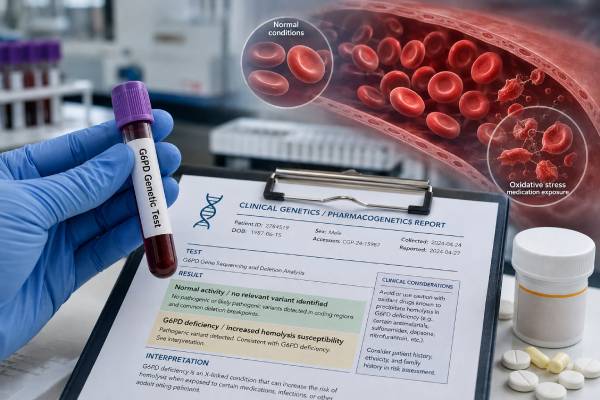
A G6PD genetic test looks for inherited changes in the glucose-6-phosphate dehydrogenase gene that can make red blood cells unusually vulnerable to oxidative stress. The result can help explain a personal or family history of hemolytic anemia and can guide decisions about medicines such as rasburicase, tafenoquine, primaquine, dapsone, and several other oxidant drugs. Genetic testing is useful, but it is not interchangeable with a quantitative G6PD enzyme activity test. Genotype identifies a DNA variant; enzyme testing estimates how much protection a person’s red blood cells have at the time of testing. Sex chromosomes, X-inactivation, recent hemolysis, transfusion, laboratory method, and the exact medication all affect interpretation. For that reason, the safest decision usually combines the genetic report with enzyme activity, treatment urgency, dose, alternative options, and clinical monitoring. This guide explains what the test measures, how results are reported, when testing is most useful, and what to do when a result is positive, negative, or uncertain.
- G6PD deficiency is inherited through the X chromosome and can affect people of any ancestry.
- A DNA result and an enzyme activity result answer related but different clinical questions.
- Some medicines carry a high hemolysis risk, while others can be used with precautions or routine monitoring.
- A normal genetic panel does not exclude every rare or untested G6PD variant.
- Recent hemolysis or transfusion can make enzyme testing look more reassuring than it really is.
- Dark urine, jaundice, sudden fatigue, or shortness of breath after a trigger needs prompt medical assessment.
Table of Contents
- What the G6PD genetic test measures
- Why G6PD deficiency causes hemolysis
- Who may benefit from testing
- Genetic testing versus enzyme activity
- Medication risk and prescribing decisions
- Understanding positive, negative, and uncertain results
- Testing process, timing, and limitations
- Next steps after results
What the G6PD genetic test measures
The G6PD gene provides instructions for making glucose-6-phosphate dehydrogenase, an enzyme that helps red blood cells defend themselves against oxidative damage. A genetic test analyzes this gene for variants associated with reduced enzyme function. Depending on the laboratory, testing may examine a targeted group of common variants, sequence the protein-coding regions, evaluate nearby splice regions, or use a broader method that can detect additional changes. The report should state what was analyzed because a limited panel and full-gene sequencing do not have the same ability to rule out deficiency.
G6PD is located on the X chromosome. Most males have one X chromosome, so a disease-causing variant in their single copy commonly produces a relatively consistent deficient phenotype. Most females have two X chromosomes. A female may have no variant, a variant in both copies, or a variant in one copy. In heterozygous females, random X-chromosome inactivation creates a mixture of red blood cells: some express the typical copy and others express the altered copy. The resulting enzyme activity can range from clearly deficient to apparently normal. This biological mosaicism is one reason genotype and quantitative activity may both be needed.
A genetic report may use terms such as pathogenic, likely pathogenic, variant of uncertain significance, likely benign, or benign. Some pharmacogenetic reports instead translate variants into a predicted phenotype, such as deficient, variable, or normal. The wording can differ by laboratory, and older reports may use historical World Health Organization variant classes. WHO introduced a revised classification to better reflect the overlap in enzyme activity and clinical behavior among variants. The newer framework groups variants according to whether they are associated with chronic hemolysis, acute hemolysis after triggers, no clinically significant hemolysis, or insufficient evidence. It classifies variants rather than guaranteeing the response of every individual who carries one.
The test does not predict whether hemolysis will occur on a particular day. It identifies inherited susceptibility. Actual risk depends on the person’s enzyme activity, the oxidative strength and dose of the medicine, concurrent infection, kidney and liver function, baseline hemoglobin, other blood disorders, and whether the exposure can be stopped quickly. A result therefore supports a prescribing decision; it does not replace clinical judgment or laboratory monitoring.
Why G6PD deficiency causes hemolysis
Mature red blood cells carry oxygen but have limited ways to repair oxidative injury. G6PD is essential to the pentose phosphate pathway, which produces nicotinamide adenine dinucleotide phosphate in its reduced form. That molecule helps regenerate reduced glutathione, one of the cell’s main antioxidant defenses. When G6PD activity is low, oxidant stress can damage hemoglobin and the red-cell membrane. The injured cells may be removed by the spleen or break apart within the circulation, causing hemolysis.
Many people with G6PD deficiency feel well between exposures. Hemolysis is often episodic and begins after a trigger such as an oxidant medication, a significant infection, or fava bean ingestion. The timing varies. Symptoms can appear within hours to several days, depending on the exposure and severity. Common warning signs include sudden weakness, pallor, rapid heartbeat, shortness of breath, yellowing of the eyes or skin, and urine that becomes tea-colored, cola-colored, or unusually dark. Back or abdominal discomfort may occur. Severe episodes can cause marked anemia, kidney injury, low blood pressure, or a need for transfusion.
Newborns may present differently. G6PD deficiency can contribute to significant neonatal jaundice, sometimes without an obvious medication trigger. Prompt bilirubin assessment matters because very high bilirubin can injure the nervous system. Newborn screening policies vary by country and region, so a family should not assume that every infant was tested. A known familial variant, an affected sibling, unexplained neonatal jaundice, or ancestry from a population with higher prevalence can justify a targeted discussion with the pediatric team.
The clinical spectrum is broad. Certain rare variants are associated with chronic nonspherocytic hemolytic anemia, meaning red-cell destruction can continue even without a typical external trigger. More commonly, people have adequate red-cell survival at baseline but reduced reserve during oxidative stress. Variant labels cannot perfectly predict severity because the same named variant may be associated with a range of measured activities, and a heterozygous female can have an activity level that differs substantially from another carrier of the same variant.
This variability explains why a single medication list copied from the internet is not a safe substitute for an individualized plan. Drug risk classifications are periodically updated as evidence changes. The same medicine may also carry different risk at different doses or treatment schedules. A prescriber should use a current, drug-specific guideline and should consider whether the patient has a measured activity result that is reliable for the present clinical situation.
Who may benefit from testing
Testing is most useful when the result can change a decision. A clinician may order G6PD evaluation before a medicine known to produce serious hemolysis in deficient patients. Examples include rasburicase for tumor lysis syndrome and tafenoquine for radical cure or prophylaxis of certain malaria infections. Primaquine decisions also commonly depend on G6PD status, but the required testing method and acceptable activity threshold depend on the regimen. Because some of these treatments are time-sensitive, advance documentation of G6PD status can prevent delays.
Evaluation is also reasonable after unexplained acute hemolytic anemia, particularly when it followed a medicine, infection, or fava bean exposure. Supporting laboratory findings may include a rapid fall in hemoglobin, increased reticulocytes, elevated bilirubin and lactate dehydrogenase, low haptoglobin, and characteristic red-cell changes. These findings establish hemolysis but do not by themselves prove G6PD deficiency. Other causes, including immune hemolysis, membrane disorders, hemoglobin disorders, microangiopathy, and mechanical destruction, may need investigation.
Family history can be informative. Testing may be considered when a close relative has confirmed deficiency, a known G6PD variant, severe neonatal jaundice, or a reproducible hemolytic reaction to an oxidant drug. Because inheritance is X-linked, the pattern may not look like a simple parent-to-child dominant condition. An affected male passes his X chromosome to all daughters and no sons. A female with one altered copy can pass it to children of any sex, although the clinical effect differs according to the child’s sex chromosomes and X-inactivation.
Testing may also be appropriate during preconception or family evaluation when a known familial variant could affect future children. A genetics professional can explain inheritance, reproductive probabilities, and the limits of predicting severity in females. For general preparation before pharmacogenetic testing, a broader overview of pharmacogenetic testing and medication response can help patients understand why a report must be interpreted in the context of a specific drug.
Genetic testing versus enzyme activity
Genetic testing and biochemical testing are complementary. A genetic test asks whether a recognized DNA change is present. A quantitative enzyme test measures G6PD activity in a blood sample, usually reported in units per gram of hemoglobin or as a percentage of an adjusted population median. A qualitative screening test provides a simpler deficient-or-not-deficient result around a laboratory-specific threshold. The most useful test depends on the treatment decision.
Genotype has several advantages. DNA does not change after transfusion or during an acute hemolytic episode, and a confirmed familial variant can clarify inheritance. Genetic testing can also identify heterozygous females whose total enzyme activity happens to be in a reassuring range at one point in time. However, a targeted assay may miss variants it was not designed to detect. Even sequencing may not detect every structural or regulatory change. A variant of uncertain significance may not establish whether enzyme activity is low enough to matter clinically.
Enzyme activity is closer to the immediate biological question, but timing can distort it. During acute hemolysis, the most deficient and oldest red cells may be destroyed first. The remaining circulation is enriched with younger cells and reticulocytes, which generally have higher G6PD activity. The test can therefore be falsely normal or less deficient than the person’s baseline. A recent red-cell transfusion can also mask deficiency because donor cells contribute normal enzyme activity. When clinical suspicion remains high, clinicians often repeat quantitative testing after recovery and after enough time has passed for transfused cells to clear.
Female heterozygotes require particular care. A qualitative test designed to identify severe deficiency may classify a woman with intermediate activity as normal, even though part of her red-cell population is vulnerable. Quantitative testing is more informative when a medicine has a defined activity threshold. For tafenoquine, current malaria practice generally requires a quantitative result at or above a high threshold, commonly 70% of normal activity, because the drug has a long half-life and cannot be rapidly removed after dosing. Primaquine regimens may use different thresholds and schedules, and local malaria guidance should be followed rather than applying one universal number.
A discordant result is not automatically a laboratory error. A pathogenic genotype with near-normal activity can occur in a heterozygous female. A low activity result without a detected variant may reflect an untested rare variant, preanalytic issues, or another clinical factor. The safest approach is to reconcile the report with sex chromosome context, laboratory method, timing, transfusion history, and the intended medication. A clinician may consult hematology, clinical pharmacology, infectious disease, oncology, or genetics depending on the situation.
Medication risk and prescribing decisions
The practical goal of testing is to prevent avoidable hemolysis without withholding beneficial treatment unnecessarily. Current pharmacogenetic guidance separates medicines by evidence and risk rather than treating every oxidant exposure as equally dangerous. High-risk drugs generally should be avoided in a person with a deficient phenotype unless a specialist determines that exceptional circumstances justify use and intensive management. Medium-risk drugs may be used in selected patients with cautious dosing and monitoring. Low-to-no-risk drugs can usually be prescribed at standard doses without special action solely because of G6PD status.
Rasburicase is a prominent high-risk example. It rapidly breaks down uric acid and can be lifesaving in tumor lysis syndrome, but its production of hydrogen peroxide can cause severe hemolysis and methemoglobinemia in G6PD-deficient patients. When treatment is planned, G6PD status should be established in advance whenever feasible. If tumor lysis is an emergency and status is unknown, the oncology team must balance urgency against risk and consider alternatives and immediate testing. A patient known to be deficient should have the result clearly documented so that it is visible during future cancer care.
Tafenoquine is another high-risk exposure because it can continue exerting oxidative effects for weeks. It should not be given to a patient with deficient or intermediate activity, and a quantitative test is needed before use. Standard-dose daily primaquine can also produce clinically important hemolysis in deficient individuals. Alternative dosing strategies sometimes exist for malaria, but they require disease-specific expertise, a reliable activity result, and monitoring. Patients should not self-adjust antimalarial treatment because incomplete therapy can allow relapse or continued transmission.
Other medicines considered high risk in deficient patients include dapsone, methylene blue, pegloticase, phenazopyridine, and toluidine blue. Dapsone may be encountered in infectious disease, dermatology, and hematology. Methylene blue is especially important because it is a treatment for methemoglobinemia in many patients but may be ineffective and hemolytic when G6PD activity is low. Nitrofurantoin is often treated as a medium-risk drug rather than an absolute prohibition; the decision depends on infection severity, alternatives, dose, duration, baseline blood counts, and the ability to recognize symptoms quickly.
Medication lists on old cards and websites often conflict. Some include drugs based on theoretical oxidative potential or isolated case reports, while others omit dose-dependent risk. Chloroquine and hydroxychloroquine, sulfonamides, vitamin C, and aspirin are examples for which blanket statements can be misleading. The prescriber should check a current evidence-based source for the exact drug and regimen. A person with deficiency should not stop a necessary medicine abruptly without medical advice, but should contact the prescriber promptly if a listed warning or symptom is discovered.
Understanding positive, negative, and uncertain results
A positive genetic result usually means the laboratory found a variant classified as pathogenic or likely pathogenic. The next question is not simply whether the person “has the gene”; everyone has a G6PD gene. The clinically important details are the exact variant, whether one or two X-chromosome copies are involved, the predicted effect, and whether enzyme activity confirms deficiency or an intermediate phenotype. In a male with one pathogenic variant, the result often strongly supports deficiency. In a heterozygous female, the genotype establishes carrier status but does not precisely predict the proportion of vulnerable red cells.
A negative result means that no reportable variant was detected by the method used. It lowers the probability of inherited deficiency but does not eliminate it. A targeted panel can only identify the variants included. Full sequencing may still miss certain deletions, duplications, deep intronic changes, mosaic findings, or variants that current knowledge cannot classify. If quantitative activity is low or the clinical history is strongly suggestive, the clinician should not dismiss the phenotype because a panel was negative. Expanded analysis or repeat biochemical testing may be appropriate.
A variant of uncertain significance means evidence is currently insufficient to label the change harmful or harmless. It should not be treated automatically as a confirmed deficiency, but it also should not be ignored when the medication carries a severe and preventable risk. Enzyme activity, family testing, population frequency, functional evidence, and future reclassification may clarify the finding. The general principles used to interpret a pathogenic, benign, or uncertain genetic variant are particularly important here because medication decisions may be urgent.
Some reports provide historical WHO classes, enzyme-function categories, or activity estimates. These labels can be confusing because the older Class II and Class III groups overlap substantially. The revised WHO framework was designed for variant classification, not as a stand-alone prescription for an individual. A report that lists a variant class should still be read alongside measured activity and a drug-specific guideline.
A quantitative enzyme result may be reported as deficient, intermediate, or normal, but laboratories use different instruments, reference intervals, temperatures, and denominator methods. The numerical value should be interpreted with the laboratory’s reference range and, for malaria medicines, the relevant treatment guideline. A result near a threshold deserves more caution than one far from it. Repeat testing can be reasonable when the sample was obtained during acute illness, after transfusion, or under conditions that might have affected specimen quality.
Testing process, timing, and limitations
G6PD genetic testing usually uses blood, saliva, or a cheek swab. Fasting is not normally required. The laboratory needs accurate identifiers and may request sex assigned at birth or chromosome information because copy number and interpretation depend on X-chromosome context. Patients should disclose previous bone marrow or stem-cell transplantation, because blood-derived DNA after an allogeneic transplant may represent the donor rather than the recipient. In that situation, a non-blood sample and specialist laboratory planning may be needed.
The sample itself is usually straightforward, but the clinical history is essential. The order should identify the medicine under consideration, the reason for testing, any previous hemolytic episode, neonatal jaundice, transfusion dates, and relevant family findings. These details help the laboratory and clinician decide whether targeted testing, sequencing, deletion and duplication analysis, or enzyme testing is most appropriate.
Turnaround time ranges from hours for some enzyme assays to days or weeks for genetic analysis. A time-sensitive medication should not be delayed or given on assumption without a clinician-directed contingency plan. Hospitals that frequently use rasburicase or antimalarial therapy may establish rapid testing pathways. Patients with a known result can reduce future delays by keeping a copy in the medical record and on a secure personal device.
No test predicts every episode. Genetic penetrance is affected by cellular mosaicism and exposure. Enzyme assays can vary between laboratories and can be misleading after hemolysis or transfusion. An older or uncertain report may warrant review before a high-risk medicine is prescribed.
Direct-to-consumer or broad wellness panels may include a few common G6PD variants. Such testing can identify a useful clue, but it may not have the coverage, validation, chain of custody, or clinical interpretation needed for a high-risk prescription. A medical decision should rely on a validated clinical laboratory result. Likewise, ancestry-based prediction cannot replace testing when the consequence of being wrong is severe hemolysis.
Next steps after results
After a deficient or likely deficient result, the clinician should add G6PD deficiency to the problem list and medication safety alerts, document the exact test and date, and create a drug-specific plan. The patient should receive a readable copy rather than only a verbal statement. A wallet card or emergency note can be useful, but it should identify the diagnosis and direct clinicians to the full report rather than presenting an unverified universal “never use” list.
Before starting a high-risk medicine, confirm whether the existing evidence is genetic, biochemical, or both. Check whether the enzyme result is quantitative and whether it was obtained during a reliable period. For tafenoquine or primaquine, follow the current malaria protocol and its activity threshold. For rasburicase, pegloticase, dapsone, methylene blue, and other high-risk agents, review alternatives and specialist recommendations. When a medium-risk medicine is chosen, define baseline tests, follow-up timing, symptom instructions, and a clear stop-and-call plan.
A normal result should also be documented accurately. “No variant detected” is not identical to “all G6PD deficiency excluded.” The report’s tested regions and limitations should remain attached. If the patient later has convincing hemolysis, the evaluation should be reopened rather than assuming the old panel settled the question. Conversely, a normal quantitative activity result obtained under reliable conditions may be more useful for a specific immediate prescription than a negative limited genetic panel.
Patients should seek urgent medical care for dark urine, jaundice, rapidly worsening fatigue, shortness of breath, fainting, chest pain, confusion, or a fast heartbeat after a possible trigger. They should bring the medication list and G6PD report. Emergency clinicians may need a complete blood count, hemolysis studies, kidney assessment, and methemoglobin measurement. Treatment focuses on stopping the trigger, supportive care, treating infection, maintaining kidney perfusion, and transfusion when clinically necessary.
Family communication is the final step. Relatives can be told that an inherited X-linked finding was identified and that their clinician can decide whether targeted genetic testing, enzyme activity, or both would be useful. A genetics consultation is particularly helpful for heterozygous females, families with chronic hemolysis, or couples planning a pregnancy. The best outcome of testing is not merely a label; it is a durable safety plan that follows the patient across oncology, infectious disease, primary care, emergency care, and future prescribing.
References
- Expanded Clinical Pharmacogenetics Implementation Consortium Guideline for Medication Use in the Context of G6PD Genotype 2023 (Clinical guideline)
- New WHO classification of genetic variants causing G6PD deficiency 2024 (Expert classification update)
- Functional interpretation, cataloging, and analysis of 1,341 glucose-6-phosphate dehydrogenase variants 2023 (Variant interpretation study)
- Meeting report of the technical consultation to review the classification of glucose-6-phosphate dehydrogenase (G6PD) 2022 (WHO technical report)
- Screening and the analysis of genotypic and phenotypic characteristics of glucose-6-phosphate dehydrogenase deficiency 2024 (Multicenter study)
- Glucose-6-phosphate dehydrogenase deficiency 2020 (Clinical review)
Disclaimer
This article is for general education and does not provide individual medical advice. Medication decisions, malaria treatment, and interpretation of genetic or enzyme results should be made with a qualified clinician using the full laboratory report and current drug-specific guidance. Seek urgent care for symptoms of acute hemolysis or methemoglobinemia.