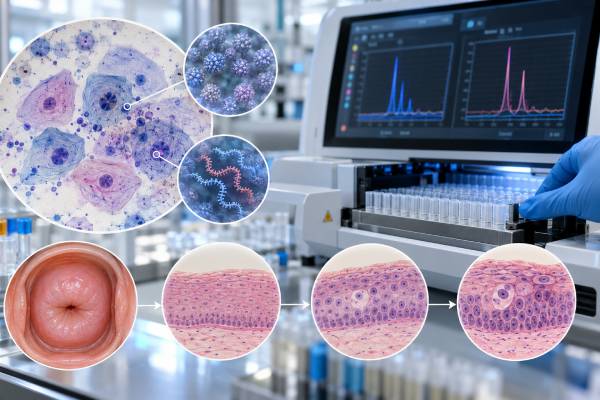
HPV 16 and HPV 18 testing identifies two high-risk human papillomavirus genotypes that account for a large share of cervical cancers. A positive result means viral DNA or RNA from one of these types was detected in a cervical or approved vaginal sample; it does not mean that cervical cancer is present. Most HPV infections clear or become undetectable, but persistent infection with a carcinogenic type can cause precancerous cell changes over time. HPV 16 carries the highest cervical precancer and cancer risk, while HPV 18 is especially important because it is strongly associated with cervical adenocarcinoma and can be harder to detect with cytology alone. Because of that risk, current management guidelines generally recommend colposcopy after a positive HPV 16 or HPV 18 result even when cytology is normal. The exact next step still depends on age, pregnancy, prior screening history, previous cervical treatment, and the testing method used.
- A positive HPV 16 or HPV 18 result means a high-risk genotype was detected; it does not diagnose cervical cancer.
- HPV 16 has the highest risk for CIN3 and cervical cancer, and HPV 18 is strongly linked with cervical adenocarcinoma.
- Positive HPV 16 or HPV 18 results usually lead to colposcopy rather than simple routine screening follow-up, even if cytology is negative.
- There is no blood test or viral “level” that tells how severe an HPV 16 or 18 infection is; management is based on genotype and cervical disease risk.
- A negative HPV 16/18 result does not rule out other carcinogenic HPV types, so the full high-risk HPV result matters.
Table of Contents
- What HPV 16 and HPV 18 Are
- How HPV 16 and HPV 18 Testing Works
- What Positive HPV 16 and HPV 18 Results Mean
- What Negative Results Mean
- Follow-Up After HPV 16 or HPV 18
- Persistence, Clearance, and Cancer Risk
- Common Questions and Next Steps
What HPV 16 and HPV 18 Are
Human papillomavirus is a large family of viruses. Some types mainly cause skin or genital warts, while a smaller group can infect the cervix and contribute to cancer. These are called high-risk, oncogenic, or carcinogenic HPV types.
HPV 16 and HPV 18 are especially important because they are responsible for a disproportionate share of invasive cervical cancers worldwide. HPV 16 is the single most carcinogenic genotype and is strongly associated with high-grade squamous precancer. HPV 18 causes fewer infections overall than HPV 16 but is overrepresented in cervical adenocarcinoma and related glandular lesions.
An HPV genotype test does not examine the cells for cancer. Instead, it detects viral genetic material. That is why a person can have a positive HPV 16 or 18 test with completely normal cytology and no visible lesion. The purpose of genotype information is to identify people whose future or current risk of cervical precancer is high enough to justify closer evaluation.
HPV infection is extremely common and is usually acquired through sexual contact. A positive result does not reveal when the infection was acquired or from whom. HPV can remain below the limits of detection and later become detectable again, so a newly positive test does not necessarily prove a recent exposure.
Vaccination prevents infection with HPV 16 and 18 and several additional high-risk types, depending on the vaccine. Vaccination greatly lowers future risk but does not treat an infection that is already established. People who have been vaccinated still follow age-appropriate cervical screening recommendations unless their clinician advises otherwise.
For a broader explanation of testing that includes multiple carcinogenic genotypes, see the high-risk HPV test. HPV 16/18 genotyping is a more specific layer of information within that screening process.
How HPV 16 and HPV 18 Testing Works
HPV testing usually uses a cervical sample collected during a speculum examination. Depending on the approved assay and screening program, a vaginal sample collected by the patient in a health care setting may also be an option. The laboratory looks for high-risk HPV DNA or, in some tests, viral RNA.
Some assays report HPV 16 and HPV 18 separately. Others report HPV 18 together with HPV 45 or provide a larger set of individual or grouped genotypes. Extended genotyping is becoming more useful because different high-risk types carry different levels of precancer risk.
A report might look like this:
- HPV 16: positive or negative
- HPV 18: positive or negative
- Other high-risk HPV: positive or negative
The exact format depends on the assay. A person may be positive for HPV 16 and another high-risk type at the same time, or positive for HPV 18 without HPV 16.
HPV testing can be used as primary screening, meaning the HPV result is the first screening test. It can also be part of cotesting with a Pap test, or used after certain abnormal cytology results. When a high-risk HPV result is positive, additional triage may include cytology, genotype information, or p16/Ki-67 dual stain depending on the screening pathway.
No fasting, medication change, or blood draw is needed. However, the sample must contain enough appropriate cells or vaginal material for the assay to be valid. If the laboratory reports an invalid or unsatisfactory result, repeat collection may be necessary.
Self-collected vaginal specimens are an important newer option in selected screening settings. Current guidance still distinguishes self-collected vaginal HPV testing from clinician-collected cervical sampling because cytology and some triage tests require a cervical specimen. A positive self-collected HPV 16 or 18 result generally leads to colposcopy with clinician-collected cervical evaluation.
What Positive HPV 16 and HPV 18 Results Mean
A positive HPV 16 result means the assay detected HPV 16 genetic material. This genotype has the highest risk of causing CIN3, the most severe grade of cervical intraepithelial neoplasia before invasive cancer, as well as cervical cancer itself.
A positive HPV 18 result means HPV 18 was detected. HPV 18 also carries substantial cancer risk and has a strong association with glandular precancer and adenocarcinoma. Because glandular lesions can be less obvious on cytology and colposcopy, HPV 18 positivity receives special attention in management guidelines.
A positive result is not the same as a positive cancer test. Most people with HPV 16 or HPV 18 do not have invasive cervical cancer at the time of testing. The result instead identifies a higher-risk group in whom colposcopy and biopsy can find or exclude precancer.
The risk associated with HPV depends on more than genotype. Important factors include:
- whether the infection persists over time;
- current cytology findings;
- prior HPV and Pap results;
- previous CIN2, CIN3, adenocarcinoma in situ, or treatment;
- immune status;
- age and screening history;
- smoking and other cofactors.
A positive genotype can coexist with normal cytology because HPV-related molecular changes can develop before cells look abnormal under a microscope. That is why normal cytology does not cancel the risk associated with HPV 16 or 18.
If cytology shows a high-grade abnormality such as HSIL, the immediate risk is higher still and management may move more quickly. The p16 marker may be used on biopsy tissue to help pathologists classify certain precancerous lesions, but p16 is not a substitute for HPV genotype testing.
What Negative Results Mean
A negative HPV 16/18 result means those genotypes were not detected in the tested sample. The next question is whether other high-risk HPV types were detected.
If HPV 16 and 18 are negative but another carcinogenic type is positive, the person is still HPV-positive and may need cytology, dual-stain triage, or repeat testing based on the genotype group and prior history. Current extended-genotyping guidance recognizes that risks differ among types such as HPV 45, 31, 33/58, 52, and other groups.
If the entire high-risk HPV test is negative, the short-term risk of cervical precancer is low in an average-risk person with an adequate screening test. The recommended screening interval depends on age, the screening method, whether the sample was clinician- or self-collected, and national guidelines.
A negative test is not permanent immunity. A person can acquire a new HPV infection later, and a previously undetectable infection can sometimes become detectable. Screening should therefore continue at the recommended interval.
False-negative results are uncommon with validated HPV assays but can occur. Possible reasons include a sample with too little material, viral concentration below the assay limit, collection problems, or a lesion caused by a genotype not included in the test. Symptoms such as unexplained vaginal bleeding, bleeding after sex, persistent watery or bloody discharge, or pelvic pain require medical evaluation regardless of a recent negative HPV screen.
Follow-Up After HPV 16 or HPV 18
For most screening situations, a positive HPV 16 or HPV 18 result is considered high enough risk to warrant colposcopy. Colposcopy is an examination of the cervix using magnification after dilute acetic acid is applied. If an abnormal area is seen, the clinician can take a biopsy for diagnosis.
Current enduring management guidance recommends colposcopy after positive HPV 16 or 18 results. This applies even when cytology is negative because the genotype itself carries sufficient risk.
At colposcopy, the clinician may inspect the entire transformation zone, take targeted biopsies, and in some situations sample the endocervical canal. The exact procedure depends on age, pregnancy status, cervical anatomy, cytology, and whether the squamocolumnar junction is fully visible.
Biopsy results determine the next stage of management. Common possibilities include:
- no precancer found;
- CIN1, a low-grade lesion that often regresses;
- CIN2 or CIN3, higher-grade precancer that may require treatment or carefully selected observation;
- adenocarcinoma in situ;
- invasive cervical cancer, which requires oncology evaluation.
A Ki-67-related dual-stain test can help triage some HPV-positive results, but HPV 16 and HPV 18 are exceptions in important current algorithms: even a negative dual-stain result generally does not replace the recommendation for colposcopy when HPV 16 or 18 is present.
Pregnancy changes how some diagnostic and treatment procedures are timed, but it does not make a high-risk HPV result irrelevant. Pregnant patients should have management tailored by an experienced clinician rather than delaying evaluation on their own.
Persistence, Clearance, and Cancer Risk
The key biological event in cervical carcinogenesis is usually persistent high-risk HPV infection, not a single brief exposure. The immune system clears or suppresses many infections within one to two years. When HPV 16 or 18 remains detectable and causes ongoing expression of viral oncogenes, the risk of high-grade precancer increases.
HPV does not usually progress directly from infection to cancer in a short period. Cervical cancer generally develops through precancerous stages over years, which is why screening and treatment of CIN2 or CIN3 are so effective at prevention.
Persistence can be difficult to interpret from tests alone. If HPV 16 is positive today and positive again a year later, it may represent persistent infection, but exact viral behavior cannot be determined from a standard qualitative test. Most clinical assays report detected/not detected rather than a meaningful viral load.
There is no medication that reliably eradicates cervical HPV itself. Management focuses on detecting and treating the cell changes HPV can cause. Smoking cessation, appropriate follow-up, and vaccination when eligible can reduce future risk, but supplements or unproven “HPV clearing” products should not replace medical surveillance.
HPV 16 and 18 are important but not the only oncogenic types. Worldwide analyses show that multiple genotypes contribute to cervical cancer. This is why a person with a negative HPV 16/18 result but positive “other high-risk HPV” still needs risk-based management.
The cervical cancer biomarker panel concept includes HPV, cytology-related biomarkers such as p16/Ki-67, and tissue findings, but these tests are used at different steps rather than as one universal blood panel.
Common Questions and Next Steps
Does HPV 16 or HPV 18 mean a partner was recently unfaithful?
No. HPV can remain undetectable for years and later become detectable. A test cannot determine when the infection was acquired or identify the source.
Can a person have both HPV 16 and HPV 18?
Yes. Coinfection with more than one HPV genotype is possible. Management is based on the highest-risk finding and the full screening history.
Does a positive result affect fertility?
The infection itself usually does not prevent pregnancy. Fertility considerations become more important if high-grade precancer requires excisional treatment. Patients who may want future pregnancies should discuss treatment options and obstetric implications with their clinician.
Should a partner be tested?
Routine HPV testing is not generally used to screen male partners, and there is no standard partner-management program comparable with bacterial sexually transmitted infections. Partners can discuss HPV vaccination and appropriate anogenital cancer screening if they have specific risk factors.
What should happen after the result?
The most useful next step is to review the complete report, not only the word “positive.” Ask which genotype was detected, whether cytology was performed, whether the sample was self-collected or clinician-collected, and what prior results are on record. Then follow the recommended colposcopy or surveillance interval.
Do not delay evaluation because there are no symptoms. Cervical precancer usually causes none. Conversely, do not wait for a routine screening appointment if abnormal bleeding, persistent discharge, or pelvic symptoms develop. Screening is designed for people without symptoms; symptoms require diagnostic assessment.
It is also worth separating screening from vaccination decisions. A current HPV 16 or 18 infection does not make vaccination useless if a person is still within an age group for which vaccination is recommended or may be considered. The vaccine cannot clear the detected infection, but it can protect against vaccine-covered HPV types that have not been acquired. The decision should follow age-based recommendations and individual discussion with a clinician.
After colposcopy, keep copies of the HPV genotype, cytology, biopsy, and treatment reports. Future management is risk-based, and an earlier CIN2+ diagnosis or treatment can change screening intervals for many years. A complete record prevents a later normal test from being interpreted without the history that gives it meaning. This is particularly important after treatment for high-grade precancer, when surveillance lasts much longer than routine screening.
Follow-up recommendations can also differ for people who are immunocompromised, pregnant, or previously treated for CIN2, CIN3, or adenocarcinoma in situ. In those settings, the usual screening algorithm may not apply exactly. The safest interpretation is therefore the genotype result plus the person’s documented cervical history and the specific management guideline used by the treating clinician.
References
- Applying Results of Extended Genotyping to Management of Positive Cervicovaginal Human Papillomavirus Test Results: Enduring Guidelines 2025 (Guideline)
- Self-Collected Vaginal Specimens for HPV Testing: Recommendations From the Enduring Consensus Cervical Cancer Screening and Management Guidelines Committee 2025 (Guideline)
- Self-collected vaginal specimens for human papillomavirus testing and guidance on screening exit: An update to the American Cancer Society cervical cancer screening guideline 2025 (Guideline)
- Causal attribution of human papillomavirus genotypes to invasive cervical cancer worldwide: a systematic analysis of the global literature 2024 (Systematic Analysis)
- Recommendations for Use of p16/Ki67 Dual Stain for Management of Individuals Testing Positive for Human Papillomavirus. 2024 (Guideline)
- 2019 ASCCP Risk-Based Management Consensus Guidelines for Abnormal Cervical Cancer Screening Tests and Cancer Precursors 2020 (Guideline)
Disclaimer
HPV 16 and HPV 18 results must be interpreted with the full high-risk HPV report, cytology, age, pregnancy status, and prior cervical history. A positive result does not diagnose cervical cancer, but it usually requires timely follow-up because these genotypes carry higher precancer risk. Anyone with abnormal vaginal bleeding or other concerning symptoms should seek diagnostic care rather than relying on a screening result alone.