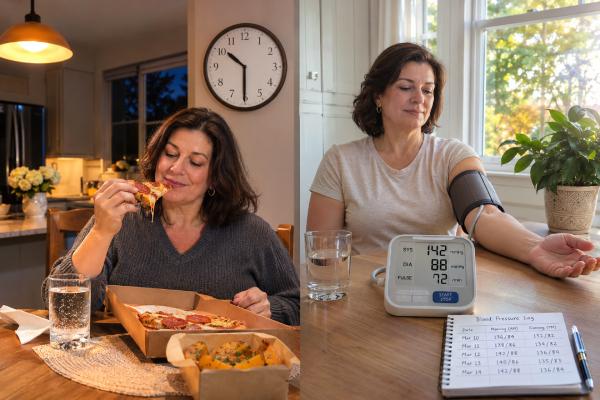
Late-night eating can contribute to higher morning blood-pressure readings in some people, but the relationship is not as simple as “eat after 8 p.m. and your pressure rises.” Direct evidence is still limited, and meal timing is often mixed together with sodium intake, alcohol, sleep loss, reflux, shift work, and excess calories. A large salty meal close to bedtime can increase fluid retention and thirst, disturb sleep, and leave the cardiovascular system handling a metabolic load at a time when it normally winds down. Circadian biology may also make late eating less favorable for glucose and vascular regulation. However, not every late meal raises blood pressure, and some studies of time-restricted eating show mixed results. The useful question is whether your own morning average improves when dinner is earlier, lighter, and lower in sodium while everything else stays stable. A structured one- to two-week experiment, combined with correct home measurements, can reveal far more than one unusually high reading after a late dinner.
Table of Contents
- Why Morning Blood Pressure Can Be Higher
- How Late Meals May Affect Morning Readings
- What the Research Shows
- Meal Quality Matters as Much as Timing
- A Practical Evening Eating Plan
- How to Test the Effect at Home
- When High Morning Readings Need Medical Attention
Why Morning Blood Pressure Can Be Higher
Blood pressure is not fixed throughout the day. In many people it falls during sleep, then begins to rise before waking as the nervous system and hormones prepare the body for activity. This normal “morning surge” is influenced by sympathetic nervous-system activity, cortisol, blood-vessel tone, posture, and the transition from sleep to wakefulness.
People differ in how much their pressure drops overnight. Some show a normal nighttime “dip,” while others have a smaller dip or no dip at all. Sleep apnea, diabetes, kidney disease, autonomic problems, obesity, aging, high sodium intake, and some medication schedules can contribute to abnormal nighttime patterns. That means a high morning reading may have several causes before dinner timing is even considered.
The first step is therefore to confirm that the pattern is real. One morning of 148/88 mmHg after a poor night does not establish morning hypertension. A week of repeated measurements taken under the same conditions is much more informative.
For accurate comparison, take your reading after waking and using the bathroom, before breakfast, exercise, caffeine, or smoking, and before morning blood-pressure medication unless your clinician has told you to measure at another time. Sit quietly for five minutes and use a validated upper-arm cuff. The guide to measuring blood pressure at home explains the technique in more detail.
If your morning average is consistently higher than your evening average, meal timing is one possible contributor, but not the only one. Sleep quality, medication duration, sleep apnea, alcohol, pain, stress, and sodium intake often deserve equal or greater attention. The article on why blood pressure is high in the morning covers those broader causes.
How Late Meals May Affect Morning Readings
Several mechanisms could connect a late dinner or nighttime snack with the next morning’s pressure.
Sodium and fluid retention: Restaurant meals, takeout, pizza, processed meats, soups, sauces, chips, and packaged snacks can contain a large sodium load. Sodium causes the body to retain more water. In salt-sensitive people, that can increase blood volume and pressure for hours afterward. A late high-sodium meal may therefore affect overnight and morning readings more than an earlier low-sodium meal.
Sleep disruption: Heavy meals close to bed can worsen reflux, bloating, body temperature, and sleep quality. Alcohol with a late meal may make you sleepy initially but fragment sleep later in the night. Poor sleep can increase sympathetic activity and is associated with higher blood pressure. For people with obstructive sleep apnea, alcohol and large meals may compound an already abnormal nighttime pattern.
Circadian mismatch: The body’s metabolic systems follow a day-night rhythm. Insulin sensitivity and glucose handling tend to be less favorable later in the biological day. Eating a large share of daily calories late may therefore produce a different metabolic response than eating the same meal earlier. Those metabolic changes do not translate automatically into a higher morning pressure, but they provide a plausible pathway linking habitual late eating with cardiometabolic risk.
Sympathetic and digestive activity: Digestion itself increases blood flow to the gastrointestinal tract and triggers hormonal responses. Going to bed while processing a very large meal may keep the body in a more metabolically active state during the first part of sleep.
Indirect calorie effects: Late-night eating is often additional eating rather than simply shifted eating. Repeated extra calories can promote weight gain, and excess body weight is a major long-term driver of hypertension.
These mechanisms explain why timing may matter, but they also show why “late eating” is hard to study. The clock time is tangled with what was eaten, how much was eaten, whether alcohol was involved, and how well the person slept.
What the Research Shows
Research on eating time and blood pressure is promising but still developing.
A 2024 systematic review specifically examined time of eating, exercise, and sleep in adults with elevated blood pressure or hypertension. Only a small number of eligible studies were available. Among studies that assessed later eating, some found an association with higher pressure while others did not. The review described the evidence as preliminary because study designs and timing definitions varied.
That is an important limitation. “Late eating” can mean dinner after 8 p.m., a snack within two hours of bed, a large percentage of calories after 7 p.m., or a long eating window that stretches from early morning to midnight. These exposures are not equivalent.
Time-restricted eating research provides another clue. Reviews and meta-analyses have found that limiting the daily eating window can improve body weight and some cardiometabolic markers, including blood pressure, but results are not uniform. A 2026 network meta-analysis of randomized trials reported overall improvements in several metabolic outcomes and suggested that earlier eating windows generally perform favorably. Earlier reviews focused on metabolic syndrome also noted that blood-pressure results were mixed and that timing may matter.
The strongest conclusion is therefore modest: regularly shifting substantial calorie intake into the late evening may be less favorable for cardiometabolic health, but current evidence does not prove that a specific dinner cutoff will lower morning blood pressure in everyone.
It also does not mean people who work evenings or shifts are destined to have high pressure. Circadian disruption is one risk factor among many, and practical consistency often matters more than following an idealized clock schedule that is impossible for your life.
If you want to experiment with an earlier eating window, the discussion of time-restricted eating for heart and blood-sugar health can help you compare the broader evidence.
Meal Quality Matters as Much as Timing
A late bowl of plain yogurt with berries is not metabolically equivalent to a midnight pizza, fries, and several alcoholic drinks. When people blame “eating late,” the composition and size of the meal may be doing much of the work.
For morning blood pressure, sodium is especially important. Consider two dinners:
- Grilled fish, roasted vegetables, a small baked potato, olive oil, and fruit.
- Takeout noodles with soy-based sauce, fried appetizers, processed meat, and alcohol.
Both could be eaten at 9 p.m., but the second meal may deliver several times more sodium, more calories, and more alcohol. It is also more likely to cause thirst, poor sleep, and reflux. If the morning reading is higher, clock time alone cannot explain the difference.
Carbohydrate quality matters too. A very large refined-carbohydrate meal late at night can produce a larger glucose and insulin excursion than a balanced meal with vegetables, protein, whole grains, and healthy fats. Over time, repeated excess calories and poor diet quality can worsen insulin resistance and body weight, both of which are related to hypertension.
Alcohol deserves separate attention. It may temporarily relax blood vessels, but heavier use can raise blood pressure over time and impair sleep. A late dinner paired with two or three drinks can therefore affect the morning through several pathways.
A useful evening pattern is built around vegetables, beans or another protein source, whole grains or starchy vegetables in a sensible portion, and mostly unsaturated fats. Keep heavily salted sauces and packaged foods modest. The relationship between sodium and high blood pressure is often more actionable than trying to identify the perfect dinner hour.
If you are genuinely hungry near bedtime, a small snack can be reasonable. Hunger that repeatedly wakes you or makes sleep difficult is not a cardiovascular win. The goal is to avoid turning the last hours of the day into the largest, saltiest eating period.
A Practical Evening Eating Plan
You do not need a rigid rule such as “never eat after 6 p.m.” A more sustainable target is to finish the main evening meal about two to three hours before bed when your schedule allows.
That interval is practical rather than magical. It gives digestion time to progress and reduces the chance that a large meal, reflux, alcohol, or a salty snack will overlap with the first hours of sleep. Someone who goes to bed at 10:30 p.m. might aim to finish dinner around 7:30–8 p.m.; someone who works until 9 p.m. may need a different structure.
If dinner must be late, change the size and composition rather than skipping it entirely. For example:
- Eat a more substantial breakfast and lunch so you are not ravenous at night.
- Have a planned late-afternoon snack with fruit plus yogurt, nuts, or another protein source.
- Make the late meal smaller and lower in sodium.
- Choose grilled, baked, or minimally processed foods instead of takeout most nights.
- Limit alcohol close to bedtime.
- Avoid drinking excessive fluid simply because a salty meal made you thirsty.
Shift workers can use the same principle relative to their sleep period: avoid making the final pre-sleep meal the largest meal of the waking period when possible. Perfect circadian alignment may not be realistic, so focus on consistency, diet quality, and enough sleep.
A short walk after dinner can also help post-meal glucose control and may support better metabolic health. See walking after dinner for blood sugar and heart health. Keep the walk comfortable rather than turning it into a hard workout right before bed if vigorous exercise disrupts your sleep.
The key is to make earlier, lighter eating easy enough to repeat. A plan that works five or six nights each week is more informative than an extreme fasting schedule followed for three days.
How to Test the Effect at Home
A simple personal experiment can show whether evening meal timing is relevant to your morning readings.
First, collect a baseline for seven days. Keep your usual dinner habits and measure blood pressure every morning under standardized conditions. If possible, also measure in the evening before dinner or several hours afterward. Record bedtime, dinner time, alcohol, unusually salty meals, and sleep duration.
Then spend another one to two weeks changing only the evening pattern:
- Finish the main meal roughly two to three hours before sleep when practical.
- Keep dinner sodium moderate and avoid unusually large portions.
- Avoid or minimize alcohol during the test period.
- Keep caffeine, exercise, and medication timing stable.
- Measure blood pressure at the same times using the same arm and cuff.
- Compare weekly averages, not individual peaks.
Another reason morning values can look worse after a late night is simple measurement context. You may sleep less, wake later, rush to get ready, or measure immediately after climbing stairs, showering, or arguing with an alarm clock. Those differences can move the number independently of the meal. A valid comparison requires the same five minutes of seated rest on both “late dinner” and “earlier dinner” mornings.
Temperature can matter as well. Cold exposure narrows peripheral blood vessels and may raise pressure temporarily, while a warm room can do the opposite. Decongestants, nonsteroidal anti-inflammatory drugs, nicotine, and some stimulant medications can also shift readings. If one of these factors changes during your experiment, note it rather than automatically attributing the result to dinner.
Finally, morning blood pressure is most useful when interpreted as a pattern rather than a contest for the lowest number. A small but repeatable improvement that comes with better sleep and easier meal control is valuable. A dramatic one-day drop followed by a return to baseline is not evidence that a 7 p.m. dinner is a treatment.
A change of a few mmHg in the average can be meaningful if it is consistent, but do not overinterpret tiny differences. Home devices have measurement variability, and your biology varies from day to day.
Use a consistent home blood-pressure monitoring routine rather than checking repeatedly after every meal. Repeated checking can create anxiety and produce a pile of incomparable numbers.
Also note whether sleep improves. If earlier dinner reduces reflux, snoring after alcohol, nighttime awakenings, or morning grogginess, those benefits may be worthwhile even if the pressure change is small.
Keep the experiment long enough to average out ordinary noise. Weekends, restaurant meals, stressful workdays, menstrual-cycle changes, illness, and disrupted sleep can all move pressure temporarily. If the first week after changing dinner is unusual, extend the comparison rather than drawing a conclusion from three or four mornings.
Do not change prescribed medication timing as part of a meal experiment unless your clinician specifically recommends it. Moving medication can produce a stronger effect than moving dinner and may create periods of under- or overtreatment.
When High Morning Readings Need Medical Attention
Meal timing is worth testing only after you recognize when the pattern needs medical evaluation.
Contact your clinician if home readings are repeatedly above your treatment target despite good technique, especially if the morning average is consistently much higher than later readings. The cause may be sleep apnea, inadequate medication coverage overnight, kidney disease, endocrine conditions, high sodium intake, or another issue that will not be solved by earlier dinner alone.
Sleep apnea deserves particular attention if you snore loudly, stop breathing during sleep, wake with headaches or dry mouth, or feel excessively sleepy during the day. Untreated apnea can prevent the normal nighttime blood-pressure dip and increase cardiovascular risk. The relationship between poor sleep and high blood pressure is often more important than meal timing itself.
Very high readings require a different response. If your blood pressure is around 180/120 mmHg or higher, repeat the measurement after several minutes of quiet rest. If it remains that high and you have chest pain, shortness of breath, weakness, numbness, confusion, severe headache, vision change, or another concerning symptom, seek emergency care. Follow your clinician’s instructions for severe readings even without symptoms.
For everyone else, treat meal timing as one adjustable part of a larger plan. Earlier eating may lower morning pressure for some people, particularly when it also reduces sodium, alcohol, excess calories, and sleep disruption. But if your numbers remain high, the right conclusion is not that you failed the experiment. It is that another cause or a stronger treatment strategy deserves attention.
References
- Association between time-of-day for eating, exercise, and sleep with blood pressure in adults with elevated blood pressure or hypertension: a systematic review 2024 (Systematic Review)
- Time-Restricted Eating in Metabolic Syndrome-Focus on Blood Pressure Outcomes 2022 (Review)
- The Effect of Time-Restricted Eating on Cardiometabolic Risk Factors: A Systematic Review and Meta-Analysis 2024 (Systematic Review)
- Effects of timing and eating duration of time restricted eating on metabolic outcomes: systematic review and network meta-analysis 2026 (Systematic Review)
- Associations between circadian disruption and cardiometabolic disease risk: A review 2023 (Review)
Disclaimer
This article is for general education and does not replace diagnosis or treatment from a healthcare professional. Persistent high morning blood pressure can have causes that need medical evaluation, and prescribed medication should not be changed to test meal timing without clinician guidance. Seek urgent care for severely elevated blood pressure with chest pain, breathing difficulty, neurologic symptoms, fainting, or other emergency signs.