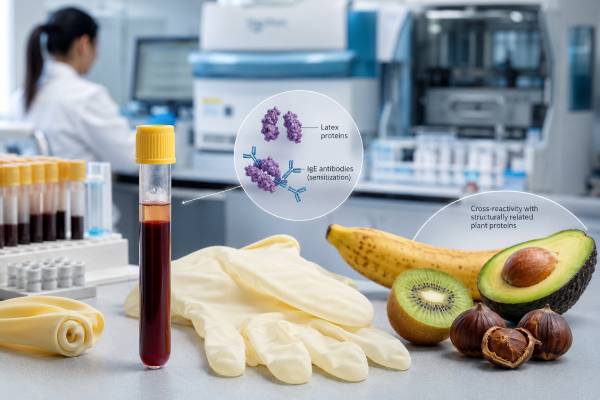
A latex IgE test is a blood test that looks for immunoglobulin E antibodies directed against proteins in natural rubber latex. It can support a diagnosis when symptoms occur after contact with latex gloves, balloons, condoms, dental dams, medical equipment, or airborne glove powder. The test is safer than deliberate exposure and can be useful when skin testing is unavailable, but it cannot diagnose latex allergy by itself. A positive result means the immune system recognizes latex; it does not prove that every future exposure will cause symptoms or predict exactly how severe a reaction might be. A negative result lowers the likelihood of an IgE-mediated latex allergy, yet it may miss some people with a convincing reaction history. Results therefore make the most sense when interpreted alongside the timing and pattern of symptoms, the type of product involved, occupational exposure, related food reactions, and—when needed—latex allergen component testing.
- The test measures latex-specific IgE in blood, usually reported in kUA/L or as a laboratory class.
- A positive result indicates sensitization, not automatic clinical allergy; symptoms after real exposure remain essential.
- Higher values can strengthen suspicion but do not reliably predict reaction severity or guarantee anaphylaxis.
- No fasting is usually needed, and antihistamines generally do not interfere with a blood IgE test.
- Banana, avocado, kiwifruit, and chestnut reactions may reflect latex–fruit cross-reactivity, but positive food tests alone do not prove symptoms.
- Breathing trouble, throat swelling, faintness, or rapidly spreading hives after latex exposure requires emergency care, regardless of the test value.
Table of Contents
- What the Latex IgE Test Measures
- When Latex IgE Testing Is Useful
- Understanding Positive, Negative, and Borderline Results
- Latex Components and Cross-Reactivity
- Preparation, Sample Collection, and Timing
- Limitations and Follow-Up Testing
- Living Safely With Suspected or Confirmed Latex Allergy
- Questions to Ask About Your Result
What the Latex IgE Test Measures
The latex IgE test measures antibodies against proteins from natural rubber latex, which comes from the sap of the rubber tree Hevea brasiliensis. In an IgE-mediated allergy, these antibodies attach to mast cells and basophils. When latex proteins later contact the skin, eyes, nose, lungs, mucous membranes, or bloodstream, the cells may release histamine and other inflammatory chemicals. Symptoms can begin within minutes and range from itching or hives to wheezing, low blood pressure, and anaphylaxis.
The test is different from a total IgE measurement. A specific IgE blood test asks whether IgE recognizes one named allergen, while total IgE measures all IgE in the sample. A person can have a normal total IgE and still have latex-specific IgE. Conversely, a very high total IgE may make small latex-specific results harder to interpret because nonspecific sensitization becomes more common.
Most laboratories use an automated immunoassay. The report may show a numerical concentration in kilo units of allergen-specific IgE per liter, written as kUA/L, and sometimes a class from 0 to 6. The familiar cutoff of 0.35 kUA/L is common, but some systems report values as low as 0.10 kUA/L. These cutoffs describe analytical detection, not a universal boundary between safe and allergic.
A latex IgE result answers a narrow question: are detectable IgE antibodies binding to the latex extract used in this assay? It does not show which product caused a reaction, whether chemical additives were responsible, or whether a future reaction will be mild or severe.
Three different conditions are often confused:
- IgE-mediated natural rubber latex allergy usually causes rapid hives, swelling, nasal or eye symptoms, asthma, or anaphylaxis.
- Allergic contact dermatitis is a delayed T-cell reaction, often to rubber-processing chemicals such as thiurams, carbamates, or mercaptobenzothiazole. Patch testing—not latex IgE—helps evaluate it.
- Irritant contact dermatitis causes dry, cracked, burning skin from friction, sweating, repeated washing, or glove occlusion. It is not an allergy and produces no meaningful latex-specific IgE pattern.
That distinction matters because a person with hand eczema after glove use may need a different test and a different avoidance plan than someone who develops immediate wheezing when powdered gloves are opened nearby.
When Latex IgE Testing Is Useful
Testing is most useful when the clinical story suggests an immediate reaction to natural rubber latex. The strongest histories describe reproducible symptoms shortly after a recognizable exposure. Examples include hives where a glove touched the skin, lip swelling after blowing up a balloon, wheezing in a room where powdered latex gloves were used, or an unexplained reaction during surgery or dental care.
A clinician may order the blood test when:
- immediate symptoms followed glove, balloon, condom, catheter, dental, or surgical exposure;
- repeated occupational contact occurs in health care, dentistry, laboratories, food handling, cleaning, hairdressing, or manufacturing;
- a patient has had many surgeries or procedures, especially from childhood;
- spina bifida, urinary tract abnormalities, or other conditions led to frequent catheterization or operations;
- skin-prick testing is unavailable, unsafe, or difficult to interpret;
- severe eczema, extensive skin disease, or medicines that suppress skin responses limit skin testing;
- a perioperative reaction requires investigation after other causes such as antibiotics, neuromuscular blockers, chlorhexidine, or anesthetic agents are considered;
- symptoms occur with foods commonly associated with latex–fruit syndrome.
The blood test can be drawn even when a patient takes antihistamines. That makes it convenient when stopping medication would be uncomfortable or unsafe. It also avoids exposing the patient’s skin to latex extract. However, convenience should not turn into indiscriminate screening. Testing people with no symptoms or relevant exposure increases the chance of finding sensitization that has no clinical importance.
Risk factors change the pretest probability—the likelihood of allergy before the laboratory result is known. A modest positive value is more persuasive in a nurse with immediate glove-related hives than in someone who has never reacted to latex. The same principle applies to a negative result: it is reassuring when the history is weak, but less decisive after a clearly timed systemic reaction.
Routine population screening is generally not helpful. A test should answer a clinical question, because labeling someone as latex-allergic can affect surgical scheduling, dental care, employment precautions, and access to products. A false label may create unnecessary restrictions, while a missed diagnosis can lead to dangerous re-exposure.
Understanding Positive, Negative, and Borderline Results
A positive latex-specific IgE result means sensitization. Clinical allergy is present only when sensitization matches a compatible exposure and symptom history. Laboratories differ in assay design, extract composition, reporting classes, and reference intervals, so the report’s own interpretive notes deserve attention.
| Result pattern | What it can mean | What it cannot establish |
|---|---|---|
| Undetectable or below the laboratory cutoff | IgE-mediated latex allergy is less likely | It does not completely exclude allergy when the history is strong |
| Low or borderline detectable result | Early, weak, or cross-reactive sensitization is possible | It does not prove symptoms will occur with latex products |
| Clearly positive result with matching immediate symptoms | Supports clinically relevant latex allergy | It does not predict the exact severity of the next reaction |
| Positive result without a reaction history | Asymptomatic sensitization or cross-reactivity may be present | It should not automatically lead to a definitive allergy label |
Many reports group results into classes, but class labels are not standardized enough to use as stand-alone risk categories. A class 2 result is not “twice as allergic” as class 1, and a class 4 result does not forecast anaphylaxis. Reaction severity depends on many variables: route of exposure, amount of allergen, asthma control, mucosal or surgical exposure, prior reaction pattern, and coexisting illness.
False-positive or clinically irrelevant results can occur. Cross-reactive carbohydrate determinants may cause IgE binding to plant-derived test extracts without meaningful symptoms. Profilin sensitization, particularly to the latex component Hev b 8, can also produce a positive whole-latex result in people whose primary sensitization is to pollens. High total IgE and broad atopy may add background reactivity.
False-negative results also occur. Commercial extracts may not contain every relevant latex protein in equal amounts. The patient’s IgE level may be below the assay threshold, or the suspected event may have involved a latex protein poorly represented in that platform. A negative blood test cannot explain a delayed rash from rubber additives because that condition uses a different immune pathway.
The result should be read with four questions:
- Did symptoms start within minutes to about two hours of exposure?
- Were the symptoms typical of an immediate allergic reaction?
- Was natural rubber latex actually present in the product or procedure?
- Are there alternative causes that fit better?
When all four support latex allergy, even a low result may deserve specialist review. When none support it, a positive result may be incidental.
Latex Components and Cross-Reactivity
Whole-extract testing combines many latex proteins into one assay. Component-resolved testing measures IgE to individual allergenic proteins, called Hev b components. It can help distinguish genuine latex sensitization from pollen-related cross-reactivity and may clarify why different risk groups show different patterns.
Hev b 5 and Hev b 6.01 or Hev b 6.02 are commonly associated with clinically relevant latex allergy in health care workers and other adults with occupational exposure. Hev b 1 and Hev b 3 are especially important in people with spina bifida or a history of repeated surgery. Hev b 8 is a profilin. Isolated Hev b 8 sensitization often reflects cross-reactivity with pollen profilins and may be less likely to represent symptomatic latex allergy, although no component should be interpreted without the history.
Component results can be useful when a whole-latex IgE test is positive but the patient has never reacted, or when the history is convincing and the extract result is weak. They are not available everywhere, and they do not replace specialist assessment.
Latex–fruit syndrome occurs because some latex proteins resemble proteins in plant foods closely enough for IgE to recognize both. The foods most often associated include:
- banana;
- avocado;
- kiwifruit;
- chestnut;
- papaya.
Other reported foods include tomato, potato, bell pepper, peach, fig, melon, and passion fruit. The list is broad, but a person with latex allergy does not need to avoid every potentially cross-reactive food. Avoidance is based on actual symptoms, not a theoretical relationship or a positive panel alone.
Reactions can range from mouth itching to generalized hives, vomiting, breathing problems, or anaphylaxis. The prevalence of latex–fruit syndrome varies widely across studies because definitions and testing methods differ. Asking about food reactions is useful, but large “screening panels” may identify sensitization without disease.
Pollen cross-reactivity creates another source of confusion. Profilins are present in many pollens, foods, and latex. A person with grass or birch pollen allergy may have IgE that binds Hev b 8 and a latex extract even though gloves and balloons cause no symptoms. In this setting, component testing can prevent an unnecessary latex-allergy label.
When laboratory results conflict with the history, a basophil activation test may be considered at specialized centers. It measures cellular activation after allergen exposure in the laboratory, but availability and standardization remain limited.
Preparation, Sample Collection, and Timing
A latex IgE blood test usually requires no fasting and no special diet. Water is allowed, and most usual medicines can continue. Antihistamines do not suppress serum IgE in the way they can suppress skin-test responses. Patients should still give the ordering clinician a complete medication list, especially if a broader allergy evaluation is planned.
The sample is collected from a vein, usually from the arm. The procedure takes a few minutes. Temporary bruising, tenderness, or lightheadedness can occur, but the test itself cannot trigger a latex reaction from the allergen assay because the patient is not exposed to latex proteins during analysis. The collection site should use latex-safe supplies when allergy is suspected. Modern phlebotomy equipment is often latex-free, but the patient should tell staff before the draw rather than assume.
Testing does not need to occur during a reaction. Allergen-specific IgE generally remains detectable after symptoms resolve. However, a sample taken very soon after severe anaphylaxis can occasionally be less informative, and clinicians may repeat testing weeks later if the history is compelling and the first result is negative. This is a case-specific decision rather than a fixed rule.
If the suspected event occurred during surgery or another medical procedure, write down the date, location, timing, medicines, devices, skin preparations, and sequence of symptoms. The anesthesia record and operative notes may be crucial. Latex may be only one of several possible triggers. Blood tryptase drawn during and after the event can help document mast-cell activation; a separate tryptase blood test is interpreted according to its timing and the patient’s baseline.
Before testing, useful preparation includes:
- bringing photographs of rashes or swelling;
- listing exact products, brands, and settings linked to symptoms;
- noting how quickly symptoms began and how long they lasted;
- recording treatments used and whether epinephrine was needed;
- identifying reactions to banana, avocado, kiwifruit, chestnut, or other foods;
- noting occupational exposure, childhood surgeries, catheter use, and asthma.
These details often change the meaning of the same laboratory number more than the numerical class does.
Limitations and Follow-Up Testing
No single laboratory result settles every latex-allergy question. The main limitation is the gap between sensitization and disease. IgE can bind an allergen in a test tube even when ordinary exposure causes no symptoms. The reverse also happens when a relevant allergen is missing or underrepresented in the extract.
Skin-prick testing can provide additional evidence where standardized latex reagents and experienced allergy services are available. Because testing may provoke a systemic reaction, it belongs in a medical setting prepared to treat anaphylaxis. Intradermal testing carries greater risk and is not a routine first step for latex.
Patch testing evaluates delayed allergy to rubber additives, not immediate allergy to natural rubber proteins. It is appropriate when dermatitis appears hours to days after glove or rubber contact and stays mainly where the product touched. A patch-test result to a chemical accelerator does not mean the patient has IgE-mediated latex allergy.
Provocation or challenge procedures may be used in selected specialist settings when history and tests remain discordant. Examples include controlled glove-use or mucosal exposure protocols. Deliberate exposure is not a home test. Rubbing a balloon on the skin, wearing a latex glove “to see what happens,” or testing a condom can cause a serious reaction and provides poorly controlled information.
A referral to an allergist is particularly valuable when:
- the reaction involved breathing, circulation, or more than one organ system;
- surgery, dental care, childbirth, or repeated procedures are expected;
- the blood test and symptom history disagree;
- occupational decisions depend on the diagnosis;
- multiple foods or pollens create cross-reactivity questions;
- the patient has asthma, prior anaphylaxis, or an epinephrine prescription;
- a delayed glove rash may require patch testing.
The clinician may combine the history, whole-latex IgE, component IgE, skin testing, and occasionally cellular testing. The objective is not to accumulate positive tests. It is to identify the most likely mechanism and build an exposure plan that is strict enough for safety without being unnecessarily restrictive.
Living Safely With Suspected or Confirmed Latex Allergy
Avoidance is the main preventive treatment for confirmed IgE-mediated latex allergy. Natural rubber latex can appear in gloves, balloons, elastic bands, some sports equipment, adhesive products, dental items, catheters, tourniquets, and older medical devices. Product composition changes, so labels and manufacturer information matter more than appearance.
“Latex-free” and “synthetic rubber” are preferable terms. Products made from nitrile, vinyl, neoprene, silicone, polyurethane, or other synthetic materials do not contain natural rubber latex proteins, although they can have their own additives or performance limits. “Hypoallergenic latex” is not reliably safe for someone with IgE-mediated latex allergy; it may reduce chemical additives while still containing natural latex proteins.
A practical safety plan includes:
- telling medical, dental, pharmacy, workplace, and emergency personnel about the allergy;
- asking facilities to document it prominently and use a latex-safe environment;
- avoiding powdered natural rubber latex gloves, which can disperse allergen into the air;
- wearing medical identification when reactions have been systemic;
- carrying epinephrine auto-injectors when prescribed and knowing how to use them;
- keeping asthma well controlled because respiratory disease can complicate severe reactions;
- checking balloons, gloves, condoms, diaphragms, and household products before use;
- discussing occupational exposure with an allergy specialist and workplace health service.
For planned surgery or a dental procedure, contact the facility in advance. A latex-safe room may require scheduling, removal of latex products, alternative gloves and devices, and clear communication across the team. Do not rely only on mentioning the allergy at check-in.
Emergency symptoms include trouble breathing, throat tightness, repetitive coughing, faintness, confusion, weak pulse, or rapidly progressing symptoms involving several body systems. Use epinephrine promptly if prescribed and call emergency services. Antihistamines may reduce itching or hives, but they do not replace epinephrine for anaphylaxis.
People with possible latex–fruit syndrome should avoid only foods that have caused symptoms until evaluated. Broad dietary restriction can reduce nutrition and quality of life without improving safety. A supervised food evaluation may separate true allergy from pollen-related mouth symptoms or an unrelated food intolerance.
Questions to Ask About Your Result
A laboratory number becomes useful when it changes a clear plan. Bring the report and ask how it fits the actual reaction rather than focusing only on whether it is “high” or “low.”
Helpful questions include:
- Does my history sound like immediate latex allergy, delayed contact allergy, or irritation?
- What cutoff and assay did this laboratory use?
- Could pollen profilin or another cross-reactive protein explain the result?
- Would Hev b component testing clarify whether sensitization is clinically relevant?
- Do I need skin-prick testing, patch testing, or a specialist-supervised challenge?
- Which products and medical situations require strict latex avoidance?
- Should I carry epinephrine, wear medical identification, or have a written action plan?
- How should upcoming surgery, dental treatment, pregnancy care, or workplace exposure be handled?
- Which foods, if any, should I avoid based on my own symptoms?
- Should a negative result be repeated because the original reaction was severe or highly convincing?
The safest interpretation avoids two opposite errors: dismissing a convincing immediate reaction because one test is negative, and diagnosing allergy solely from a positive result in someone without symptoms. A well-matched history and test result can support a confident diagnosis. Discordant cases need careful follow-up rather than assumptions.
References
- Latex Allergy – From Discovery to Component-resolved Diagnosis 2024 (Review)
- Revisiting Latex-Fruit Syndrome after 30 Years of Research 2024 (Systematic Review)
- Component-Resolved and Multiplex-Specific IgE Diagnostics 2025 (Review)
- Newly Updated! Latex Allergy Diagnosis and Management 2022 (Review)
- EAACI guidelines: Anaphylaxis (2021 update) 2022 (Guideline)
Disclaimer
This article provides general education about latex-specific IgE testing and cannot diagnose an allergy or replace evaluation by a qualified clinician. Suspected severe reactions need assessment by an allergy specialist, and breathing difficulty, throat swelling, faintness, or rapidly worsening symptoms after latex exposure require emergency treatment.