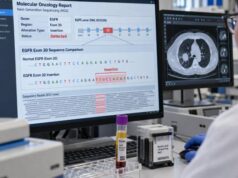
A MET exon 14 skipping test looks for a specific oncogenic alteration in the MET gene that causes exon 14 to be removed from the final MET RNA transcript. This abnormal splicing reduces normal breakdown of the MET receptor, allowing MET signaling to remain active longer and promote cancer growth. MET exon 14 skipping, often shortened to METex14, is an actionable driver in a small but important subset of non-small cell lung cancers (NSCLC). It is not one single DNA mutation: many different sequence changes around exon 14 can disrupt normal splicing and produce the same skipped transcript. Because of that complexity, testing method matters. DNA-based next-generation sequencing (NGS), RNA-based NGS, and other validated assays may be used, and complementary DNA/RNA testing can improve detection. A positive result can directly affect targeted-treatment options. A negative result is most reliable when the assay adequately covers the relevant splice regions and the specimen contains enough tumor material.
- What it measures: The test identifies DNA variants or RNA transcripts that cause MET exon 14 to be skipped during gene splicing.
- What a positive result means: METex14 is an oncogenic driver and can make advanced NSCLC eligible for MET-targeted therapy when other clinical criteria are met.
- How common it is: Systematic-review data place METex14 in roughly 2% of unselected NSCLC, with higher frequencies in some histologic subgroups such as sarcomatoid carcinoma.
- Why RNA can help: DNA changes that cause exon skipping are diverse and may be missed by limited panels; RNA testing can directly demonstrate the abnormal skipped transcript.
- What it is not: MET exon 14 skipping is different from MET amplification and c-MET protein overexpression, even though all involve the MET pathway.
Table of Contents
- What MET Exon 14 Skipping Is
- Who Should Be Tested and When
- How MET Exon 14 Skipping Is Tested
- How to Read METex14 Results
- What a Positive Result Can Mean for Treatment
- Resistance and Repeat Testing
- Limitations and Next Steps
What MET Exon 14 Skipping Is
MET is a receptor tyrosine kinase that helps control cell growth, survival, movement, and repair. The MET gene is transcribed into RNA, and that RNA is then spliced so that exons are joined into a mature messenger RNA template. In METex14-altered lung cancer, the splicing machinery removes exon 14 from the final transcript.
Why does one missing exon matter? Exon 14 contains a region involved in binding CBL, a protein that helps mark MET for degradation. When exon 14 is skipped, this regulatory region is lost. The MET receptor can remain active longer, increasing downstream signaling through growth and survival pathways.
METex14 is unusual because the same functional outcome can be produced by many different DNA changes. Variants may occur at the splice donor site, splice acceptor site, nearby intronic sequences, or within exon 14 itself. Some deletions can be large and complex. The clinically important feature is not merely the location of one variant; it is whether that change disrupts splicing and leads to exon 14 skipping.
This is why a report may describe “MET exon 14 skipping,” “METex14,” “MET Δex14,” or a specific splice-site mutation. When the assay directly evaluates RNA, it may report the skipped transcript itself.
METex14 is distinct from MET amplification. Amplification increases the number of MET gene copies, while exon 14 skipping alters RNA processing and receptor turnover. Both can activate MET, but they are separate biomarkers.
Who Should Be Tested and When
METex14 testing is generally included in comprehensive molecular profiling for patients with advanced NSCLC, especially non-squamous tumors. Current precision-oncology practice favors broad testing because clinical features cannot reliably identify all patients with actionable drivers.
A large systematic review reported a median METex14 frequency of about 2.0% in unselected NSCLC and about 2.4% in adenocarcinoma or non-squamous subgroups. Frequency was higher in pulmonary sarcomatoid carcinoma in the reviewed literature. METex14 is often associated with older age compared with some other oncogene-driven lung cancers, but it can occur across smoking histories and other demographic groups.
Testing based only on age, sex, or smoking history would therefore miss patients. Molecular selection should be driven primarily by the tumor type and clinical setting.
Testing may be ordered:
- at initial diagnosis of advanced or metastatic NSCLC;
- on a surgical or biopsy specimen when an actionable result could affect postoperative treatment planning;
- at recurrence if earlier molecular profiling was incomplete;
- on plasma ctDNA when tissue is insufficient or a rapid noninvasive result is useful; or
- again at progression when acquired resistance to a MET inhibitor is being investigated.
METex14 is usually assessed as part of a lung cancer NGS panel rather than as an isolated test. That approach also checks for other actionable drivers that may change treatment.
How MET Exon 14 Skipping Is Tested
Testing can use DNA, RNA, or both, and the choice affects sensitivity because METex14 is caused by diverse splicing variants.
DNA-based NGS
DNA sequencing looks for sequence changes around exon 14 that are known or predicted to disrupt splicing. A well-designed assay needs adequate coverage of both splice boundaries and nearby intronic regions. Some small panels cover only part of the relevant region and can miss unusual deletions or deep splice variants.
The advantage of DNA testing is that it can identify METex14-associated variants while simultaneously assessing other drivers and co-mutations. The limitation is inferential: a DNA variant may be predicted to alter splicing without directly showing the resulting RNA transcript.
RNA-based NGS
RNA sequencing can directly detect the abnormal transcript in which exon 13 is joined to exon 15, demonstrating that exon 14 was skipped. This can resolve uncertain DNA findings and detect functional skipping caused by diverse genomic variants.
RNA testing has its own challenges. RNA degrades more easily than DNA, especially in old or poorly fixed tissue. Very small biopsies may not yield enough high-quality RNA. A technically failed RNA assay should not be interpreted as a negative biomarker result. The distinction matters because “not detected” and “not evaluable” lead to different next steps; the latter often supports repeat testing with another specimen or method.
Complementary DNA and RNA testing
Because the two methods have different strengths, combined DNA/RNA testing can improve diagnostic confidence. Recent laboratory data show that adding RNA analysis and ensuring DNA panels cover both exon 14 splice sites can increase detection compared with limited DNA-only approaches.
Other methods, including reverse-transcription PCR, can detect known skipped transcripts, but broad NGS is often preferred in NSCLC because many biomarkers must be assessed at once.
Plasma testing is another option. A lung cancer liquid biopsy may identify a METex14-associated DNA alteration when tumor DNA is present in blood. As with other plasma tests, a negative result can be falsely reassuring if the tumor sheds little ctDNA.
How to Read METex14 Results
A METex14 report may be straightforward or highly technical. The first question is whether the laboratory classifies the finding as pathogenic or likely pathogenic and consistent with exon 14 skipping.
A positive report can take several forms:
- a known splice-site substitution;
- an insertion or deletion affecting the splice donor or acceptor region;
- a larger deletion involving exon 14 boundaries;
- an exonic variant known to disrupt normal splicing; or
- direct RNA evidence showing an exon 13-to-exon 15 junction.
If RNA confirms the skipped transcript, the functional interpretation is usually clear. With DNA-only results, the laboratory may use prior evidence, splicing prediction, databases, or orthogonal testing to determine whether the variant truly causes skipping.
A variant of uncertain significance (VUS) near exon 14 is not equivalent to a confirmed METex14 driver. Treatment should not be based solely on an uncertain splice prediction without stronger evidence.
A negative result should be checked for assay adequacy. Useful questions include:
- Did the DNA panel cover both splice junctions and relevant intronic regions?
- Was RNA sequencing performed, and did it pass quality control?
- Was there enough tumor in the specimen?
- If plasma was used, was tumor DNA detectable at all?
- Was a technically failed component clearly identified?
These details matter because a “not detected” result from a limited assay is weaker than a negative result from a validated combined DNA/RNA approach with good tumor content.
A practical issue is turnaround time and specimen preparation. Tissue NGS often takes about one to several weeks from the time a suitable specimen reaches the molecular laboratory, although the exact interval varies. Small biopsies may first need pathology review, tumor-area marking, DNA/RNA extraction, and quality-control checks. If the initial specimen fails, repeating extraction or obtaining another sample can add delay. Plasma can usually be collected quickly, but the speed advantage is useful only if the assay actually detects enough tumor-derived DNA to answer the question.
METex14 is also a good example of why the phrase “mutation status” can be misleading. Unlike a biomarker defined by one recurrent substitution, such as BRAF V600E, exon 14 skipping can result from dozens of distinct genomic events. Two patients can therefore have completely different DNA variants but the same functional skipped RNA transcript. Laboratories may normalize these diverse findings under one clinically meaningful label: MET exon 14 skipping. That functional label is often more useful for treatment than memorizing the exact nucleotide notation.
The nomenclature on a report can still matter when the result is unusual. A sequence change may be described with genomic coordinates, coding-DNA notation, and protein notation. Because splice variants can lie outside the protein-coding exon, some may have no straightforward amino-acid change. If the clinical interpretation says the variant is known to disrupt exon 14 splicing, that annotation is more important than whether a protein change appears in the variant name.
Pathologists and molecular laboratories also need to protect scarce tissue. Lung biopsies are often small, and the same specimen may be needed for histology, immunohistochemistry, PD-L1 testing, and broad molecular profiling. Using an efficient NSCLC biomarker strategy can reduce serial testing that exhausts the block before all actionable markers are assessed. For this reason, broad DNA/RNA NGS is often more practical than ordering a long sequence of one-gene assays.
Finally, a detected METex14 alteration should be checked against the pathology diagnosis. It is most strongly established as an oncogenic driver in NSCLC, but rare MET splice alterations can occur in other cancers. The treatment evidence attached to a biomarker depends on tumor type and regulatory context, so the same molecular term does not automatically imply the same therapy in every malignancy.
What a Positive Result Can Mean for Treatment
A confirmed METex14 alteration is an actionable oncogenic driver. Selective MET tyrosine kinase inhibitors have produced substantial tumor responses in advanced METex14-positive NSCLC, including in patients with brain metastases in clinical studies.
The treatment decision depends on disease stage, prior therapy, regulatory approvals, guideline recommendations, comorbidities, and the exact clinical setting. A positive molecular test is necessary for biomarker-directed treatment but does not by itself determine the full care plan.
It is also important to separate METex14 from other MET findings. A patient with high c-MET protein expression but no exon 14 skipping does not have the same biomarker. A patient with MET copy-number gain has a different molecular alteration with different testing thresholds and evidence.
PD-L1 expression may also be present in METex14 tumors, but the presence of an actionable driver changes how treatment options are weighed. Broad biomarker review should occur before selecting initial systemic therapy whenever the clinical situation allows.
Clinical trials and long-term follow-up studies have shown that MET inhibitors can produce responses, but resistance eventually occurs in many advanced cancers. A positive result should therefore be viewed as both a treatment opportunity and a molecular feature that may need reassessment later if the disease progresses.
Resistance and Repeat Testing
Resistance to MET-directed therapy can develop through on-target or off-target mechanisms.
On-target resistance involves new mutations in the MET kinase domain. Alterations at residues such as D1228 and Y1230 have been described after selective type I MET inhibitors. These changes can interfere with drug binding while preserving MET signaling.
Off-target resistance can activate alternative pathways. Alterations involving KRAS, EGFR, HER family signaling, or other bypass mechanisms have been reported. The exact pattern depends on prior treatment and the individual tumor.
At progression, repeat resistance mutation testing may help determine whether the cancer remains MET-dependent or has switched to another escape route. Tissue and plasma can be complementary. Plasma may reveal several resistant clones, while tissue can show histologic change and provide more complete morphology.
A repeat test should not be ordered simply because a certain number of months has passed. It is most useful when there is documented progression and a plausible treatment decision depends on the result.
Limitations and Next Steps
The main testing challenge is that METex14 is a splicing event caused by many different genomic variants. This creates a genuine assay-design problem: the laboratory must recognize not only common hotspot changes but also uncommon deletions and splice-disrupting variants that can occur on either side of exon 14. A test that was excellent for typical point mutations can still be poorly suited to this biomarker if its capture probes do not extend far enough into the relevant intronic regions. An assay that recognizes only a narrow list of DNA mutations can miss real cases.
Other limitations include:
- poor RNA quality in small or old tissue specimens;
- insufficient tumor percentage for reliable sequencing;
- plasma false negatives when ctDNA shedding is low;
- uncertain splice-site variants whose functional effect is unclear;
- confusing METex14 with amplification or protein overexpression; and
- assuming clinical features can substitute for molecular testing.
If the report is negative but clinical suspicion remains high, it can be reasonable to ask whether the testing method had adequate splice-region coverage and whether RNA analysis could add information. If a DNA VUS is near the exon 14 splice boundary, RNA testing may help clarify whether the transcript is actually skipped.
Patients should also ask whether the report tested other major NSCLC drivers. A METex14 result is usually part of a wider molecular profile, and identifying all relevant alterations helps avoid incomplete treatment planning.
The clearest practical interpretation is simple: a confirmed MET exon 14 skipping alteration identifies a molecularly defined NSCLC subtype with targeted-treatment implications. The complexity lies in detecting it accurately. Good testing uses an assay capable of capturing diverse splice-disrupting variants, confirms functional skipping when needed, and interprets the result in the context of tumor type, stage, and treatment history.
If results are borderline or the assay has limited splice-region coverage, reviewing the raw variant, RNA evidence, and specimen quality can prevent both false reassurance and overcalling.
References
- MET Exon 14 Skipping Mutation in NSCLC: From Genomic Discovery to Biomarker-Guided Therapeutic Innovation 2026 (Review)
- From knowledge to action: The journey toward targeting the MET pathway via MET exon 14 skipping 2025 (Review)
- Advances in clinical research of MET exon 14 skipping mutations in non-small cell lung cancer 2025 (Review)
- Capmatinib in MET exon 14-mutated non-small-cell lung cancer: final results from the open-label, phase 2 GEOMETRY mono-1 trial 2024
- MET Exon 14 Skipping in NSCLC: A Systematic Literature Review of Epidemiology, Clinical Characteristics, and Outcomes. 2023 (Systematic Review)
Disclaimer
This article is for general education and does not replace individualized medical advice. MET exon 14 results should be interpreted by qualified oncology and pathology professionals using the exact assay, specimen quality, cancer stage, and treatment history. Do not change cancer treatment based on a molecular result without discussing it with the treating team.