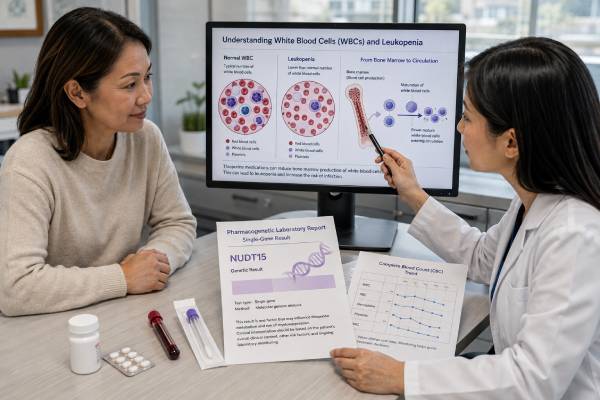
A NUDT15 genetic test helps estimate whether standard doses of thiopurine medicines could cause excessive bone marrow suppression. Thiopurines—including mercaptopurine, azathioprine, and thioguanine—are used in leukemia treatment and in selected autoimmune, inflammatory, and transplant settings. Reduced-function NUDT15 variants allow more toxic thioguanine metabolites to be incorporated into DNA, increasing the risk of severe leukopenia, neutropenia, infection, and sometimes rapid hair loss. Results are commonly translated into normal, intermediate, or poor metabolizer status. The result can guide the starting dose, but it does not replace complete blood counts, disease-specific treatment protocols, or testing of TPMT, another important thiopurine gene. Dose recommendations also differ by medicine and indication: a dose suitable for childhood leukemia cannot be transferred directly to inflammatory bowel disease. The safest interpretation combines both genes, the planned regimen, baseline blood counts, other medicines, and close follow-up after every dose change.
- NUDT15 variants can greatly increase thiopurine-related leukopenia and neutropenia risk.
- Intermediate metabolizers usually need a lower starting dose when the planned dose is standard or high.
- Poor metabolizers require drastic reduction for some cancer regimens or a nonthiopurine alternative.
- TPMT and NUDT15 should be considered together because either can cause severe toxicity.
- Genetic testing never replaces ongoing blood counts and clinical monitoring.
Table of Contents
- Why NUDT15 matters before thiopurine treatment
- How thiopurines and NUDT15 work
- Reading normal, intermediate, and poor metabolizer results
- Dose decisions by drug and indication
- TPMT, combined genotypes, and other treatment factors
- Monitoring, adverse effects, and urgent symptoms
- Test limitations and practical next steps
Why NUDT15 matters before thiopurine treatment
Thiopurines can be highly effective, but the dose that is appropriate for one person may be dangerously high for another. The most clinically important inherited causes of unusually low tolerance are reduced activity of NUDT15 and thiopurine S-methyltransferase, or TPMT. Identifying a high-risk genotype before treatment allows the prescriber to lower the initial dose or select another medicine rather than waiting for profound cytopenia to reveal the problem.
NUDT15 testing is especially valuable because toxicity can develop quickly. A person with little or no NUDT15 function may experience severe neutropenia after what would be a routine dose for a normal metabolizer. Recovery can require treatment interruption, hospitalization, infection management, transfusion support, or growth factors. In cancer treatment, prolonged interruption can also interfere with the intended chemotherapy schedule.
The test is not a general cancer or autoimmune-disease test. It does not show whether mercaptopurine will cure leukemia, whether azathioprine will control inflammatory bowel disease, or whether an organ transplant will be rejected. It predicts one important component of drug tolerance. Disease response still depends on the diagnosis, regimen, adherence, immune biology, drug interactions, and many other factors.
Testing may be ordered before the first dose, after unexpected myelosuppression, or as part of a broader pharmacogenetic panel. Pre-treatment testing is preferable when results can be returned without delaying urgent therapy, because the main purpose is to choose a safer starting dose. When treatment must begin immediately, clinicians may start cautiously and revise the plan when results arrive.
A blood, saliva, or cheek-swab sample is usually sufficient. Because the result reflects inherited DNA, it generally remains valid for life. Keep the full laboratory report, including the variants tested, star alleles, predicted phenotype, test method, and limitations. A brief chart entry such as “NUDT15 positive” is not precise enough for future prescribing.
How thiopurines and NUDT15 work
Azathioprine is converted to mercaptopurine, while mercaptopurine and thioguanine enter overlapping pathways that produce thioguanine nucleotides. Some of these metabolites are incorporated into DNA and disrupt cell replication. That effect is useful against rapidly dividing leukemia cells and can suppress overactive immune cells, but excessive incorporation also injures normal bone marrow precursors.
NUDT15 acts as a protective “sanitizing” enzyme. It converts active thioguanine triphosphates into less reactive forms, reducing their incorporation into DNA. When NUDT15 activity is reduced, DNA-incorporated thioguanine rises and cells become unusually sensitive to thiopurines. The result may be leukopenia, neutropenia, anemia, thrombocytopenia, or pancytopenia.
This mechanism differs from TPMT. TPMT methylates thiopurine metabolites and changes the balance between active thioguanine nucleotides and methylated metabolites. A patient with TPMT deficiency often has markedly elevated red-cell thioguanine nucleotide concentrations. NUDT15 deficiency may cause severe DNA-level toxicity even when conventional red-cell metabolite results are not dramatically elevated. For that reason, a “therapeutic” metabolite level does not exclude NUDT15-related risk.
The adverse effect most closely linked to NUDT15 is myelosuppression, particularly leukopenia and neutropenia. Alopecia can be a striking early clue, especially in patients with very low activity, because hair follicles also contain rapidly dividing cells. NUDT15 status is less useful for predicting nausea, pancreatitis, liver injury, allergy-like reactions, or the long-term malignancy risks of immunosuppression. Those adverse effects involve different mechanisms.
The common coding variant c.415C>T, p.Arg139Cys, also known as rs116855232, is present in widely reported reduced- or no-function alleles. Reports may use star-allele names such as *1 and *3, but nomenclature changes as allele definitions are refined. Other variants can also reduce function, and their frequencies differ among populations.
Reading normal, intermediate, and poor metabolizer results
The laboratory converts the detected alleles into a predicted phenotype. The phenotype is more useful for prescribing than the raw DNA letters, provided the report used current allele-function assignments.
| Predicted NUDT15 phenotype | Typical allele pattern | Expected thiopurine risk |
|---|---|---|
| Normal metabolizer | Two normal-function alleles | Usual NUDT15-related risk; toxicity can still occur for other reasons |
| Intermediate metabolizer | One normal-function allele plus one decreased- or no-function allele | Increased risk of leukopenia, neutropenia, and dose intolerance |
| Poor metabolizer | Two no-function alleles, or another combination producing little or no activity | Greatly increased risk; conventional dosing can cause prolonged, potentially fatal myelosuppression |
Normal metabolizer
A normal result means the tested alleles predict normal NUDT15 activity. Standard starting doses can generally be considered from the NUDT15 perspective. It does not mean the patient is protected from myelosuppression. TPMT deficiency, renal or hepatic impairment, drug interactions, infection, malnutrition, disease-related marrow suppression, and other chemotherapy agents may still lower blood counts.
A normal result also depends on test coverage. A targeted panel may not detect a rare reduced-function variant. When severe or repeated myelosuppression occurs despite a normal result, clinicians should evaluate TPMT, adherence and dosing, interacting medicines, bone marrow status, infection, and whether broader genetic testing is warranted.
Intermediate metabolizer
An intermediate result predicts reduced NUDT15 activity and increased sensitivity. Current pharmacogenetic guidance recommends a lower starting dose when the usual starting dose for that medicine and indication is standard or high. The recommended range is deliberately broad because tolerance varies. Some intermediate metabolizers eventually tolerate near-standard doses, while others require substantial long-term reduction.
Dose escalation, when needed for disease control, should occur only after blood counts demonstrate tolerance at a stable dose. The interval between adjustments matters because marrow toxicity may be delayed. A patient should not interpret an initially normal blood count as permission to increase the medicine independently.
Poor metabolizer
A poor result signals very high risk. For mercaptopurine or thioguanine used in malignancy, guidance calls for a drastically reduced starting dose and less frequent administration, followed by careful adjustment under the specific chemotherapy protocol. For nonmalignant conditions treated with azathioprine or mercaptopurine, a nonthiopurine alternative is often preferred.
“Poor metabolizer” does not mean the medicine can never be used. In acute lymphoblastic leukemia, thiopurines may be essential and can sometimes be administered at a tiny fraction of the usual dose under specialist supervision. The same risk-benefit calculation is different for an autoimmune disease with several effective alternatives. That is why the diagnosis must appear alongside the genotype in every dosing decision.
An indeterminate or possible intermediate result means the laboratory cannot assign function confidently. The report may have found a variant with uncertain activity, an incomplete allele call, or a combination not fully resolved by the assay. The prescriber may repeat testing, use a more comprehensive method, or start cautiously with intensified monitoring.
Dose decisions by drug and indication
The phrase “reduce the thiopurine dose” is incomplete. Mercaptopurine, azathioprine, and thioguanine have different standard doses, uses, schedules, and supporting evidence. The appropriate percentage reduction is calculated from the standard starting dose for the actual protocol, not from a generic tablet strength.
Mercaptopurine
Mercaptopurine is a core component of maintenance therapy for acute lymphoblastic leukemia and is also used in selected nonmalignant conditions. When TPMT is normal and NUDT15 is intermediate, current guidance recommends considering approximately 30% to 80% of the standard starting dose if the protocol uses a high standard dose. If the protocol already begins below that threshold, an additional preemptive reduction may not be necessary.
For a NUDT15 poor metabolizer receiving mercaptopurine for malignancy, the recommended approach is far more conservative: a roughly tenfold reduction in the daily-equivalent starting amount and administration only several days per week rather than every day, with later adjustment according to blood counts and protocol goals. This is specialist chemotherapy dosing, not a formula for self-use. For nonmalignant disease, an alternative medicine is generally considered.
Azathioprine
Azathioprine is used in inflammatory bowel disease, rheumatologic and dermatologic conditions, autoimmune hepatitis, and transplantation, among other settings. It is converted to mercaptopurine, so NUDT15 status remains relevant. For an intermediate metabolizer with normal TPMT, guidance recommends about 30% to 80% of a standard high starting dose. If the planned dose is already low, the clinician may choose close monitoring rather than another automatic reduction.
For a poor metabolizer, current guidance favors an alternative nonthiopurine immunosuppressant. In many nonmalignant diseases, the benefit of azathioprine does not justify the complexity and danger of extreme dose reduction when other therapies are available.
Thioguanine
Thioguanine is used mainly in malignant disease and occasionally in specialized nonmalignant regimens. Intermediate metabolizers generally start at a reduced percentage of a standard high dose. Poor metabolizers require drastic reduction and reduced frequency if thioguanine is essential. The evidence base is smaller than for mercaptopurine, so the oncology protocol and treatment center’s experience are especially important.
Why percentages are not universal prescriptions
A 50% reduction can represent very different milligram doses in leukemia, inflammatory bowel disease, or transplant medicine. Pediatric dosing may use body-surface area, while adult autoimmune dosing often uses body weight. Combination chemotherapy intentionally targets a degree of marrow suppression that would be unacceptable in a nonmalignant condition. The disease-specific protocol therefore comes first; pharmacogenetics modifies its starting point.
The genotype recommendations mainly address the starting dose. Subsequent dosing is individualized according to complete blood counts, disease response, infection, adherence, metabolite measurements when useful, and the doses of other myelosuppressive medicines. A reduced initial dose is not “undertreatment” when it produces the same biologic exposure in a genetically sensitive patient.
TPMT, combined genotypes, and other treatment factors
A NUDT15 result should rarely be interpreted in isolation. TPMT and NUDT15 act independently, and a patient can carry reduced-function variants in either or both genes. Testing only TPMT misses many high-risk patients, particularly in populations where NUDT15 variants are common. Testing only NUDT15 misses TPMT deficiency, which is an equally important cause of life-threatening thiopurine toxicity.
A person who is intermediate for both TPMT and NUDT15 has greater risk than someone intermediate for only one gene. Updated guidance treats this as a compound intermediate phenotype and recommends a larger starting reduction—often about 20% to 50% of a standard high dose—followed by cautious titration. Any combination that includes a poor-metabolizer result in either gene demands extreme caution.
TPMT can be evaluated by genotype or by red-cell enzyme activity. Phenotyping has advantages because it measures current enzyme activity, but recent transfusion can make the result misleading by introducing donor red cells. Genotyping is unaffected by transfusion but detects only the variants included in the assay. NUDT15 is generally assessed by genotype because a routine clinical enzyme assay is not widely available.
Ancestry affects variant frequencies. NUDT15 no-function alleles are particularly important in people with East Asian, South Asian, Hispanic/Latino, and Indigenous American ancestry, while TPMT variants have historically received more attention in populations of European ancestry. These are population trends, not rules. Both genes contain clinically relevant variants across world populations, and ancestry should not be used to deny testing.
Other factors can amplify toxicity. Allopurinol and febuxostat inhibit xanthine oxidase and can markedly alter mercaptopurine metabolism. Combining allopurinol with a deliberately reduced thiopurine dose is sometimes used by specialists in inflammatory bowel disease, but accidental coadministration at a full thiopurine dose can be dangerous. Other immunosuppressants, chemotherapy drugs, infections, renal or hepatic impairment, and baseline marrow disease also affect counts.
Adherence complicates interpretation. A patient who takes little medication may have normal counts despite a high-risk genotype, then develop abrupt toxicity after resuming the prescribed dose. Conversely, unexplained high metabolite levels or cytopenia may reflect a dosing error. Open, nonjudgmental discussion of missed or extra doses is a safety measure, not a test of character.
Monitoring, adverse effects, and urgent symptoms
Genotyping reduces preventable risk but cannot make thiopurines safe without monitoring. A complete blood count with differential is obtained before treatment and repeated frequently during initiation and dose changes. The exact schedule depends on the indication and protocol. Liver tests and renal function may also be monitored, and oncology regimens may require many additional assessments.
Key values include the white blood cell count, absolute neutrophil count, hemoglobin, and platelet count. A falling count may lead to dose interruption, reduction, infection precautions, or investigation of another cause. Because marrow recovery takes time, simply withholding one dose may not stop counts from continuing to fall.
Contact the treatment team urgently for fever, chills, sore throat, mouth ulcers, a new cough, painful urination, or other signs of infection. Severe neutropenia can blunt typical inflammatory symptoms, so even a single fever may require emergency evaluation under an oncology or immunosuppression plan. Unusual bruising, pinpoint red spots, nosebleeds, prolonged bleeding, marked fatigue, shortness of breath, or pallor can indicate low platelets or anemia.
Sudden or extensive hair loss can be a clue to severe thiopurine sensitivity, especially early in therapy. It is not merely cosmetic when accompanied by falling counts. Persistent vomiting, severe diarrhea, upper abdominal pain, jaundice, dark urine, or rash also warrants prompt review, but these effects are not specifically predicted by NUDT15.
Azathioprine can cause an idiosyncratic pancreatitis syndrome, particularly in inflammatory bowel disease. NUDT15 testing does not reliably predict it. Severe upper abdominal pain radiating to the back, repeated vomiting, or unexplained fever should be assessed rather than attributed to the genetic result.
Patients should receive written instructions for missed doses. Doubling the next dose can be dangerous. Liquid mercaptopurine must be measured with the supplied oral syringe, and caregivers may need gloves and safe-handling education because thiopurines are cytotoxic. Tablets and suspensions should be stored securely away from children.
Even normal metabolizers should report symptoms and attend every laboratory appointment. Conversely, an intermediate or poor result should not create panic. With a properly reduced dose, many patients can receive effective therapy safely. The purpose of testing is to make treatment possible at a tolerable exposure, not simply to label a person as unable to use a drug.
Test limitations and practical next steps
A targeted NUDT15 assay may test only common variants. Rare reduced-function alleles, structural changes, or variants enriched in underrepresented populations may be missed. Sequencing can improve coverage but may identify variants of uncertain significance that do not support a clear dose recommendation.
Star-allele nomenclature evolves. An allele name on an older report may be reclassified as new functional evidence emerges. The exact genomic variants and laboratory date allow a pharmacogenetics service to reinterpret the result. Do not rely on a screenshot that shows only “normal” or “abnormal.”
Direct-to-consumer data are not a substitute for a validated clinical test. Raw files can have strand-orientation errors, limited coverage, or imputed rather than directly measured variants. Before changing an essential leukemia or immunosuppressive regimen, confirm the genotype in a qualified laboratory.
The result also cannot explain every episode of cytopenia. Viral infection, leukemia relapse, aplastic processes, nutritional deficiency, autoimmune disease, and other medicines can suppress marrow. If counts remain low despite a major thiopurine reduction, clinicians may examine the bone marrow or investigate alternative causes rather than assuming genetics is the entire explanation.
Before treatment, ask the prescriber or pharmacist:
- Were both NUDT15 and TPMT evaluated, and what are the exact phenotypes?
- Which thiopurine and disease-specific protocol will be used?
- What standard starting dose is the genetic percentage being applied to?
- When will the first blood count be checked, and how often after changes?
- Which medicines or supplements could interact, especially allopurinol or febuxostat?
- What fever threshold or symptom requires emergency evaluation?
- How should a missed or vomited dose be handled?
- Will thiopurine metabolite testing be useful, and what can it not show about NUDT15?
Keep a medication calendar and record laboratory dates, dose changes, treatment holds, infections, transfusions, and adverse effects. For a child, ensure that every caregiver and school health plan uses the same instructions. For an adult seeing multiple specialists, share the pharmacogenetic report with oncology, gastroenterology, rheumatology, transplant, primary care, and pharmacy teams as relevant.
The central message is practical: NUDT15 testing can prevent severe toxicity when it changes the starting plan before exposure. A normal result supports standard NUDT15-based dosing but does not remove the need for monitoring. An intermediate result calls for a lower, carefully titrated start. A poor result requires an alternative or a highly specialized, drastically reduced regimen. In every case, the safest dose is established through genetics and the patient’s blood-count response over time.
References
- Clinical Pharmacogenetics Implementation Consortium (CPIC) Guideline for Thiopurine Dosing Based on TPMT and NUDT15 Genotypes: 2025 Update 2026 (Clinical Guideline)
- Table of Pharmacogenomic Biomarkers in Drug Labeling 2026 (Regulatory Resource)
- MERCAPTOPURINE tablet 2025 (Prescribing Information)
- TPMT and NUDT15 genotyping, TPMT enzyme activity and metabolite determination for thiopurines therapy: a reference laboratory experience 2025 (Laboratory Study)
- Personalization of thiopurine therapy: Current recommendations and future perspectives 2024 (Review)
- Prevalence of NUDT15 Genetic Variants and Incidence of Thiopurine-induced Leukopenia in Inflammatory Bowel Disease: A Systematic Review and Meta-analysis 2023 (Systematic Review)
Disclaimer
This article provides general educational information and is not a substitute for individualized oncology, gastroenterology, rheumatology, transplant, or pharmacy advice. Never start, stop, or change mercaptopurine, azathioprine, or thioguanine based on a genetic result without the prescribing team. Fever, infection symptoms, bleeding, or severe weakness during thiopurine treatment requires prompt medical assessment.