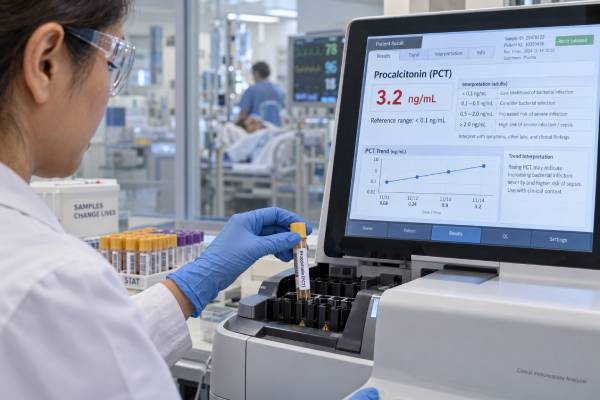
A procalcitonin (PCT) test measures a protein in blood that often rises during a significant systemic bacterial infection. Healthy people usually have very low concentrations. When bacterial toxins and inflammatory signals activate tissues throughout the body, procalcitonin production can increase rapidly, making the test useful in emergency, hospital, and intensive care settings. PCT can support an assessment for sepsis, help estimate the likelihood of bacterial lower respiratory infection, and contribute to decisions about when antibiotics may be stopped. It cannot identify the organism, locate the infection, or diagnose sepsis by itself. Early or localized bacterial disease may produce a low result, while major surgery, trauma, burns, shock, kidney dysfunction, and certain cancers can raise PCT without bacterial sepsis. Cutoffs also depend on the clinical protocol and timing of the sample. The safest interpretation combines the level and its trend with symptoms, vital signs, organ function, cultures, imaging, and the clinician’s estimate of infection probability.
- Procalcitonin is most useful as an adjunct for systemic bacterial infection and sepsis assessment.
- A high result supports concern but does not prove that bacteria are the cause.
- A low result cannot safely exclude very early, localized, or atypical infection.
- Serial measurements are often more informative than a single value.
- Current sepsis guidance does not recommend waiting for PCT before starting urgently needed antibiotics.
Table of Contents
- What Procalcitonin Is and How It Responds to Infection
- Procalcitonin Ranges, Units, and Common Cutoffs
- What Can Cause High Procalcitonin?
- What a Low Procalcitonin Result Can and Cannot Rule Out
- How PCT Fits Into Sepsis and Bacterial Infection Assessment
- Using Trends to Guide Antibiotic Duration
- Testing, Follow-Up, and When to Seek Urgent Care
What Procalcitonin Is and How It Responds to Infection
Procalcitonin is the precursor of calcitonin, a hormone involved in calcium regulation. Under ordinary conditions, specialized cells in the thyroid process procalcitonin into calcitonin, leaving only tiny amounts of intact PCT in circulation. During a systemic bacterial response, many tissues outside the thyroid begin releasing procalcitonin into the bloodstream.
Bacterial toxins and inflammatory cytokines stimulate this production. Viral immune signaling tends to suppress it to some degree, which helps explain why PCT is often higher in bacterial than in uncomplicated viral infection. The distinction is not absolute. Severe viral disease, bacterial coinfection, immune suppression, timing, and noninfectious tissue injury can blur the pattern.
PCT may begin rising within several hours of a major bacterial stimulus and often reaches a more informative level over the next 12 to 24 hours. If the infection is controlled and the patient improves, the concentration generally falls with an approximate biological half-life of about a day. This relatively predictable decline makes serial testing useful in selected hospital protocols.
The test is usually performed on serum or plasma obtained from a vein. No special preparation or fasting is typically required. The laboratory uses an immunoassay and reports the concentration most often in nanograms per milliliter (ng/mL) or micrograms per liter (µg/L). These units are numerically equivalent: 1 ng/mL equals 1 µg/L.
PCT differs from a C-reactive protein test. CRP rises in many infectious and noninfectious inflammatory states and can remain elevated for varied reasons. Procalcitonin is more closely associated with systemic bacterial signaling, although it is still nonspecific. A clinician may order both because they answer overlapping but different questions.
It also differs from cultures and molecular tests. PCT reflects the patient’s host response; it does not detect bacteria directly. Blood, urine, sputum, wound, or cerebrospinal fluid testing may identify the organism and guide antibiotic selection. A high PCT cannot supply that information.
Procalcitonin Ranges, Units, and Common Cutoffs
There is no single cutoff that applies to every patient and infection. Laboratories and clinical protocols may use different thresholds for suspected lower respiratory infection, bacteremia, sepsis progression, neonatal care, surgery, or antibiotic discontinuation. The report’s interpretive comments and the local protocol should take priority over a generic chart.
Common adult interpretive bands are often described approximately as follows:
| PCT concentration | Possible interpretation in an adult | Major caution |
|---|---|---|
| Below 0.10 ng/mL | Systemic bacterial infection is less likely | Does not exclude early or localized infection |
| 0.10–0.24 ng/mL | Low concentration; bacterial cause may be less likely in some respiratory protocols | Clinical risk can override the number |
| 0.25–0.49 ng/mL | Intermediate zone; bacterial pneumonia or bacteremia becomes more plausible | Noninfectious elevations and kidney dysfunction can overlap |
| 0.50–2.00 ng/mL | Systemic bacterial infection or sepsis risk deserves stronger consideration | Not diagnostic and not a measure of organ failure |
| Above 2.00 ng/mL | May indicate high risk of progression in a critically ill patient | Severe trauma, shock, surgery, burns, and other causes can also raise PCT |
These bands are educational examples, not treatment instructions. A PCT of 0.3 ng/mL may be interpreted differently in a stable outpatient with cough, a patient immediately after major surgery, and an immunocompromised patient with low blood pressure. Some protocols place more weight on percentage decline than on an absolute cutoff.
The result should be evaluated against the assay used by the laboratory. PCT methods are generally designed to measure low concentrations, but analytical differences, reporting limits, and clinical validation may vary. Results from different laboratories are not always perfectly interchangeable.
Newborns require special interpretation because PCT can rise physiologically during the first days after birth. Children also have age- and setting-specific protocols. Adult cutoffs should not be applied casually to neonatal or pediatric sepsis assessment.
A very high value often increases concern for severe systemic bacterial inflammation, but it does not define sepsis. Sepsis requires infection-related organ dysfunction. Conversely, a person can have sepsis with a modest PCT, particularly early in the course, with localized sources, or when immune responses are altered.
What Can Cause High Procalcitonin?
Systemic bacterial infection is the main reason clinicians order PCT. Pneumonia, bloodstream infection, kidney infection, intra-abdominal infection, severe skin or soft-tissue infection, and other bacterial sources may raise it. Concentrations tend to be higher when the response is widespread or accompanied by shock, but there is extensive overlap.
A high PCT may support concern for:
- bacteremia or bacterial sepsis;
- severe community-acquired or hospital-acquired bacterial pneumonia;
- complicated urinary tract or kidney infection;
- bacterial meningitis or another invasive infection;
- secondary bacterial infection complicating a viral illness;
- failure to control an infection source.
PCT can also rise without bacterial infection. Important alternatives include:
- Major surgery: Extensive procedures, especially cardiothoracic or abdominal surgery, can produce a temporary rise. The postoperative trend and clinical course matter.
- Severe trauma or burns: Widespread tissue injury and systemic inflammation can stimulate PCT.
- Shock: Cardiogenic shock, prolonged circulatory failure, and tissue hypoperfusion may increase concentrations.
- Kidney dysfunction: Baseline PCT may be higher and decline more slowly, making fixed thresholds less reliable.
- Severe liver disease: Advanced illness and systemic inflammation can alter interpretation.
- Certain cancers: Medullary thyroid carcinoma, some neuroendocrine tumors, and other malignancies may raise PCT.
- Other intense inflammatory states: Severe pancreatitis, cardiac arrest, and some immune therapies may create false-positive concern.
The timing of these events is crucial. A postoperative PCT that peaks and then falls may reflect surgical injury. A value that continues rising while fever, pain, oxygen need, or blood pressure worsens raises greater concern for infection or another complication.
A high result does not tell the clinician which antibiotic to choose. Cultures, local resistance patterns, infection source, allergies, recent antibiotic exposure, and organ function guide therapy. PCT should not substitute for source control, such as draining an abscess or removing an infected device when required.
It also does not distinguish all bacterial infections equally well. Intracellular organisms, chronic localized infections, endocarditis, osteomyelitis, and abscesses may produce lower values than expected. The absence of a dramatic increase should not overrule strong disease-specific evidence.
What a Low Procalcitonin Result Can and Cannot Rule Out
A low PCT lowers the probability of some systemic bacterial infections, particularly bacteremia and bacterial lower respiratory infection in appropriately selected patients. It is not a universal “no bacteria” result.
False reassurance can occur when:
- the sample is drawn very early, before PCT has had time to rise;
- the infection remains localized rather than producing a systemic response;
- the organism or infection type generates little PCT;
- the patient is severely immunocompromised and cannot mount a typical response;
- antibiotics or source control have already reduced the stimulus;
- the illness is fungal, viral, parasitic, or caused by an atypical organism.
A low result does not exclude appendicitis, a small abscess, early pneumonia, endocarditis, osteomyelitis, infected hardware, or a urinary infection. Those diagnoses rely on symptoms, examination, imaging, urine testing, cultures, and other targeted evidence.
Nor does a low PCT exclude sepsis from a nonbacterial infection. Sepsis can be triggered by viral, fungal, or other pathogens. Organ dysfunction and the patient’s condition determine urgency, not the biomarker alone.
Repeat testing may be appropriate when suspicion remains high and the initial sample was early. The timing is chosen by the clinical team and protocol, often within 6 to 24 hours. A rising value can support an evolving systemic bacterial process, while a persistently low value may add evidence against it. Neither pattern should be interpreted in isolation.
PCT is especially risky when used as a gatekeeper for antibiotics in a patient with shock, meningitis concern, profound immune suppression, or another time-critical syndrome. In those situations, clinicians collect cultures quickly and begin empiric treatment based on the overall risk rather than waiting for a biomarker.
A white blood cell count may also be normal during serious infection or abnormal for noninfectious reasons. Agreement between low PCT and a normal WBC can be reassuring only when the history, vital signs, and examination also indicate low risk.
How PCT Fits Into Sepsis and Bacterial Infection Assessment
Sepsis is life-threatening organ dysfunction caused by a dysregulated response to infection. Clinicians look for a suspected or confirmed infection plus evidence that organs are failing or circulation is compromised. PCT contributes to the infection assessment but does not measure all features of sepsis.
A sepsis evaluation may include:
- temperature, heart rate, breathing rate, blood pressure, oxygen level, and mental status;
- blood cultures and cultures from the suspected source;
- lactate, kidney and liver tests, coagulation studies, and blood gases;
- CBC, CRP, and other inflammatory markers;
- urinalysis, respiratory testing, or cerebrospinal fluid analysis;
- chest imaging, ultrasound, CT, or other source-directed imaging.
PCT is useful because it can provide supportive evidence that systemic inflammation is bacterial rather than purely noninfectious. A high or rising value may strengthen concern, while a low value may reduce the probability in a stable, carefully assessed patient. The effect on decision-making depends on the pretest probability: the clinician’s estimate before seeing the result.
When pretest probability is high, even a low PCT may not lower risk enough to withhold treatment. When probability is low, a modest elevation from kidney dysfunction or surgery may not justify antibiotics. This is the same principle used for many diagnostic tests: results modify probability rather than replacing it.
The 2026 Surviving Sepsis Campaign guidance suggests using clinical evaluation alone rather than adding PCT to decide whether to start antimicrobials in adults with possible or probable sepsis or septic shock. The reason is safety and limited evidence that PCT improves initiation decisions. Urgent antibiotic treatment should not be delayed in probable or definite sepsis, especially with shock.
PCT is also not an alternative to looking for source control. An obstructed infected kidney, perforated bowel, abscess, necrotizing infection, or infected catheter may require a procedure. Biomarker decline cannot compensate for an untreated source.
Using Trends to Guide Antibiotic Duration
One of PCT’s most useful roles is antibiotic stewardship: helping reduce unnecessary antibiotic exposure without compromising treatment. This use relies on a protocol, repeated measurements, and clinical improvement rather than one isolated result.
In selected adults with sepsis or lower respiratory infection, clinicians may consider stopping antibiotics when PCT has fallen substantially from its peak—often by 80% or more—or dropped below a protocol-specific level. The exact rule varies. Stable vital signs, controlled infection source, improving organ function, culture results, and the diagnosed infection remain essential.
The 2026 Surviving Sepsis Campaign suggests using PCT together with clinical evaluation to help decide when to discontinue antimicrobials in adults with sepsis or septic shock when source control is adequate and the optimal duration is unclear. This is a conditional recommendation with limited certainty, not an instruction to stop treatment automatically.
A falling PCT may indicate that the systemic bacterial stimulus is resolving. Failure to fall can prompt questions such as:
- Is the antibiotic active against the organism?
- Was the infection source drained or removed?
- Is there a new or secondary infection?
- Could kidney dysfunction be slowing the decline?
- Is a noninfectious inflammatory complication maintaining the level?
Some infections require treatment based on established durations and source-specific evidence regardless of PCT. Examples may include endocarditis, osteomyelitis, central nervous system infection, deep abscesses, and infections involving prosthetic material. Immunocompromised patients and those with unusual pathogens may also fall outside standard algorithms.
PCT should never be used by a patient to start, shorten, or stop prescribed antibiotics independently. Ending therapy too early can cause relapse or complications; continuing unnecessarily can cause adverse effects, Clostridioides difficile infection, drug interactions, and antimicrobial resistance. Stewardship balances both risks.
Testing, Follow-Up, and When to Seek Urgent Care
No fasting or special preparation is usually needed. Tell the clinical team about recent surgery, trauma, burns, kidney disease, cancer, immune-suppressing treatment, antibiotics, and the time symptoms began. Those details can change how a result is interpreted.
A practical review follows five questions:
- Why was PCT ordered? A sepsis workup, pneumonia assessment, and antibiotic-discontinuation protocol use the value differently.
- When was the sample taken? An early low result may need repetition if suspicion remains high.
- What is the clinical probability of bacterial infection? Symptoms, examination, source, and vital signs establish the starting point.
- Are there nonbacterial reasons for elevation? Surgery, shock, burns, renal dysfunction, and cancer may confound the result.
- What is the trend? A consistent rise or fall often carries more information than one number.
An inflammatory marker panel may add context, but no panel can confirm sepsis. Cultures can be negative even in treated or difficult-to-grow infections, so clinicians integrate all available evidence and reassess frequently.
Seek emergency care for confusion, severe shortness of breath, bluish or mottled skin, fainting, very low blood pressure, rapid deterioration, little or no urine, severe pain, fever with extreme weakness, or concern for sepsis. Do not wait for a PCT test or home result. Sepsis treatment is time-sensitive.
For a nonurgent result, useful questions include whether the value is being used diagnostically or as a trend, what cutoff the local protocol applies, whether renal function or recent procedures could affect it, and what other findings support or oppose bacterial infection.
PCT works best as a probability-adjusting and trend-monitoring tool. Its clinical value comes from placing the number at the right point in the illness, recognizing false positives and false negatives, and never allowing it to overrule a deteriorating patient.
References
- Procalcitonin Test 2025
- Procalcitonin 2025
- Procalcitonin, Serum 2026
- Surviving Sepsis Campaign: International Guidelines for Management of Sepsis and Septic Shock 2026 2026
- Procalcitonin Guided Antibiotic Stewardship 2024
Disclaimer
This article is for general education and cannot diagnose bacterial infection or sepsis or guide an individual antibiotic decision. Procalcitonin thresholds vary by protocol, and both false-positive and false-negative results occur. Seek emergency care immediately for possible sepsis or rapid clinical deterioration, regardless of the PCT value.