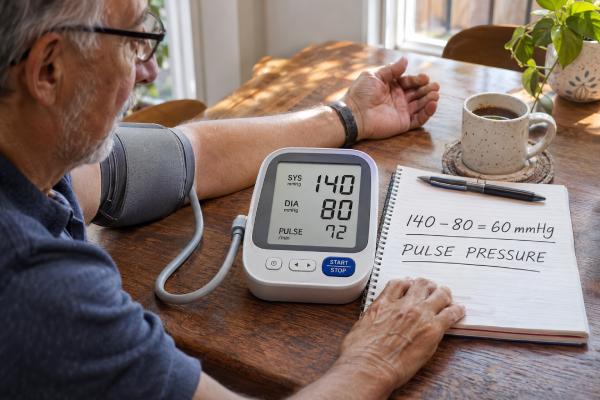
Pulse pressure is the difference between the top and bottom numbers in a blood pressure reading. If your blood pressure is 120/80 mm Hg, your pulse pressure is 40 mm Hg. It is easy to calculate, but it is not usually the main number used to diagnose or treat high blood pressure. Systolic and diastolic pressure still matter more for routine decisions.
Even so, pulse pressure can provide useful context. A wider pulse pressure becomes more common with age as large arteries stiffen, and in older or higher-risk adults it can be associated with greater cardiovascular risk. A narrow pulse pressure can occur when the heart is pumping less blood forward, but it can also appear temporarily from measurement variation or normal physiology. There is no single pulse-pressure cutoff that diagnoses arterial disease or tells you what treatment you need. The useful question is whether the pattern is persistent, how high the actual systolic and diastolic readings are, and whether symptoms or other risk factors are present.
Table of Contents
- What Pulse Pressure Is and How to Calculate It
- What a Wide Pulse Pressure Can Mean
- What a Narrow Pulse Pressure Can Mean
- How Age and Arterial Stiffness Change Pulse Pressure
- When Pulse Pressure Is Worth Discussing With a Clinician
- How to Measure and Track Pulse Pressure Correctly
- What You Can Do About a Wide Pulse Pressure
What Pulse Pressure Is and How to Calculate It
Blood pressure is written as two numbers. Systolic pressure, the top number, is the pressure in the arteries when the heart contracts. Diastolic pressure, the bottom number, is the pressure while the heart relaxes between beats.
Pulse pressure is simply:
Systolic blood pressure − diastolic blood pressure = pulse pressure
Examples:
| Blood pressure | Calculation | Pulse pressure |
|---|---|---|
| 110/70 mm Hg | 110 − 70 | 40 mm Hg |
| 120/80 mm Hg | 120 − 80 | 40 mm Hg |
| 140/80 mm Hg | 140 − 80 | 60 mm Hg |
| 150/70 mm Hg | 150 − 70 | 80 mm Hg |
| 95/75 mm Hg | 95 − 75 | 20 mm Hg |
A value around 40 mm Hg is common in younger and middle-aged adults with blood pressure near 120/80. But pulse pressure does not have one universal “normal range” that works for every age and clinical setting. It changes with age, arterial stiffness, stroke volume, heart rate, medications, and the accuracy of the measurement.
This is why a pulse pressure of 60 mm Hg means something different in a healthy 25-year-old after exercise than in an 80-year-old with persistent systolic hypertension. Context matters.
The actual blood pressure category still comes first. A person with 160/100 has a pulse pressure of 60, but the urgent clinical issue is that the blood pressure itself is very high. A person with 130/70 also has a pulse pressure of 60, yet the interpretation is different.
If you are unsure how the basic blood pressure numbers are classified, see normal blood pressure readings and what they mean.
What a Wide Pulse Pressure Can Mean
A wide pulse pressure means there is a larger-than-usual gap between systolic and diastolic pressure. A pulse pressure of 60 mm Hg or more is often used in research as a marker of widening, especially in older adults, but it is not a stand-alone diagnosis.
The most common reason for a persistently wide pulse pressure with aging is arterial stiffness. Healthy large arteries stretch when the heart ejects blood and recoil between beats. As those arteries become stiffer, systolic pressure tends to rise while diastolic pressure may stay the same or fall. The gap widens.
This pattern often appears as isolated systolic hypertension: high systolic pressure with a relatively normal or lower diastolic pressure.
A wide pulse pressure can also occur with conditions that increase the amount of blood ejected with each beat or reduce diastolic pressure, including certain valve problems, severe anemia, hyperthyroidism, fever, or high-output states. Those causes are less common than age-related arterial stiffness and should be interpreted by a clinician rather than self-diagnosed from one reading.
In a 2023 analysis of more than 65,000 people enrolled in cardiovascular outcome trials, each 10 mm Hg higher baseline pulse pressure was associated with greater risk of death, heart attack, or stroke. Participants with pulse pressure at or above 60 mm Hg also had higher event risk than those below 60 mm Hg. That does not mean 60 mm Hg is a danger line for every individual; the participants already had cardiovascular disease or risk factors, and pulse pressure acted as a risk marker rather than proof of a specific disease.
A wide pulse pressure is most useful when it is persistent. One reading after climbing stairs, drinking caffeine, feeling anxious, or using the wrong cuff size may tell you very little.
If widening occurs alongside rising systolic pressure over the years, the more important issue is often vascular aging and blood pressure control. The article on arterial stiffness explains that connection in more detail.
What a Narrow Pulse Pressure Can Mean
A narrow pulse pressure means the systolic and diastolic numbers are closer together. A value around 20 to 25 mm Hg can be considered narrow in many clinical discussions, but—as with a wide pulse pressure—the meaning depends on context.
A narrow pulse pressure can appear when the heart is ejecting less blood with each beat. That can happen in serious conditions such as advanced heart failure, major blood loss, shock, severe dehydration, or certain valve problems.
However, a narrow reading is not automatically an emergency. Home blood pressure measurements can vary because of technique, cuff fit, body position, talking, movement, or device error. Some healthy people also have lower systolic pressure and a relatively small gap without symptoms.
Symptoms are important. A narrow pulse pressure deserves prompt evaluation when it occurs with:
- fainting or near-fainting;
- severe weakness;
- confusion;
- cold, clammy skin;
- chest pain;
- marked shortness of breath;
- very low blood pressure;
- signs of major bleeding or dehydration.
In those situations, the pulse pressure is not the main problem. It is one clue that circulation may be inadequate.
For a stable person at home, repeat the measurement correctly before drawing conclusions. If the pattern persists over multiple readings—especially with fatigue, dizziness, breathlessness, swelling, or exercise intolerance—discuss it with a clinician.
Do not try to “treat” a narrow pulse pressure by consuming extra salt, caffeine, or fluids unless you know the cause. The right response depends on whether the issue is dehydration, medication, heart function, or simply measurement error.
How Age and Arterial Stiffness Change Pulse Pressure
Pulse pressure often changes across the lifespan. In younger adults, systolic and diastolic pressure may rise together. With advancing age, the aorta and other large arteries gradually lose elasticity. Systolic pressure may continue to rise while diastolic pressure plateaus or falls, causing pulse pressure to widen.
This is one reason isolated systolic hypertension becomes common in older adults.
Arterial stiffness is not only an age issue. It is also influenced by long-term blood pressure, diabetes, smoking, kidney disease, inflammation, and other cardiovascular risk factors. Researchers often measure stiffness more directly with carotid-femoral pulse wave velocity, which tracks how quickly the pressure wave travels through the aorta and large arteries.
Recent studies support arterial stiffness as a useful integrated marker of vascular risk. A 2025 meta-analysis of people with moderate blood pressure found that higher carotid-femoral pulse wave velocity added some predictive information beyond traditional risk factors. Another 2025 cohort study found repeated pulse-wave-velocity measurements were associated with hypertension-mediated organ damage and cardiovascular complications.
Pulse pressure is much easier to calculate than pulse wave velocity, but it is also less specific. A wide pulse pressure can suggest stiff arteries, especially in older adults, yet it cannot measure arterial stiffness precisely.
That distinction prevents a common mistake: treating a home blood pressure gap as if it were a direct test of “arterial age.” It is not.
Age also changes how aggressively clinicians interpret the diastolic number. In an older adult with stiff arteries, reducing systolic pressure is important, but pushing diastolic pressure too low may be a concern in some people with coronary disease because the coronary arteries receive much of their blood flow during diastole. Treatment therefore focuses on the whole patient, not pulse pressure in isolation.
If your blood pressure numbers vary substantially from day to day, blood pressure variability is another useful concept. Pulse pressure can bounce simply because either the systolic or diastolic number changed temporarily.
Another useful comparison is pulse pressure versus mean arterial pressure. They are not the same measurement. Pulse pressure describes the swing between systolic and diastolic pressure, while mean arterial pressure estimates the average pressure driving blood through the circulation during one cardiac cycle. Clinicians may care about both in different settings, especially in hospitals, but neither replaces the standard systolic and diastolic reading for routine home blood-pressure decisions.
Exercise also temporarily widens pulse pressure in many healthy people. During aerobic activity, systolic pressure rises as the heart pumps more blood, while diastolic pressure may change little. That wider gap during exercise is expected and should not be interpreted using resting thresholds. The same principle applies immediately after climbing stairs or rushing to the blood-pressure cuff. For a meaningful resting pulse pressure, measure after several quiet minutes rather than during normal physiologic stress.
Because pulse pressure is derived from two values, small shifts can look dramatic. A change from 130/80 to 135/75 widens pulse pressure from 50 to 60 mm Hg even though each component moved only 5 mm Hg. This is another reason trends are more useful than single calculations.
When Pulse Pressure Is Worth Discussing With a Clinician
Pulse pressure is worth bringing up when it shows a consistent pattern, especially if the actual blood pressure is abnormal or you have symptoms.
Examples include:
- repeated readings around 150/70, 160/70, or similar wide-gap patterns;
- systolic pressure that has been rising while diastolic pressure stays flat or falls;
- repeated pulse pressure around or above 60 mm Hg in an older adult with cardiovascular risk factors;
- unusually narrow pulse pressure with dizziness, faintness, fatigue, or shortness of breath;
- a major change from your usual pattern;
- wide pulse pressure plus a known heart valve problem, kidney disease, or cardiovascular disease.
What a clinician does next depends on the context. They may review your home technique, medications, symptoms, and cardiovascular risk. They may check for anemia or thyroid disease, listen for a heart murmur, assess kidney function, or order an echocardiogram if a structural heart problem is suspected.
If office readings and home readings do not match, ambulatory monitoring can provide a clearer picture over 24 hours. That includes daytime, nighttime, and activity-related blood pressure. See 24-hour ambulatory blood pressure monitoring for how that testing works.
A pulse pressure number by itself rarely determines treatment. Clinicians usually act on the underlying issue: hypertension, arterial stiffness risk factors, medication effects, a valve disorder, low circulating volume, or another cause.
Remember that cardiovascular risk rises continuously rather than at one magical pulse-pressure threshold. A persistent 58 mm Hg gap does not become harmless because it is under 60, and a single 62 mm Hg reading does not prove disease.
How to Measure and Track Pulse Pressure Correctly
A pulse pressure calculation is only as good as the blood pressure reading used to create it.
For home measurements:
- Avoid exercise, smoking, and caffeine for about 30 minutes beforehand when possible.
- Empty your bladder.
- Sit quietly for about five minutes with your back supported.
- Keep feet flat on the floor and legs uncrossed.
- Support the arm so the cuff is near heart level.
- Use a validated upper-arm monitor with the correct cuff size.
- Take two readings about one minute apart and record both.
Cuff size matters more than many people realize. A cuff that is too small can overestimate blood pressure. A cuff that is too large can distort it in the other direction. Because pulse pressure is calculated from two numbers, any measurement error can affect the gap.
If you need help choosing equipment, see home blood pressure monitor guidance and why cuff size affects accuracy.
Do not obsess over the pulse pressure from every individual reading. Track the actual systolic and diastolic values first. If you want to review the pulse pressure later, subtract the average diastolic pressure from the average systolic pressure over several days.
For example, suppose your seven-day average is 136/76. The average pulse pressure is 60 mm Hg. That is more meaningful than reacting to one 148/82 reading after a stressful meeting.
Home tracking is particularly useful when medications are being adjusted because it can reveal whether systolic pressure is improving, whether diastolic pressure is falling too far, and whether the overall pattern is stable.
What You Can Do About a Wide Pulse Pressure
There is no home treatment aimed specifically at “closing the gap.” The goal is to improve the factors driving the numbers and reduce overall cardiovascular risk.
If high systolic pressure is the main issue, standard blood pressure management matters most. That may include medication plus lifestyle changes such as:
- reducing excess sodium;
- eating a DASH- or Mediterranean-style diet;
- exercising regularly;
- maintaining a healthy body weight;
- stopping smoking;
- limiting alcohol;
- treating sleep apnea when present;
- controlling diabetes and cholesterol.
Regular aerobic exercise and blood pressure control may improve vascular function over time, although age-related arterial stiffening cannot be completely reversed. Strength training can also be part of a healthy plan when performed safely.
Do not try to raise diastolic pressure on your own just to make the pulse pressure look narrower. For example, adding large amounts of salt could worsen systolic hypertension. The goal is not to create a cosmetically “better” subtraction result; it is to achieve safe actual blood pressure values.
Medication choices are individualized. In older adults with isolated systolic hypertension, clinicians may use thiazide-type diuretics, calcium channel blockers, renin-angiotensin system drugs, or other agents depending on the person’s conditions and tolerability. The pulse pressure may narrow as systolic pressure improves, but treatment targets are based on guideline-directed blood pressure goals and patient factors, not on a specific pulse-pressure target.
If you are just beginning lifestyle treatment, safe exercise for high blood pressure and the DASH diet are practical places to start.
The most useful way to think about pulse pressure is as a clue. A persistent wide gap can reflect arterial stiffening and higher vascular risk, particularly later in life. A narrow gap can sometimes signal low forward blood flow. But the number does not replace systolic pressure, diastolic pressure, symptoms, or clinical evaluation. Track the pattern correctly, focus on the underlying blood pressure problem, and use pulse pressure as added context rather than a diagnosis.
If you bring pulse-pressure concerns to an appointment, bring the underlying readings rather than only the calculated differences. A clinician needs to see whether the pattern comes from high systolic pressure, low diastolic pressure, or both, and whether it changes with posture, medications, exercise, or time of day. Include the monitor model, cuff size, and a few days of dated readings if possible. That context is more useful than a single wide value because treatment decisions depend on the actual blood pressures, symptoms, age, medical history, and overall cardiovascular risk.
References
- Association of pulse pressure with death, myocardial infarction, and stroke among cardiovascular outcome trial participants 2023
- Predictive power of 24-h ambulatory pulse pressure and its components for mortality and cardiovascular outcomes in 11 848 participants recruited from 13 populations 2022
- Usefulness of Arterial Stiffness as an Integrated Marker of Cardiovascular Risk 2025
- Association between carotid-femoral pulse wave velocity and cardiovascular disease in individuals with moderate blood pressure: a systematic review and individual participant meta-analysis 2025 (Systematic Review)
- Pathophysiology, Diagnosis, and Management of Hypertension in the Elderly. 2023 (Review)
- Blood Pressure Explained: A Helpful Guide 2026
Disclaimer
This article provides general education and does not replace medical evaluation. Seek urgent care for chest pain, fainting, severe shortness of breath, confusion, signs of shock, or very abnormal blood pressure with concerning symptoms. Persistent wide or narrow pulse pressure should be interpreted alongside your actual blood pressure, age, symptoms, medications, and medical history.