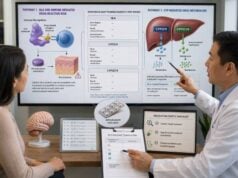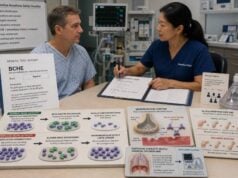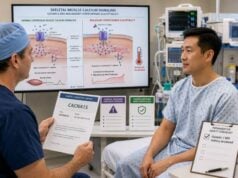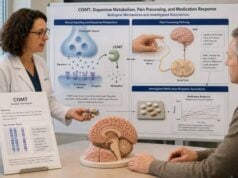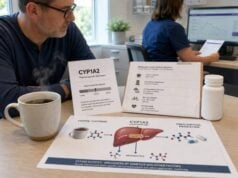
An RYR1 genetic test looks for inherited variants associated with malignant hyperthermia susceptibility, a potentially fatal reaction to certain general anesthetics and the muscle relaxant succinylcholine. A pathogenic or likely pathogenic RYR1 variant can establish that a person should receive a non-triggering anesthetic plan. A negative result is less definitive because current testing does not identify every genetic cause of susceptibility, and some families have risk linked to CACNA1S, STAC3, or an as-yet-unidentified change. A variant of uncertain significance also cannot confirm or exclude risk. Testing is commonly considered after a suspected malignant hyperthermia event, a positive muscle contracture test, a known family variant, or a concerning family history. Results should be reviewed by an experienced genetics or malignant-hyperthermia team before surgery. When risk remains unresolved, anesthesiologists can still provide safe care by avoiding triggering agents, preparing the anesthesia machine appropriately, monitoring closely, and ensuring rapid access to dantrolene.
- A pathogenic or likely pathogenic RYR1 result usually supports malignant hyperthermia susceptibility and the use of trigger-free anesthesia.
- A negative RYR1 test does not rule out susceptibility, because genetic testing has incomplete sensitivity.
- A variant of uncertain significance is inconclusive and should not be treated as proof of either safety or disease.
- Known triggers include volatile inhaled anesthetics and succinylcholine; many intravenous, local, and regional anesthetic options are non-triggering.
- No fasting is needed for the DNA test, which usually uses blood, saliva, or a cheek swab.
- Rapidly rising carbon dioxide, muscle rigidity, tachycardia, acidosis, hyperkalemia, or rapidly increasing temperature during anesthesia is an emergency requiring immediate treatment.
Table of Contents
- How RYR1 causes anesthesia risk
- Who should consider testing
- Testing methods and sample process
- Positive, negative, and uncertain results
- When muscle contracture testing is needed
- Planning anesthesia after results
- Recognizing and treating an MH crisis
- Family testing, muscle symptoms, and follow-up
How RYR1 causes anesthesia risk
RYR1 provides instructions for the ryanodine receptor type 1, a large calcium-release channel in skeletal muscle. During normal muscle contraction, the channel releases calcium from an internal storage structure called the sarcoplasmic reticulum. Calcium allows muscle fibers to contract, and the channel then closes so the muscle can relax and energy use can return toward baseline.
Certain RYR1 variants make this calcium-control system unstable. Exposure to a triggering anesthetic can cause uncontrolled calcium release, sustained muscle contraction, and a rapid increase in metabolism. The body consumes oxygen, produces large amounts of carbon dioxide and heat, develops acidosis, and may release potassium and muscle proteins into the blood. Without prompt treatment, malignant hyperthermia can lead to dangerous arrhythmias, kidney injury, disseminated intravascular coagulation, cardiac arrest, and death.
Malignant hyperthermia susceptibility is usually inherited in an autosomal dominant pattern. One disease-associated variant can increase risk, and each child of a person carrying that variant generally has a 50% chance of inheriting it. Penetrance is reduced, which means not everyone with a pathogenic variant develops a crisis. A person may undergo one or more apparently uneventful anesthetics and still react during a later exposure. Prior safe anesthesia therefore does not exclude susceptibility.
RYR1 is the main known gene, but it is not the only one. Pathogenic variants in CACNA1S and rare variants in STAC3 can also cause susceptibility. Some diagnostic panels include all three genes. A focused CACNA1S genetic test may be relevant when RYR1 testing is negative or the family’s known variant is in CACNA1S.
Not every RYR1 variant causes malignant hyperthermia. RYR1 is a large gene with many rare variants in the population. Some are benign, some cause congenital myopathies, some are associated with exertional rhabdomyolysis or heat illness, and many remain uncertain. Classification requires population data, family segregation, functional studies, clinical evidence, and expert criteria. A laboratory should not label a rare missense change as dangerous merely because it occurs in RYR1.
Malignant hyperthermia is a pharmacogenetic condition: risk becomes most important when a genetically susceptible person encounters a trigger. It differs from fever due to infection and from heat stroke, although severe hypermetabolism can produce a rapid temperature rise. The word “hyperthermia” can be misleading because elevated temperature may be a late sign during an anesthetic crisis.
Who should consider testing
RYR1 testing is most informative when it begins with a person who had a well-documented suspected malignant hyperthermia episode or a positive muscle contracture test. Finding a pathogenic variant in that person allows targeted testing of relatives. Testing an unaffected relative first, without knowing the familial cause, is more likely to produce an uninformative negative result or an uncertain variant.
Common reasons for referral include:
- a prior anesthetic event with unexplained rapid carbon dioxide rise, generalized or jaw-muscle rigidity, acidosis, hyperkalemia, rhabdomyolysis, rapidly increasing temperature, arrhythmia, or response to dantrolene;
- a positive caffeine–halothane contracture test or in vitro contracture test;
- a pathogenic or likely pathogenic RYR1, CACNA1S, or STAC3 variant in a biological relative;
- a close relative with a convincing malignant hyperthermia crisis or anesthesia-related death;
- unexplained severe rhabdomyolysis, recurrent exertional rhabdomyolysis, heat-related illness, or markedly elevated creatine kinase with features suggesting an RYR1-related disorder;
- a congenital muscle disorder associated with RYR1;
- an incidental RYR1 variant discovered during exome, genome, or neuromuscular testing that requires expert assessment.
A mild fever, postoperative shivering, ordinary muscle soreness, nausea, or delayed waking alone is not specific for malignant hyperthermia. Many anesthesia complications resemble parts of an MH episode. The original anesthesia record, end-tidal carbon dioxide trend, temperature trend, blood gases, potassium, creatine kinase, urine findings, medications, and dantrolene response can help an expert judge the likelihood of a true crisis.
Testing can be appropriate even when surgery is not imminent because results may take weeks and family evaluation may take longer. However, an operation does not always need to be postponed while testing is incomplete. If the team treats the patient as susceptible and uses a prepared, trigger-free technique in an appropriate facility, necessary surgery can often proceed safely.
A person with only a distant or vague family story may begin with records review and genetic counseling. The goal is to identify the affected relative, clarify biological relationships, and determine whether a known familial variant exists. Testing a relative for one established variant is simpler and more decisive than sequencing the entire gene without a reference point.
An RYR1 test is not a general test for anesthesia allergy. It does not predict nausea, difficult intubation, local-anesthetic reactions, prolonged paralysis from BCHE deficiency, opioid response, or latex allergy. Those concerns require different evaluations. A broader malignant hyperthermia genetic test may include several susceptibility genes but still does not cover every anesthesia complication.
Testing methods and sample process
Clinical RYR1 testing usually begins with a blood sample, although saliva or a cheek swab may be accepted. Fasting is not required, and medications do not need to be stopped for germline DNA analysis. Blood may be preferred when a high-quality sample is needed quickly or when previous saliva collection failed.
The ordering clinician or genetic counselor should provide a detailed indication. Laboratories interpret variants more accurately when they know whether the person had a suspected crisis, a positive contracture test, an RYR1-related myopathy, exertional rhabdomyolysis, or a known family variant.
Several test strategies are available:
- Targeted familial-variant testing checks only the pathogenic or likely pathogenic change already identified in a relative. It is usually the clearest and least expensive approach for family members.
- Full RYR1 sequencing examines coding regions and nearby splice sites for single-nucleotide variants and small insertions or deletions.
- Deletion and duplication analysis looks for larger copy-number changes that sequencing may miss.
- A malignant-hyperthermia panel may include RYR1, CACNA1S, STAC3, and sometimes additional muscle genes.
- Exome or genome sequencing may be used when the phenotype includes a broader neuromuscular disorder or prior testing was unrevealing.
The laboratory should use current transcript references and RYR1-specific variant-classification criteria. Because many variants are missense changes, functional evidence and expert curation are particularly important. The report should identify the exact DNA and protein change, zygosity, classification, evidence, inheritance when known, test limitations, and recommended follow-up.
Turnaround commonly ranges from two to several weeks, although targeted testing may be faster. Urgent surgery planning should not depend on receiving a result if a trigger-free plan can be arranged. The anesthesiologist should be told about the concern as early as possible.
A clinical test may report one of several outcomes: pathogenic, likely pathogenic, variant of uncertain significance, likely benign, benign, or no reportable variant. These categories follow evidence standards and can change over time. The raw DNA finding may stay the same while the classification is upgraded or downgraded.
Direct-to-consumer genotyping is not adequate for excluding malignant hyperthermia susceptibility. Consumer arrays test a small subset of variants and may contain false positives. A reported RYR1 finding should be confirmed in a clinical laboratory before it guides family testing or permanent medical records.
Consent should address the possibility of discovering an RYR1 variant related to muscle disease rather than anesthesia risk alone. Some people with RYR1-related conditions have weakness, exercise intolerance, muscle pain, heat sensitivity, or rhabdomyolysis. Others remain asymptomatic outside anesthetic exposure.
Positive, negative, and uncertain results
The meaning of an RYR1 result depends on classification and clinical context. “Positive” should be reserved for a pathogenic or likely pathogenic variant that is accepted as causative for malignant hyperthermia susceptibility or an RYR1-related disorder relevant to the patient.
| Result | Meaning | Usual next step |
|---|---|---|
| Pathogenic or likely pathogenic variant associated with MHS | Genetic susceptibility is established or strongly supported | Use trigger-free anesthesia, document the result, and offer targeted family testing |
| No pathogenic variant found | Testing did not identify a known cause; susceptibility is not excluded | Base management on personal and family history and consider contracture testing or broader evaluation |
| Variant of uncertain significance | Evidence is insufficient to classify the variant as harmful or harmless | Do not use it for predictive family testing; seek expert review and consider additional testing |
| Benign or likely benign variant | The variant is not considered a cause of susceptibility | Do not use it to explain risk; continue evaluation if clinical suspicion remains |
| Known familial pathogenic variant not detected | The tested relative did not inherit that specific family variant | Risk related to that variant is greatly reduced; confirm whether another independent risk factor exists |
A pathogenic result does not predict whether or when a crisis will occur. It does not provide a percentage risk for each anesthetic exposure, and it does not mean the person has ongoing hyperthermia. It means triggering anesthetics should be avoided and the information should follow the patient across health systems.
A negative result is more complicated. Current genetic testing identifies a causative variant in many, but not all, people with confirmed susceptibility. Technical limitations, unknown genes, untested regulatory variants, mosaicism, or uncertain variant interpretation can leave the cause unresolved. A person with a convincing prior event or positive contracture test remains susceptible even when sequencing is negative.
A variant of uncertain significance, or VUS, is not a positive result. It should not be used to declare relatives susceptible or unaffected. Family studies may help determine whether the variant tracks with disease, but testing healthy relatives solely to “see who has it” can create confusion unless guided by a genetics team. The principles are similar to those described for a variant of uncertain significance in genetic testing.
Reclassification is common enough to plan for. Patients should retain the original report, keep contact information current with the ordering clinic, and ask whether the laboratory issues amended results. Before a future surgery, an old VUS should be checked against current expert databases and guidance.
A result may also indicate an RYR1-related myopathy without clear malignant hyperthermia evidence. That finding may prompt neuromuscular evaluation while the anesthesia plan remains conservative. The absence of weakness does not prove the variant is harmless.
When muscle contracture testing is needed
Muscle contracture testing assesses how a fresh skeletal-muscle sample responds to caffeine and halothane. In North America it is commonly called the caffeine–halothane contracture test, or CHCT. In Europe it is called the in vitro contracture test, or IVCT. It remains an important diagnostic method because genetic testing cannot exclude all susceptibility.
The test requires a surgical muscle biopsy, usually from the thigh, and the fresh tissue must be analyzed promptly at a specialized center. Samples cannot usually be shipped long distances like routine blood tests. Access, travel, cost, age, and medical fitness for biopsy can limit availability.
Contracture testing may be considered when:
- a person had a convincing suspected MH episode but genetic testing was negative or inconclusive;
- a family has confirmed contracture-test susceptibility but no causative variant has been found;
- an uncertain RYR1 variant needs additional clinical context;
- a definitive assessment is important for a person or family and testing is available;
- expert review recommends it after an anesthesia-related event.
A positive contracture test supports susceptibility and should lead to trigger-free anesthesia. A negative result can provide stronger reassurance than a negative gene panel in some settings, but interpretation depends on the validated protocol and clinical context. The testing center should explain sensitivity, specificity, and whether the result applies to relatives.
Contracture testing is not performed during an acute crisis. During a suspected event, treatment comes first. Blood tests, anesthesia records, and event details are collected for later evaluation. Genetic and contracture testing are arranged after recovery.
A person who cannot access contracture testing can still be managed safely as potentially susceptible. The practical anesthesia precaution is avoidance of triggers, not exposure to a trigger to test the diagnosis. No one should receive volatile anesthetics or succinylcholine simply to determine whether a reaction occurs.
Testing should be coordinated through a malignant hyperthermia center when possible. These centers can review the event, select the most informative family member, arrange the correct assay, and prevent unnecessary repeat testing.
Planning anesthesia after results
People with confirmed or unresolved malignant hyperthermia risk can receive anesthesia safely when the team uses non-triggering drugs and an appropriate facility. The patient should contact the surgeon and anesthesia service before the procedure rather than waiting until the day of surgery.
The triggering agents are potent volatile inhalational anesthetics, including sevoflurane, desflurane, isoflurane, and older agents such as halothane, plus the depolarizing neuromuscular blocker succinylcholine. Avoidance applies whether the person has had a previous safe anesthetic.
Many alternatives are considered non-triggering, including regional anesthesia, local anesthetics, nitrous oxide, propofol, ketamine, etomidate, benzodiazepines, opioids, dexmedetomidine, and nondepolarizing muscle relaxants. The anesthesiologist chooses among them based on the procedure and health status. “Non-triggering” does not mean free of ordinary anesthetic risks.
Preparation may include removing or disabling vaporizers, changing the breathing circuit and carbon-dioxide absorbent, flushing the workstation according to its model, or using activated charcoal filters under an established protocol. The facility should have dantrolene available rapidly wherever triggering agents are administered, and the team should have a crisis plan.
Monitoring typically includes continuous carbon dioxide measurement during general anesthesia, oxygen saturation, heart rate, blood pressure, and core temperature for appropriate procedures. The anesthesia team watches for unexplained rising end-tidal carbon dioxide, tachycardia, rigidity, acidosis, and hyperkalemia rather than waiting for fever.
An outpatient procedure may be reasonable in a prepared facility when the patient is otherwise suitable. Confirmed susceptibility does not automatically require admission or cancellation. Postoperative observation depends on the procedure, anesthetic, clinical course, and local guidance. After an uneventful trigger-free anesthetic, prolonged observation solely for susceptibility may not be necessary.
Patients can carry a medical alert card or bracelet that says “Malignant hyperthermia susceptible—avoid volatile anesthetics and succinylcholine.” The exact laboratory report should also be available. Listing “all anesthesia allergy” is less useful and may unnecessarily restrict safe options.
Dental offices, emergency departments, military services, and ambulatory surgery centers should receive the information when they might use general anesthesia or succinylcholine. Local anesthetics used for routine dental procedures are not malignant-hyperthermia triggers.
Recognizing and treating an MH crisis
Malignant hyperthermia can begin during anesthesia or shortly after exposure. The earliest sign is often an unexplained rise in end-tidal carbon dioxide despite increased ventilation. Tachycardia, generalized rigidity, jaw-muscle rigidity after succinylcholine, respiratory and metabolic acidosis, hyperkalemia, arrhythmias, and muscle breakdown may follow. Temperature can rise rapidly but may not be the first abnormality.
When MH is suspected, the anesthesia team stops triggering agents, calls for help, gives intravenous dantrolene, hyperventilates with high-flow oxygen, cools the patient when appropriate, and treats acidosis, hyperkalemia, and arrhythmias. The team monitors creatine kinase, potassium, blood gases, kidney function, coagulation, urine output, and myoglobin. Intensive care observation is usually required because symptoms can recur after initial control.
Calcium-channel blockers should not be combined with dantrolene in an MH crisis because severe hyperkalemia and cardiovascular collapse may occur. The exact emergency protocol is handled by trained clinicians and local guidelines.
Survivors need referral for formal review. The event should be documented in detail, including anesthetic drugs, timing, carbon dioxide, temperature, blood gases, potassium, creatine kinase, rigidity, urine findings, dantrolene dose, and response. This record may be more informative than a brief discharge diagnosis.
Relatives should not assume they are safe because they have never had surgery or because they tolerated anesthesia previously. Until family testing clarifies status, close biological relatives may be advised to tell anesthesiologists about the family history and receive trigger-free care.
Outside anesthesia, unexplained severe rhabdomyolysis or heat illness in an RYR1 carrier requires urgent treatment for muscle breakdown, electrolyte abnormalities, and kidney injury. Dantrolene use outside an anesthetic MH crisis is a specialist decision; people should not self-treat based on a genetic result.
Family testing, muscle symptoms, and follow-up
When a pathogenic family variant is known, targeted testing can identify relatives who inherited it. Biological parents, siblings, and adult children are often considered first. Testing minors may be appropriate because anesthesia precautions can be needed in childhood. Genetic counseling helps explain inheritance, reduced penetrance, and the limits of a negative result.
A relative who tests positive should use trigger-free anesthesia even if healthy and previously exposed without a reaction. A relative who tests negative for the known family variant is generally not at increased risk from that variant. However, the family history should be reviewed for evidence of more than one condition or uncertain biological relationships.
Families should avoid testing a VUS as though it were a confirmed familial mutation. Predictive testing is most reliable when the variant is pathogenic or likely pathogenic and clearly associated with susceptibility. Expert laboratories may reclassify variants as new evidence becomes available.
Some RYR1 carriers have symptoms beyond anesthetic risk. These may include congenital weakness, delayed motor development, exercise intolerance, muscle cramps, persistent creatine kinase elevation, recurrent rhabdomyolysis, heat intolerance, or episodes after intense exercise, illness, fasting, or certain drugs. RYR1-related disorders include central core disease, multiminicore disease, centronuclear myopathy, and other phenotypes.
A neuromuscular evaluation may include history, examination, creatine kinase, electromyography, muscle imaging, and other testing. Exercise advice should be individualized. Most carriers do not need to avoid all activity, but people with prior rhabdomyolysis or heat illness may need guidance about hydration, heat exposure, gradual conditioning, illness, and warning symptoms such as severe muscle pain, weakness, swelling, or dark urine.
The final follow-up plan should include:
- a clearly worded anesthesia alert in the medical record;
- the full genetic and contracture-test reports;
- a list of relatives who may benefit from counseling;
- re-evaluation of uncertain variants over time;
- early communication with anesthesia teams before procedures;
- specialist review of muscle symptoms or recurrent rhabdomyolysis;
- an emergency plan for future suspected reactions.
An RYR1 test can provide decisive protection when it finds a well-established disease-associated variant. Its greatest limitation is that a negative or uncertain result may leave risk unresolved. Safe anesthesia does not require certainty: when suspicion remains, a carefully prepared trigger-free plan can prevent the exposure that causes the crisis.
References
- Nonsyndromic Malignant Hyperthermia Susceptibility 2025 (Review)
- Variant Curation Expert Panel Recommendations for RYR1 Pathogenicity Classifications in Malignant Hyperthermia Susceptibility 2021 (Guideline)
- Updated variant curation expert panel criteria and pathogenicity classifications for 251 variants for RYR1-related malignant hyperthermia susceptibility 2022 (Guideline)
- Genetic Testing for Malignant Hyperthermia Susceptibility—How Do We Make It Work? 2025 (Review)
- EMQN Best Practice Guidelines for Genetic Testing and Reporting in RYR1-related disorders 2026 (Guideline)
- European Malignant Hyperthermia Group 2025 guidelines for the investigation of malignant hyperthermia susceptibility 2026 (Guideline)
Disclaimer
This article is educational and does not replace evaluation by an anesthesiologist, geneticist, neuromuscular specialist, or malignant hyperthermia center. A negative or uncertain RYR1 result may not exclude susceptibility. Tell the anesthesia team about any personal or family concern before a procedure, and treat a suspected malignant hyperthermia event as an immediate medical emergency.