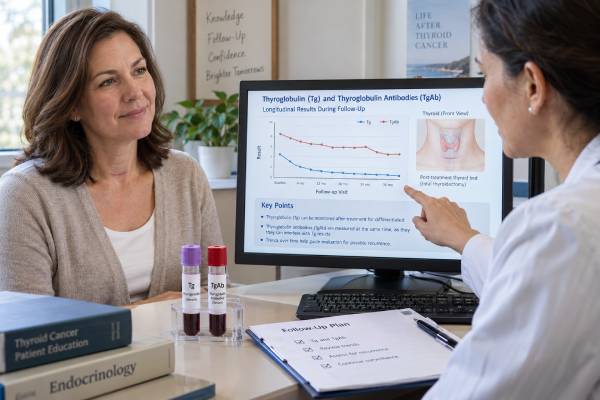
Squamous cell carcinoma antigen (SCC antigen, SCC-Ag, or SCCA) is a blood tumor marker that can be elevated in several cancers made of squamous cells, most notably squamous cervical cancer. It is used mainly as an adjunct for prognosis and treatment monitoring in selected patients whose tumor produced the marker before treatment. SCC antigen is not accurate enough to screen healthy people for cancer, and a high result cannot identify a tumor by itself. Benign skin disease, inflammatory lung conditions, and impaired kidney function can also increase the concentration. Reference intervals are assay-specific, and even the upper limit can differ by sex or laboratory method. The most useful interpretation is therefore a trend: Was SCC antigen elevated at diagnosis, did it fall with successful treatment, and is it rising again alongside symptoms or imaging findings? A normal result does not exclude squamous cancer, and an elevated surveillance value usually requires confirmation and clinical evaluation rather than being treated as proof of recurrence.
- SCC antigen is most established as a monitoring and prognostic marker in squamous cervical cancer.
- It is not suitable as a stand-alone cancer screening or diagnostic test.
- Kidney impairment, psoriasis and other skin disorders, and some inflammatory lung diseases can raise SCC antigen.
- Reference cutoffs vary by assay; one current method reports upper limits around 1.7–2.0 mcg/L depending on sex.
- Serial trends are generally more useful than a single result, particularly when the marker was elevated before treatment.
Table of Contents
- What the SCC antigen blood test measures
- Which cancers can raise SCC antigen
- What a high SCC antigen level means
- Benign causes and kidney-function effects
- SCC antigen in cervical cancer monitoring
- Use in lung, head and neck, esophageal, and other squamous cancers
- Testing, repeat results, and next steps
What the SCC antigen blood test measures
SCC antigen refers to proteins in the serpin family associated with squamous epithelial cells, particularly SCCA1 and SCCA2. Modern laboratory assays may detect one or both forms. These proteins can be released into the bloodstream by squamous cell carcinomas, but they are also produced by normal and inflamed epithelial tissues.
The blood test is usually performed on serum. Results may be reported in micrograms per liter (mcg/L) or nanograms per milliliter (ng/mL); these units are numerically equivalent. The laboratory’s own reference interval must be used because assay antibodies, calibration, and the populations used to set normal limits differ.
One current major laboratory reports upper reference values of 2.00 mcg/L for males and 1.67 mcg/L for females with its method. Other laboratories commonly use cutoffs near 1.5 or 2.0 ng/mL. A value above one laboratory’s cutoff should not be applied to another assay without confirmation.
SCC antigen is best described as a tumor-associated marker. It is neither cancer-specific nor organ-specific. It can be elevated in cervical squamous cell carcinoma, but also in squamous tumors of the lung, head and neck, esophagus, skin, anus, and other sites.
The test does not reveal where an abnormality is located. It also cannot determine tumor grade or stage on its own. Imaging, endoscopy, examination, and pathology remain the methods used to locate and confirm cancer.
Which cancers can raise SCC antigen
The strongest clinical evidence for serum SCC antigen is in squamous cell carcinoma of the cervix. Pretreatment concentrations tend to be higher in patients with greater tumor burden, larger tumors, lymph-node involvement, or more advanced disease. Elevated pretreatment values have also been associated with a higher risk of recurrence in many studies.
SCC antigen may rise in head and neck squamous cell carcinoma, including tumors of the oral cavity, pharynx, and larynx. It has been studied for prognosis and monitoring, but it is not sufficiently sensitive or specific to replace imaging, examination, or tissue sampling.
Some patients with squamous non-small cell lung cancer have elevated SCC antigen. Again, the marker is not used to diagnose lung cancer by itself. CT imaging, bronchoscopy or other sampling, histology, and molecular testing are much more important for diagnosis and treatment selection.
Elevations can also occur in esophageal squamous cell carcinoma, anal squamous cancer, vulvar and vaginal squamous cancers, and some skin squamous carcinomas. The clinical value varies greatly by tumor type and is often less established than in cervical cancer.
Not every squamous tumor releases measurable SCC antigen. Sensitivity is limited, particularly in early-stage disease. A normal value therefore cannot be used as reassurance that a suspicious lesion is benign.
Conversely, adenocarcinomas and other nonsquamous tumors are generally less likely to elevate SCC antigen. In cervical adenocarcinoma, other markers and imaging may be more informative depending on the setting.
What a high SCC antigen level means
A high SCC antigen means the measured concentration exceeds the reference interval for that assay. The finding becomes more meaningful when the patient has a known squamous carcinoma that was already associated with an elevated baseline value.
Before a cancer diagnosis, an isolated high SCC antigen is nonspecific. It should not trigger a conclusion that a person has squamous cancer. The clinician first considers symptoms, examination findings, kidney function, benign inflammatory conditions, and whether there is a specific organ that needs imaging or direct evaluation.
In a patient with known cervical squamous cancer, a higher pretreatment SCC antigen has repeatedly been associated with worse prognostic features at the population level. A 2023 study of early-stage cervical squamous or adenosquamous cancer found that pretreatment SCC antigen added prognostic information to stage in that cohort. Such thresholds are research-derived and should not be turned into universal individual treatment cutoffs.
After treatment, a value that falls into the laboratory’s normal range can support a favorable response when the marker was elevated at baseline. Persistent elevation can raise concern for residual disease, but treatment-related inflammation and benign causes still need consideration.
A later rise during surveillance may prompt imaging or a more focused evaluation for recurrence. The marker’s value is greatest when the patient’s tumor was known to secrete SCC antigen before therapy. If baseline SCC antigen was normal, follow-up testing is less likely to detect recurrence.
The absolute number does not directly state tumor size or stage. A very high value may correlate with larger disease burden in populations, but individual patients vary widely.
Benign causes and kidney-function effects
SCC antigen can rise without cancer because the proteins measured by the test are also associated with normal squamous epithelium and inflammatory tissue.
Kidney impairment is a particularly important confounder. Reduced renal function can decrease clearance or otherwise alter circulating marker concentrations. An unexpected elevation should therefore be interpreted with creatinine and estimated glomerular filtration rate, especially if the result is only mildly abnormal.
Skin disorders can produce elevated SCC antigen. Psoriasis, eczema, and other inflammatory or hyperproliferative skin conditions are recognized examples. A flare of extensive skin disease can sometimes cause a substantial increase.
Inflammatory respiratory disease can also raise the marker. Asthma and other benign pulmonary conditions have been reported as causes on current laboratory references.
Other benign epithelial or inflammatory conditions may contribute depending on the assay and clinical context. This lack of specificity is one reason SCC antigen is unsuitable for population screening.
Preanalytical contamination can occasionally matter because squamous epithelial material is common in the environment. Laboratories use controlled collection and assay procedures to minimize this risk. When a result is unexpectedly extreme and inconsistent with the patient, repeating the sample may be appropriate.
The key principle is proportionality. A mildly elevated SCC antigen in someone with kidney disease and active psoriasis has a different meaning from a rapidly rising value in a patient previously treated for SCC antigen-secreting cervical cancer.
SCC antigen in cervical cancer monitoring
Cervical cancer is the setting in which SCC antigen has its clearest tumor-marker role. It can be measured before treatment to establish whether the patient’s tumor produces the marker. If elevated, it provides a baseline for later comparison.
During or after chemoradiation, a decrease often accompanies tumor response. Persistent posttreatment elevation has been associated with residual disease or poorer outcomes in observational studies. A 2025 study in advanced cervical cancer also found that normalization after systemic therapy was associated with longer survival, although that evidence comes from a small retrospective cohort and does not make SCC antigen a treatment decision by itself.
For surveillance, the key question is sensitivity versus specificity. A 2024 study of patients treated with definitive chemoradiation found that an elevated follow-up SCC antigen was highly specific for recurrence but had low sensitivity. In plain language, when the marker was high it was concerning, but many recurrences occurred without an elevated result.
That limitation has practical consequences. A normal surveillance SCC antigen cannot replace symptom review, pelvic examination, or indicated imaging. New bleeding, pelvic pain, leg swelling, urinary or bowel changes, cough, unexplained weight loss, or other concerning symptoms need clinical evaluation regardless of the marker.
Guidelines for cervical cancer follow-up focus on clinical assessment and appropriate imaging rather than relying on serum SCC antigen alone. Measurement may be useful in selected patients, especially when it was elevated before treatment, but practice varies by center.
A rising value commonly leads to confirmation and imaging rather than immediate treatment. Recurrence should be established anatomically or pathologically when feasible before a major management decision.
Use in lung, head and neck, esophageal, and other squamous cancers
SCC antigen has been investigated across many squamous cancers because the underlying proteins are associated with squamous epithelial differentiation. Its usefulness, however, is not uniform.
In lung cancer, SCC antigen can be elevated in squamous non-small cell lung cancer, but modern diagnosis and management depend on imaging, histologic subtype, stage, and molecular or immune biomarkers. Serum SCC antigen is not adequate for lung cancer screening and does not replace low-dose CT in people who meet screening criteria.
In head and neck cancer, the physical examination, endoscopy, imaging, HPV or EBV-related testing in appropriate sites, and tissue pathology are central. SCC antigen may correlate with tumor burden in some studies, but routine use varies and it is not a universal standard marker.
In esophageal squamous carcinoma, SCC antigen has been studied alongside markers such as CYFRA 21-1 and CEA. It may provide prognostic information in selected patients but cannot diagnose an esophageal lesion or substitute for endoscopy and biopsy.
For vulvar, vaginal, anal, and cutaneous squamous cancers, evidence is more limited and clinical practice differs. The marker should only be ordered when a specialist believes the result could change monitoring or management.
The broad lesson is that the same laboratory analyte can have different clinical value depending on the cancer. A test that is useful for following one patient’s cervical cancer should not automatically be assumed useful for screening another organ.
Testing, repeat results, and next steps
SCC antigen testing requires a routine blood draw and usually does not require fasting. Patients should follow the performing laboratory’s instructions and provide a medication and medical history, including kidney disease, skin disorders, lung inflammation, and any current cancer treatment.
For monitoring, consistency matters. Serial measurements are easiest to interpret when performed with the same assay. Switching laboratories can create apparent changes that reflect method differences rather than biology.
If an isolated high result is found in someone without known cancer, the clinician should not order a broad series of scans solely because of the marker. Evaluation should be driven by symptoms, examination, age-appropriate screening, and organ-specific risk. A repeat measurement may be reasonable when benign confounders or analytical variation are plausible.
If SCC antigen rises in a person previously treated for a squamous cancer, the significance depends on baseline marker status. A confirmed upward trend in someone whose original tumor produced SCC antigen is more concerning and may prompt targeted imaging or specialist review.
Treatment should not be changed solely because of the blood value without supporting clinical evidence. Even a highly specific surveillance marker can produce false positives, and imaging can identify the location and extent of disease needed for treatment planning.
The test is therefore most useful as a signal—not a verdict. It can reinforce evidence of response, identify a pattern that deserves investigation, or contribute prognostic information, but the diagnosis and management of squamous cancers remain grounded in pathology, imaging, and clinical assessment.
Trend interpretation is particularly important around treatment. Radiation and chemotherapy can change tumor-marker concentrations over different time frames, and a measurement obtained too early may not represent the final response. Clinicians generally compare the posttreatment value with the pretreatment baseline and the expected timing for that cancer rather than assuming that every result should normalize immediately.
When SCC antigen is used during surveillance, a repeat abnormal result is often more persuasive than a single borderline value. The clinician may first verify kidney function, review skin or lung inflammation, and repeat the assay before ordering extensive imaging. A consistently rising trend in a patient whose original tumor produced the marker is more concerning than a one-time fluctuation of a few tenths of a unit.
The marker can also be psychologically difficult because patients may see a number change before they know whether anything has happened anatomically. A small rise should be viewed as a reason to gather evidence, not as proof that cancer has returned. Conversely, a normal value should not delay evaluation of new symptoms. This balanced approach reflects the test’s central limitation: useful specificity in some settings, but insufficient sensitivity to act as a stand-alone surveillance strategy.
Because SCC antigen is not standardized as a universal treatment target, clinicians generally avoid choosing chemotherapy, radiation dose, or surgery solely from the marker value. Its strongest role is contextual: a high baseline can identify a patient whose tumor is biologically trackable with the assay, and a later change can add evidence to the rest of the follow-up picture.
Patients should also compare results in the same units. Although mcg/L and ng/mL are numerically equivalent, some reports may use different formatting or reference intervals. The printed laboratory range and assay method are more reliable than an internet cutoff, especially when a result is close to the upper limit.
References
– ESGO/ESTRO/ESP Guidelines for the management of patients with cervical cancer – Update 2023 2023 (guideline) – Accuracy of surveillance serum squamous cell carcinoma antigen for cervical cancer recurrence after definitive chemoradiation 2024 (surveillance study) – Clinical utility of pretreatment serum squamous cell carcinoma antigen for prognostication and decision-making in patients with early-stage cervical cancer 2023 (prognostic study) – Posttreatment squamous cell carcinoma antigen: A prognostic marker for patients with advanced cervical cancer treated with bevacizumab-paclitaxel-cisplatin therapy 2025 (prognostic study) – Promising predictive molecular biomarkers for cervical cancer (Review) 2024 (review) – SCCA – Overview: Squamous Cell Carcinoma Antigen, Serum 2026 (laboratory reference)
Disclaimer
This article is for general education and does not diagnose cancer or recurrence. SCC antigen reference limits and assay methods vary, and benign conditions—especially kidney impairment and inflammatory skin disease—can elevate the result. A rising value in a cancer survivor should be interpreted by the treating oncology team together with symptoms, examination, imaging, and the patient’s baseline marker pattern.