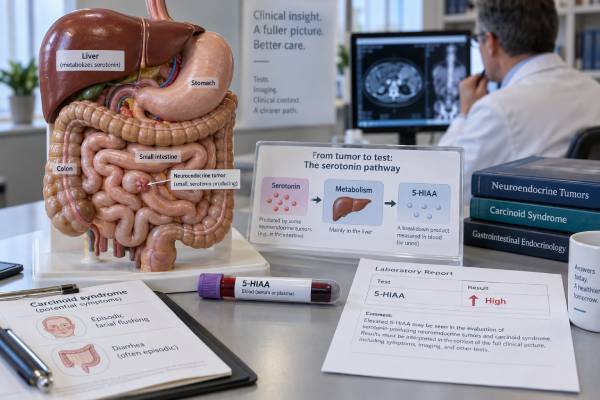
A 5-HIAA blood test measures 5-hydroxyindoleacetic acid, the main breakdown product of serotonin. It is used mainly when a serotonin-producing neuroendocrine tumor is suspected or already known, especially in people with symptoms of carcinoid syndrome such as recurrent flushing and secretory diarrhea. Traditionally, 5-HIAA has been measured in a 24-hour urine collection, but plasma and serum assays are increasingly available and can be more convenient. A high blood 5-HIAA level can support evidence of excess serotonin production, but it is not specific enough to diagnose a neuroendocrine tumor by itself. Food, medications, kidney function, assay method, and the tumor’s biology can all affect interpretation. The most useful result is one obtained under the laboratory’s preparation rules and interpreted together with symptoms, imaging, pathology, and other markers. Serial measurements may also help follow disease activity and assess risk of serotonin-related complications such as carcinoid heart disease.
- 5-HIAA reflects serotonin metabolism: it is the main metabolite formed after the body breaks down serotonin.
- A high result can support carcinoid syndrome: especially when flushing, chronic watery diarrhea, bronchospasm, or a known serotonin-secreting neuroendocrine tumor is present.
- Blood reference ranges are assay-specific: plasma and serum methods use different units and cutoffs, so the laboratory’s own range should be used rather than a universal number.
- Diet and medicines can interfere: serotonin-rich foods and certain drugs may alter 5-HIAA, so preparation instructions matter.
- Kidney impairment can complicate interpretation: reduced clearance can change circulating 5-HIAA and may make urine and blood results less comparable.
Table of Contents
- What 5-HIAA Measures
- Why a Blood 5-HIAA Test Is Ordered
- How to Prepare for the Test
- What High and Normal Results Mean
- Blood Versus Urine 5-HIAA
- 5-HIAA in Monitoring and Carcinoid Heart Disease
- Limitations and Next Steps
What 5-HIAA Measures
5-HIAA stands for 5-hydroxyindoleacetic acid. It is the major metabolite of serotonin, also called 5-hydroxytryptamine or 5-HT. Serotonin is made from the amino acid tryptophan and is produced in several tissues, including specialized enterochromaffin cells in the gastrointestinal tract. After serotonin is released and metabolized, much of it is converted to 5-HIAA, which circulates in blood and is then cleared through the kidneys.
That pathway makes 5-HIAA useful when a tumor is producing excessive serotonin. Some well-differentiated neuroendocrine tumors, particularly those arising in the small intestine, can secrete large amounts of serotonin. When serotonin reaches the systemic circulation, it can cause carcinoid syndrome. Typical features include episodic flushing and chronic secretory diarrhea. Some people also develop wheezing, abdominal cramping, or progressive heart-valve disease.
The blood test does not measure the tumor itself. It measures a downstream chemical product of hormone secretion. This distinction is important because neuroendocrine tumors are biologically diverse. Some do not make serotonin at all. Others may make serotonin but not enough to push 5-HIAA above the laboratory range. A normal result therefore cannot exclude every neuroendocrine tumor.
A separate serotonin blood test measures the parent hormone rather than its metabolite. In many clinical settings, 5-HIAA is preferred because it integrates serotonin metabolism over time and may be less affected by brief fluctuations than a single serotonin concentration.
Another commonly used neuroendocrine marker is chromogranin A. Chromogranin A can be elevated in many neuroendocrine tumors, but it is influenced by proton-pump inhibitors, kidney disease, and other conditions. 5-HIAA is more specifically tied to serotonin production and carcinoid syndrome.
Why a Blood 5-HIAA Test Is Ordered
A blood 5-HIAA test is usually ordered for one of three reasons: to investigate symptoms suggestive of carcinoid syndrome, to characterize a known neuroendocrine tumor, or to follow biochemical disease activity over time.
Carcinoid syndrome becomes more likely when symptoms form a recognizable pattern. Recurrent flushing plus persistent watery diarrhea is more suggestive than either symptom alone. The syndrome most often occurs when a serotonin-producing gastrointestinal neuroendocrine tumor has spread to the liver, because liver metastases can release serotonin directly into systemic circulation. It can also occur with some bronchial or ovarian neuroendocrine tumors, where secreted hormones can bypass first-pass metabolism by the liver.
A clinician may consider 5-HIAA when there is:
- recurrent unexplained flushing, especially with diarrhea;
- chronic secretory diarrhea after more common gastrointestinal causes have been evaluated;
- wheezing or bronchospasm that occurs with flushing episodes;
- a known small-intestinal or other serotonin-producing neuroendocrine tumor;
- liver metastases from a neuroendocrine tumor;
- concern about carcinoid heart disease;
- a need to track a previously elevated marker during treatment or follow-up.
The test is less helpful as a broad screening test in people without symptoms or a known neuroendocrine tumor. A random marker ordered without a clear clinical question can create false positives and unnecessary imaging.
The term “carcinoid” is still used for the hormone syndrome, although modern pathology classifies these cancers more specifically as neuroendocrine tumors or neuroendocrine neoplasms. The diagnosis of the tumor itself relies on imaging and tissue pathology, including tumor differentiation and proliferation measures such as mitotic count and Ki-67 index. Biochemical markers help answer a different question: whether the tumor is producing clinically meaningful hormones.
How to Prepare for the Test
Preparation matters because 5-HIAA can be influenced by diet, supplements, and medications. Exact instructions vary by laboratory and assay, so the requisition or collection instructions should be followed precisely. Do not stop prescription medicines on your own; ask the ordering clinician whether any medication needs to be held and whether doing so is safe.
Historically, 5-HIAA testing has required avoidance of foods rich in serotonin or related compounds for a period before and during urine collection. Depending on the assay, laboratories may ask patients to avoid items such as bananas, plantains, pineapple, kiwi, plums, tomatoes, avocados, eggplant, walnuts, pecans, and other nuts. Modern mass-spectrometry methods can reduce some analytical interferences, but biological effects from serotonin-rich foods can still matter.
Supplements containing tryptophan or 5-hydroxytryptophan can also affect serotonin metabolism and should be disclosed. A complete medication list is useful because older and newer assays differ in how susceptible they are to specific drug interferences.
Some laboratories request fasting before a plasma 5-HIAA draw. Others do not. When fasting is required, water is usually allowed. Because blood 5-HIAA methods are not yet standardized to one universal protocol, the lab-specific instruction is more important than any generic rule.
Kidney function should also be considered. 5-HIAA is cleared in part through the kidneys. Significant renal impairment can alter circulating concentrations and may reduce the reliability of comparisons with urinary excretion. A clinician may review creatinine and estimated glomerular filtration rate when interpreting an unexpected result.
The blood draw itself is routine. The sample is collected from a vein and sent for serum or plasma analysis, often by liquid chromatography with tandem mass spectrometry. Results may be reported in nmol/L, ng/mL, or another unit. Never compare a number with a cutoff expressed in a different unit without conversion.
What High and Normal Results Mean
A high 5-HIAA result means that serotonin metabolism is increased, but the degree of elevation and the clinical setting determine how strongly it points toward a serotonin-secreting neuroendocrine tumor.
There is no single universal blood cutoff. In one modern study comparing serum and plasma assays, a cutoff of 135 nmol/L was evaluated, but that research threshold should not replace the reference interval printed on an individual laboratory report. Assays differ in calibration, specimen type, and population. The correct question is whether the result is above the validated range for the specific method used.
A markedly high result
A clearly elevated result in a person with classic flushing and diarrhea, or in someone with a known small-intestinal neuroendocrine tumor, is more meaningful than a borderline elevation found incidentally. Marked biochemical serotonin excess can also signal greater risk of carcinoid heart disease, especially when elevation is persistent.
A mildly high result
A small increase needs more cautious interpretation. Possible explanations include diet, medication effects, kidney dysfunction, assay variation, or another source of increased serotonin metabolism. Repeating the test under controlled preparation conditions may be more useful than immediately assuming tumor progression.
A normal result
A normal blood 5-HIAA result makes substantial serotonin overproduction less likely, but it does not rule out a neuroendocrine tumor. Many pancreatic, gastric, rectal, lung, and other neuroendocrine tumors do not secrete serotonin. Even some small-intestinal tumors may produce little 5-HIAA when disease burden is limited.
Symptoms also matter. If flushing is present but 5-HIAA is normal, clinicians may investigate other causes such as menopause, mast-cell disorders, medication effects, pheochromocytoma, thyroid disease, rosacea, anxiety-related autonomic symptoms, or other endocrine conditions. If diarrhea is the main issue, common gastrointestinal causes remain much more frequent than carcinoid syndrome.
A high result should therefore be treated as evidence to integrate, not as a stand-alone diagnosis. Imaging such as contrast CT, MRI, or somatostatin-receptor imaging may be needed when biochemical and clinical findings justify it.
Timing can also explain apparently inconsistent results. Hormone secretion may change with treatment, tumor growth, liver involvement, diet, or medication use. A single mildly high value that returns to the reference range under controlled conditions is different from a steady rise over several measurements. When the test is being used for follow-up, clinicians generally learn more from a consistent trend obtained by the same method than from small day-to-day differences.
The absolute value should also be interpreted in relation to symptoms. Someone with frequent flushing and high-volume diarrhea plus a substantially elevated 5-HIAA has a different clinical picture from an asymptomatic person with a result just above the upper limit. Symptom diaries can be helpful when episodes are intermittent. Recording flushing frequency, stool frequency, treatment timing, and major dietary changes gives the care team context for deciding whether a biochemical change reflects the disease or a temporary confounder.
When a repeat test is planned, ask whether preparation should be identical to the first collection. Using the same fasting status, dietary restrictions, medication plan, laboratory, and specimen type makes serial values easier to compare. If the test changes from plasma to serum or from blood to urine, the numbers should be treated as measurements from different systems rather than as one continuous series.
Blood Versus Urine 5-HIAA
The 24-hour urine 5-HIAA test remains the traditional and best-established biochemical test for carcinoid syndrome, but blood-based testing is becoming more practical and better validated.
A 24-hour urine collection has one major advantage: it integrates excretion across an entire day. It also has major drawbacks. Every urine sample must be collected during the specified period, the container may need preservative, storage instructions must be followed, and an incomplete collection can produce a misleading result. Dietary preparation may be required for the entire collection interval.
Plasma or serum testing requires only one blood draw. Recent evidence shows strong agreement between plasma and serum 5-HIAA and reasonable agreement with urinary measurement in patients with neuroendocrine tumors. This convenience can make blood testing especially useful for repeated monitoring.
| Feature | Blood 5-HIAA | 24-hour urine 5-HIAA |
|---|---|---|
| Collection | Single blood draw | All urine for 24 hours |
| Convenience | High | Lower |
| Standardization | Growing but assay-dependent | Longer clinical track record |
| Diet/medication effects | Still relevant | Still relevant |
| Kidney function influence | Important | Important |
| Best use | Selected diagnosis and serial monitoring where validated | Established evaluation of carcinoid syndrome |
The two tests should not be assumed to have interchangeable numerical reference ranges. A result of 20 in one unit system may have no direct meaning in the other. Trends should ideally be followed using the same specimen type, assay, and laboratory when possible.
If blood and urine results disagree, first check collection quality, preparation, units, kidney function, and whether both tests were performed near the same time. A clinician may repeat one or both rather than treating the discrepancy as proof that one result is wrong.
5-HIAA in Monitoring and Carcinoid Heart Disease
Serial 5-HIAA measurements can be useful when the marker was elevated at baseline in a patient with a serotonin-secreting neuroendocrine tumor. The goal is usually to follow biochemical hormone activity, not to replace imaging.
A falling level after surgery or treatment can support a biochemical response. A sustained rise may suggest increasing serotonin production, but treatment decisions should not be made from the marker alone. Tumor size, imaging findings, symptoms, and medication changes must be considered. Somatostatin analogs can reduce hormone secretion even when tumor size changes little, so biochemical and radiographic responses may not move in parallel.
One of the most important reasons to recognize persistent serotonin excess is carcinoid heart disease. Long-term exposure to serotonin and related mediators can cause fibrotic damage, particularly to right-sided heart valves. Tricuspid regurgitation and pulmonary valve disease may develop and can eventually lead to right-sided heart failure.
People with carcinoid syndrome may need cardiac assessment when 5-HIAA is substantially elevated, symptoms suggest heart involvement, or clinical guidelines recommend screening. Relevant symptoms include new ankle swelling, abdominal fluid accumulation, increasing breathlessness, reduced exercise tolerance, fatigue, or a new heart murmur. Echocardiography is central to evaluating valve structure and function.
High 5-HIAA is associated with greater risk, but it does not prove that valve disease is present. Conversely, once carcinoid heart disease is established, cardiac management depends on echocardiographic findings and symptoms, not solely on the marker level.
Limitations and Next Steps
The main limitation of 5-HIAA is that it measures one biochemical pathway. Neuroendocrine tumors can produce many different hormones, and some produce none at clinically detectable levels. A normal 5-HIAA therefore cannot function as a universal “negative tumor marker.”
Common mistakes include:
- assuming a borderline high result proves cancer;
- ignoring diet or supplement preparation;
- comparing plasma, serum, and urine values as though their cutoffs were identical;
- using a different laboratory for every follow-up test and then overreacting to small changes;
- interpreting a normal result as proof that no neuroendocrine tumor exists;
- monitoring the marker without periodically reassessing symptoms and imaging.
If the result is unexpectedly high, the first step is often to verify the context. Check preparation, medications, supplements, kidney function, specimen type, and the laboratory reference range. If the elevation remains unexplained or is clinically convincing, evaluation may include dedicated imaging and referral to an endocrinologist, gastroenterologist, oncologist, or neuroendocrine tumor specialist.
If a known neuroendocrine tumor is being followed, ask whether 5-HIAA was elevated before treatment. A marker that was never abnormal may be a poor surveillance tool for that individual. In that case, imaging and other disease-specific measures may provide more useful follow-up information.
Urgent evaluation is appropriate for severe dehydration from uncontrolled diarrhea, fainting, chest pain, rapidly worsening breathlessness, or signs of heart failure. These problems require direct treatment and should not wait for routine tumor-marker follow-up.
The most useful interpretation of a 5-HIAA blood test is therefore practical and individualized: confirm that the sample was collected correctly, use the assay’s own range, determine whether symptoms and tumor biology fit serotonin excess, and follow meaningful trends rather than isolated small fluctuations.
References
- Biochemical Markers for Neuroendocrine Tumors: Traditional Circulating Markers and Recent Development—A Comprehensive Review 2024 (Review)
- European Neuroendocrine Tumor Society (ENETS) 2024 guidance paper for the management of well-differentiated small intestine neuroendocrine tumours 2024 (Guideline)
- Plasma or serum 5-hydroxyindoleacetic acid can be used interchangeably in patients with neuroendocrine tumours 2023
- Urinary 5-Hydroxyindolacetic Acid Measurements in Patients with Neuroendocrine Tumor-Related Carcinoid Syndrome: State of the Art 2023 (Review)
- European Neuroendocrine Tumor Society (ENETS) 2022 Guidance Paper for Carcinoid Syndrome and Carcinoid Heart Disease 2022 (Guideline)
Disclaimer
A 5-HIAA blood test cannot diagnose or exclude a neuroendocrine tumor on its own. Results should be interpreted by a qualified clinician using the laboratory’s assay-specific range, preparation conditions, kidney function, symptoms, imaging, and pathology when available. Seek urgent care for severe dehydration, fainting, chest pain, or rapidly worsening shortness of breath.