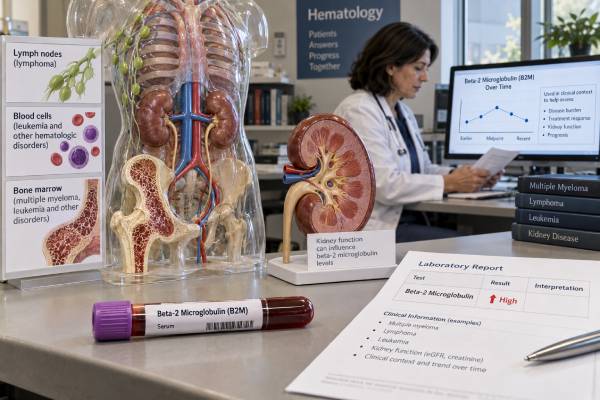
Beta-2 microglobulin, usually shortened to beta-2 microglobulin or B2M, is a small protein released from the surface of most nucleated cells. A blood B2M test is used mainly as a prognostic and staging marker in certain blood cancers, especially multiple myeloma and some lymphomas, rather than as a stand-alone cancer screening test. The result is also strongly affected by kidney function because healthy kidneys filter B2M from the blood and proximal tubules break it down. That means a high level can reflect increased cell turnover, reduced kidney clearance, inflammation, or a combination of these factors. In multiple myeloma, B2M is part of established staging systems and carries important prognostic information, but clinicians interpret it with albumin, LDH, cytogenetics, and renal function. In lymphoma and leukemia, its role varies by disease subtype. A single high B2M value cannot diagnose cancer or determine prognosis without clinical context.
- Typical serum B2M reference ranges are roughly 0.7–2.5 mg/L: exact limits vary by laboratory and assay.
- High B2M can reflect cancer or kidney impairment: reduced glomerular filtration is one of the most important noncancer causes of elevation.
- In multiple myeloma, B2M is a core staging marker: the International Staging System uses cutoffs of 3.5 mg/L and 5.5 mg/L with serum albumin.
- Higher B2M often tracks greater disease burden or worse prognosis: this is best established in myeloma and several lymphoma subtypes.
- B2M is not a cancer screening test: normal results do not exclude leukemia, lymphoma, or myeloma, and high results are not specific for malignancy.
Table of Contents
- What Beta-2 Microglobulin Measures
- Normal Range and Why Kidney Function Matters
- Beta-2 Microglobulin in Multiple Myeloma
- Beta-2 Microglobulin in Lymphoma and Leukemia
- How to Interpret High and Changing Results
- Limitations and Related Tests
- What to Do After a High Result
What Beta-2 Microglobulin Measures
Beta-2 microglobulin is the light-chain component of major histocompatibility complex class I molecules, which are present on the surface of nearly all nucleated cells. As cells naturally turn over, B2M is released into the bloodstream. The kidneys filter it through the glomeruli, after which the proximal tubules normally reabsorb and degrade most of it.
This biology explains why the serum concentration depends on two broad forces: how much B2M is being produced and released and how effectively the kidneys are clearing it. Cancer can increase production because there are more malignant cells and more cellular turnover. Immune activation and inflammation can also increase production. Kidney dysfunction can raise the serum concentration even when production is not unusually high.
B2M therefore behaves differently from a highly tumor-specific marker. It is better thought of as a combined signal of cell turnover, immune-system activity, and renal clearance.
Clinicians most often use serum B2M in hematologic malignancies. In multiple myeloma it is built into formal staging systems. In lymphoma it can add prognostic information, particularly in some B-cell lymphomas. In leukemia, elevated B2M has been associated with disease burden and outcome in selected settings, but its role is less universal and it does not replace blood counts, bone marrow studies, flow cytometry, cytogenetics, or molecular testing.
B2M can also be measured in urine, where it serves a different purpose. Urinary beta-2 microglobulin may indicate proximal tubular injury because filtered B2M is normally reabsorbed by those tubules. Serum and urine B2M should therefore not be interpreted as interchangeable versions of the same test.
Normal Range and Why Kidney Function Matters
A common adult serum reference interval is roughly 0.7–2.5 mg/L, but laboratories use different methods and limits. Some reports have upper limits near 1.8, 2.0, or 2.4 mg/L. The correct comparison is always the reference interval printed on the report.
No fasting is usually required. The sample is collected from a vein. What matters most is having recent kidney-function data available, especially serum creatinine and estimated glomerular filtration rate, or eGFR.
As kidney filtration declines, B2M accumulates in the blood. This can produce a substantial elevation in chronic kidney disease and kidney failure. The effect is clinically important because kidney impairment is also common in multiple myeloma. Myeloma proteins can damage the kidneys, dehydration and high calcium can reduce renal function, and some patients already have unrelated chronic kidney disease.
A high B2M in myeloma can therefore reflect both tumor biology and renal impairment. That does not make the marker useless; the established staging systems were developed with this real-world biology in mind. But it does mean the value should not be interpreted as a direct measurement of tumor mass.
Other noncancer factors can raise serum B2M, including chronic inflammatory conditions, some infections, autoimmune disease, and states of increased lymphocyte activation. Age and general health can also influence concentration indirectly through kidney function and inflammation.
When B2M changes over time, compare kidney function at the same time points. A rise from 3 to 5 mg/L during an episode of acute kidney injury does not carry the same meaning as the same rise with stable creatinine and clear evidence that a blood cancer is progressing.
Beta-2 Microglobulin in Multiple Myeloma
B2M has its strongest and most standardized cancer role in multiple myeloma. It is one of the central variables in the International Staging System, or ISS, and remains part of later refinements that add LDH and genetic risk.
The original ISS uses serum B2M and albumin:
| ISS stage | Laboratory definition |
|---|---|
| Stage I | B2M below 3.5 mg/L and albumin at least 3.5 g/dL |
| Stage II | Does not meet criteria for stage I or III |
| Stage III | B2M at least 5.5 mg/L |
The Revised International Staging System, or R-ISS, adds serum LDH and high-risk cytogenetic abnormalities such as del(17p), t(4;14), and t(14;16). The newer R2-ISS further refines risk and includes additional genetic information such as 1q abnormalities. B2M remains important, but modern myeloma prognosis is not based on B2M alone.
Why does B2M predict outcome? Partly because higher levels can reflect greater plasma-cell burden and more aggressive disease. Partly because kidney dysfunction itself is a major complication of myeloma and is associated with worse clinical status. The marker therefore captures more than one dimension of disease severity.
A patient being evaluated for myeloma usually needs a much broader workup than B2M. The multiple myeloma test panel commonly includes serum protein electrophoresis, immunofixation, serum free light chains, blood counts, calcium, creatinine, and imaging. Bone marrow examination and cytogenetic testing are required to characterize the plasma-cell clone and risk.
The serum free light chain test is particularly important because monoclonal kappa or lambda light chains can establish clonality and may contribute directly to kidney injury. B2M does not identify the monoclonal protein type.
During treatment, B2M may fall as disease and kidney function improve, but it is not the main response marker. Myeloma response is usually assessed with M-protein measurements, free light chains when applicable, marrow response, imaging, and increasingly measurable residual disease testing. B2M is more valuable for baseline staging and overall risk than for day-to-day response decisions.
A dedicated beta-2 microglobulin test for myeloma staging is therefore best understood within the full staging system rather than as a solitary prognostic number.
Beta-2 Microglobulin in Lymphoma and Leukemia
In lymphoma, elevated B2M is often associated with greater tumor burden, advanced disease, and worse outcomes, but its clinical weight depends on the lymphoma subtype and the prognostic model being used.
Studies in diffuse large B-cell lymphoma have repeatedly found an association between high B2M and shorter overall or progression-free survival. A recent systematic review and meta-analysis concluded that elevated B2M had independent prognostic value across observational studies. B2M has also been incorporated into or studied alongside prognostic scores in follicular lymphoma, mantle cell lymphoma, and other lymphoid cancers.
That does not mean B2M replaces established disease-specific scores. For diffuse large B-cell lymphoma, the International Prognostic Index uses age, stage, LDH, performance status, and extranodal involvement. Other lymphoma types have their own validated systems. B2M may add information but should not be substituted for the model used by the treating hematologist.
The LDH tumor marker test is another nonspecific blood marker frequently used in lymphoma. Like B2M, LDH can rise for many noncancer reasons, but it is deeply integrated into several prognostic models.
In leukemia, B2M can be elevated because of increased turnover of malignant white cells and immune-system activation. It has been investigated as a prognostic marker in chronic lymphocytic leukemia and other leukemias, but modern leukemia assessment relies far more heavily on cell counts, immunophenotyping, chromosome changes, and molecular mutations.
For example, chronic lymphocytic leukemia treatment planning may depend on TP53 disruption, del(17p), IGHV mutation status, disease symptoms, blood counts, and lymph-node burden. B2M can contribute to prognostic indices but cannot identify those key biologic features.
A high B2M should therefore be interpreted as a risk-associated biomarker, not a leukemia or lymphoma diagnostic test. A normal result does not exclude disease, and a high result in someone without a confirmed hematologic diagnosis should prompt evaluation of many possible causes.
How to Interpret High and Changing Results
The most useful interpretation starts with the reason the test was ordered.
Mildly elevated B2M
A mild increase may reflect early kidney dysfunction, chronic inflammation, age-related changes, or a hematologic condition. If cancer has not been diagnosed, clinicians usually look first at the complete blood count, creatinine/eGFR, symptoms, and other abnormal tests rather than ordering extensive cancer imaging from B2M alone.
Markedly elevated B2M
A larger elevation deserves more attention but is still not specific. Severe renal impairment can produce very high serum B2M. In a person with established myeloma, a high value may contribute to stage and prognosis. In lymphoma, it may support evidence of high disease burden when aligned with imaging and other markers.
Falling B2M
A decline can occur when cancer responds to treatment, kidney function improves, inflammation resolves, or more than one of these happens simultaneously. In myeloma, response should still be judged using disease-specific criteria rather than B2M alone.
Rising B2M
A rise with stable kidney function and worsening cancer findings is more concerning for disease activity than a rise that occurs during dehydration or acute kidney injury. Compare creatinine, eGFR, LDH, blood counts, imaging, and the relevant monoclonal-protein measurements at the same time point.
Small changes near the reference limit can also reflect analytical variation. If an unexpected result would alter staging or treatment, repeating the assay may be appropriate, especially when other clinical data do not support the change.
Why the same B2M number can mean different things
Consider two people with a serum B2M of 5.8 mg/L. One has newly diagnosed multiple myeloma, normal creatinine, a high monoclonal-protein burden, and extensive marrow involvement. In that setting, the B2M result is consistent with advanced biologic burden and meets the ISS stage III threshold. Another person may have no evidence of cancer but an eGFR that has fallen sharply because of acute kidney injury. The numerical result is similar, but the clinical meaning is very different.
This is why clinicians often interpret B2M as a context-dependent marker rather than a stand-alone threshold test. Useful questions include whether kidney function is stable, whether the patient has a confirmed cancer diagnosis, whether treatment has recently started, and whether other disease measures are moving in the same direction.
Timing matters as well. A B2M value obtained during dehydration, sepsis, or rapidly changing kidney function may not represent the patient’s usual baseline. Once the acute problem improves, repeating B2M together with creatinine and eGFR can show how much of the elevation was related to impaired clearance. Conversely, a persistent rise across several measurements with stable renal function may be more informative in a person with known lymphoma or myeloma.
There is also no reason to chase every small numerical movement. Laboratory imprecision, biologic day-to-day variation, and modest changes in filtration can shift B2M without indicating a meaningful change in cancer status. Trends are most useful when they are sustained and agree with disease-specific evidence.
Limitations and Related Tests
B2M is useful precisely because it reflects several important biological processes, but that same feature limits specificity.
The major limitations are:
- kidney function strongly influences the serum value;
- inflammation and immune activation can elevate it without cancer;
- different malignancies use B2M differently;
- a normal value does not exclude hematologic cancer;
- serial changes do not always separate tumor response from renal recovery or decline.
No single universal “cancer cutoff” exists. The 3.5 and 5.5 mg/L thresholds are meaningful within the myeloma ISS, not as general rules for diagnosing cancer.
Other tests answer questions B2M cannot. Serum protein electrophoresis and immunofixation identify monoclonal proteins. Flow cytometry classifies abnormal lymphoid or myeloid cells. Bone marrow biopsy measures plasma-cell or blast involvement. Cytogenetic and molecular tests identify high-risk mutations and treatment targets.
In kidney evaluation, serum creatinine, eGFR, urine albumin, urinalysis, and sometimes cystatin C are more standard measures of renal function. B2M can be informative, but it is not usually the first or only kidney test.
One practical mistake is to compare serum B2M with urinary B2M as if they share the same interpretation. High serum B2M often reflects reduced filtration or increased production. High urinary B2M more directly suggests impaired proximal tubular reabsorption when the specimen is handled correctly.
What to Do After a High Result
If B2M is high, the next step is usually to identify which part of the biology is driving it. Start with kidney function, known diagnosis, symptoms, and companion tests.
For a person with newly diagnosed myeloma, the hematology team will use B2M as one component of staging and then combine it with albumin, LDH, cytogenetics, and other disease features. Treatment is not selected from the B2M value alone.
For a person with lymphoma, ask whether B2M is part of the disease-specific prognostic approach being used. The number may add risk information but should be interpreted alongside stage, LDH, pathology, molecular findings, and performance status.
If cancer has not been diagnosed, a high B2M should not trigger the conclusion that leukemia, lymphoma, or myeloma is present. The clinician may repeat kidney tests, review medications and inflammatory conditions, obtain a complete blood count, and order more targeted testing only if the rest of the history points in that direction.
Seek prompt medical evaluation for symptoms such as severe weakness, confusion, reduced urine output, new shortness of breath, rapidly worsening swelling, unexplained fever, or significant bleeding. These symptoms may reflect kidney failure, infection, anemia, or other complications that need direct assessment regardless of the B2M result.
The most important question is not simply whether B2M is “high,” but whether the elevation is being used for a validated purpose and whether kidney function has been accounted for. That approach turns a nonspecific protein into a useful staging and prognostic tool.
References
- Beta-2 microglobulin in lymphoma. 2025 (Review)
- Prognostic Role of Beta-2 Microglobulin in Diffuse Large B-Cell Lymphoma: Systematic Review and Meta-Analysis of Observational Studies 2025 (Systematic Review)
- Second Revision of the International Staging System (R2-ISS) for Overall Survival in Multiple Myeloma: A European Myeloma Network (EMN) Report Within the HARMONY Project 2022
- Diagnosis and Management of Multiple Myeloma: A Review 2022 (Review)
- Beta 2 microglobulin in kidney failure: A review and an algorithm for renal replacement therapy 2022 (Review)
Disclaimer
Beta-2 microglobulin is a nonspecific biomarker and cannot diagnose leukemia, lymphoma, myeloma, or kidney disease by itself. Results should be interpreted by a qualified clinician with kidney function, the complete blood count, disease-specific tests, imaging, and pathology. Urgent symptoms such as reduced urine output, severe shortness of breath, confusion, or significant bleeding require direct medical assessment.