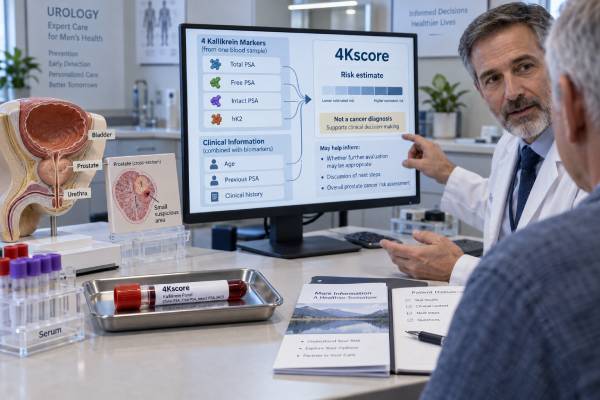
The 4Kscore test is a blood test used after prostate cancer risk has already become a concern, often because prostate-specific antigen (PSA) is elevated or changing. Instead of treating PSA as a yes-or-no cancer test, the 4Kscore combines four kallikrein proteins with clinical information to estimate the chance that a prostate biopsy would find clinically significant prostate cancer. The result is reported as a percentage, not as a diagnosis. A lower percentage may support continued observation or additional noninvasive evaluation, while a higher percentage can strengthen the case for prostate MRI, biopsy, or both. The test is most useful when the next step is genuinely uncertain. It does not replace a urologic assessment, MRI, or biopsy, and it can miss some important cancers. Its value comes from adding another layer of risk information so that biopsy decisions are based on more than a total PSA number alone.
- The 4Kscore estimates biopsy risk: it reports the percentage likelihood of finding clinically significant, generally Grade Group 2 or higher, prostate cancer.
- It measures four kallikreins: total PSA, free PSA, intact PSA, and human kallikrein 2 (hK2), combined with clinical factors in an algorithm.
- A score below 7.5% is often treated as lower risk: this cutoff has been studied, but it is not a universal rule for avoiding biopsy.
- A score of 20% or higher has commonly been described as high risk: the decision still depends on MRI findings, PSA density, age, health, family history, and personal preferences.
- No special fasting is usually required: follow the laboratory’s instructions and tell the clinician about recent prostate procedures, infections, or medications that could affect PSA-related measurements.
Table of Contents
- What the 4Kscore Test Measures
- Who May Benefit From Testing
- How to Prepare and What to Expect
- How to Interpret a 4Kscore Result
- How 4Kscore Fits With MRI and Biopsy
- Limitations and Common Causes of Confusion
- What to Do After the Result
What the 4Kscore Test Measures
The 4Kscore is a risk-stratification test, not a stand-alone cancer test. It uses a panel of four proteins in the kallikrein family that are related to prostate biology: total PSA, free PSA, intact PSA, and human kallikrein 2, also called hK2. These laboratory values are combined with clinical information in a proprietary prediction model to estimate the probability that a biopsy would detect clinically significant prostate cancer.
Clinically significant disease is generally defined around International Society of Urological Pathology Grade Group 2 or higher. Grade Group 2 corresponds to Gleason score 3 + 4 = 7. That distinction matters because one of the main problems with PSA-based screening is that it can lead to biopsies that find Grade Group 1 cancers unlikely to threaten health, while exposing patients to anxiety, procedures, and possible overtreatment.
The test builds on information already contained in PSA biology. A standard PSA blood test measures total circulating PSA, but PSA can rise because of benign prostate enlargement, inflammation, infection, urinary retention, ejaculation, instrumentation, or cancer. Measuring different PSA forms adds information about how likely an elevation is to reflect a clinically important tumor.
Free PSA is especially relevant because the percentage of PSA circulating unbound tends to be lower in many men with prostate cancer than in men with benign enlargement. A separate percent free PSA test can be useful on its own, but the 4Kscore incorporates free PSA with additional kallikrein measurements and clinical factors.
The output is a probability. If the report says 12%, for example, it means the model estimates about a 12% chance that a biopsy would find the type of prostate cancer the test is designed to predict. It does not mean that 12% of the prostate is cancerous, that there is an 88% certainty of being cancer-free, or that a cancer present would have a 12% chance of spreading.
Who May Benefit From Testing
The 4Kscore is most useful when a clinician and patient are deciding whether an abnormal prostate cancer screening picture justifies MRI, biopsy, or closer observation. In modern practice, that often means a person with a mildly to moderately elevated PSA, an unexpected PSA rise, a concerning digital rectal examination, or persistent concern after a previous negative biopsy.
Current prostate cancer guidance supports the selective use of secondary blood or urine biomarkers when the result could realistically change the biopsy decision. The key phrase is could change the decision. If biopsy is clearly indicated because of a very suspicious MRI or other high-risk findings, another biomarker may add little. At the other extreme, if PSA is very low and the overall risk picture is reassuring, a secondary test may not be needed.
Situations in which a 4Kscore may be considered include:
- PSA in a range where benign and malignant causes overlap, often roughly 2.5–10 ng/mL.
- A prior negative prostate biopsy with continued PSA concern.
- A desire to reduce unnecessary biopsy while accepting a small risk of delaying diagnosis.
- A decision about whether prostate MRI should be the next step.
- An equivocal MRI result, especially when the overall clinical risk remains uncertain.
The test should be interpreted alongside age, life expectancy, family history, inherited cancer risk, ancestry, prior biopsy findings, prostate volume, PSA trend, and digital rectal examination. PSA density can also be important. PSA density divides serum PSA by prostate volume, typically measured on ultrasound or MRI. A larger benign prostate can produce more PSA, so PSA density helps put the blood value in anatomical context.
Some people compare the 4Kscore with the Prostate Health Index, another blood-based secondary test. Both aim to improve risk assessment beyond total PSA. They use different biomarker combinations and algorithms, and neither automatically replaces MRI or biopsy. The better choice often depends on local availability, cost, previous testing, and how the urology team uses the result.
How to Prepare and What to Expect
The 4Kscore requires a blood sample, and fasting is generally not the main preparation issue. What matters more is whether something has recently happened that could alter PSA-related measurements and make the result harder to interpret.
Before the blood draw, tell the ordering clinician about a recent urinary tract infection, prostatitis, urinary retention, catheter placement, cystoscopy, prostate biopsy, or other manipulation of the prostate or urinary tract. Clinicians may delay PSA-based testing after some of these events so that temporary inflammation or tissue disruption has time to settle. The exact waiting period depends on what occurred and on the clinical situation.
Ejaculation and vigorous cycling can produce small temporary PSA changes in some men. Many clinicians advise avoiding ejaculation for 24–48 hours before a PSA-related blood draw when a borderline result could affect management. A laboratory may have its own preparation instructions, which should take priority.
Medication history matters too. Drugs such as finasteride and dutasteride can substantially lower PSA over time. They do not simply make prostate cancer risk disappear; they change how PSA values should be interpreted. Testosterone therapy, treatment for prostate cancer, and medications used for urinary symptoms should also be reported.
The blood collection itself is routine. Results are usually returned as a single percentage risk plus supporting information. Unlike a total PSA result, there is no simple concentration that can be labeled “normal.” The central number is the calculated risk percentage.
A useful practical step is to confirm that the clinical information entered for the calculation is accurate. Age, prior biopsy status, and other model variables can influence the estimate. If a report appears inconsistent with the medical history, the ordering office should verify the inputs before major decisions are made.
How to Interpret a 4Kscore Result
The safest way to interpret a 4Kscore is as a continuous probability: higher numbers generally mean a greater likelihood of clinically significant cancer on biopsy. Risk bands can be helpful for discussion, but they should not be treated as hard biological boundaries.
| 4Kscore result | Common interpretation | What it may lead to |
|---|---|---|
| Below 7.5% | Lower estimated risk | Observation, repeat PSA assessment, or selective MRI depending on the rest of the risk picture |
| 7.5% to 19.9% | Intermediate estimated risk | More individualized use of MRI, PSA density, examination findings, and patient preferences |
| 20% or higher | Higher estimated risk | Stronger consideration of MRI and/or biopsy, especially when other findings are concerning |
The 7.5% threshold has clinical research behind it. In a pooled analysis of prospective studies, using 7.5% as a biopsy decision point reduced biopsies while maintaining high sensitivity for Grade Group 2 or higher cancer. More recent screening-trial data also found that a 7.5% reflex threshold could reduce MRI use and biopsies in men with elevated PSA, although a small number of clinically important cancers would have had delayed diagnosis.
That tradeoff is central to the test. A lower threshold catches more cancers but sends more men to MRI and biopsy. A higher threshold avoids more procedures but increases the chance of delaying detection. There is no threshold that removes uncertainty.
A score of 6% should not be viewed as categorically different from 8% without considering the rest of the case. Similarly, a score of 22% is not a diagnosis of cancer. It is a signal that the pretest concern has increased enough that further evaluation may be worthwhile.
The result also should not be used to predict the exact stage of a cancer, whether it has spread, or whether treatment would be necessary. Those questions require imaging, tissue diagnosis, grading, and staging if cancer is found.
When discussing a borderline score, it helps to ask what would change management. For example, an older adult with serious competing health problems may reasonably choose observation at a risk percentage that would prompt biopsy in a healthy 55-year-old with a strong family history. The number is the same; the clinical meaning is not.
How 4Kscore Fits With MRI and Biopsy
The 4Kscore and multiparametric prostate MRI answer different questions. The blood test estimates probability, while MRI looks for suspicious structural lesions and helps target a biopsy. Using them together can improve decision-making when PSA alone is not specific enough.
One practical pathway is: elevated PSA, repeat or confirmatory assessment when appropriate, secondary risk testing, MRI for men whose remaining risk justifies imaging, and biopsy when the combined evidence crosses an agreed threshold. Other practices obtain MRI first and use a biomarker when MRI is negative or equivocal. Both approaches reflect the same principle: avoid making a biopsy decision from one isolated number.
A negative MRI lowers risk but does not eliminate cancer. Likewise, a low 4Kscore lowers estimated probability but does not eliminate cancer. If the MRI shows a highly suspicious PI-RADS 4 or 5 lesion, the imaging result may outweigh a low biomarker result. If MRI is negative, a low 4Kscore and low PSA density together may provide more reassurance than any one factor alone.
Biopsy remains the test that establishes the tissue diagnosis. Modern biopsy can be performed through the perineum or rectum, often with MRI targeting when a lesion is visible. A biopsy provides the Gleason pattern, Grade Group, amount of tumor in sampled cores, and other pathological details needed for treatment decisions.
The 4Kscore is therefore best thought of as a decision aid before biopsy, not a substitute for biopsy. It is designed to reduce low-value procedures while preserving a high chance of finding cancers that matter. That same goal explains why clinicians may combine it with PSA density, MRI, family history, and other validated risk calculators rather than letting the 4Kscore act as a single gatekeeper.
Limitations and Common Causes of Confusion
A 4Kscore can improve risk prediction, but it cannot resolve every reason PSA may be abnormal. The four measured proteins are all linked to kallikrein biology, so conditions that affect the prostate can still influence the underlying laboratory values.
Common interpretation problems include:
- Treating the result as a cancer diagnosis. A percentage estimates risk; only tissue sampling can confirm prostate cancer.
- Using one cutoff as an automatic biopsy rule. Research thresholds are useful, but age, MRI, PSA density, prior biopsy, inherited risk, and health status matter.
- Ignoring temporary PSA influences. Infection, urinary retention, recent procedures, and sometimes recent ejaculation can complicate PSA-based assessment.
- Comparing results from different testing strategies as if they were interchangeable. The 4Kscore, PHI, MRI, PSA density, and urine markers do not measure the same thing.
- Using the test after prostate cancer is already established for routine treatment monitoring. The 4Kscore was developed mainly for pre-biopsy risk assessment, not for tracking response to therapy.
The test can produce false reassurance. Research using low-risk thresholds shows high negative predictive value in selected populations, but not 100%. A clinically significant cancer can still be present with a low score. The real-world impact depends on who is tested. Predictive values change with the underlying prevalence of significant cancer in the population.
A high score can also occur without a biopsy showing clinically significant disease. This is expected from any probabilistic test. If a score is 25%, roughly three out of four people with that exact modeled probability would not be expected to have the target outcome, even if the model is perfectly calibrated.
Cost and access are additional limitations. Insurance coverage varies, and a test that does not change the next step may add expense without adding value. It is reasonable to ask the urologist in advance: “What would we do if the result is 5%, 15%, or 30%?” If the answer is the same in every case, the test may not be necessary.
What to Do After the Result
The next step should be based on the combined risk picture, not the percentage alone. A structured follow-up discussion can prevent both unnecessary alarm and false reassurance.
For a lower score, ask whether PSA should be repeated, whether prostate volume and PSA density are known, and whether MRI adds meaningful information. A low score can support deferring biopsy in an appropriate patient, but follow-up should still be defined. “No biopsy today” should not become “no follow-up.”
For an intermediate score, the decision is often most sensitive to context. MRI findings, PSA density, family history, inherited mutations, previous biopsy pathology, age, and personal tolerance for uncertainty can shift the balance. This is where shared decision-making matters most.
For a higher score, discuss whether MRI has already been performed and whether biopsy is indicated. A higher percentage does not tell you where a lesion is, so MRI may help target suspicious areas before tissue sampling. If biopsy is recommended, ask whether a transperineal approach is available and how infection risk, anesthesia, and MRI targeting will be handled.
Seek prompt medical review rather than waiting on a tumor-marker plan if there are symptoms of acute urinary infection, fever with urinary symptoms, inability to urinate, or severe new urinary obstruction. Those problems need direct evaluation and can also distort PSA-related testing.
The most useful question after receiving a 4Kscore is not “Is this normal?” but “How does this change my estimated risk and what decision does it change?” The test works best when it helps a patient and clinician choose among observation, MRI, and biopsy with a clearer understanding of the benefits and tradeoffs.
References
- Blood and urine-based biomarkers in prostate cancer: Current advances, clinical applications, and future directions 2025 (Review)
- Prostate tumor markers: diagnosis, prognosis and management 2024 (Review)
- Performance of 4Kscore as a Reflex Test to Prostate-specific Antigen in the GÖTEBORG-2 Prostate Cancer Screening Trial 2024
- Implementation of 4Kscore as a Secondary Test Before Prostate Biopsy: Impact on US Population Trends for Prostate Cancer 2023
- A 4Kscore Cut-off of 7.5% for Prostate Biopsy Decisions Provides High Sensitivity and Negative Predictive Value for Significant Prostate Cancer 2021
Disclaimer
The 4Kscore is a clinical risk-assessment tool and cannot diagnose or rule out prostate cancer by itself. Interpretation should be individualized by a qualified clinician using PSA history, examination findings, imaging, prior biopsy information, overall health, and personal preferences. Seek medical care promptly for acute urinary retention, fever with urinary symptoms, or other urgent problems rather than relying on a tumor-marker result.