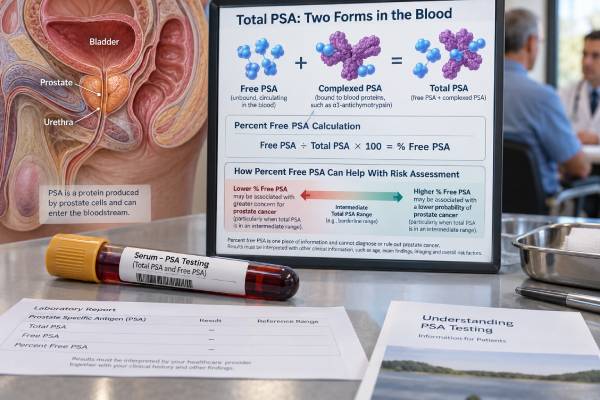
A free PSA test measures the amount of prostate-specific antigen (PSA) circulating in the blood without being attached to other proteins. It is usually interpreted together with total PSA, because the percentage of PSA that is free can help refine prostate cancer risk when a total PSA result is elevated or borderline. In general, a lower percent free PSA is associated with a higher chance of prostate cancer, while a higher percentage is more often seen with benign prostate enlargement. The result does not diagnose or rule out cancer by itself. Age, prostate size, inflammation, recent procedures, medications, family history, examination findings, MRI results, and other biomarkers can all change what a particular result means. Free PSA is therefore best viewed as one part of a risk assessment that helps decide whether repeat testing, imaging, another blood or urine biomarker, or prostate biopsy is appropriate.
- Percent free PSA is calculated as free PSA divided by total PSA × 100.
- A lower percent free PSA generally points to higher prostate cancer risk; a higher percentage generally points to lower risk.
- The test is most useful when total PSA is in a borderline or “gray-zone” range rather than clearly very low or very high.
- Common decision cutoffs such as 10% and 25% are guides, not universal biopsy rules.
- Free PSA should be interpreted with age, prostate size, symptoms, medications, MRI findings, and overall clinical risk.
Table of Contents
- What the Free PSA Test Measures
- How Percent Free PSA Is Calculated
- What Percent Free PSA Results Mean
- What Can Affect Free and Total PSA
- When Doctors Use Free PSA
- What Happens After a Free PSA Result
- Limits of the Test and Questions to Ask
What the Free PSA Test Measures
Prostate-specific antigen is a protein made mainly by prostate cells. Small amounts normally enter the bloodstream. Once in blood, PSA circulates in more than one molecular form. Some PSA is bound to proteins, and some remains unbound. The unbound portion is called free PSA.
A standard PSA blood test usually reports total PSA. Total PSA includes both free PSA and PSA that is attached to certain blood proteins. A free PSA test measures the unbound component separately.
The distinction matters because benign prostate tissue and prostate cancer tend to release PSA in different proportions. Men with benign prostate enlargement often have a larger free fraction, while men with prostate cancer, on average, have a smaller free fraction. There is substantial overlap, however. That is why free PSA improves risk estimation rather than providing a yes-or-no cancer diagnosis.
Free PSA is usually reported in ng/mL, just like total PSA. The absolute free PSA number is less useful than the free-to-total PSA ratio, usually expressed as percent free PSA. For example, a free PSA of 1.0 ng/mL means something different when the total PSA is 4 ng/mL than when the total PSA is 10 ng/mL.
The test is mainly used during evaluation for possible prostate cancer. It is not a tumor-specific marker: PSA can rise because of benign prostatic hyperplasia (BPH), inflammation, urinary retention, or other prostate-related factors. Also, the percent free PSA distribution differs with age, prostate volume, assay method, and the patient population being tested.
This is one reason clinicians increasingly combine PSA information with additional clinical variables rather than relying on one cutoff. Depending on the situation, that may include a digital rectal examination, prostate MRI, PSA density, family history, genetic risk, or newer biomarker tests.
How Percent Free PSA Is Calculated
Percent free PSA is a simple ratio:
Percent free PSA = (free PSA ÷ total PSA) × 100
Suppose total PSA is 6.0 ng/mL and free PSA is 1.2 ng/mL. The calculation is:
1.2 ÷ 6.0 × 100 = 20% free PSA
The percentage is usually easier to interpret than the free PSA concentration alone because it describes the balance between unbound and total PSA.
| Total PSA | Free PSA | Percent free PSA |
|---|---|---|
| 4.0 ng/mL | 1.2 ng/mL | 30% |
| 6.0 ng/mL | 1.2 ng/mL | 20% |
| 8.0 ng/mL | 0.8 ng/mL | 10% |
These examples show why the free PSA value should not be interpreted by itself. The same free PSA concentration can produce a very different percentage depending on the total PSA.
Percent free PSA has historically been studied most in men whose total PSA falls in a moderately elevated range, especially about 4–10 ng/mL. Some clinical approaches also consider it when total PSA is roughly 2.5–10 ng/mL. The exact range in which a laboratory or clinician uses the test can vary.
The “gray zone” is important because total PSA in this range can occur with either prostate cancer or benign conditions. A secondary measure that improves specificity may help avoid some unnecessary biopsies while still identifying men who need further evaluation.
The free and total PSA measurements should ideally come from the same blood draw and compatible assay system. Laboratories can use different methods and calibrations, so comparing a percentage calculated from mismatched assays or from tests done at different times can introduce error. When following a trend, using the same laboratory or assay platform when practical makes comparisons more consistent.
What Percent Free PSA Results Mean
Lower percent free PSA generally means higher prostate cancer probability, but no single percentage proves cancer. Clinicians interpret the result as a continuous risk marker, not as a pass-fail test.
A commonly used practical framework is:
| Percent free PSA | General interpretation | Typical clinical implication |
|---|---|---|
| 10% or less | Relatively higher cancer risk | Often strengthens the case for further evaluation |
| More than 10% to 25% | Intermediate risk range | Other risk factors become especially important |
| More than 25% | Relatively lower cancer risk | May support observation or additional risk assessment in some patients |
These bands are not universal diagnostic thresholds. A person with 8% free PSA does not automatically have prostate cancer, and a person with 28% is not guaranteed to be cancer-free. Older studies established many of the familiar cut points, but modern prostate evaluation increasingly uses individualized risk estimates, MRI, and secondary biomarkers.
The meaning also depends on the total PSA. A percent free PSA is most informative when the total PSA is in a range where benign and malignant causes overlap. If total PSA is substantially elevated, clinicians may proceed with evaluation regardless of the percentage. If total PSA is very low, percent free PSA may add little information.
Age and prostate size can matter as well. Larger benign prostates can produce more PSA and may have a higher free fraction. The pretest probability of clinically significant cancer also changes with family history, ancestry, known inherited cancer-risk variants, prior biopsy results, and physical examination findings.
Another important distinction is between detecting any prostate cancer and detecting clinically significant prostate cancer, generally meaning disease likely to benefit from treatment rather than very low-grade disease that may be safely monitored. Modern diagnostic strategies focus increasingly on identifying clinically significant cancer while reducing unnecessary biopsy and overdiagnosis.
For that reason, percent free PSA is often considered beside tests such as the Prostate Health Index (PHI) or 4Kscore, which combine multiple measurements into broader risk estimates.
What Can Affect Free and Total PSA
PSA is prostate-specific, not cancer-specific. Many factors can change total PSA, free PSA, or their ratio. Understanding them helps prevent a temporary or explainable elevation from being treated as a cancer diagnosis.
Benign prostate enlargement (BPH) is one of the most common reasons for an increased PSA, especially with age. A larger prostate contains more PSA-producing tissue. BPH often produces a relatively higher percentage of free PSA than prostate cancer, which is why the ratio can be useful in borderline cases.
Prostatitis and urinary infection can raise PSA, sometimes substantially. Acute inflammation may make a screening PSA difficult to interpret. A clinician may treat a confirmed infection or allow inflammation to settle before repeating the test rather than immediately using the value for biopsy decisions.
Urinary retention and manipulation of the prostate may also alter PSA. Recent catheterization in a difficult clinical setting, cystoscopy, prostate biopsy, or other procedures can affect the timing of testing. A prostate biopsy can elevate PSA for weeks, so follow-up testing should be scheduled with that history in mind.
Ejaculation can produce a modest temporary PSA increase in some men. Many clinicians advise avoiding ejaculation for roughly 24–48 hours before a PSA test when a borderline result could influence an important decision. Vigorous cycling has also been discussed as a possible transient influence, although the size and consistency of the effect vary between studies.
Medications can lower PSA. Finasteride and dutasteride, commonly used for BPH and hair loss, can reduce total PSA substantially over time. Clinicians account for treatment duration and expected suppression when interpreting the result. Do not stop these medicines simply to change a PSA result unless the prescribing clinician advises it.
Test method matters too. Free PSA is less stable than total PSA under some specimen-handling conditions, and assays are not perfectly interchangeable. A surprising change should therefore be interpreted in context rather than assumed to represent a sudden biological shift.
When a PSA result is unexpected, the most useful question is often not “Is this cancer?” but “Could anything have temporarily changed this result, and should the test be repeated under more standardized conditions?”
When Doctors Use Free PSA
The free PSA test is mainly a secondary risk-stratification test. It is most helpful after total PSA has raised concern but before a decision about prostate biopsy is final.
One common situation is a man with a total PSA around 4–10 ng/mL and no obvious explanation for the elevation. A lower percent free PSA may increase concern enough to favor MRI, another biomarker, or biopsy. A higher percentage may support a less invasive next step if the rest of the risk profile is reassuring.
Free PSA can also be useful after a previous negative biopsy if PSA remains elevated, although modern guidelines emphasize combining available information. That may include a prior biopsy result, prostate MRI, PSA density, age, family history, and risk calculators. The PSA density calculation is especially useful when prostate volume is known because it asks whether the PSA is high relative to gland size.
The test is less useful as a stand-alone population screening tool. Screening decisions usually begin with total PSA, shared decision-making, age, health status, and individual risk. If total PSA is abnormal, clinicians may repeat it first because a meaningful proportion of newly elevated PSA results return toward baseline on retesting.
Free PSA also forms part of some newer multivariable blood tests. PHI, for example, combines total PSA, free PSA, and a PSA precursor called [-2]proPSA. These composite tests can outperform total PSA alone for estimating the chance of clinically significant cancer in appropriately selected patients.
The key point is that free PSA helps answer a narrower question: given an already concerning PSA situation, does the pattern of PSA forms shift the estimated cancer risk up or down? It does not replace imaging, biopsy, or clinical judgment when those are indicated.
What Happens After a Free PSA Result
The next step depends on the full risk picture rather than the percentage alone. A clinician may choose repeat testing, MRI, another biomarker, biopsy, or continued observation.
Repeat PSA under standardized conditions
If total PSA is newly elevated or there is a plausible temporary cause, repeating total and free PSA can be reasonable. The repeat may be delayed until a urinary infection, prostatitis episode, urinary retention, or recent prostate procedure has resolved. Consistency in laboratory method can make the trend easier to interpret.
Estimate risk with more than one variable
Modern prostate cancer evaluation commonly combines PSA with age, family history, prostate volume, examination findings, and prior biopsy history. A prostate cancer biomarker panel or validated risk calculator may provide additional information when the biopsy decision remains uncertain.
Consider prostate MRI
Multiparametric MRI can identify suspicious areas and improve targeting if biopsy is needed. MRI can also contribute useful reassurance when no suspicious lesion is seen, although a negative MRI does not make the cancer risk zero. PSA density and other factors help determine whether biopsy should still be considered after a negative scan.
Proceed to biopsy when risk is high enough
A prostate biopsy is the test that can establish a tissue diagnosis of prostate cancer. Free PSA may help decide whether the probability of clinically significant disease justifies that invasive step, but it cannot substitute for pathology.
If a biopsy detects cancer, percent free PSA usually becomes much less important. Management then depends mainly on cancer grade, stage, PSA, imaging, tumor volume, genomic information when appropriate, life expectancy, and patient preferences.
A single low percent free PSA is rarely an emergency. It is a reason for timely follow-up, not a reason to assume that advanced cancer is present. Conversely, a reassuring percentage should not delay evaluation when other findings are strongly concerning, such as a distinctly abnormal examination, steadily rising PSA, suspicious MRI lesion, or major hereditary risk.
Limits of the Test and Questions to Ask
Free PSA improves risk assessment, but its limitations explain why clinicians do not use it as a stand-alone cancer test.
First, benign and malignant conditions overlap. Some men with BPH have low percent free PSA, and some men with prostate cancer have relatively high percentages. Second, cutoffs differ across studies and assay systems. A value that is treated as “low” in one clinical pathway may be interpreted somewhat differently in another.
Third, percent free PSA does not directly measure tumor aggressiveness. It may help estimate the chance that a biopsy will find cancer, but it cannot tell with certainty whether a tumor is Grade Group 1 or a more clinically significant cancer. Other biomarkers, MRI, and ultimately biopsy provide different pieces of that question.
Fourth, the test works best in a defined clinical context. Using a percentage without considering total PSA can be misleading. For example, 15% free PSA with a total PSA of 5 ng/mL is a different clinical situation from 15% free PSA with a total PSA of 25 ng/mL.
Useful questions to ask after receiving a result include:
- What were my total PSA, free PSA, and percent free PSA, and were they measured from the same sample?
- Is my total PSA in the range where percent free PSA is most informative?
- Could infection, urinary retention, ejaculation, a recent procedure, or a medication have changed the result?
- How does my age, prostate volume, family history, and prior PSA trend change my baseline risk?
- Would repeating PSA, calculating PSA density, using PHI or 4Kscore, or obtaining an MRI meaningfully change the biopsy decision?
- What level of risk would make biopsy reasonable for me, considering both the benefits of detecting significant cancer and the harms of unnecessary testing?
The most useful interpretation is therefore not “normal” versus “abnormal.” It is a calibrated estimate of risk that supports a shared decision about what to do next.
References
- Early Detection of Prostate Cancer: AUA/SUO Guideline Part I: Prostate Cancer Screening 2023 (Guideline)
- Early Detection of Prostate Cancer: AUA/SUO Guideline Part II: Considerations for a Prostate Biopsy 2023 (Guideline)
- Prostate-specific antigen screening for prostate cancer: Diagnostic performance, clinical thresholds, and strategies for refinement 2024 (Review)
- Utility of PSA free-to-total ratio for clinically significant prostate cancer in men with a PSA level of <4 ng/mL 2025 (Review)
- The research progress on diagnostic indicators related to prostate-specific antigen gray-zone prostate cancer 2025 (Review)
- Evaluation of blood and urine based biomarkers for detection of clinically-significant prostate cancer 2025 (Review)
Disclaimer
This article is for general education and does not diagnose prostate cancer or replace individualized medical care. PSA and percent free PSA results should be interpreted by a qualified clinician using your age, medical history, examination, medications, imaging, and other risk factors. Do not delay recommended follow-up or change prescription medicines based only on a PSA result.