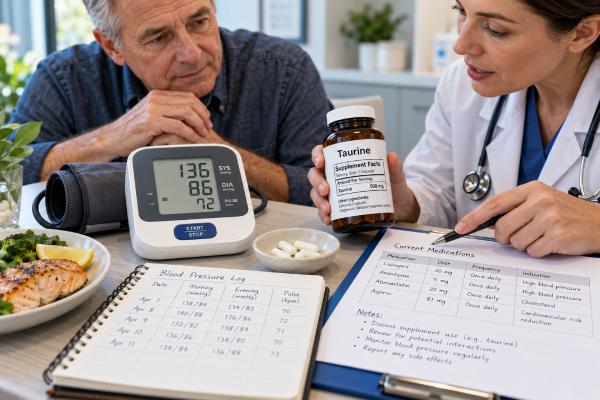
Taurine may lower blood pressure modestly, but it should be viewed as an optional supplement—not a replacement for proven hypertension treatment. Recent meta-analyses of randomized trials suggest average reductions of roughly 4 mmHg in systolic blood pressure and 1–3 mmHg in diastolic pressure. Some studies also report improvements in triglycerides, glucose regulation, and vascular function. The evidence is promising, but the trials are generally small, use different doses, and often include people with metabolic or cardiovascular conditions.
Most research has used about 1–3 g of taurine per day, although study doses range more widely. A recent analysis suggested that 1.5–3 g per day produced favorable cardiometabolic effects. Taurine appears well tolerated in short- and medium-term studies, but long-term supplement safety is less certain. If you already take blood pressure medication, have kidney or heart disease, are pregnant, or are considering a high-dose product, discuss it with a clinician or pharmacist before starting.
Table of Contents
- What Taurine Is and How It May Affect Blood Pressure
- What the Blood Pressure Research Shows
- Taurine Dosage: What Studies Have Used
- Food Sources vs. Taurine Supplements
- Safety, Side Effects, and Medication Concerns
- Who Might Consider Taurine—and Who Should Be Cautious
- How to Use Taurine Without Missing Bigger Blood Pressure Priorities
What Taurine Is and How It May Affect Blood Pressure
Taurine is a sulfur-containing amino acid-like compound found naturally in the body. Unlike many amino acids, it is not mainly used to build proteins. It is concentrated in tissues such as the heart, brain, retina, and skeletal muscle, where it participates in cell-volume regulation, calcium handling, bile-acid formation, antioxidant defenses, and electrical stability of cell membranes.
The body can make taurine from other sulfur-containing amino acids, and food adds another source. Seafood, fish, meat, and dairy contain taurine; plant foods generally contain little or none.
Researchers have proposed several ways taurine could influence blood pressure:
- Blood vessel relaxation. Taurine may support endothelial function and signaling pathways that help arteries dilate.
- Calcium regulation. Calcium movement inside vascular smooth-muscle cells affects how tightly blood vessels contract.
- Sympathetic nervous system effects. Some research suggests taurine may reduce excessive “fight-or-flight” signaling that can raise blood pressure.
- Renin-angiotensin system effects. This hormone system helps regulate blood vessel tone and fluid balance, and taurine may influence it.
- Antioxidant and anti-inflammatory actions. These may support vascular function, although the clinical importance remains uncertain.
These mechanisms are biologically plausible, but mechanisms alone do not prove that a supplement prevents heart attacks or strokes. The useful question is whether controlled human trials show a meaningful effect on blood pressure and whether that benefit is large enough to matter in real life.
For context, even a small sustained reduction in blood pressure can be valuable at a population level. But a supplement that lowers systolic pressure by a few points is not equivalent to bringing uncontrolled hypertension into a safe range. If you are unsure where your readings fall, normal blood pressure ranges and what they mean can help you interpret the numbers.
What the Blood Pressure Research Shows
The overall finding from recent meta-analyses is fairly consistent: taurine supplementation appears to produce a small average reduction in blood pressure.
A 2024 systematic review and meta-analysis that pooled 20 randomized controlled trials and 808 participants found average reductions of about 4.0 mmHg in systolic blood pressure and 1.4 mmHg in diastolic pressure. A separate 2024 meta-analysis focused on metabolic syndrome-related outcomes and reported a similar systolic reduction of about 4.0 mmHg and a diastolic reduction of about 1.5 mmHg.
A broader 2026 meta-analysis of 34 randomized trials found an average systolic reduction of about 4.4 mmHg and a diastolic reduction of about 2.5 mmHg. In that analysis, daily doses around 1.5–3 g appeared to perform well across several cardiometabolic outcomes.
Those averages sound precise, but the real-world response is not. Some people may experience little change, while others may see a larger reduction. Trials differ in participant health, baseline blood pressure, dose, duration, diet, medication use, and study design.
It is also worth separating statistical significance from clinical significance. A 3–4 mmHg fall in systolic pressure is not dramatic for one office reading, but if it is sustained it may still contribute to lower long-term risk. On the other hand, someone averaging 155/95 mmHg should not expect taurine alone to bring the pressure into a normal range. That level usually requires a broader treatment plan and often medication.
A 2025 randomized, double-blind trial in adults with type 2 diabetes used 2.4 g of taurine per day for 12 weeks. It reported lower systolic blood pressure and improvements in measures of vascular function compared with placebo. Earlier randomized research in people with prehypertension also found blood pressure and vascular benefits with 1.6 g per day for 12 weeks.
The evidence has three important limitations.
First, blood pressure is usually a secondary or intermediate outcome, not a hard cardiovascular endpoint. We do not have strong evidence that taking taurine prevents heart attacks, strokes, or cardiovascular death.
Second, many trials are small. Meta-analysis increases statistical power by combining them, but it does not erase differences in study quality or populations.
Third, some participants are already taking standard medical therapies. That makes it difficult to know exactly how much benefit comes from taurine alone and how much reflects background treatment.
So the most defensible conclusion is: taurine may be a useful adjunct for some adults, with an average blood-pressure effect in the same general range as other modest lifestyle or nutritional changes, but it is not established as a stand-alone treatment for hypertension.
If your readings are already in the hypertensive range, understanding what Stage 1 hypertension means and what to do next is more important than choosing a supplement first.
Taurine Dosage: What Studies Have Used
Clinical trials have used a wide range of taurine doses, commonly from about 0.5 g to 6 g per day. For blood pressure and cardiometabolic outcomes, many studies fall between 1 and 3 g per day.
A practical evidence-based range looks like this:
| Daily amount | How to interpret it |
|---|---|
| 500 mg–1 g | Lower end of research doses; some studies use amounts in this range |
| 1.5–3 g | Common research range; recent meta-analysis found favorable cardiometabolic effects here |
| 3–6 g | Used in some trials, but long-term safety data are less robust at higher intakes |
For someone who has discussed supplementation with a clinician, there is little reason to assume that “more is better.” Higher doses do not have clearly proven cardiovascular advantages, and they create more uncertainty about side effects and interactions.
Powders can make dose errors easier than capsules, especially when the scoop size is unclear. If you use a powder, measure the amount according to the product label rather than estimating by eye. A product that lists “taurine blend” without stating the exact milligrams is less useful for a deliberate trial because you cannot know whether your intake resembles research doses.
The research does not establish a universally best timing schedule. Some supplements are taken once daily; others split the amount into two or three doses. Taurine does not need to be taken immediately before exercise to influence resting blood pressure.
Trial duration also varies. Blood pressure studies commonly last several weeks to a few months. If you start taurine and want to know whether it is doing anything, measure blood pressure consistently rather than judging from how you feel. Hypertension often causes no symptoms, and a person cannot reliably sense a 4 mmHg change.
Use a validated upper-arm cuff, sit quietly for about five minutes, and take readings under similar conditions. Two readings separated by about a minute can reduce random variation. Track the average over days or weeks. a consistent home blood pressure monitoring routine matters more than tiny differences between supplement brands.
Do not increase the dose simply because a few readings remain high. Persistent hypertension needs a complete plan that may include medication, dietary changes, exercise, weight management, sleep evaluation, and treatment of other medical causes.
Food Sources vs. Taurine Supplements
Taurine occurs naturally in animal foods, especially seafood and meat. Shellfish such as mussels and scallops can be relatively rich sources; fish, dark poultry meat, and other meats also contribute. Dairy provides smaller amounts. Plant-based foods contain little taurine, although the human body can synthesize it.
Dietary taurine intake is usually far below the doses used in supplement trials. That means eating more seafood is not equivalent to taking 2–3 g of isolated taurine. The food can still be the better cardiovascular choice because it brings other nutrients with it, including protein and, in fatty fish, omega-3 fats.
A food-first approach also avoids a common trap: confusing taurine with energy drinks. Taurine is frequently listed on energy-drink labels, but those products may also contain substantial caffeine, sugar, or other stimulants. The cardiovascular effects of an energy drink cannot be attributed to taurine alone.
For someone with high blood pressure, a high-caffeine energy drink is a poor way to “get taurine.” Caffeine can temporarily raise blood pressure in some people, and sugar-heavy drinks can work against weight, triglyceride, and glucose goals. If taurine is being used deliberately, a single-ingredient supplement with a clearly labeled dose is easier to evaluate.
Quality matters because dietary supplements are not reviewed like prescription drugs for proof of effectiveness before sale. Choose products that disclose the taurine dose clearly and avoid proprietary blends that make the amount hard to determine. Independent third-party testing can add reassurance about identity and contamination, although it does not prove that the supplement will lower your blood pressure.
Safety, Side Effects, and Medication Concerns
Taurine has generally shown a good short-term safety profile in clinical trials. Recent meta-analyses did not find a significant excess of adverse effects compared with control groups. Still, “generally well tolerated” is not the same as “risk-free for everyone.”
An older quantitative risk assessment identified 3 g per day as an observed safe supplemental level for healthy adults based on the available human data. That was not an official tolerable upper intake level, and higher doses have been used in studies without obvious toxicity. The key limitation is that long-term, high-dose safety is not as well established.
Reported or possible side effects can include:
- Nausea or stomach discomfort
- Diarrhea
- Headache or dizziness
- Excessive blood-pressure lowering in susceptible people
The most relevant interaction for a blood-pressure article is straightforward: taurine may add to the effect of antihypertensive medication. If your medication already brings your pressure close to the lower end of your target, adding another blood-pressure-lowering agent could contribute to lightheadedness or hypotension.
That does not mean taurine and blood pressure drugs can never be used together. It means the combination should be deliberate and monitored, especially with ACE inhibitors, ARBs, calcium channel blockers, diuretics, beta blockers, or other medications that lower pressure.
People with kidney disease should also be cautious. The kidneys influence amino-acid handling and supplement clearance, and advanced kidney disease often comes with complicated medication and electrolyte management. Pregnancy and breastfeeding are other situations where supplement use should be individualized because robust high-dose safety data are limited.
If you experience fainting, persistent dizziness, weakness, or unusually low home readings after starting a supplement, stop self-escalating the dose and contact a clinician. A sudden severe symptom should not be managed by adjusting supplements at home.
Who Might Consider Taurine—and Who Should Be Cautious
Taurine is most reasonable to consider when blood pressure is mildly elevated and the person already has the fundamentals in place: accurate measurements, appropriate medical follow-up, a heart-healthy diet, regular exercise, and good medication adherence when medication is prescribed.
It may be of particular interest to people with a cluster of cardiometabolic risk factors because recent trials and meta-analyses have reported modest improvements not only in blood pressure but also in triglycerides, fasting glucose, insulin resistance, or inflammatory markers. These findings are not uniform enough to make taurine a standard treatment, but they help explain why researchers continue to study it.
Taurine is less appropriate as a self-directed experiment when:
- Blood pressure is severely elevated or rapidly worsening
- You have symptoms such as chest pain, neurologic changes, severe shortness of breath, or fainting
- You recently started or changed blood pressure medication
- You have advanced kidney disease or a complex heart condition
- You are pregnant or breastfeeding
- You are using multiple supplements or medications with possible overlapping effects
Someone with a reading such as 128/78 mmHg has a very different risk situation from someone repeatedly measuring 175/105 mmHg. The second person needs timely medical evaluation, not a supplement trial.
Taurine also should not distract from causes of resistant or difficult-to-control hypertension. Sleep apnea, excess sodium, heavy alcohol intake, certain medications, kidney disease, endocrine disorders, and poor medication adherence can all keep blood pressure high. Addressing those factors may produce a much larger benefit than adding another supplement.
How to Use Taurine Without Missing Bigger Blood Pressure Priorities
If you and your clinician decide taurine is reasonable, make it one controlled change rather than adding several supplements at once. That makes both benefits and side effects easier to interpret.
A sensible process is:
- Establish a baseline. Record home blood pressure for several days before starting.
- Use a clearly labeled single-ingredient product. Avoid energy-drink mixtures as a taurine strategy.
- Stay within a conservative studied range. Common research doses are around 1–3 g per day; higher is not automatically better.
- Keep medications unchanged unless your prescriber says otherwise. Never substitute taurine for an antihypertensive drug on your own.
- Recheck the trend. Compare multi-day averages after several weeks under similar measurement conditions.
- Report low readings or symptoms. Your clinician may need to review the whole treatment plan.
Most importantly, keep taurine in perspective. The DASH diet for high blood pressure, sodium reduction, adequate dietary potassium when medically appropriate, regular aerobic activity, weight loss when needed, good sleep, and limiting alcohol have much broader evidence behind them.
Those basics can also reinforce one another. Better diet quality can lower sodium and improve potassium intake; regular activity can reduce resting pressure and improve insulin sensitivity; weight loss can improve sleep apnea and metabolic health. The combined effect can be much larger than any single supplement. If adding taurine makes the plan more complicated or distracts from medication adherence, the tradeoff is not worthwhile.
If you want a food-based strategy with strong blood-pressure relevance, increasing potassium-rich foods can help many adults, although potassium is not safe to increase freely with some kidney conditions or medications. potassium-rich foods for blood pressure explains the practical options and cautions.
Taurine may eventually prove to be a useful adjunct in cardiovascular care, but the current evidence supports modest expectations. Think in terms of a few mmHg, not a cure. A supplement that produces a small improvement can still be worthwhile when it is safe, affordable, and layered on top of proven habits—but the foundation remains accurate diagnosis and comprehensive blood pressure management.
References
- Effects of Oral Taurine Supplementation on Cardiometabolic Risk Factors: A Meta-analysis and Systematic Review of Randomized Clinical Trials 2026 (Systematic Review)
- Taurine reduces the risk for metabolic syndrome: a systematic review and meta-analysis of randomized controlled trials 2024 (Systematic Review)
- Insights into the cardiovascular benefits of taurine: a systematic review and meta-analysis 2024 (Systematic Review)
- Taurine ameliorates blood pressure and vascular function in patients with type 2 diabetes: Randomized, double-blind, placebo-controlled trial 2025 (RCT)
- Functional Role of Taurine in Aging and Cardiovascular Health: An Updated Overview 2023 (Review)
- Risk assessment for the amino acids taurine, L-glutamine and L-arginine 2008 (Risk Assessment)
Disclaimer
This article is for general education and does not replace medical advice. Taurine can potentially add to blood-pressure-lowering treatment, so people taking antihypertensive medication or living with kidney or cardiovascular disease should discuss supplementation with a clinician or pharmacist. Do not use taurine to delay evaluation of severely elevated blood pressure or concerning symptoms.