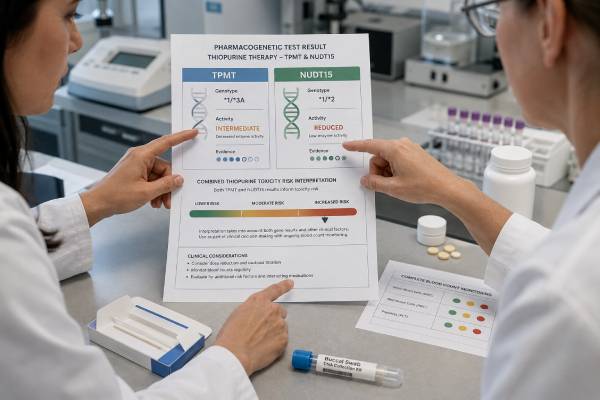
A thiopurine pharmacogenetic test examines TPMT and NUDT15, two genes that strongly influence tolerance to azathioprine, mercaptopurine, and thioguanine. Reduced function in either pathway allows active thiopurine metabolites to have a greater effect on bone marrow, increasing the risk of severe leukopenia, neutropenia, anemia, thrombocytopenia, and treatment interruption. The result is used mainly to select a safer starting dose before therapy, not to decide whether the medicine will work. People with normal function in both genes generally begin with the usual protocol dose. Intermediate metabolizers often need a reduced starting dose, while poor metabolizers may need a very large reduction or a different medicine, especially for noncancer conditions. A person with reduced function in both genes may require a greater adjustment than someone affected in only one. Genetic guidance never replaces blood-count and liver-test monitoring. Infection, interacting medicines, kidney or liver disease, adherence, the treatment indication, and evolving blood counts continue to determine the final dose.
- Genes tested: TPMT and NUDT15 should be considered together because either can raise thiopurine toxicity risk.
- Medicines affected: Azathioprine, mercaptopurine, and thioguanine are the principal thiopurines covered by current guidance.
- Main predicted harm: Reduced function increases dose-related bone marrow suppression, especially low white blood cells and neutrophils.
- Typical response: Intermediate and poor metabolizers start lower and are titrated according to blood counts, disease response, and protocol.
- Critical limitation: Testing does not predict every adverse effect, including most pancreatitis, liver injury, infection, or allergic reactions.
Table of Contents
- Why Thiopurines Need Personalized Dosing
- TPMT and NUDT15 Pathways
- Who Should Be Tested and When
- Genotyping, Phenotyping, and Sample Details
- Reading Combined TPMT and NUDT15 Results
- Dose Planning by Drug and Indication
- Monitoring for Toxicity After Treatment Starts
- Limitations, Cost, and Long-Term Use of Results
Why Thiopurines Need Personalized Dosing
Thiopurines interfere with DNA and RNA synthesis through active nucleotide metabolites. They are used in very different clinical settings: mercaptopurine and thioguanine are important in leukemia protocols, while azathioprine and mercaptopurine are used for inflammatory bowel disease, autoimmune disorders, and prevention of transplant rejection. The intended dose, acceptable degree of bone marrow suppression, and alternatives differ across these settings.
The therapeutic range can be narrow. Too little medicine may fail to control leukemia or immune-mediated inflammation. Too much active metabolite can suppress production of white blood cells, red blood cells, and platelets. Severe neutropenia can permit life-threatening infection; thrombocytopenia can increase bleeding; anemia can cause weakness and shortness of breath.
Historically, clinicians started with protocol-based doses and adjusted after blood counts changed. TPMT and NUDT15 testing moves some of that learning before the first dose. It identifies patients who are unlikely to tolerate conventional exposure, allowing the initial regimen to be lowered rather than waiting for profound cytopenia.
The result does not produce one universal dose. A leukemia protocol may intentionally titrate mercaptopurine toward a target degree of myelosuppression because adequate treatment intensity is important for cure. In a nonmalignant condition, a clinician may have more freedom to choose an alternative drug for a poor metabolizer. Azathioprine doses are not directly interchangeable with mercaptopurine or thioguanine doses.
Thiopurine pharmacogenetics is therefore a starting-dose framework. The ultimate regimen depends on:
- the exact medicine and indication;
- whether treatment is malignant or nonmalignant;
- TPMT and NUDT15 results together;
- baseline blood counts and organ function;
- other chemotherapy or immunosuppressive medicines;
- infections and inflammation;
- metabolite measurements when used; and
- serial evidence of benefit and toxicity.
This is one of the clearest examples of a pharmacogenetic test that can prevent a predictable, dose-dependent adverse reaction, but only when the result is tied to an appropriate protocol.
TPMT and NUDT15 Pathways
TPMT and NUDT15 protect cells from excessive exposure to active thiopurine nucleotides through different mechanisms. Reduced activity in either gene increases sensitivity, but the biochemical route and population distribution are not identical.
TPMT
TPMT encodes thiopurine S-methyltransferase. This enzyme methylates thiopurine compounds and helps divert them away from formation of active thioguanine nucleotides. Reduced or absent TPMT activity permits higher concentrations of active metabolites at a given dose.
Common no-function or reduced-function alleles include TPMT*2, *3A, *3B, and *3C, although allele frequencies vary. A person with one no-function allele is usually an intermediate metabolizer. A person with two no-function alleles is a poor metabolizer and is highly vulnerable to severe, prolonged myelosuppression from standard doses.
TPMT deficiency has been recognized for decades. It is more commonly captured in populations of European or African ancestry by standard variant panels, but rare alleles occur worldwide. No ancestry group can be assumed to have normal function.
NUDT15
NUDT15 encodes an enzyme that inactivates cytotoxic thiopurine nucleotide triphosphates. Reduced function allows more active metabolites to be incorporated into DNA, making blood-forming cells unusually sensitive even when some conventional metabolite measurements do not appear extremely high.
The best-known variant is NUDT15 c.415C>T, which produces the p.Arg139Cys change and appears in alleles such as *2 and *3. Other reduced-function alleles also exist. NUDT15 variants are particularly important in people with East Asian, South Asian, Indigenous American, and Hispanic or Latino ancestry, but they are not confined to those groups.
Why both genes matter
Testing TPMT alone can miss a major source of risk, especially in populations where NUDT15 reduced-function alleles are more frequent. Testing NUDT15 alone can miss classic TPMT deficiency. A patient who is intermediate for both genes—sometimes called a compound intermediate metabolizer—may have greater intolerance than a patient intermediate for only one.
The genes predict dose tolerance, not immune status or disease severity. “Poor metabolizer” does not mean the patient’s liver or overall metabolism is failing. It means a specific protective pathway has little functional activity, so the same thiopurine dose has a stronger cellular effect.
Who Should Be Tested and When
Testing is most useful before the first thiopurine dose. A pre-treatment result allows the clinician to select a guideline-based starting dose and avoids exposing a poor metabolizer to a conventional regimen. Many oncology, gastroenterology, rheumatology, dermatology, and transplant practices include TPMT and NUDT15 testing in their prescribing workflow.
People who may be tested include those preparing to receive:
- mercaptopurine as part of acute lymphoblastic leukemia or lymphoblastic lymphoma therapy;
- thioguanine in an oncology protocol;
- azathioprine for inflammatory bowel disease, autoimmune hepatitis, rheumatic disease, dermatologic disease, or another immune-mediated condition;
- mercaptopurine for inflammatory bowel disease; or
- a thiopurine as part of transplant immunosuppression.
Testing can also be ordered after therapy begins if unexplained leukopenia, neutropenia, or inability to tolerate expected doses develops. In that setting, clinicians must address the current toxicity immediately; the genetic result may explain susceptibility but should not delay stopping or reducing treatment when clinically necessary.
A previous normal TPMT enzyme activity result does not provide NUDT15 information. Likewise, a limited genetic panel may test only a few common alleles. The ordering clinician should verify whether both genes were adequately assessed.
Family members do not routinely need testing merely because a relative has a reduced-function allele. The finding is inherited, but it is most relevant when that person is considering a thiopurine. If a relative does need one of these medicines, the known family result may support prompt testing.
Testing is not a substitute for baseline evaluation. Before therapy, clinicians commonly review complete blood count, liver tests, kidney function, infection status, vaccination considerations, pregnancy-related issues, and concurrent medicines. Some indications require additional screening or specialty protocols.
The result should be available to every clinician involved in treatment. An oncology protocol, gastroenterology note, pharmacy system, and primary medical record should not contain conflicting phenotype labels. Structured storage of the genotype and phenotype makes the finding reusable if a different thiopurine is prescribed years later.
Genotyping, Phenotyping, and Sample Details
TPMT can be assessed by genotype or by measuring enzyme activity in red blood cells. NUDT15 is usually assessed by genotype. These approaches answer related but not identical questions.
Genotyping
A DNA test uses blood, saliva, or a cheek swab. It identifies selected inherited variants and assigns star alleles or a predicted function category. DNA is stable throughout life, so a valid result generally does not need to be repeated.
The main limitation is coverage. Targeted panels detect common alleles but can miss rare or population-specific variants. A laboratory should state which alleles were examined and whether an indeterminate result could reflect incomplete phasing or uncertain function.
Genotyping can be performed after blood transfusion because DNA from a cheek swab or an appropriately handled blood sample generally reflects the patient, but recent allogeneic hematopoietic stem cell transplantation can complicate which genetic source is measured in blood. The laboratory and transplant team should select the correct specimen.
TPMT enzyme phenotyping
A red-cell TPMT activity test measures the enzyme’s functional activity. It can detect low activity even when the causal variant is not on a targeted genetic panel. It may therefore complement genotyping.
However, enzyme testing has important interferences. Recent red blood cell transfusion can make the measured activity reflect donor cells. Certain medicines and laboratory conditions may affect results. After thiopurine exposure, interpretation can also be complicated. The ordering clinician should provide transfusion and medication history.
Genotype and enzyme activity occasionally disagree. Possible reasons include transfusion, rare variants, sample problems, concurrent medicines, or biological factors not captured by the test. A discordant result deserves specialist laboratory review before dosing is based on the more reassuring value.
A high-quality report should include the exact variants or alleles, predicted TPMT and NUDT15 phenotypes, assay limitations, and a current drug-specific recommendation. A vague “normal” result without stating the genes and coverage is inadequate.
Turnaround ranges from rapid in-house testing to several weeks. If treatment cannot wait, clinicians may begin with a cautious protocol and intensive monitoring, then adjust when the result arrives. For planned therapy, ordering early avoids this compromise.
Reading Combined TPMT and NUDT15 Results
The safest interpretation treats TPMT and NUDT15 as a combined risk profile. Each gene is assigned a phenotype, then the two are considered together with the drug and indication.
| Combined result pattern | Expected tolerance | General prescribing meaning |
|---|---|---|
| Normal TPMT and normal NUDT15 | Typical genetically predicted tolerance | Use the standard starting protocol, with routine blood-count monitoring |
| Intermediate in one gene, normal in the other | Reduced tolerance and higher myelosuppression risk | Consider a reduced starting dose; titrate by counts, response, and indication |
| Intermediate in both genes | Substantially reduced tolerance | Use a greater reduction than for a single intermediate result and monitor closely |
| Poor metabolizer in either gene | Very low tolerance to conventional dosing | Use a major dose reduction for malignant disease or consider an alternative for nonmalignant disease |
| Indeterminate or uncertain function | Cannot be predicted reliably | Use cautious clinical dosing and seek pharmacogenetic or laboratory consultation |
The report may list star alleles, such as TPMT1/3A or NUDT151/3. The star-allele pair is the diplotype. It is translated into normal, intermediate, or poor metabolizer status. Some updated frameworks use more detailed activity categories, but the medication recommendation remains the practical endpoint.
A normal result does not guarantee freedom from toxicity. Standard doses can still suppress bone marrow because of infection, organ dysfunction, interacting medicines, other chemotherapy, dosing error, or unexplained individual sensitivity. Complete blood counts remain essential.
An intermediate result does not mean the medicine is prohibited. Many intermediate metabolizers receive thiopurines successfully at reduced doses. The clinician waits long enough after each dose change to judge the full effect because blood-count suppression may be delayed.
A poor-metabolizer result is clinically urgent before treatment. Conventional doses can cause severe and prolonged marrow toxicity. For cancer therapy, thiopurines may remain essential, so experts use markedly reduced doses and careful titration. For a nonmalignant disorder, another medicine may be preferable.
A result marked uncertain should not be converted into a confident dose category by consumer software. Rare variants and allele-phasing problems require a laboratory with pharmacogenetic expertise. Raw SNP genotyping data are not a substitute for a clinically validated TPMT and NUDT15 report.
Dose Planning by Drug and Indication
Current guidelines provide separate recommendations for azathioprine, mercaptopurine, and thioguanine and distinguish malignant from nonmalignant treatment. Exact percentages and schedules belong in the treating protocol, because dose targets differ substantially.
Azathioprine
Azathioprine is converted to mercaptopurine and then to active metabolites. In normal metabolizers, the standard starting dose for the condition is generally used. An intermediate metabolizer usually starts lower, with later adjustment according to blood counts and clinical effect. A poor metabolizer treated for a nonmalignant condition is often offered an alternative immunosuppressant because the required dose reduction can be extreme and difficult to manage.
Azathioprine has a major interaction with allopurinol and febuxostat, which inhibit xanthine oxidase and can dramatically increase active thiopurine exposure. The combination requires expert dose adjustment or avoidance. Genotype does not protect against this interaction.
Mercaptopurine
Mercaptopurine is central to maintenance therapy for acute lymphoblastic leukemia. For normal metabolizers, protocol dosing is used. Intermediate metabolizers receive a reduced starting dose when the standard regimen is high enough to pose excess risk. Poor metabolizers may tolerate only a small fraction of the conventional dose, often given less frequently, with careful titration.
In oncology, the goal is not to eliminate all myelosuppression. Clinicians balance treatment intensity, neutrophil targets, infection risk, treatment interruptions, and relapse prevention. A dose that looks unusually low may be appropriate for a poor metabolizer because intracellular exposure remains high.
Thioguanine
Thioguanine enters the active nucleotide pathway more directly. TPMT and NUDT15 status still affect tolerance, but dose recommendations differ from mercaptopurine. Clinicians should never transfer a percentage adjustment from one thiopurine to another without using the correct table.
Compound intermediate metabolizers
A patient intermediate for both TPMT and NUDT15 needs special attention. Updated guidance emphasizes a greater reduction than for a single intermediate phenotype. The exact starting point depends on drug and indication, followed by slow titration after enough time has passed to observe marrow effects.
Dose changes should be based on the prescribed protocol, not a simplified consumer interpretation. The prescriber may also use thiopurine metabolite testing, especially in inflammatory bowel disease or when adherence, shunting, toxicity, or nonresponse is uncertain. Metabolites complement rather than replace genotype and blood counts.
Monitoring for Toxicity After Treatment Starts
Every patient needs laboratory monitoring, including those with normal TPMT and NUDT15 function. Baseline and serial complete blood counts detect falling white cells, neutrophils, hemoglobin, and platelets. Liver tests monitor hepatotoxicity. The frequency is highest after starting treatment and after dose changes, then may decrease once the regimen is stable.
Patients should receive clear instructions about symptoms that require urgent contact:
- fever, chills, or signs of infection;
- unusual bruising, bleeding, or pinpoint red spots;
- severe fatigue, pallor, dizziness, or shortness of breath;
- mouth ulcers or persistent sore throat;
- jaundice, dark urine, or severe abdominal pain;
- persistent vomiting or diarrhea; and
- any sudden deterioration during chemotherapy or immunosuppression.
A fever in a patient with possible neutropenia can be an emergency. The treatment team may instruct the patient to seek immediate assessment rather than wait for the next clinic visit.
Not all adverse effects are predicted by TPMT and NUDT15. Thiopurines can cause liver injury, nausea, infection, and pancreatitis. Thiopurine-induced pancreatitis is often idiosyncratic and is associated with other genetic and immune factors, not primarily the dose-tolerance pathways covered by this test. Normal TPMT and NUDT15 results do not reduce the need to evaluate severe upper abdominal pain.
Blood counts may fall because of the underlying disease, viral infection, other chemotherapy, trimethoprim-sulfamethoxazole, methotrexate, or another marrow-suppressing medicine. The clinician considers timing and all exposures before attributing the change solely to thiopurine genotype.
Adherence matters in both directions. Missed doses can cause treatment failure, while accidental extra doses can cause toxicity. Patients and caregivers should use the exact tablet strength and schedule prescribed, especially when reduced doses or non-daily schedules are required. Oral chemotherapy should be handled and stored according to oncology instructions.
Metabolite testing can sometimes clarify whether active thioguanine nucleotides are low, therapeutic, or excessive and whether methylated metabolites are high. Results must be interpreted with dose history, timing, genotype, and disease-specific targets. They do not replace the complete blood count.
Limitations, Cost, and Long-Term Use of Results
The greatest limitation is that testing predicts only part of toxicity. It is powerful for inherited susceptibility to dose-dependent myelosuppression, but it cannot anticipate every marrow response or adverse event. Patients with normal-function results can still become severely cytopenic, and reduced-function patients can sometimes tolerate more than initially expected under expert monitoring.
Assay coverage is another concern. Variant panels designed around one population may miss alleles important in another. TPMT and NUDT15 allele frequencies differ globally, and increasingly diverse patients require broad, transparent coverage. Sequencing may identify rare variants but can generate uncertain findings that lack dosing evidence.
Genotype and TPMT enzyme activity are not interchangeable in every situation. Recent transfusion, hematopoietic stem cell transplantation, medicines, and sample quality can complicate phenotyping or the genetic source of a blood sample. Discordant findings should be resolved rather than ignored.
Cost varies by country, laboratory, and whether testing is targeted or part of a panel. Coverage may depend on diagnosis and prescribing policy. The cost should be weighed against the potential consequences of severe myelosuppression, hospitalization, infection, and treatment interruption. Ask whether both genes are included, whether professional interpretation is billed separately, and whether the result will be integrated into the medical record.
The result has lifelong relevance. A patient tested before leukemia therapy may later encounter azathioprine for an autoimmune condition, or vice versa. The exact genotype, phenotype, laboratory, date, and assay coverage should be retained. A wallet card or patient-portal copy can help, but structured electronic documentation is more likely to trigger a future prescribing alert.
After testing, the patient and clinician should confirm:
- Both TPMT and NUDT15 were assessed adequately.
- The result was translated with the current guideline.
- The recommendation matches the exact thiopurine and indication.
- The starting prescription includes the correct tablet strength and schedule.
- Baseline and follow-up blood tests are arranged.
- Interacting medicines, especially xanthine oxidase inhibitors, were reviewed.
- The patient knows which symptoms require urgent care.
- Dose escalation will occur only after sufficient monitoring.
The strongest use of thiopurine pharmacogenetics is preventive. It identifies patients for whom a conventional first dose is predictably dangerous and gives the treatment team a safer starting point. Continued blood-count monitoring then personalizes the dose further, preserving effectiveness while reducing avoidable toxicity.
References
- Clinical Pharmacogenetics Implementation Consortium Guideline for Thiopurine Dosing Based on TPMT and NUDT15 Genotypes: 2025 Update (2026, Clinical Guideline)
- Table of Pharmacogenetic Associations (2022, Regulatory Resource)
- TPMT and NUDT15 Genotyping, TPMT Enzyme Activity and Thiopurine Dose Selection in Clinical Practice (2024, Review)
- Azathioprine Dose Tailoring Based on Pharmacogenetic Testing and Clinical Outcomes (2023, Clinical Study)
- Examination of TPMT and NUDT15 Variants to Predict Thiopurine Toxicity in Pediatric Patients (2025, Clinical Study)
- TPMT and NUDT15 Test Fact Sheet (2025, Laboratory Guidance)
Disclaimer
This article provides general education and is not an individual thiopurine dosing plan. Azathioprine, mercaptopurine, and thioguanine can cause severe or life-threatening bone marrow suppression, so genetic results must be interpreted by the treating specialist and followed by scheduled blood-count and liver-test monitoring. Do not start, stop, or change a thiopurine dose without direct medical instructions; fever or signs of infection during treatment may require urgent assessment.