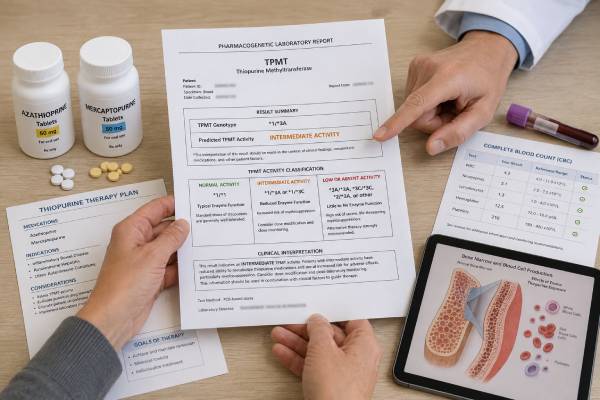
A TPMT genetic test identifies inherited variants that reduce thiopurine S-methyltransferase activity and increase sensitivity to azathioprine, mercaptopurine, and thioguanine. TPMT normally helps divert thiopurine medicines away from active nucleotide metabolites. When activity is reduced or absent, a standard dose can generate excessive intracellular exposure and cause profound bone marrow suppression. The laboratory usually reports two TPMT alleles and assigns normal, intermediate, or poor metabolizer status. Normal metabolizers generally start with the usual condition-specific dose. Intermediate metabolizers often need a lower starting dose, while poor metabolizers may need a major reduction for cancer therapy or an alternative medicine for a noncancer condition. The result must be interpreted with NUDT15 because a normal TPMT result does not exclude another important inherited cause of thiopurine intolerance. It also does not replace complete blood counts, liver tests, interaction review, or clinical monitoring. The final dose is determined by the exact medicine, treatment purpose, blood-cell response, disease control, and other therapies.
- Primary purpose: Identify patients at increased risk of severe, dose-related thiopurine myelosuppression.
- Key medicines: Azathioprine, mercaptopurine, and thioguanine require drug-specific interpretation.
- Result categories: Normal, intermediate, and poor metabolizer phenotypes predict progressively lower dose tolerance.
- Important companion gene: NUDT15 should also be considered, especially when TPMT is normal but toxicity occurs.
- Ongoing requirement: Regular complete blood counts are necessary for every patient, regardless of genotype.
Table of Contents
- What TPMT Testing Is Designed to Prevent
- How TPMT Controls Thiopurine Metabolites
- Clinical Settings for TPMT Testing
- Genetic Testing Versus TPMT Enzyme Activity
- TPMT Alleles, Phenotypes, and Result Meaning
- Azathioprine and Mercaptopurine Dose Decisions
- Blood-Count Monitoring and Adverse Effects
- What a TPMT Result Misses
What TPMT Testing Is Designed to Prevent
Thiopurines are prodrugs that are converted through several pathways into active thioguanine nucleotides. These metabolites interfere with nucleic-acid synthesis and cell signaling. That activity can suppress abnormal immune responses or destroy rapidly dividing leukemia cells, but it can also injure normal bone marrow.
The most serious predictable toxicity is myelosuppression. Depending on which blood-cell lines are affected, laboratory findings may include:
- leukopenia, meaning a low total white blood cell count;
- neutropenia, which increases the risk of bacterial and fungal infection;
- anemia, which may cause fatigue, pallor, dizziness, or shortness of breath;
- thrombocytopenia, which can cause bruising and bleeding; or
- pancytopenia, in which all three major blood-cell lines are reduced.
A person with very low TPMT activity cannot inactivate thiopurine compounds through the usual methylation pathway. Conventional doses can therefore produce a dangerous and prolonged buildup of active metabolites. Pre-treatment testing gives the clinician an opportunity to reduce exposure before blood counts collapse.
TPMT testing is not a general test for medication allergy. It does not predict immediate hypersensitivity, most nausea, or thiopurine-induced pancreatitis. It does not show whether an inflammatory disease will respond or whether leukemia will be cured. Its most reliable role is estimating dose tolerance.
The test is also not a replacement for a treatment protocol. The acceptable dose and degree of marrow suppression differ between oncology and nonmalignant disease. In leukemia, mercaptopurine may be indispensable, and specialists may use extremely low doses in poor metabolizers while titrating toward protocol goals. In autoimmune disease, an alternative immunosuppressant may be safer and simpler.
Used correctly, a TPMT result reduces avoidable harm without automatically withholding effective therapy. It is an example of medication-focused genetic information rather than a diagnosis of inherited disease. A broader pharmacogenetic evaluation may include TPMT alongside NUDT15 and other actionable genes.
How TPMT Controls Thiopurine Metabolites
The TPMT gene encodes thiopurine S-methyltransferase, an enzyme found in many tissues and commonly measured in red blood cells. TPMT adds a methyl group to thiopurine compounds. This shifts material away from the pathway that produces cytotoxic thioguanine nucleotides.
When TPMT activity is normal, standard protocol doses generate a balance of active and methylated metabolites. When activity is reduced, more substrate remains available for activation. The same oral dose can therefore have a stronger effect on bone marrow.
TPMT activity follows a codominant inheritance pattern. Each person inherits one allele from each biological parent, and both contribute to the phenotype. Commonly recognized alleles include:
- TPMT*1: Usually assigned normal function.
- TPMT*2: A no-function allele.
- TPMT*3A: A common no-function allele in many people of European ancestry.
- TPMT*3B and *3C: No-function alleles with varying population frequencies.
- Other rare alleles: Some have reduced, no, uncertain, or newly characterized function.
One normal-function allele plus one no-function allele usually produces intermediate activity. Two no-function alleles produce poor activity. The exact allele distribution differs among populations, so a panel built around a limited set can miss rare or ancestry-associated variants.
TPMT affects metabolite balance as well as toxicity. Patients with high TPMT activity may generate relatively more methylated metabolites and, in some situations, less active thioguanine nucleotide exposure. This has led to metabolite-guided strategies in inflammatory bowel disease, including carefully supervised use of allopurinol with a drastically reduced thiopurine dose in selected patients. That combination is complex and potentially dangerous if attempted without specialist management.
Allopurinol and febuxostat inhibit xanthine oxidase, another thiopurine-inactivation pathway. They can sharply increase active exposure even in a patient with normal TPMT. A genetic result never overrides this interaction.
The TPMT pathway also differs from NUDT15. NUDT15 removes active thiopurine nucleotide triphosphates that could be incorporated into DNA. A person can have normal TPMT activity but poor NUDT15 function and still experience severe early leukopenia. This is why contemporary guidance evaluates both genes rather than treating TPMT as a complete answer.
Clinical Settings for TPMT Testing
Testing is ideally performed before the first dose. It may be ordered by an oncologist, gastroenterologist, rheumatologist, dermatologist, hepatologist, transplant specialist, or another clinician who uses thiopurines.
Common clinical contexts include:
Acute lymphoblastic leukemia
Mercaptopurine is a major component of maintenance therapy for acute lymphoblastic leukemia and lymphoblastic lymphoma. Maintaining effective treatment intensity matters, but conventional exposure can be catastrophic for a TPMT poor metabolizer. Oncology teams use the genotype with protocol-specific dosing, frequent blood counts, and other chemotherapy information.
Inflammatory bowel disease
Azathioprine or mercaptopurine may be used to maintain remission in Crohn disease or ulcerative colitis. TPMT testing can help avoid an unsafe first dose. It does not predict pancreatitis, and it does not establish whether a thiopurine is the best choice compared with biologic or small-molecule therapy.
Autoimmune and inflammatory conditions
Azathioprine is used in conditions such as autoimmune hepatitis, systemic autoimmune disease, inflammatory myopathy, vasculitis, and some dermatologic disorders. The starting recommendation depends on the condition and on whether other immunosuppressants are being used.
Transplantation
Azathioprine is less dominant than some newer transplant medicines but remains relevant in selected patients. The result may influence dose tolerance, while the full immunosuppressive regimen determines infection and marrow risk.
Testing can also be useful after unexpected toxicity. Severe or repeated myelosuppression at ordinary or low doses should prompt evaluation of TPMT and NUDT15 if reliable results are not already available. Treatment of the current cytopenia should not wait for genetic testing.
A stable patient who has tolerated a full thiopurine dose for years is unlikely to be a TPMT poor metabolizer, but a formal result may still be useful before future re-exposure. Long-term tolerance does not eliminate the need for continued laboratory monitoring because infection, organ dysfunction, new medicines, and dosing errors can change risk.
Children and adults can both be tested. The inherited genotype is the same throughout life, although treatment protocols and dose calculations differ by age, body size, and disease.
Genetic Testing Versus TPMT Enzyme Activity
TPMT status can be assessed through DNA genotyping or through a red blood cell enzyme-activity assay. Some centers use one approach; others use both when the result is unclear or when comprehensive assessment is needed.
TPMT genotyping
Genotyping uses blood, saliva, or a cheek swab to identify specific alleles. Its advantages include lifelong stability, resistance to most short-term physiologic changes, and direct connection to star-allele dosing guidance. A valid result can be stored and reused for future thiopurine prescriptions.
Its main weakness is incomplete variant coverage. A targeted assay may detect the common *2 and *3 alleles but miss a rare reduced-function variant. A report should state exactly which alleles or positions were examined. An apparent *1 assignment often means “no tested variant detected,” not that every base in the gene was proven normal.
TPMT enzyme phenotyping
Phenotyping measures TPMT activity in red blood cells. It can identify low functional activity caused by a rare variant that a limited genotype panel misses. It also provides a direct biochemical measurement rather than an inferred phenotype.
However, recent red blood cell transfusion can make the result reflect donor cells. Leukemia, altered red-cell production, certain medicines, and laboratory handling can also affect interpretation. Enzyme testing should generally be performed before thiopurine treatment and with relevant transfusion history available.
Genotype and enzyme activity usually agree but are not identical. If a result is discordant, the clinician should not simply choose the more reassuring category. A laboratory specialist may recommend repeat testing, expanded sequencing, review of transfusions, or examination of interfering medicines.
NUDT15 genotyping is a separate requirement. A normal TPMT enzyme activity does not show that NUDT15 is normal. Modern ordering should make clear whether both genes were assessed.
Sample selection can be complicated after allogeneic hematopoietic stem cell transplantation. Blood cells may carry donor DNA, while other tissues retain recipient DNA. The laboratory must know the clinical history and choose a specimen that answers the intended medication question.
Turnaround may range from a day or two in a rapid laboratory to several weeks. When therapy is planned, ordering early is preferable. If urgent treatment must begin, specialists may use a conservative interim dose and intensive monitoring until the result is available.
TPMT Alleles, Phenotypes, and Result Meaning
The report normally progresses from allele pair to predicted phenotype to drug-specific recommendation. The table below summarizes the broad interpretation.
| TPMT result | Expected enzyme activity | General thiopurine implication |
|---|---|---|
| Two normal-function alleles | Normal metabolizer | Use the standard starting protocol if NUDT15 is also normal, then monitor |
| One normal-function and one no- or reduced-function allele | Intermediate metabolizer | Start lower for many regimens and titrate after observing blood-count response |
| Two no-function alleles | Poor metabolizer | Use a major reduction in malignant disease or consider an alternative in nonmalignant disease |
| Rare, uncertain, or unresolved allele combination | Indeterminate | Do not assume normal tolerance; use specialist interpretation and cautious monitoring |
A normal-metabolizer result means no tested TPMT deficiency was identified. It does not guarantee tolerance. Other causes of myelosuppression include NUDT15 variants, infection, other chemotherapy, organ dysfunction, drug interactions, and individual variation.
An intermediate-metabolizer result is common enough that many clinicians encounter it routinely. These patients can often use thiopurines effectively, but the first dose is reduced and changes are made slowly. Because marrow effects can take time to appear, escalating too quickly can create delayed toxicity.
A poor-metabolizer result has major clinical importance. A full dose may cause life-threatening, prolonged pancytopenia. For leukemia, the medicine may remain necessary, so an oncology protocol may use a small fraction of the usual dose at a reduced frequency. For inflammatory or autoimmune disease, another treatment is often considered.
The terms “heterozygous deficiency” and “homozygous deficiency” may appear in older reports or drug labels. They roughly correspond to intermediate and poor metabolizer categories, but current interpretation should use the exact alleles and updated guideline.
A variant of uncertain significance should not be treated as either normal or deficient without evidence. Consumer raw-data interpretation is especially unreliable because one single-nucleotide variant may not define the full allele, and strand or quality errors can alter the apparent call.
Azathioprine and Mercaptopurine Dose Decisions
A TPMT result guides the starting dose. The later dose is personalized from blood counts, disease response, other treatments, and sometimes thiopurine metabolite measurements. Current recommendations also require the NUDT15 phenotype and distinguish malignant from nonmalignant indications.
Azathioprine
Azathioprine is converted to mercaptopurine after administration. For a TPMT normal metabolizer with normal NUDT15 function, the usual condition-specific starting dose is generally appropriate. An intermediate metabolizer often begins at a reduced percentage of that dose and is titrated after enough time has passed to evaluate marrow response.
For a TPMT poor metabolizer receiving azathioprine for a nonmalignant condition, clinicians commonly choose another immunosuppressant. If no suitable alternative exists, dosing requires specialist expertise and intensive monitoring. Standard dosing is unsafe.
Azathioprine dosing must account for allopurinol or febuxostat. These interactions can require a profound dose reduction and close metabolite and blood-count monitoring. A patient should never combine them casually based on an internet dosing table.
Mercaptopurine
Mercaptopurine dosing differs sharply between leukemia and inflammatory bowel disease. In leukemia, the dose is part of a multi-drug protocol and may be adjusted to blood-count targets. An intermediate metabolizer may need a reduced starting dose, especially when the protocol’s usual dose is high. A poor metabolizer may require approximately one-tenth or less of conventional exposure, sometimes with less frequent administration, under oncology supervision.
In nonmalignant disease, a safer alternative may be preferable for a poor metabolizer. Intermediate metabolizers often tolerate a reduced regimen with gradual titration.
A dose that appears very low on the prescription can still produce substantial intracellular exposure in a deficient patient. Family members or outside clinicians should not “correct” it to a usual dose without consulting the treating specialist.
Thioguanine
Although the title focuses on azathioprine and mercaptopurine, TPMT also affects thioguanine. Its pathway and dose recommendations are distinct. Adjustments cannot be copied directly from mercaptopurine tables.
When both TPMT and NUDT15 are intermediate, the reduction may need to be greater than for either result alone. The updated guideline emphasizes combined interpretation. Disease-specific protocols should always take priority over a generic percentage.
Blood-Count Monitoring and Adverse Effects
Genetic testing reduces risk but does not eliminate it. Every patient needs a baseline complete blood count and repeated testing after treatment starts. Monitoring is usually frequent during initiation and after dose changes, then spaced out once a stable regimen is established. Liver tests are also commonly followed.
Clinicians watch trends rather than a single number. Falling neutrophils, platelets, or hemoglobin may require holding the medicine, reducing the dose, assessing infection, or reviewing other marrow-suppressive treatments. The action threshold depends on the indication and protocol.
Patients should know the warning signs of significant cytopenia:
- fever, chills, or a new infection;
- mouth ulcers or persistent sore throat;
- unusual bruising, nosebleeds, gum bleeding, or pinpoint red spots;
- severe fatigue, pallor, dizziness, or breathlessness;
- rapidly worsening weakness; and
- any acute illness during intensive chemotherapy or immunosuppression.
Fever with possible neutropenia may be a medical emergency. Patients should follow the treating team’s urgent-contact instructions rather than wait for a routine appointment.
Other thiopurine adverse effects require separate attention. Liver injury can cause rising enzymes, jaundice, itching, or dark urine. Pancreatitis can cause severe upper abdominal pain, often radiating to the back, with nausea or vomiting. TPMT genotype does not reliably predict these complications.
Nausea, reduced appetite, rash, infection, and long-term malignancy risks may also affect treatment decisions. Some risks relate to total immunosuppression rather than thiopurine metabolism alone.
Medication reconciliation is essential. Allopurinol and febuxostat are the best-known interactions, but other chemotherapy, trimethoprim-sulfamethoxazole, methotrexate, and immunosuppressants can amplify marrow effects. Kidney or liver dysfunction may alter tolerance.
Adherence must be assessed sensitively. Low metabolite concentrations and inadequate disease control may reflect missed doses rather than rapid metabolism. Conversely, accidental double dosing can precipitate toxicity. Oral chemotherapy schedules should be written clearly and verified at each visit.
Thiopurine metabolite testing can sometimes distinguish low exposure, excessive active metabolites, or high methylated metabolites. It is useful in selected patients but cannot replace blood counts or genetic information.
What a TPMT Result Misses
The most important gap is NUDT15. A patient may have normal TPMT function and still be highly sensitive to thiopurines because NUDT15 cannot adequately inactivate cytotoxic nucleotide triphosphates. NUDT15 reduced-function variants occur worldwide and are especially common in several Asian and Indigenous American populations and in people with Hispanic or Latino ancestry. Testing decisions should not rely on appearance or self-identified race.
A TPMT panel can also miss rare variants. “No variant detected” means no covered variant was found. Expanded sequencing may identify additional alleles, but the function of rare changes may be uncertain. Laboratories should report coverage and limitations plainly.
The test does not predict all causes of marrow suppression. Viral infection, nutritional deficiency, bone marrow disease, other anticancer drugs, kidney or liver dysfunction, and drug interactions can produce similar laboratory changes. It also does not predict most pancreatitis or hepatotoxicity.
Evidence and dose tables evolve. The exact allele calls should be retained so they can be reinterpreted under future guidance. A color-coded risk category without the genotype may become obsolete.
Cost varies with the laboratory and whether testing includes both TPMT and NUDT15. A targeted assay may be inexpensive compared with hospitalization for severe pancytopenia, but insurance policies differ. Patients should ask whether the price includes professional interpretation and whether a separate enzyme-activity test is needed.
Privacy considerations are similar to other inherited pharmacogenetic results. Consent should address sample storage, data sharing, and research use. Legal protection for genetic information differs by jurisdiction and type of insurance.
A practical response to a completed test is to:
- Confirm the allele pair and predicted TPMT phenotype.
- Check whether NUDT15 was tested and interpreted.
- Match the recommendation to azathioprine, mercaptopurine, or thioguanine specifically.
- Distinguish malignant from nonmalignant treatment.
- Review interacting medicines and baseline laboratory tests.
- Arrange a written blood-count and liver-test schedule.
- Document urgent symptoms and contact instructions.
- Save the result in a lifelong, searchable section of the health record.
TPMT testing is valuable because it identifies an avoidable source of extreme exposure before harm occurs. Its safest use is neither to ignore thiopurines nor to trust DNA alone, but to combine a genotype-informed first dose with disciplined monitoring and disease-specific expertise. Clear communication among the laboratory, pharmacist, prescriber, patient, and caregivers also helps prevent dosing errors when unusually small doses or non-daily schedules are required.
References
- Clinical Pharmacogenetics Implementation Consortium Guideline for Thiopurine Dosing Based on TPMT and NUDT15 Genotypes: 2025 Update (2026, Clinical Guideline)
- Azathioprine Therapy and TPMT and NUDT15 Genotype (2020, Medical Genetics Summary)
- Mercaptopurine Therapy and TPMT and NUDT15 Genotype (2020, Medical Genetics Summary)
- TPMT and NUDT15 Genotyping, TPMT Enzyme Activity, and Thiopurine Dose Selection in Clinical Practice (2024, Clinical Study)
- Genotype and Phenotype Correlation of the TPMT*8 Allele With Mercaptopurine Metabolism (2024, Functional Study)
- Azathioprine Dose Tailoring Based on Pharmacogenetic Information: Insights of Clinical Implementation (2023, Clinical Study)
Disclaimer
This article is general educational information and does not provide an individual azathioprine or mercaptopurine dose. Thiopurines can cause severe or fatal bone marrow suppression, so TPMT and NUDT15 results must be interpreted by the treating specialist and followed by scheduled complete blood counts and other laboratory monitoring. Do not start, stop, or alter treatment without medical instructions; fever or signs of infection during therapy may require urgent evaluation.