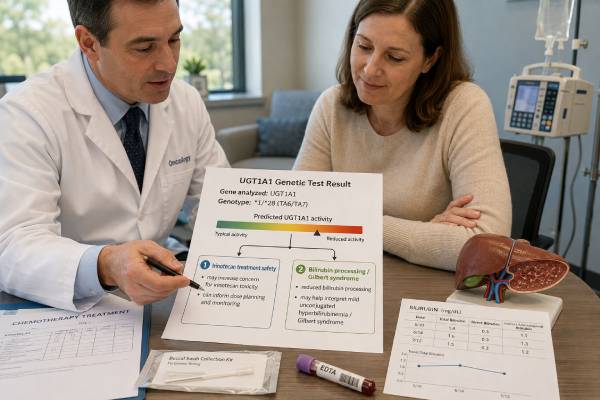
A UGT1A1 genetic test has two main clinical uses. In oncology, it can identify patients who clear the active irinotecan metabolite SN-38 more slowly and therefore face a higher risk of severe neutropenia and diarrhea. In liver evaluation, it can support a diagnosis of Gilbert syndrome when blood tests show persistent or intermittent unconjugated hyperbilirubinemia without hemolysis or liver disease. The best-known reduced-function allele is UGT1A128, while UGT1A16 is especially important in many East Asian populations. A person with two reduced- or no-function alleles may be classified as a poor metabolizer. For irinotecan, that result may lead to a lower starting dose followed by careful escalation according to tolerance and cancer-treatment goals. For Gilbert syndrome, the same gene result usually explains a benign lifelong bilirubin pattern rather than a need for treatment. The report must be interpreted for its specific purpose because allele coverage, phenotype definitions, and clinical consequences differ. Genotype does not replace blood counts during chemotherapy or a proper evaluation of jaundice.
- Two distinct uses: Irinotecan dose planning and evaluation of inherited unconjugated hyperbilirubinemia.
- Key alleles: UGT1A1*28 and *6 reduce enzyme function, but their frequencies differ among populations.
- Cancer implication: Poor metabolizers have greater SN-38 exposure and higher risk of severe neutropenia and diarrhea.
- Gilbert implication: Reduced UGT1A1 activity can cause mild, fluctuating bilirubin elevation without liver damage.
- Essential limitation: The test cannot determine an irinotecan dose by itself or rule out other causes of jaundice.
Table of Contents
- One Gene, Two Clinical Questions
- UGT1A1, Bilirubin, and SN-38 Clearance
- When UGT1A1 Testing Is Considered
- Test Methods and Allele Coverage
- Interpreting UGT1A1 Genotypes and Phenotypes
- Using Results Before Irinotecan
- Using Results for Gilbert Syndrome
- Limitations, Other Drugs, and Next Steps
One Gene, Two Clinical Questions
UGT1A1 testing sits at the intersection of pharmacogenetics and inherited bilirubin disorders. The DNA result may be identical in both settings, but the question being asked changes the meaning of the answer.
Before irinotecan, the question is: Will reduced glucuronidation increase exposure to a toxic active metabolite? Irinotecan is converted to SN-38, which damages rapidly dividing cancer cells but can also injure bone marrow and the intestinal lining. UGT1A1 helps deactivate SN-38. Low activity can increase toxicity at a given dose.
During evaluation of unexplained bilirubin elevation, the question is: Can reduced bilirubin glucuronidation explain the laboratory pattern? UGT1A1 attaches glucuronic acid to unconjugated bilirubin so it can be excreted in bile. Mildly reduced activity commonly causes Gilbert syndrome. Profound deficiency can cause the much rarer and more serious Crigler–Najjar syndromes.
These uses should not be blended carelessly. A report ordered for Gilbert syndrome may test a promoter repeat but omit other variants important for irinotecan in a diverse population. A pharmacogenetic panel may classify metabolizer status but not provide the comprehensive sequencing needed to investigate severe childhood hyperbilirubinemia.
The result also does not answer every clinical question. In oncology, tumor type, irinotecan regimen, starting dose, liver function, performance status, other chemotherapy, and treatment intent affect the plan. In bilirubin evaluation, clinicians must exclude hemolysis, hepatitis, bile-duct obstruction, medication effects, and other liver or blood disorders.
UGT1A1 testing is therefore best understood as a targeted tool. It can prevent a predictable chemotherapy complication or confirm a likely benign explanation for laboratory findings, but it must be connected to the correct clinical pathway. A broader pharmacogenetic panel may include UGT1A1 along with other medication-response genes, while diagnostic sequencing may examine the gene more comprehensively.
UGT1A1, Bilirubin, and SN-38 Clearance
UGT1A1 encodes UDP-glucuronosyltransferase 1A1, an enzyme concentrated in the liver. Glucuronidation attaches a water-soluble glucuronic-acid group to certain compounds. This chemical change makes them easier to excrete.
Bilirubin metabolism
Bilirubin is produced mainly when old red blood cells are broken down. The initial form is unconjugated bilirubin, which travels in the blood bound to albumin. Liver cells take it up, and UGT1A1 converts it to conjugated bilirubin. Conjugated bilirubin enters bile and leaves the body through the intestine.
When UGT1A1 activity is mildly reduced, unconjugated bilirubin can rise, especially during fasting, dehydration, illness, stress, strenuous exercise, sleep deprivation, or menstruation. This is the usual pattern of Gilbert syndrome. Liver enzymes and blood counts are otherwise typically normal.
Irinotecan metabolism
Irinotecan is converted by carboxylesterases to SN-38, a much more active topoisomerase I inhibitor. UGT1A1 glucuronidates SN-38 to SN-38G, a less active metabolite that can be eliminated. Reduced UGT1A1 function increases SN-38 exposure.
Higher exposure is associated with:
- severe neutropenia or febrile neutropenia;
- delayed diarrhea, which may be prolonged and dangerous;
- treatment delays and dose reductions;
- dehydration and electrolyte disturbance; and
- hospitalization in severe cases.
The genotype effect is dose dependent. At higher or moderate irinotecan doses, poor metabolizers are more likely to show clinically important toxicity. At very low doses, the difference may be less pronounced, although monitoring remains necessary.
UGT1A1 is not the only determinant of exposure. Liver function, bilirubin, other enzymes and transporters, body size, regimen, prior treatment, concurrent medicines, and intestinal reactivation of SN-38 metabolites all contribute. The genetic result improves risk estimation rather than replacing pharmacology or clinical judgment.
When UGT1A1 Testing Is Considered
Testing may be considered before an irinotecan-containing regimen when the result would change the initial dose, monitoring intensity, or choice of treatment. It is particularly relevant when a moderate or high irinotecan dose is planned, when the patient already has risk factors for neutropenia, or when the oncology service uses a genotype-guided protocol.
Irinotecan appears in regimens for colorectal, pancreatic, gastric, lung, gynecologic, and other cancers. The same genotype can have different practical consequences in FOLFIRI, FOLFIRINOX, liposomal irinotecan, single-agent treatment, or another combination. Each protocol has its own dose levels and modification rules.
Testing may also be ordered after unexpectedly severe toxicity. A poor-metabolizer result can help explain profound neutropenia or diarrhea and inform future dosing. Acute toxicity must still be treated immediately; genetic testing should not delay supportive care.
For bilirubin evaluation, UGT1A1 testing is considered when:
- unconjugated bilirubin is repeatedly elevated;
- liver enzymes and other liver-function indicators are otherwise reassuring;
- hemolysis has been excluded;
- the pattern is consistent with Gilbert syndrome but diagnostic certainty is useful;
- bilirubin elevation complicates cancer-treatment decisions;
- an atypical presentation raises concern for a more severe UGT1A1 disorder; or
- family counseling or medication planning would benefit from confirmation.
Genetic testing is not required for every person with a classic Gilbert pattern. Many clinicians diagnose it clinically after appropriate laboratory evaluation. Testing becomes more valuable when the pattern is uncertain, bilirubin is higher than expected, another condition is possible, or a medication affected by UGT1A1 is being considered.
Newborn or childhood jaundice requires a different level of urgency. Severe unconjugated hyperbilirubinemia can damage the brain. Crigler–Najjar syndrome and other neonatal conditions require specialist assessment and often comprehensive genetic analysis rather than a limited *28 test.
A previous UGT1A1 result can be reused because inherited DNA does not change. The original report should be reviewed to confirm which variants were tested and whether its interpretation is suitable for the new clinical question.
Test Methods and Allele Coverage
UGT1A1 testing usually uses blood, saliva, or a cheek swab. Laboratories may perform targeted genotyping, promoter-repeat analysis, sequencing, or a broader pharmacogenetic panel.
The UGT1A1*28 allele contains seven TA repeats in the promoter instead of the usual six. The longer repeat reduces gene expression. Because repeat regions can be technically challenging, the report should state that the promoter was directly assessed rather than inferred.
UGT1A1*6 contains a coding change, c.211G>A, producing p.Gly71Arg. It reduces enzyme activity and is particularly important in East Asian populations. A panel that tests only *28 can miss poor metabolizers who carry 6/6 or 6/28.
Other alleles include increased-function *36, decreased-function *37, and rare coding variants with reduced or no function. Severe UGT1A1 deficiency can result from pathogenic variants not included on routine irinotecan panels.
A useful laboratory report should state:
- the exact variants and repeat alleles tested;
- the two assigned alleles or diplotype;
- whether phasing was determined or inferred;
- the predicted function of each allele;
- the resulting metabolizer phenotype;
- limitations for rare variants and ancestry coverage; and
- the source of the clinical recommendation.
Targeted testing is efficient when the clinical question is irinotecan risk in a population well covered by the assay. Full-gene sequencing is more suitable when severe bilirubin elevation suggests Crigler–Najjar syndrome or when common alleles do not explain the phenotype. Sequencing may still miss certain structural or regulatory changes and can identify variants of uncertain significance.
Consumer raw data require caution. Repeat-length variants may not be represented accurately, and one isolated marker may not define the full UGT1A1 allele. Medication decisions should rely on a clinically validated report rather than a third-party interpretation of a single SNP result.
Turnaround varies from several days to a few weeks. For planned chemotherapy, testing should be ordered early enough to affect cycle-one dosing. Treatment should not be delayed unnecessarily when a safe standard protocol and intensive monitoring can be used while awaiting the result.
Interpreting UGT1A1 Genotypes and Phenotypes
UGT1A1 reports may use star alleles, repeat counts, or metabolizer categories. Interpretation should consider both alleles and their functional effect.
| Example result pattern | Predicted function | General irinotecan implication | Possible bilirubin implication |
|---|---|---|---|
| Two normal-function alleles, often *1/*1 | Normal metabolizer | No genotype-based starting reduction; use standard clinical monitoring | Gilbert syndrome is less likely from common tested alleles |
| One normal and one decreased-function allele, such as *1/*28 or *1/*6 | Intermediate metabolizer | Modestly increased exposure; action depends on dose, regimen, and other risk factors | May contribute to mild bilirubin elevation but is not always sufficient alone |
| Two decreased-function alleles, such as *28/*28, *6/*6, or *6/*28 | Poor metabolizer | Higher SN-38 exposure and toxicity risk; lower starting dose may be recommended | Common genetic basis for Gilbert syndrome, depending on allele combination and clinical pattern |
| Rare no-function variants | Markedly reduced or absent function | Potentially high drug sensitivity; specialist interpretation required | May indicate Crigler–Najjar syndrome rather than typical Gilbert syndrome |
| Uncertain or incomplete result | Indeterminate | Do not assume normal clearance; use clinical risk and expert review | Does not confirm or exclude an inherited bilirubin disorder |
The label “poor metabolizer” describes reduced glucuronidation capacity. It does not mean the entire liver is failing. Many people with Gilbert syndrome and a poor-metabolizer diplotype are healthy and have normal liver structure and life expectancy.
A heterozygous result usually carries less risk than two reduced-function alleles, but it is not irrelevant. At high irinotecan doses or in a patient with other vulnerabilities, an intermediate result may influence monitoring or dose selection. Guidelines differ in whether they recommend routine action for intermediate metabolizers.
A normal result does not guarantee freedom from chemotherapy toxicity. Severe neutropenia and diarrhea can occur because of regimen intensity, liver dysfunction, other medicines, infection, age, nutritional status, or non-UGT1A1 pathways.
For Gilbert syndrome, genotype must match the biochemical phenotype. A positive 28/28 result in a patient with predominantly conjugated bilirubin, high liver enzymes, anemia, or evidence of obstruction should not end the evaluation. Conversely, a classic clinical pattern may support Gilbert syndrome even if a limited panel does not find common alleles.
Using Results Before Irinotecan
The oncology team integrates the UGT1A1 phenotype with the exact irinotecan product, dose, schedule, tumor type, combination regimen, liver tests, baseline blood counts, and treatment objective.
For a normal metabolizer, no genotype-specific reduction is generally required. Standard protocol dosing and routine monitoring are used. For an intermediate metabolizer, the team may proceed with the usual dose or choose additional caution depending on regimen intensity and other risk factors.
For a poor metabolizer, current guidance commonly recommends a reduced starting dose. The Dutch Pharmacogenetics Working Group recommends beginning at about 70% of the usual dose and increasing if tolerated. The United States irinotecan label advises considering at least one dose-level reduction for patients with 28/28, 6/6, or 6/28, while acknowledging that the exact reduction is not fixed.
These recommendations are not interchangeable with a patient-specific prescription. A “dose level” is defined by the chemotherapy protocol. The chosen reduction may differ for conventional irinotecan and liposomal irinotecan, and combination regimens have separate rules.
After treatment begins, monitoring includes:
- complete blood counts before and during cycles;
- assessment for fever or infection;
- bowel-movement frequency and severity;
- hydration, kidney function, and electrolytes when diarrhea occurs;
- bilirubin and liver tests; and
- treatment response and cumulative tolerance.
Irinotecan causes two types of diarrhea. Early diarrhea during or soon after infusion can be part of an acute cholinergic syndrome and is managed differently from delayed diarrhea. Delayed diarrhea can be severe, prolonged, and life-threatening. Patients need written instructions about antidiarrheal treatment and when to contact the oncology team.
Fever, chills, severe weakness, uncontrolled diarrhea, inability to drink, dizziness, reduced urination, or blood in stool requires prompt assessment. Neutropenic fever is an emergency.
Dose escalation in a poor metabolizer may be considered if early cycles are tolerated and greater intensity is needed. The goal is not permanent undertreatment; it is to approach effective exposure without subjecting the patient to an avoidable first-cycle crisis.
UGT1A1 testing may be especially valuable when a patient has baseline bilirubin elevation from Gilbert syndrome. The result can help distinguish benign bilirubin metabolism from liver dysfunction while also informing irinotecan risk. The oncology team still evaluates both issues separately.
Using Results for Gilbert Syndrome
Gilbert syndrome is a common, benign condition caused by reduced UGT1A1 activity. It usually produces mild, intermittent unconjugated hyperbilirubinemia. Many people are diagnosed after routine blood tests rather than because of symptoms.
The typical evaluation shows:
- elevated total bilirubin with a predominantly unconjugated fraction;
- normal alanine aminotransferase, aspartate aminotransferase, alkaline phosphatase, and other liver findings;
- no evidence of accelerated red blood cell breakdown;
- no bile-duct obstruction; and
- a stable or fluctuating pattern over time.
Bilirubin may rise during fasting, dehydration, infection, psychological stress, strenuous exercise, lack of sleep, or menstruation. Mild yellowing of the eyes can occur during these episodes. Gilbert syndrome does not usually cause progressive liver damage and generally requires no treatment.
Genetic testing can confirm reduced-function UGT1A1 alleles when the laboratory pattern is compatible. It is especially helpful when patients have undergone repeated evaluations, when the bilirubin level is atypical, when cancer therapy depends on bilirubin interpretation, or when a more severe inherited disorder is being considered.
A genetic result cannot replace basic laboratory evaluation. Hemolysis can raise unconjugated bilirubin and may be assessed with complete blood count, reticulocytes, lactate dehydrogenase, haptoglobin, and blood-smear findings. Liver and biliary disease can coexist with Gilbert syndrome.
Very high unconjugated bilirubin, jaundice beginning in infancy, neurologic symptoms, or a result containing severe no-function variants raises concern for Crigler–Najjar syndrome. Type I and type II have far more serious consequences than Gilbert syndrome and require specialist care.
People with confirmed Gilbert syndrome should tell clinicians before receiving medicines affected by UGT1A1. The condition itself does not automatically prohibit irinotecan, but it can signal reduced clearance. Some other medicines can raise bilirubin or depend on UGT1A1 pathways.
Routine lifestyle restrictions are unnecessary. Regular meals, hydration, and awareness of triggers may reduce visible jaundice episodes, but bilirubin fluctuations are not evidence that the liver is being damaged. New abdominal pain, dark urine with pale stools, itching, fever, weight loss, or persistent worsening jaundice should be evaluated rather than attributed automatically to Gilbert syndrome.
Limitations, Other Drugs, and Next Steps
UGT1A1 testing has strong biological relevance but imperfect predictive power. For irinotecan, it explains only part of SN-38 exposure and toxicity. For Gilbert syndrome, common-allele testing may not detect rare variants or alternative causes of bilirubin elevation.
Coverage varies widely. A test that reports only *28 may perform adequately for one purpose in one population but miss *6 and other alleles in another. Laboratories should avoid describing a limited panel as comprehensive. Full sequencing provides broader coverage but can produce uncertain findings and may still miss regulatory or structural changes.
Clinical guidelines are not fully uniform. Regulatory labels and professional groups differ in which genotypes trigger dose reduction and how much to reduce. This reflects differences in evidence review, dose ranges, and health-system practice. The oncology protocol and local pharmacogenetic expertise should guide the final choice.
Other UGT1A1-related medicines include sacituzumab govitecan, whose active payload is SN-38; poor metabolizers may have greater neutropenia risk and require close monitoring. Atazanavir can cause unconjugated hyperbilirubinemia, particularly in people with reduced UGT1A1 function. Some cancer medicines can also cause bilirubin elevations through this pathway. The actionability of a stored result should be checked each time a new drug is considered.
Cost depends on whether the test is targeted, part of a panel, or comprehensive diagnostic sequencing. Insurance coverage varies by indication and jurisdiction. Patients should ask what alleles are included, whether interpretation is included, and whether the result will be stored for future use.
Privacy and consent matter because the result is inherited. Patients should understand sample retention, data sharing, and research policies. Family members may carry the same alleles, but testing is usually most useful when they have their own bilirubin question or medication decision.
After receiving a report, useful next steps are to:
- Identify the exact alleles and predicted phenotype.
- Verify that both *28 and *6 were considered when clinically relevant.
- Clarify whether the test was ordered for irinotecan, bilirubin evaluation, or both.
- For chemotherapy, match the result to the exact regimen and dose level.
- For jaundice, confirm the bilirubin fraction and exclude hemolysis and liver disease.
- Store the result in a reusable section of the health record.
- Revisit the interpretation before future UGT1A1-related medicines.
- Seek specialist review for severe hyperbilirubinemia or rare variants.
The value of UGT1A1 testing comes from precision of purpose. In oncology, it can support a safer first irinotecan cycle. In Gilbert syndrome, it can end unnecessary concern by explaining a benign bilirubin pattern. Neither use is safe when the genotype is separated from the dose, laboratory findings, or clinical context. Careful documentation prevents the same result from being misapplied years later.
References
- Dutch Pharmacogenetics Working Group Guideline for the Gene–Drug Interaction of UGT1A1 and Irinotecan (2023, Clinical Guideline)
- Table of Pharmacogenetic Associations (2022, Regulatory Resource)
- Irinotecan Therapy and UGT1A1 Genotype (2018, Medical Genetics Summary)
- Genetic Testing of UGT1A1 in the Diagnosis of Gilbert Syndrome (2022, Diagnostic Study)
- Meta-Analysis Revisiting the Influence of UGT1A1*28 on Irinotecan Safety in Colorectal Cancer (2024, Systematic Review)
- Revisiting UGT1A1 Pharmacogenetic Testing Before Irinotecan Therapy (2022, Clinical Review)
Disclaimer
This article is for general education and does not provide an irinotecan dose or diagnose the cause of jaundice. Chemotherapy dosing must be determined by the oncology team and followed by blood-count, diarrhea, liver-function, and clinical monitoring; severe diarrhea or fever during treatment requires urgent medical advice. Persistent or worsening jaundice should be evaluated rather than assumed to be Gilbert syndrome.