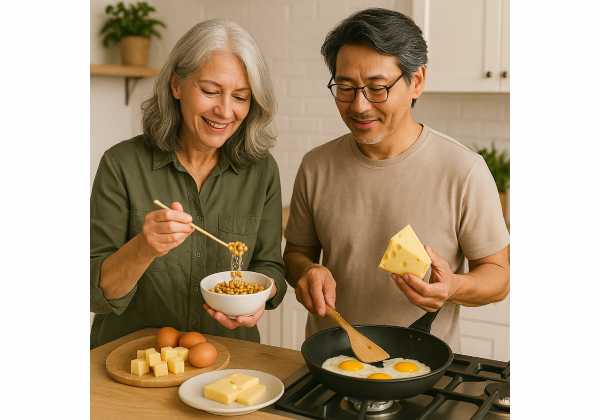
Vitamin K2 belongs in a healthy-aging food pattern because it helps activate proteins involved in bone mineralization and calcium handling. The richest food source is natto, a fermented soybean food high in MK-7, a long-chain form of K2. Cheese offers smaller but useful amounts of several menaquinones, especially in aged and fermented varieties. Eggs provide modest MK-4, along with protein, choline, and other nutrients that fit well into meals for older adults.
Vitamin K2 is not a stand-alone longevity shortcut. It works best inside a plate that also covers protein, calcium, vitamin D, magnesium, fiber, and unsaturated fats. Food sources matter because they bring K2 with a larger nutrition package: natto with soy protein and fermentation compounds, cheese with calcium and protein, and eggs with high-quality protein and choline. People taking warfarin need steady vitamin K intake and clinician guidance before changing these foods.
Table of Contents
- What Vitamin K2 Does in the Body
- K1, K2, MK-4, and MK-7 Without the Confusion
- Best Food Sources: Natto, Cheese, Eggs, and Everyday Options
- How K2 Fits Bone, Vascular, and Metabolic Aging
- How to Build K2-Rich Meals Without Overdoing Calories or Sodium
- Who Needs Caution with Vitamin K2 Foods
- Common Mistakes with K2 Foods
- A Simple Weekly Food Plan for K2
What Vitamin K2 Does in the Body
Vitamin K2 helps the body activate proteins that need vitamin K to work. The process is called carboxylation. In plain language, vitamin K helps certain proteins “switch on” so they bind calcium correctly.
Two proteins explain most of the interest in vitamin K2 for healthy aging:
- Osteocalcin, a protein involved in bone mineralization.
- Matrix Gla protein, often called MGP, a protein studied for its role in limiting inappropriate calcium buildup in soft tissues.
Bones need enough mineral, enough protein structure, and regular loading from movement. Blood vessels, meanwhile, work best when they stay flexible and avoid excess calcification. Vitamin K participates in both areas, which is why K2 often appears in discussions of bone density, arterial calcification, and long-term healthspan.
Vitamin K also supports normal blood clotting. That clotting role is essential, not optional. The body uses vitamin K-dependent clotting factors to stop bleeding after injury. This is also why people taking vitamin K antagonist medicines, especially warfarin, need consistent vitamin K intake rather than sudden increases or decreases.
The adult adequate intake for total vitamin K is commonly listed as 120 mcg per day for men and 90 mcg per day for women. These values cover total vitamin K, not K2 alone. There is no separate official daily target for vitamin K2 from food. That gap matters because K1 and K2 come from different foods and behave differently in the body.
Most adults eating varied diets avoid severe vitamin K deficiency. Severe deficiency in adults is rare and usually involves fat malabsorption, certain medications, or major digestive disease. The more interesting aging question is not classic deficiency, but whether a steady intake of vitamin K-rich foods helps maintain better function over decades.
K1, K2, MK-4, and MK-7 Without the Confusion
Vitamin K is a family of related compounds. The two food forms that matter most are vitamin K1 and vitamin K2.
Vitamin K1, also called phylloquinone, comes mainly from leafy greens and some plant oils. Kale, spinach, collards, broccoli, soybean oil, and canola oil provide K1. K1 strongly supports clotting protein activation in the liver.
Vitamin K2, also called menaquinone, comes mainly from fermented foods and some animal foods. K2 includes several forms, named MK-4, MK-7, MK-8, MK-9, and so on. The number tells you about the side chain structure of the molecule.
The forms differ by food source:
| Form | Common food sources | Why it matters |
|---|---|---|
| K1 | Leafy greens, broccoli, plant oils | Main dietary vitamin K form in many diets; supports normal clotting and overall vitamin K status |
| MK-4 | Egg yolks, chicken, meat, some dairy | Short-chain K2 form found in animal foods; usually present in modest amounts |
| MK-7 | Natto | Long-chain K2 form with high food concentrations in natto |
| MK-8 and MK-9 | Aged cheeses and fermented dairy | Longer-chain menaquinones formed by bacteria during fermentation |
K1-rich vegetables still matter, even in an article about K2. A healthy plate does not trade greens for cheese or eggs. Greens bring vitamin K1, potassium, magnesium, folate, fiber, and carotenoids. K2 foods add a different vitamin K profile.
K2 also comes with more variability than K1. Natto is consistently high in MK-7 when made with the right bacteria. Cheese varies widely by bacterial cultures, fermentation time, fat content, and production method. Eggs vary by the hen’s feed and the yolk content of the serving.
This is why food-first K2 planning should stay simple: eat some fermented foods, include modest amounts of dairy or eggs if they fit your diet, and keep leafy greens as a regular part of meals.
Best Food Sources: Natto, Cheese, Eggs, and Everyday Options
Natto, cheese, and eggs each bring vitamin K2 in different amounts and forms. Natto is the clear K2 heavyweight. Cheese is the most familiar K2 source in many Western diets. Eggs are not high-K2 foods, but they contribute MK-4 in a practical, nutrient-dense package.
Natto: the strongest food source of MK-7
Natto is fermented soybeans. It has a sticky texture, a strong aroma, and a savory flavor that people usually love or need time to learn. A typical 3-ounce serving of natto provides about 850 mcg of vitamin K as MK-7, far more than most foods.
A smaller serving still counts. Even 1–2 tablespoons of natto stirred into rice, added to a bowl, or served with scallions and mustard gives a meaningful K2 dose. People new to natto often do better starting with a teaspoon or tablespoon rather than a full pack.
Natto also brings:
- Soy protein
- Fiber
- Iron, potassium, and magnesium
- Fermentation-derived compounds
- A strong savory flavor that helps simple meals feel satisfying
Natto fits naturally with the broader value of fermented foods for healthy aging, though it is much richer in K2 than yogurt, kefir, kimchi, or miso.
The main caution is medication-related. Natto is not a casual food change for someone taking warfarin. Its MK-7 content is high enough to interfere with anticoagulation control when intake changes suddenly.
Cheese: useful K2 with calcium, protein, sodium, and saturated fat
Cheese contains menaquinones made during fermentation. Hard and aged cheeses often contain more K2 than fresh cheeses, although values vary. Gouda, Edam, Jarlsberg-style cheeses, blue cheese, and some aged curd cheeses often appear in K2 discussions. Cheddar and mozzarella contain smaller amounts in many food tables, but still contribute.
Cheese is not “just K2.” It also provides calcium, protein, phosphorus, and fat. Those nutrients make cheese useful for bone-supportive eating, especially when the rest of the plate includes plants and enough total protein. A calcium-rich eating pattern pairs well with vitamin D and calcium foods for aging bones because bone health depends on more than one nutrient.
The tradeoffs are real. Many cheeses are calorie-dense and high in sodium. Some are high in saturated fat. A practical serving is often 20–40 g, not a large cheese board. Use cheese as a flavor-rich ingredient rather than the main event:
- Crumbled aged cheese over a lentil salad
- A small slice with fruit and walnuts
- Grated hard cheese over vegetables
- Cottage cheese or fresh cheese for protein, while recognizing it usually has less K2 than aged cheese
People managing LDL cholesterol, ApoB, hypertension, or weight gain should choose portions carefully. Cheese can fit, but it should not crowd out beans, vegetables, fish, nuts, or olive oil. For a heart-focused food pattern, connect cheese portions with broader food moves that improve blood lipids rather than treating K2 as a reason to eat unlimited dairy fat.
Eggs: modest MK-4 plus choline and high-quality protein
Eggs provide a small amount of K2, mainly MK-4, in the yolk. A large hard-boiled egg is often listed at about 4 mcg of vitamin K as MK-4. That is modest compared with natto, but eggs bring other nutrients that support healthy aging.
The yolk contains choline, lutein, zeaxanthin, selenium, fat-soluble vitamins, and most of the egg’s K2. The white supplies protein but little fat and little K2. For brain and muscle support, eggs fit especially well with choline-rich foods for cognitive longevity and protein-forward meals.
Eggs work best when paired with fiber-rich plants:
- Eggs with spinach, mushrooms, and tomatoes
- A boiled egg sliced over a bean-and-vegetable bowl
- Egg salad made with Greek yogurt, herbs, and celery
- Vegetable omelet with a small amount of aged cheese
Egg intake should match the person. Many healthy adults tolerate eggs well in the context of a high-fiber, unsaturated-fat-rich diet. People with diabetes, very high LDL cholesterol, familial hypercholesterolemia, or a history of cardiovascular disease should follow individualized guidance from their clinician or dietitian.
Other foods that add smaller amounts
K2 also appears in chicken, pork, beef, liver, butter, fermented dairy, and some fermented vegetables. The amounts are usually modest, and processed meats are not a preferred longevity food just because they contain some K2.
Aging-friendly K2 choices should pass a whole-food test. Natto, eggs, yogurt, kefir, and modest portions of cheese fit better than salami or heavily processed meats. K2 content does not cancel out excess sodium, preservatives, low fiber, or a poor overall dietary pattern.
How K2 Fits Bone, Vascular, and Metabolic Aging
Vitamin K2 is most relevant to healthy aging through bone metabolism and calcium regulation. The evidence is strongest for changes in vitamin K-dependent markers, such as undercarboxylated osteocalcin. Evidence for fractures, cardiovascular events, and long-term disease prevention is more mixed.
Bone: K2 supports the proteins that help bind calcium
Bone is living tissue. It constantly breaks down old mineral and builds new mineral. That remodeling process relies on protein, minerals, hormones, mechanical loading, and several vitamins.
Vitamin K helps activate osteocalcin. Undercarboxylated osteocalcin rises when vitamin K status is low. Carboxylated osteocalcin reflects better vitamin K-dependent activation. Supplement trials and food studies often show that vitamin K2 improves these markers.
That does not mean K2 alone builds strong bones. Bone health also needs:
- Enough total protein
- Calcium-rich foods
- Adequate vitamin D status
- Magnesium and potassium from plants
- Resistance training and impact or weight-bearing movement
- Fall prevention, balance work, and vision correction when needed
K2 foods belong in a larger bone-friendly eating pattern. A natto bowl after a strength session, a yogurt-and-cheese lunch with vegetables, or eggs with greens at breakfast supports the larger system better than a single isolated nutrient.
Blood vessels: promising biology, cautious interpretation
Matrix Gla protein helps regulate calcification in soft tissues. Vitamin K is needed to activate it. This makes K2 interesting for vascular aging, especially arterial stiffness and coronary artery calcification.
Human evidence is not as simple as the mechanism. Observational studies have linked higher menaquinone intake with better cardiovascular patterns in some populations. Trials of vitamin K supplementation show encouraging changes in markers such as inactive MGP and some calcification measures, but results are not uniform enough to treat K2 foods as a proven cardiovascular therapy.
A food-based approach stays reasonable: include K2 foods in a diet that already protects the vascular system. That means vegetables, beans, fruit, whole grains if tolerated, fish or other omega-3 sources, nuts, seeds, olive oil, and controlled sodium. K2 does not replace blood pressure control, lipid management, exercise, or not smoking.
Metabolic health: food context matters more than K2 alone
K2 foods affect metabolic health through the full meal, not only the vitamin. Natto brings soy protein and fiber. Eggs bring protein and satiety. Cheese brings protein and calcium but also sodium and saturated fat.
For healthy aging, the metabolic effect depends on what the K2 food replaces. Natto replacing refined breakfast cereal improves the plate. Eggs replacing a pastry improve the plate. A small piece of aged cheese replacing ultra-processed snacks can improve the plate. Large cheese portions added on top of an already calorie-dense diet move in the wrong direction.
The same food can help or hurt depending on the pattern. A two-egg vegetable omelet with beans and greens is different from eggs with processed meat and white toast. Cheese over a bean salad is different from cheese-heavy pizza with little fiber. Food context decides the result.
How to Build K2-Rich Meals Without Overdoing Calories or Sodium
K2-rich meals should feel normal, filling, and balanced. The easiest method is to start with a protein anchor, add colorful plants, include a healthy fat, and use a K2 food in a portion that fits the meal.
Aging-friendly meals need enough protein to protect muscle. Many adults over 50 do better when each meal includes a clear protein source rather than saving most protein for dinner. K2 foods help here because natto, cheese, and eggs all bring protein. For people mixing animal and plant foods, plant and animal protein for aging muscles offers a useful lens for meal planning.
Use these practical portions:
| Food | Practical serving | Best use | Main watch-out |
|---|---|---|---|
| Natto | 1 tablespoon to 3 ounces | Rice bowls, savory breakfasts, tofu bowls, vegetable bowls | Very high vitamin K; caution with warfarin |
| Aged cheese | 20–40 g | Flavor accent over vegetables, beans, eggs, or whole-grain dishes | Sodium, saturated fat, calories |
| Eggs | 1–2 eggs | Breakfast, salads, bowls, quick dinners | Individual LDL response; yolk needed for K2 and choline |
| Fermented dairy | ¾–1 cup yogurt or kefir | Breakfast, snacks, sauces | Usually less K2 than aged cheese; choose unsweetened versions |
For calorie control, treat cheese as a concentrated food. A small amount delivers flavor. Grating hard cheese creates more surface area and spreads taste through the meal. Strong cheeses help because a little goes further.
For sodium control, compare labels. Cheese sodium varies widely. Natto sauce packets also add sodium, so use only part of the packet or season with scallions, mustard, ginger, vinegar, or chili instead.
For better absorption, include some fat with vitamin K-rich plant foods. Vitamin K is fat-soluble. A salad with olive oil, avocado, nuts, seeds, egg yolk, or cheese supports absorption better than dry raw greens alone. This fits well with healthy fats for longevity, especially olive oil, nuts, seeds, and avocado.
Meal examples:
- Natto, brown rice, cucumber, scallions, sesame seeds, and a soft egg
- Lentil salad with arugula, roasted peppers, walnuts, and shaved aged cheese
- Two eggs with spinach, mushrooms, tomatoes, and a side of berries
- Greek yogurt bowl with berries and nuts, plus a small cheese-and-vegetable plate at lunch
- Tofu and vegetable bowl with a spoonful of natto stirred in after cooking
The best K2 meal is the one repeated comfortably. A food that feels punishing will not stay in the rotation.
Who Needs Caution with Vitamin K2 Foods
Vitamin K2 foods are safe for most adults in normal food portions. The main caution is not toxicity. It is medication interaction and sudden intake change.
People taking warfarin need consistent vitamin K intake. Warfarin works by opposing vitamin K activity. A sudden increase in natto, greens, or K2 supplements can change INR control. The usual advice is not “avoid all vitamin K.” It is to keep intake steady and coordinate with the clinician managing anticoagulation.
Natto deserves special attention because it contains very high MK-7. A person on warfarin should not add natto casually. Even a healthy food becomes risky when it changes anticoagulation balance.
Other groups needing professional guidance include:
- People with fat malabsorption, including some with celiac disease, Crohn’s disease, pancreatic insufficiency, bile duct disease, or short bowel syndrome
- People after certain bariatric surgeries
- People taking bile acid sequestrants such as cholestyramine or colestipol
- People using orlistat, which reduces fat absorption
- People on long courses of antibiotics when diet quality is poor
- People with advanced kidney disease, especially if mineral metabolism is abnormal
- People with soy allergy, for natto
- People with egg allergy, for eggs
Food safety also matters more with age. Older adults and immunocompromised people should handle eggs, dairy, and fermented foods carefully. Choose pasteurized dairy, keep cold foods cold, avoid cracked eggs, cook eggs until safe for the person’s risk level, and follow storage dates. Safe handling fits into broader food safety for older adults, especially when adding fermented or animal foods.
K2 supplements are a separate decision. This article focuses on food. Supplements deliver isolated doses that may be much higher than usual food intake, and they deserve clinician review when medications, kidney disease, osteoporosis treatment, or cardiovascular disease are involved.
Common Mistakes with K2 Foods
K2 foods help most when they improve the whole diet. The common mistakes come from turning a useful nutrient into a magic bullet.
Mistake 1: Eating large amounts of cheese “for K2.”
Cheese contributes K2, calcium, and protein, but large portions add calories, sodium, and saturated fat. Use aged cheese as a flavorful accent. Natto is a stronger K2 source if the person wants a food-based boost and can safely eat soy.
Mistake 2: Ignoring leafy greens because K2 sounds more advanced.
K1-rich greens remain valuable. They supply vitamin K, minerals, fiber, and phytochemicals. A longevity plate should include both green plants and, when tolerated, K2 foods.
Mistake 3: Treating eggs as a high-K2 food.
Eggs contain MK-4, but the amount is modest. Their bigger value is the package: protein, choline, carotenoids, selenium, and convenience.
Mistake 4: Adding natto while on warfarin without medical guidance.
Natto is extremely high in vitamin K2. Sudden changes in intake can interfere with anticoagulation management.
Mistake 5: Expecting K2 to replace resistance training.
Bone needs loading. Nutrition supplies materials and cofactors; muscles and bones still need force. Strength training, walking, stair climbing, balance work, and safe impact progressions remain central.
Mistake 6: Buying supplements before fixing meals.
Food patterns solve more than one problem at once. A meal with protein, fiber, plants, and K2 foods supports muscle, gut function, glucose control, and micronutrient adequacy better than a capsule added to a weak diet.
A Simple Weekly Food Plan for K2
A practical K2 plan uses repeatable foods, not complicated tracking. Since there is no official K2-only target, focus on steady inclusion rather than chasing a number.
For most adults not taking warfarin, a simple weekly rhythm looks like this:
- Eat leafy greens or cruciferous vegetables most days for K1, fiber, magnesium, and potassium.
- Use one K2-rich fermented food if it fits your diet, such as natto once or several times weekly.
- Use aged cheese in small portions when it improves a plant-rich meal.
- Include eggs if tolerated, especially when they replace lower-protein breakfasts or snacks.
- Keep the rest of the diet rich in beans, fish or other omega-3 foods, nuts, seeds, fruit, olive oil, and enough total protein.
A week might look like this:
| Day | K2 food idea | Balanced plate |
|---|---|---|
| Monday | Eggs | Vegetable omelet with spinach, mushrooms, tomatoes, and fruit |
| Tuesday | Aged cheese | Lentil salad with arugula, olive oil, walnuts, and shaved cheese |
| Wednesday | Natto | Natto rice bowl with cucumber, scallions, sesame, and tofu or egg |
| Thursday | Eggs | Boiled egg over bean-and-vegetable soup or salad |
| Friday | Fermented dairy or cheese | Unsweetened yogurt with berries and nuts, or vegetables with a small cheese portion |
| Saturday | Natto or eggs | Savory breakfast bowl with greens and whole grains |
| Sunday | Aged cheese | Vegetable soup, beans, herbs, olive oil, and grated hard cheese |
People who dislike natto still have options. Use cheese in modest amounts, include eggs if appropriate, eat greens often, and build the rest of the diet well. People who eat fully plant-based diets get plenty of K1 from greens but have fewer reliable K2 foods unless they eat natto. That makes natto especially useful for plant-based eaters who enjoy it and do not have medication conflicts.
Vitamin K2 from food works best as a quiet habit. A spoonful of natto, a small amount of aged cheese, or eggs in a plant-rich meal will not transform health by itself. Repeated over months and years, these foods add one more layer to a pattern that protects bone, muscle, vascular function, and resilience.
References
- Vitamin K – Health Professional Fact Sheet 2021 (Fact Sheet)
- Vitamin K – a scoping review for Nordic Nutrition Recommendations 2023 2023 (Review)
- Menaquinone Content of Cheese 2018 (Food Analysis)
- Habitual natto intake elevates serum MK-7 levels, enhances osteocalcin carboxylation, and supports bone density: a meta-analysis of Japanese evidence 2025 (Meta-analysis)
- Effects of vitamin K supplementation on bone mineral density at different sites and bone metabolism in the middle-aged and elderly population 2024 (Meta-analysis)
- Vitamin K supplementation and vascular calcification: a systematic review and meta-analysis of randomized controlled trials 2023 (Systematic Review)
Disclaimer
This article is educational and does not replace care from a qualified health professional. People taking warfarin or other anticoagulant therapy should not change vitamin K intake, add natto, or use vitamin K supplements without guidance from the clinician managing their medication. People with osteoporosis, kidney disease, malabsorption, or complex medication plans should get individualized nutrition advice.