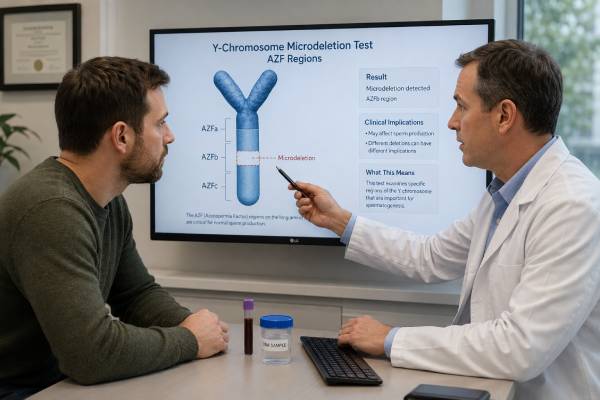
A Y-chromosome microdeletion test looks for missing DNA in the azoospermia factor, or AZF, regions of the Y chromosome. These regions contain genes needed for sperm production, so a deletion can explain non-obstructive azoospermia or a very low sperm concentration and can influence whether surgical sperm retrieval is likely to succeed. The result must name the deleted region: complete AZFa, complete AZFb, combined AZFbc, and complete AZFc deletions do not have the same prognosis. Partial AZFc findings such as gr/gr deletions are different again and may be population-dependent risk factors rather than a complete explanation for infertility. Testing is usually performed on blood DNA by validated multiplex PCR markers. It is not a general test of every fertility gene or the entire Y chromosome. A negative result therefore does not rule out genetic male infertility. The test is most useful when ordered after repeated semen analysis and clinical evaluation show severely impaired sperm production rather than an obstruction.
- The indication matters. Current guidance targets azoospermia and extremely low sperm concentration with evidence of impaired sperm production, not every abnormal semen analysis.
- The deleted AZF region predicts clinical options. Complete AZFa or AZFb deletions have a very poor sperm-retrieval prognosis; complete AZFc deletions have variable outcomes.
- “Microdeletion positive” is incomplete reporting. The exact region, markers, and whether the deletion is complete or partial are essential.
- An AZFc deletion can be passed to a son. Sperm used through ICSI carries the same Y chromosome, so male offspring are expected to inherit the deletion.
- A negative test does not end the workup. Karyotype, hormones, examination, imaging, and selected gene tests may still identify another cause.
Table of Contents
- Why the Y chromosome matters for sperm production
- Who should be offered AZF microdeletion testing
- How the laboratory detects a microdeletion
- What AZFa, AZFb, and AZFc results mean
- How results change sperm retrieval and treatment plans
- Inheritance, ICSI, and family-building decisions
- Limitations, companion tests, and questions to ask
Why the Y chromosome matters for sperm production
The Y chromosome contains genes involved in sex development and spermatogenesis. On its long arm, Yq, lies a complex region called AZF. It contains repeated and nearly identical DNA blocks that make the chromosome vulnerable to rearrangement during cell division. Recombination between the wrong repeated segments can remove a stretch of DNA while leaving the rest of the Y chromosome present.
Clinically important deletions are grouped into AZFa, AZFb, and AZFc. These labels describe overlapping functional regions rather than three simple single genes. AZFa includes genes such as USP9Y and DDX3Y. AZFb contains multiple genes and transcription units important for germ-cell development. AZFc includes repeated gene families such as DAZ, CDY1, and BPY2. Because the architecture is repetitive, the same broad region can be lost through recurrent deletion mechanisms in unrelated individuals.
A person with an AZF microdeletion usually has typical male external anatomy and may have normal testosterone production. The primary effect is often on the germ cells that become sperm. Depending on the deletion, testicular histology may show absence of germ cells, maturation arrest, or reduced and patchy sperm production.
Azoospermia means no sperm are found in the ejaculate after appropriate semen analysis, including examination of the centrifuged pellet. It can be obstructive, where sperm production is preserved but blocked, or non-obstructive, where production is severely impaired. AZF deletions cause the non-obstructive form. Testing is therefore less informative when examination, hormones, semen volume, or imaging strongly support an obstruction.
Severe oligozoospermia means a very low sperm concentration. Thresholds differ across older studies and guidelines, but the probability of a clinically important Y deletion rises as sperm concentration falls. Current U.S. guidance uses a much lower threshold than earlier recommendations, focusing testing on azoospermia or sperm concentration of 1 million/mL or less when primary infertility and signs of impaired sperm production are present.
The deletion is generally a new event in the patient because severe infertility limits natural father-to-son transmission. With intracytoplasmic sperm injection, however, a sperm carrying the deleted Y can fertilize an egg, making inheritance counseling essential.
Who should be offered AZF microdeletion testing
A Y-chromosome microdeletion test should answer a defined question: is a missing AZF region contributing to severe sperm-production failure, and would that result change counseling or treatment?
The evaluation should begin with at least two semen analyses when possible because sperm concentration fluctuates. A laboratory should confirm azoospermia by examining the pellet after centrifugation. The clinician also reviews testicular size, epididymis and vas deferens, varicocele, prior surgery or infection, medications, testosterone or anabolic steroid exposure, chemotherapy, radiation, childhood undescended testes, and family history.
Hormonal testing commonly includes follicle-stimulating hormone and testosterone. Elevated FSH and small testes support impaired sperm production, although normal FSH does not exclude focal spermatogenesis. Low semen volume, acidic pH, or absent vas deferens may instead suggest obstruction and point toward CFTR-related testing or imaging.
The 2024 AUA/ASRM male infertility guideline recommends Y-chromosome microdeletion analysis for males with primary infertility who have azoospermia or a sperm concentration of 1 million/mL or less when elevated FSH, testicular atrophy, or a presumed diagnosis of impaired sperm production is present. European laboratory guidance similarly emphasizes azoospermia and severe oligozoospermia, while local thresholds and health-system policies may differ.
Testing may also be appropriate before testicular sperm extraction because a complete AZFa or AZFb deletion can prevent a futile operation. For an individual with very rare sperm in the ejaculate, an AZFc result can support discussion of sperm cryopreservation before further decline.
Routine testing is usually low yield when sperm concentration is above the severe range, when infertility is clearly obstructive, or when a reversible exposure is the likely cause. It is also not a test for erectile dysfunction, libido, sperm motility alone, recurrent miscarriage in a partner, or general health screening.
A karyotype is often ordered in parallel for non-obstructive azoospermia or severe oligozoospermia because chromosome-number or structural abnormalities can coexist or provide an alternative diagnosis. Klinefelter syndrome, mosaic sex chromosome findings, translocations, and other visible changes require a different test. The parental karyotype test guide explains that chromosome-level evaluation.
Pretest counseling should cover the possible effect on sperm-retrieval decisions, transmission to sons, uncertain partial deletions, cost, and the fact that a negative result leaves many causes unresolved.
How the laboratory detects a microdeletion
The standard clinical method uses DNA extracted from blood and multiplex polymerase chain reaction, or PCR. The laboratory amplifies selected sequence-tagged sites, known as STS markers, distributed across AZFa, AZFb, and AZFc. A control marker confirms that amplifiable DNA is present, and a female DNA control helps show that Y-specific targets are not being amplified nonspecifically.
International EAA/EMQN guidance recommends a validated core marker set that detects the vast majority of clinically relevant complete AZF deletions. When one or more markers are absent, the laboratory repeats or confirms the finding and performs deletion extension analysis with additional markers to define the boundaries. Correct boundary classification matters because a deletion initially called AZFb may actually extend into AZFc and carry a different but still poor prognosis.
PCR is well suited to this repetitive region because it asks whether carefully selected Y sequences are present. More markers are not automatically better. Poorly chosen or polymorphic markers can create false deletion calls, and commercial panels vary. A laboratory should follow current marker recommendations, use appropriate controls, and participate in external quality assessment.
Some tests use microarray, next-generation sequencing, droplet digital PCR, or another copy-number method. These platforms may identify atypical or partial changes, but repetitive Y-chromosome structure can be difficult to map. A result from a broad genomic test should be confirmed or interpreted under validated AZF standards before it is used to cancel surgery or make reproductive decisions.
The report should state:
- whether a deletion was detected;
- the region or regions involved;
- whether it appears complete or partial;
- which STS markers were absent and present;
- whether extension testing was performed;
- the expected association with sperm production and retrieval;
- inheritance implications;
- assay limitations.
A sample can be mislabeled, contaminated, or affected by rare Y-chromosome variants at primer-binding sites. An unexpected result should be confirmed on a second DNA extraction or new sample according to laboratory policy. Testing a father can occasionally clarify whether a partial deletion is inherited, but a father’s fertility does not guarantee that the same Y structure is harmless because effects may vary with genetic background and age.
Y microdeletion analysis does not sequence all genes on the Y chromosome. It does not measure sperm DNA fragmentation, hormones, chromosomal aneuploidy in individual sperm, or epigenetic quality. It is a targeted copy-loss assay.
What AZFa, AZFb, and AZFc results mean
The exact deletion category is the core of interpretation.
Complete AZFa deletion is usually associated with Sertoli-cell-only histology, meaning the seminiferous tubules lack germ cells. Mature sperm are not expected in the ejaculate, and surgical sperm retrieval has an extremely poor prognosis. A report should distinguish a complete AZFa deletion from smaller or atypical AZFa changes, because rare partial deletions can behave differently.
Complete AZFb deletion is usually associated with severe maturation arrest, in which germ cells do not complete sperm development. Complete AZFb and large combined AZFbc deletions have a very poor sperm-retrieval prognosis. Boundary errors are clinically consequential, so extension analysis should verify that the deletion is complete.
Complete AZFc deletion has the broadest phenotype. Some individuals have non-obstructive azoospermia; others have severe oligozoospermia or, less commonly, enough ejaculated sperm for assisted reproduction. Testicular sperm may be found because spermatogenesis can persist in small focal areas. Retrieval rates vary widely among studies because patients, techniques, pathology, and deletion subtypes differ. A positive AZFc result supports possibility, not certainty.
Sperm concentration in AZFc deletion carriers may decline over time. When viable ejaculated sperm are present, early cryopreservation can be discussed rather than assuming a later sample will be equivalent. The decision depends on count, motility, reproductive plans, and laboratory quality.
Complete AZFbc or AZFabc deletion removes more extensive material and generally resembles the poor prognosis of complete AZFb involvement. Large deletions may also be associated with broader Y-chromosome structural abnormalities that require cytogenetic review.
Partial AZFc deletions include gr/gr, b2/b3, and other rearrangements. A gr/gr deletion removes part, not all, of AZFc and is not equivalent to a complete AZFc deletion. Its association with impaired sperm production varies across Y-chromosome haplogroups and populations. Some fertile men carry it. Current European guidance treats gr/gr as a population-specific risk factor and leaves testing to laboratory and clinician discretion. It should not be presented as a deterministic diagnosis or used alone to predict micro-TESE outcome.
Negative result means the tested markers were present. It does not exclude an untested atypical Y deletion, a sequence variant, Klinefelter syndrome, another chromosome abnormality, an autosomal or X-linked infertility gene, prior gonadotoxic exposure, endocrine suppression, varicocele, cryptorchidism-related damage, or unexplained testicular failure.
Inconclusive or atypical result may arise from isolated marker failure, poor DNA, primer-site variation, or a complex rearrangement. Repeating the same unvalidated marker is not enough. The laboratory should use alternative markers, extension studies, or another validated method before assigning an AZF category.
How results change sperm retrieval and treatment plans
Y microdeletion testing has unusual clinical utility because some results can prevent an invasive procedure with almost no chance of success.
For a confirmed complete AZFa or complete AZFb deletion, testicular sperm extraction is generally not recommended because mature sperm have not been reliably retrieved in well-characterized complete deletions. Counseling can move directly to alternatives such as donor sperm, donor embryos, adoption, or choosing not to pursue parenthood. If an older or limited report simply says “AZFb deletion,” expert review of the markers and boundaries is reasonable before excluding surgery.
For a complete AZFc deletion, microdissection testicular sperm extraction, or micro-TESE, may be considered when no sperm are found in the ejaculate. During micro-TESE, a surgeon examines testicular tissue under magnification to identify larger seminiferous tubules that may contain focal sperm production. Success depends on more than the deletion: surgical expertise, pathology, testicular volume, prior procedures, age, and laboratory processing can matter. No hormone level or deletion subtype guarantees retrieval.
When rare ejaculated sperm are present, repeated careful semen searches and cryopreservation may avoid or postpone surgery. Multiple frozen aliquots may be considered because only a small number of sperm are required for ICSI but thaw survival and laboratory needs vary.
Retrieved or ejaculated sperm from severe male-factor infertility generally require intracytoplasmic sperm injection, where one sperm is injected into an egg. Conventional IVF relies on sperm penetrating the egg and is often not practical at these counts. ICSI overcomes the fertilization barrier but does not repair the Y deletion or guarantee embryo development, pregnancy, or live birth.
A positive microdeletion does not remove the need to evaluate the female partner and the couple’s combined reproductive prognosis. Ovarian age and reserve, uterine factors, embryo development, finances, and treatment burden influence whether sperm retrieval is a reasonable path.
Hormonal “optimization” cannot replace genes deleted from the Y chromosome. Treatment of a true endocrine deficiency, stopping exogenous testosterone, or addressing another reversible factor may improve sperm production in selected patients, but supplements or empiric hormone regimens have not been shown to regenerate a completely deleted AZF region. Clomiphene, aromatase inhibitors, gonadotropins, or antioxidants should be prescribed only for an appropriate indication, not because an AZF result is positive.
Varicocele repair decisions also require separate evidence. A microdeletion may coexist with a varicocele, but repairing the vein does not reverse the deletion. The expected benefit should be based on examination, semen parameters, hormones, female-partner factors, and the specific genetic prognosis.
Inheritance, ICSI, and family-building decisions
The Y chromosome is transmitted from a genetic father to a son. If sperm carrying an AZF deletion is used for conception, a male embryo that inherits that Y chromosome is expected to inherit the deletion. A daughter does not inherit the paternal Y chromosome.
For complete AZFc deletions, this means a son may face severe oligozoospermia or azoospermia as an adult. The exact degree cannot be predicted from the father’s sperm count because expression can vary. The deletion does not generally cause childhood illness, intellectual disability, or a broad congenital syndrome by itself; its principal expected consequence is impaired sperm production.
This creates several family-building options:
- proceed with ICSI using the patient’s sperm after counseling about transmission;
- use donor sperm to avoid transmitting the deleted Y;
- consider embryo testing or sex-selection strategies where legally and ethically available;
- use donor embryos, adoption, or another path;
- preserve sperm and defer the decision.
Preimplantation genetic testing is not a simple universal solution. A laboratory may be able to design targeted testing for a known deletion or select embryos without a Y chromosome, but accuracy, embryo number, regulation, ethics, and clinic policy vary. Testing embryos adds IVF biopsy and laboratory limitations, and it cannot guarantee a child without unrelated genetic conditions. The preimplantation genetic testing guide explains those general limits.
Couples should understand that choosing a female embryo to avoid Y transmission is different from diagnosing an embryo for the deletion itself. Policies on nonmedical sex selection and medical avoidance of an inherited infertility factor differ by country and professional body. A genetics and reproductive medicine team can explain what is technically feasible and locally permitted.
If a son is conceived with the deletion, disclosure can be planned in an age-appropriate way. There is usually no need for childhood semen testing. Counseling near adolescence or adulthood can support reproductive awareness, avoidance of gonadotoxic exposures, and timely semen analysis or sperm cryopreservation if sperm are present. The family should retain the father’s complete laboratory report because the exact deletion boundaries may guide future care.
An AZF deletion discovered in a fertile father or brother requires nuanced interpretation. Complete clinically significant deletions are rarely transmitted naturally, but partial deletions and variable AZFc phenotypes can occur in fertile men. Family testing should be targeted and accompanied by counseling, not used to label all male relatives infertile.
Limitations, companion tests, and questions to ask
Y-chromosome microdeletion testing explains only a minority of severe male infertility. It is powerful when positive in the right patient, but narrow by design.
The test does not detect chromosome count or balanced structural changes; a karyotype is needed for those. It does not diagnose CFTR-related congenital absence of the vas deferens, which causes obstruction rather than testicular production failure. It does not identify most single-gene causes of non-obstructive azoospermia, and broader infertility gene panels or exome sequencing may be considered when phenotype, family history, or specialist guidance supports them.
A complete evaluation can include:
- repeat semen analyses with pellet examination;
- reproductive history and physical examination;
- FSH, testosterone, and selected additional hormones;
- karyotype for azoospermia or severe oligozoospermia;
- CFTR testing when the vas deferens is absent or obstruction is suspected;
- scrotal or transrectal imaging for selected anatomic questions;
- targeted gene testing for syndromic or familial clues;
- genetic counseling before sperm retrieval or ICSI.
Sperm DNA fragmentation testing answers a different question and does not substitute for AZF analysis. Likewise, a normal ultrasound of the testes cannot rule out a microdeletion, and a testicular biopsy is not required simply to order the blood test.
Before testing, ask:
- Does my history suggest non-obstructive rather than obstructive azoospermia?
- Were at least two semen analyses performed, including a centrifuged pellet search?
- Why does my sperm concentration meet this laboratory or guideline threshold?
- Are karyotype or CFTR testing indicated at the same time?
- Will the laboratory distinguish complete from partial AZF deletions and perform extension analysis?
After a positive result, ask:
- Which exact markers are absent, and is the deletion complete?
- Does AZFb involvement make sperm retrieval futile, or does the report need expert boundary review?
- If the deletion is AZFc, are ejaculated sperm available for cryopreservation before surgery?
- What is this center’s micro-TESE experience in patients with the same deletion category?
- What would a son inherit, and what reproductive options are available locally?
After a negative result, ask what remains unexplained. “No AZF deletion detected” is not the same as “no genetic cause.” If non-obstructive azoospermia remains idiopathic, a male reproductive urologist or clinical geneticist can review whether broader testing is appropriate and whether the result would change treatment.
Keep the full report rather than a portal label. Future clinicians need the assay version, STS markers, deletion category, extension analysis, and laboratory interpretation. Marker standards evolve, and an old report may warrant reinterpretation before a major procedure.
The value of the test is practical: it can provide an etiologic diagnosis, prevent low-value surgery in complete AZFa or AZFb deletion, support realistic AZFc retrieval counseling, and identify a predictable father-to-son inheritance issue. It should be used as one precise part of a complete infertility evaluation, not as a stand-alone verdict on masculinity, sexual function, or the possibility of becoming a parent.
References
- American Urological Association and American Society for Reproductive Medicine: Male Infertility Guideline (2024, guideline)
- EAA/EMQN best practice guidelines for molecular diagnosis of Y-chromosomal microdeletions (2023, laboratory guideline)
- Updates to Male Infertility: AUA/ASRM Guideline (2024, guideline update)
- The Y chromosome: male reproduction and beyond (2025, review)
- Factors associated with ICSI outcomes in men with complete AZFc microdeletions (2024, research article)
- NICE fertility guideline evidence review: Y-chromosome microdeletion (2026, evidence review)
Disclaimer
This article is for general education and does not replace evaluation by a reproductive urologist, fertility specialist, or genetics professional. Testing thresholds, marker panels, sperm-retrieval outcomes, and reproductive regulations vary. Personal treatment decisions require review of the exact laboratory report and the couple’s complete clinical situation.