Outdoor conditioning turns ordinary places into a long-term fitness tool. A hill near your home, a public staircase, a park path, a trail, or a sloped driveway gives your heart, lungs, legs, balance, and coordination a stronger signal than flat walking alone. The work feels simple, but the training effect is broad: uphill effort raises aerobic demand, stairs build leg strength and power, downhill sections train controlled braking, and uneven ground challenges balance with every step.
For healthy aging, this matters because real life rarely happens on smooth, level surfaces. You climb curbs, carry groceries, cross wet pavement, step over roots, and recover from small stumbles. Outdoor conditioning prepares the body for those demands while adding fresh air, variety, and a lower barrier to consistency. Done well, it supports VO₂max, walking capacity, bone and tendon loading, insulin sensitivity, and confidence outside the gym.
Table of Contents
- Why Outdoor Conditioning Builds Longevity Fitness
- Hills, Stairs, and Terrain Do Different Jobs
- How to Control Intensity Without a Lab
- Beginner to Advanced Outdoor Workouts
- Joint Safety, Footwear, and Fall Risk
- How to Fit Outdoor Conditioning Into Your Week
- Tracking Progress and Knowing When to Back Off
Why Outdoor Conditioning Builds Longevity Fitness
Outdoor conditioning improves the qualities that keep adults capable: aerobic capacity, leg strength, balance, coordination, and confidence moving through changing environments. Flat walking is valuable, but hills, stairs, and natural surfaces add intensity and skill without requiring complex equipment.
Aging tends to reduce maximal aerobic capacity, fast muscle force, ankle strength, reaction speed, and balance reserve. Those changes show up in daily life as slower walking, difficulty with stairs, fear on uneven paths, shorter hiking tolerance, and more fatigue during errands. Outdoor conditioning addresses those losses in the same settings where they matter.
Uphill walking raises oxygen demand quickly because the body lifts its mass against gravity. This makes a modest walking speed feel like a strong cardiovascular workout. Stairs add an even larger vertical component and require repeated single-leg force. Uneven ground adds small balance corrections through the feet, ankles, hips, trunk, and eyes. These small adjustments strengthen the movement system in a way that treadmills and smooth sidewalks do not fully copy.
Outdoor work also trains pacing. A hill teaches you to manage effort before you run out of breath. Stairs teach rhythm and controlled breathing. A trail teaches foot placement, attention, and relaxed recovery after small slips or awkward steps. These skills protect independence because they transfer to travel, gardening, errands, commuting, and social activities.
For adults already following Zone 2 training, outdoor conditioning adds variety without abandoning the aerobic base. For adults focused on VO₂max intervals, hills and stairs offer a safer, lower-speed way to reach higher intensities than sprinting on flat ground.
The best outdoor plan does not chase exhaustion. It repeats manageable doses often enough for the body to adapt. A useful starting target is 1–3 outdoor conditioning sessions per week, each lasting 15–45 minutes depending on fitness, terrain, and recovery.
Hills, Stairs, and Terrain Do Different Jobs
Hills, stairs, and varied terrain all improve conditioning, but they load the body differently. Treat them as separate tools rather than interchangeable workouts.
| Tool | Main training effect | Best use | Watch point |
|---|---|---|---|
| Gentle hill | Aerobic fitness with moderate leg demand | Long steady climbs, beginner intervals | Calf and Achilles load |
| Steep hill | High-intensity cardiovascular work and hip drive | Short intervals, power hiking | Breathlessness and form breakdown |
| Stairs | Leg strength, aerobic intensity, step confidence | Short bouts, repeat climbs, daily movement snacks | Knee irritation on descent |
| Uneven trail | Balance, foot control, gait adaptability | Easy-to-moderate conditioning walks | Trip risk when fatigued |
| Downhill | Eccentric control, braking strength, coordination | Careful descents after uphill work | Quadriceps soreness and knee load |
Hills build aerobic capacity without high speed
Hills are the most forgiving way to make walking hard. Speed stays low, impact stays modest, and the heart rate rises because the body performs more mechanical work. This suits adults who dislike running or who want stronger conditioning without repeated pounding.
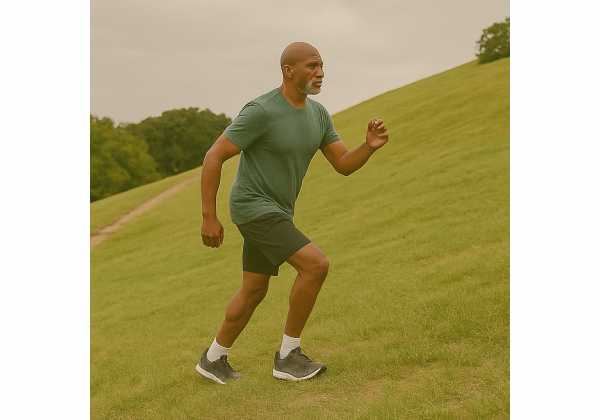
A gentle incline works well for steady aerobic sessions. A steeper hill works well for intervals. During uphill work, shorten your stride, keep your chest tall, and think about pushing the ground behind you rather than reaching far in front. The calves, glutes, hamstrings, and hip flexors all contribute.
Downhill walking deserves respect. It trains the quadriceps eccentrically, meaning the muscles lengthen while controlling your descent. This is useful for hiking and stairs, but too much downhill volume causes soreness. Early sessions should include more uphill than downhill stress when possible, such as walking up a hill and returning by a gentler route.
Stairs combine conditioning with leg strength
Stair climbing is intense because every step asks one leg to lift the body. Even short stair bouts raise breathing quickly. This makes stairs useful for busy adults who want a strong training signal in 5–15 minutes.
Use a handrail when learning, when descending, or when fatigue changes your foot placement. Step with the whole foot when possible, drive through the midfoot and heel, and avoid bouncing off the toes on every step. For many adults, walking stairs beats running stairs because it gives nearly all of the conditioning benefit with less risk.
Stairs fit naturally into everyday life. One or two flights after lunch, a controlled climb at the park, or a few repeats in an apartment building all count. People with knee pain should progress slowly and emphasize the climb more than the descent. More joint-friendly options are covered in knee and hip friendly training.
Terrain teaches the body to adapt
Uneven terrain trains the nervous system as much as the muscles. Grass, gravel, packed dirt, forest paths, sand, and cobblestones ask for small changes in stride length, ankle angle, trunk position, and visual attention. This is valuable because falls often happen when the ground changes unexpectedly.
Begin with predictable terrain: a park path with mild texture, a flat grass field, or a wide dirt trail. Save rocky paths, wet roots, loose gravel, and steep off-camber trails for later. Early terrain work should feel almost too easy from a heart-rate perspective because the skill demand is the main training stress.
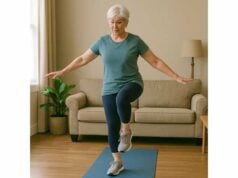
This work pairs well with balance and fall prevention drills. Formal balance work builds control in a quiet setting; outdoor terrain teaches you to use that control while moving.
How to Control Intensity Without a Lab
Outdoor intensity changes with slope, stairs, footing, wind, temperature, and fatigue. A pace that feels easy on a flat sidewalk feels hard on a hill. For longevity training, effort control matters more than speed.
Use three simple tools: talk test, breathing, and rating of perceived exertion, often called RPE. RPE is a 1–10 effort scale, where 1 feels extremely easy and 10 feels like a true maximum.
| Effort level | RPE | Talk test | Best outdoor use |
|---|---|---|---|
| Easy | 2–3 | Full sentences | Warm-ups, recovery walks, beginner terrain practice |
| Moderate | 4–5 | Short conversation | Steady hills, longer trail walks, Zone 2-style conditioning |
| Hard | 6–8 | Brief phrases | Hill repeats, stair repeats, short vigorous blocks |
| Very hard | 9 | Single words | Advanced short intervals only |
| Maximum | 10 | No talking | Not needed for longevity conditioning |
A strong weekly plan includes mostly easy and moderate work with a small amount of hard work. This matches the needs of long-term training: enough stress to improve, enough recovery to repeat.
Heart-rate tracking helps, but outdoor readings drift with heat, dehydration, caffeine, poor sleep, and accumulated fatigue. Wrist sensors also struggle during cold weather, gripping poles, or stair rail use. Treat heart rate as one input, not the boss. Breathing, posture, and repeatability give better real-world feedback.
During uphill walking, the first sign of too much intensity is usually a shortened, choppy stride with the shoulders lifting toward the ears. During stairs, the warning sign is pulling hard on the railing or missing full foot contact. During terrain work, the warning sign is looking down constantly, stumbling often, or losing relaxed rhythm.
Use the “one more repeat” rule. Finish most workouts feeling as if you had one clean repeat left. That restraint protects consistency and reduces the chance of Achilles flare-ups, knee irritation, and deep soreness.
Beginner to Advanced Outdoor Workouts
Outdoor conditioning should match your current walking ability, joint tolerance, and recovery. Progress from easier surfaces to harder surfaces, from shorter climbs to longer climbs, and from controlled effort to higher effort.
Beginner: build rhythm and confidence
Start with short, repeatable sessions. The first month should leave you fresher, not beaten up.
Workout 1: Gentle hill walk
- Warm up for 5–8 minutes on flat ground.
- Walk uphill for 1 minute at RPE 4–5.
- Walk flat or downhill slowly for 2 minutes.
- Repeat 4–6 times.
- Cool down for 5 minutes.
This session builds aerobic capacity and leg endurance without high impact. Choose a slope that lets you keep steady breathing and stable posture.
Workout 2: Stair introduction
- Warm up for 5 minutes.
- Climb 1 flight at an easy pace.
- Walk down slowly using the rail.
- Rest 60–90 seconds.
- Repeat 4–8 total flights.
- Stop before the legs feel shaky.
This is enough for the first two weeks. Add volume only when the next day feels normal.
Workout 3: Easy terrain walk
- Walk 15–25 minutes on grass, packed dirt, or a smooth trail.
- Keep effort at RPE 2–4.
- Look 2–4 steps ahead, not straight down.
- Avoid wet, rocky, or crowded routes at first.
This trains foot placement and awareness while keeping cardiovascular stress low.
Intermediate: add structure and harder climbs
After 4–8 weeks of consistent beginner work, add longer climbs or controlled intervals.
Workout 1: Hill repeats
- Warm up for 8–10 minutes.
- Climb 2 minutes at RPE 6–7.
- Recover 2–3 minutes with easy walking.
- Repeat 5–8 times.
- Cool down for 5–10 minutes.
This provides a strong VO₂max-oriented signal without sprinting. Keep the stride short and powerful.
Workout 2: Stair ladder
- Climb 1 flight, rest 30–60 seconds.
- Climb 2 flights, rest 60–90 seconds.
- Climb 3 flights, rest 90 seconds.
- Return down the ladder if form stays clean.
- Use the handrail on descents.
This workout builds leg strength, breathing control, and stair confidence. Stop the ladder early if your knees complain or your foot placement gets sloppy.
Workout 3: Rolling terrain walk
- Walk 35–60 minutes on varied but safe terrain.
- Keep most of the walk at RPE 3–5.
- Let short hills rise naturally to RPE 6.
- Stay relaxed on descents.
This resembles real hiking and supports durable conditioning. Adults who enjoy loaded walking should first master unloaded terrain, then consider walking and rucking progressions with light loads.
Advanced: use outdoor work like a training block
Advanced outdoor conditioning does not mean reckless speed. It means precise work, strong recovery, and enough movement skill for the setting.
Workout 1: Power hiking intervals
- Warm up for 10–15 minutes.
- Climb 3–4 minutes at RPE 7–8.
- Recover 3 minutes easy.
- Repeat 4–6 times.
- Cool down fully.
This session gives a large aerobic stimulus. It suits steep hills, hiking trails, or long stair sections.
Workout 2: Short stair power
- Warm up with flat walking and easy step-ups.
- Climb 10–20 seconds briskly.
- Recover 90–120 seconds.
- Repeat 6–10 times.
- Keep every rep crisp.
This develops power and high-end conditioning. Avoid running down the stairs. Descend slowly or take an elevator if available.
Workout 3: Technical terrain conditioning
- Choose a trail with moderate surface variety.
- Walk 45–75 minutes at mostly easy-to-moderate effort.
- Include 5–8 short uphill surges of 20–45 seconds.
- Keep descents controlled.
This blends endurance, balance, attention, and strength. It is demanding even when average heart rate looks moderate.
Joint Safety, Footwear, and Fall Risk
The safest outdoor conditioning plan builds tissue tolerance before it builds intensity. Muscles adapt faster than tendons, bones, joint surfaces, and balance reactions. This is why a workout that feels easy during the session still creates soreness or irritation one or two days later.
The most common trouble spots are the Achilles tendon, calves, knees, hips, and lower back. Hills increase calf and Achilles demand. Stairs increase knee and hip demand. Downhill walking increases quadriceps braking demand. Uneven terrain increases ankle and balance demand.
Use this progression order:
- Flat walking volume
- Gentle hills
- Short stair climbs
- Longer hills or more stair volume
- Uneven but predictable terrain
- Steeper hills, longer descents, or technical trails
A good warm-up reduces risk and improves the session. Walk easily for 5–10 minutes, then add ankle circles, calf raises, gentle marching, and a few short pickups in pace. A more complete joint-prep approach fits well with warm-ups for longevity training.
Footwear should match the surface. For sidewalks and stairs, use shoes with secure heel fit, enough forefoot flex, and reliable grip. For trails, choose tread that handles dirt and loose ground. Avoid worn soles, loose sandals, unstable fashion shoes, and shoes that slide on wet stairs.
Trekking poles help on hills and trails, especially during descents. They spread work across the upper body, improve rhythm, and add two extra contact points. They are not a sign of weakness. They are a smart tool for longer hikes, steeper grades, and anyone rebuilding confidence.
Use extra caution when these conditions are present:
- Wet leaves, ice, moss, mud, loose gravel, or sand over pavement
- Poor lighting or glare
- Crowded stairs or distracted pedestrians
- Carrying bags that change balance
- New bifocals or poor depth perception
- Dizziness, numb feet, or recent medication changes
- Fatigue after hard strength training
Pain rules should be simple. Mild muscle effort is fine. Sharp pain, limping, joint swelling, chest pressure, unusual shortness of breath, faintness, or pain that changes your gait means stop the session. Recurrent symptoms need professional review.
How to Fit Outdoor Conditioning Into Your Week
Outdoor conditioning works best when it supports the rest of your training instead of competing with it. A balanced week includes aerobic work, strength training, balance or mobility, and enough recovery to improve.
Most adults do well with 1–2 outdoor conditioning sessions weekly at first. Add a third session only when sleep, joints, and energy stay steady. If you already lift heavy, avoid placing hard stair repeats the day before heavy squats, lunges, or deadlifts. If you already do hard cycling or running intervals, use hills as a replacement, not an addition.
A simple weekly rhythm:
| Day | Session | Purpose |
|---|---|---|
| Monday | Strength training | Muscle and bone support |
| Tuesday | Gentle hill walk, 30–45 minutes | Aerobic base |
| Wednesday | Mobility or easy walk | Recovery |
| Thursday | Hill or stair intervals, 15–30 minutes | Higher-intensity conditioning |
| Friday | Strength training | Full-body capacity |
| Saturday | Trail or park walk, 45–75 minutes | Endurance and terrain skill |
| Sunday | Rest or easy recovery walk | Adaptation |
For busy weeks, use movement snacks. These are short bouts of purposeful activity, often 1–5 minutes. Examples include two flights of stairs after lunch, a 5-minute hill walk during a break, or a brisk loop around the block after dinner. Short sessions do not replace all structured training, but they raise weekly movement volume and reduce long sitting blocks.
Pair outdoor conditioning with strength training rather than choosing one over the other. Strength work builds the muscle and tendon capacity that makes hills and stairs feel better. Outdoor work gives strength a real-world expression. A complete weekly strength plan should include squats or sit-to-stands, hinges, step-ups or lunges, pushes, pulls, carries, and trunk control.
Recovery weeks matter. Every fourth to sixth week, reduce hill and stair volume by about one-third to one-half, especially if you have increased intensity recently. This fits the same logic as active recovery and deloads: lower the stress before the body forces you to stop.
Tracking Progress and Knowing When to Back Off
Progress in outdoor conditioning should show up as better repeatability, steadier breathing, improved confidence, and less next-day soreness. Faster times are useful, but they are not the only measure.
Track a few simple markers:
- Time to climb a familiar hill at the same effort
- Number of stair flights completed with clean form
- Breathing recovery one minute after a repeat
- Average RPE for the same route
- Next-day calf, knee, hip, or back response
- Confidence walking downhill or on uneven ground
- Resting heart rate or HRV trend if you already track them
Do not test every session. Choose one familiar hill, stair route, or trail loop and repeat it every 4–6 weeks under similar conditions. Warm up the same way, use the same shoes, and compare effort as well as time. A lower RPE at the same pace is progress. The same time with less breathlessness is progress. Better control on descents is progress.
Functional tests also help. Timed stair climbs, 6-minute walk distance, gait speed, sit-to-stand tests, and loaded carries all reveal useful changes. A broader testing routine is covered in fitness benchmarks for longevity.
Back off when warning signs accumulate. One rough day is normal. A pattern means the plan is too aggressive.
Reduce volume or intensity for a week when you notice:
- Morning tendon stiffness lasting more than 10–15 minutes
- Knee swelling or pain during descents
- Calf tightness that worsens each session
- Sleep disruption after hard workouts
- Resting heart rate above your normal range for several days
- Lower motivation paired with heavy legs
- Stumbling late in walks that used to feel easy
The first adjustment is usually simple: keep walking, but remove intensity. Replace stair repeats with flat walking. Replace steep hills with gentle slopes. Replace rocky trails with smooth park paths. Keep the habit while lowering the stress.
Outdoor conditioning should expand your life, not shrink it around recovery problems. The right dose leaves you more willing to take the stairs, explore a new walking route, join a hike, carry groceries, travel on foot, and handle uneven ground without hesitation.
References
- WHO guidelines on physical activity and sedentary behaviour: at a glance 2020 (Guideline)
- Stair-climbing interventions on cardio-metabolic outcomes in adults: A scoping review 2024 (Review)
- Assessment of Exercise Intensity for Uphill Walking in Healthy Adults Performed Indoors and Outdoors 2022 (Study)
- The Effect of Exercise Training Intensity on VO2max in Healthy Adults: An Overview of Systematic Reviews and Meta-Analyses 2022 (Review)
- Global consensus on optimal exercise recommendations for enhancing healthy longevity in older adults (ICFSR) 2025 (Consensus Statement)
- The effect of a gait and balance training program on an unstable mudflats surface in older adults: A randomized controlled pilot study 2023 (RCT)
Disclaimer
This article is educational and does not replace care from a qualified healthcare professional, physical therapist, or exercise professional. People with chest pain, unexplained shortness of breath, dizziness, recent falls, severe joint pain, neuropathy, osteoporosis-related fracture risk, or known heart disease should seek individualized guidance before starting hard hill, stair, or terrain training.