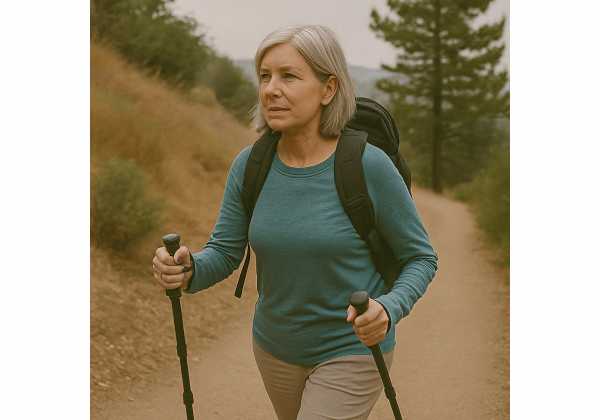
Walking protects healthy aging because it trains the exact skill adults need every day: moving confidently through the world. A strong walk uses the feet, calves, hips, trunk, heart, lungs, eyes, inner ear, and brain in one repeated pattern. When that pattern slows down or becomes hesitant, daily life starts to shrink. Stairs feel harder. Uneven sidewalks feel risky. Longer errands become tiring.
Rucking adds another layer by turning a walk into light load carriage. A backpack or weighted vest raises the effort without requiring running, jumping, or gym equipment. Used well, it builds conditioning, leg endurance, posture, and confidence outdoors. Used too aggressively, it irritates knees, hips, feet, or the lower back. Distance, load, and terrain should rise in a planned order so walking stays a lifetime tool rather than another source of aches.
Table of Contents
- Walking Builds Healthspan Through Repetition
- Distance and Weekly Volume: How Much Walking Is Enough?
- Gait Speed and Walking Skill: The Simple Signals to Track
- Rucking Load and Progression: How to Add Weight Safely
- Terrain, Hills, and Stairs: Making Walks More Useful
- Technique, Footwear, and Carry Options
- Weekly Walking and Rucking Plans
- Safety, Recovery, and Red Flags
Walking Builds Healthspan Through Repetition
Walking delivers a rare mix of benefits: it is low cost, scalable, joint-friendly for most adults, and easy to repeat often. A single walk is simple. Thousands of walks over years become a powerful training signal for the heart, blood vessels, muscles, bones, balance system, and brain.
A healthy walking pattern includes more than step count. Each stride asks the body to shift weight to one leg, stabilize the pelvis, swing the opposite leg through, clear the toes, land with control, and push off again. That repeated single-leg control is one reason walking relates so closely to independence.
Walking supports healthy aging through several pathways:
- Cardiorespiratory fitness: Brisk walking raises heart rate and breathing without the impact of running.
- Metabolic health: Short walks after meals help working muscles use glucose.
- Leg strength endurance: Calves, hamstrings, glutes, hip flexors, and trunk muscles work repeatedly.
- Balance and coordination: Outdoor walking trains visual scanning, turning, obstacle avoidance, and surface changes.
- Bone and connective tissue loading: Regular weight-bearing movement gives the feet, ankles, hips, and spine a useful mechanical signal.
- Brain engagement: Route finding, pace control, reaction to traffic, and dual-tasking keep walking cognitively active.
Gait also reflects overall reserve. A person who walks briskly with relaxed posture, good arm swing, steady rhythm, and clear foot placement usually has enough strength, balance, energy, and confidence to handle daily demands. A person who slows sharply, shuffles, widens their stance, or avoids uneven ground deserves a closer look at strength, vision, vestibular function, pain, medications, nerve health, and confidence after falls.
Walking also pairs well with other training. Strength work builds the engine. Walking expresses that engine in daily life. For a broader way to track movement ability, functional longevity tests such as gait speed, sit-to-stand, and grip strength give a simple picture of real-world capacity.
Distance and Weekly Volume: How Much Walking Is Enough?
A useful walking routine starts with weekly time, not a perfect daily step number. Public health guidelines for older adults support 150–300 minutes of moderate aerobic activity per week, plus muscle-strengthening work on at least 2 days and multicomponent balance and strength work on at least 3 days. Walking fills much of the aerobic target, while hills, stairs, resistance training, and balance drills complete the picture.
For many adults, 150 minutes means five 30-minute walks. That is a strong starting structure. A more active routine reaches 210–300 minutes weekly through longer walks, extra short walks, or active transportation.
Step counts help, but they should not become a rigid score. Research on daily steps shows benefits rising well below the popular 10,000-step target. For adults over 60, health benefits appear strong around 6,000–8,000 steps per day, with smaller added gains above that range. Younger and highly active adults often tolerate and benefit from more. The useful message is simple: raise your average from where it is now, then build toward a repeatable range.
Distance targets work best when matched to current capacity:
| Current walking level | Useful weekly target | Simple progression |
|---|---|---|
| Deconditioned or returning after illness | 10–20 minutes, 4–6 days weekly | Add 2–5 minutes to one walk at a time |
| Basic active adult | 25–40 minutes, 4–6 days weekly | Add one longer walk each week |
| Strong walker | 35–60 minutes, 5–6 days weekly | Add brisk segments, hills, or light load |
| High-capacity adult | 45–90 minutes, 4–6 days weekly | Rotate easy, brisk, hilly, and loaded walks |
Intensity matters as much as time. Easy walking feels like a 2–3 out of 10 effort. Brisk walking feels like 4–6 out of 10: breathing deepens, conversation is possible, and the pace feels purposeful. Hard walking, hill climbing, and rucking often feel like 6–8 out of 10 and need more recovery.
Short walks count. Three 10-minute walks after meals often feel easier than one long walk and work especially well for people building consistency. Longer walks build stamina, foot tolerance, and outdoor confidence. A balanced week includes both.
A strong walking week also leaves room for strength. Walking alone rarely preserves enough upper-body strength, hip strength, or power with age. A simple weekly strength plan improves the muscles that protect gait: glutes, calves, quadriceps, hamstrings, trunk, upper back, and grip.
Gait Speed and Walking Skill: The Simple Signals to Track
Gait speed is one of the most practical aging metrics because it captures many body systems at once. It does not need a lab. A stopwatch, a marked distance, and a clear hallway or sidewalk are enough.
A common test uses 4 meters. Mark a start and finish line. Walk at normal pace, time only the middle distance, and divide meters by seconds. For example, 4 meters in 4 seconds equals 1.0 meter per second. Test twice and record the better smooth attempt. Repeat every 8–12 weeks under similar conditions.
General interpretation for usual walking speed:
| Usual gait speed | Practical meaning |
|---|---|
| Below 0.8 m/s | Slower walking speed; check strength, balance, pain, confidence, and health factors |
| Around 0.8–1.0 m/s | Functional but worth improving if daily tasks feel tiring |
| Above 1.0 m/s | Solid community walking capacity |
| Above 1.2 m/s | Strong pace for many midlife and older adults |
Change matters more than one isolated number. A drop of 0.05–0.10 m/s over time is worth noticing, especially if it comes with fatigue, falls, pain, new shortness of breath, dizziness, or difficulty climbing stairs. A gain of the same size often means the training plan is working.
Gait skill includes several visible features:
- Step length: Steps should feel natural, not tiny or forced.
- Cadence: Brisk walking often lands near 100 steps per minute, though height and leg length change this.
- Toe clearance: The foot should clear the ground without scuffing.
- Arm swing: Relaxed arm swing supports rhythm and trunk rotation.
- Turning: Turns should look controlled rather than stiff, rushed, or fearful.
- Dual-task ability: Walking while talking or scanning traffic should not cause major slowing or imbalance.
Dual-task walking deserves attention because daily life rarely happens in a straight empty hallway. People cross streets, carry groceries, talk, look for signs, and avoid pets or curbs. A large slowdown during thinking tasks gives a useful clue about cognitive-motor reserve. The link between movement and cognition is strong enough that gait speed and cognition deserve to be viewed together, especially in midlife and beyond.
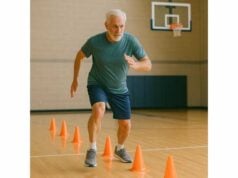
Walking skill improves with deliberate variety. Add short practice blocks after an easy warm-up: 20 seconds of faster walking, heel-to-toe walking near a wall, gentle turns, side steps, or walking while naming items in a category. Keep these drills controlled. They should sharpen coordination, not create near-falls.
Rucking Load and Progression: How to Add Weight Safely
Rucking means walking with external load, usually in a backpack or weighted vest. It raises the cost of walking without forcing a faster pace. That makes it attractive for adults who want more conditioning from the same route, dislike running, or need a joint-friendlier way to increase effort.
Load changes the exercise. A 30-minute flat walk with no load mostly trains aerobic endurance and light leg stamina. The same walk with 5–10% of body weight asks more from calves, hips, trunk, shoulders, and breathing. Add hills and the effort rises again. For longevity training, load should feel purposeful, not punishing.
Start lighter than your ego wants. A good first load is usually 5% of body weight, or about 5–10 lb for many adults. Use that for 20–30 minutes on flat ground. Keep speed comfortable. The next day should feel normal or mildly worked, not sore in the joints.
Progress one variable at a time:
- Add frequency first: Move from one loaded walk weekly to two.
- Add time second: Build from 20 minutes to 30–45 minutes.
- Add terrain third: Add mild hills or firm trails.
- Add load last: Increase by 2.5–5 lb, then hold that load for several weeks.
A safe rucking progression looks like this:
| Stage | Load | Duration | Terrain | Frequency |
|---|---|---|---|---|
| Introduction | 5% body weight | 20–30 min | Flat, predictable | 1 day/week |
| Base building | 5–8% body weight | 30–45 min | Flat or gentle hills | 1–2 days/week |
| Solid routine | 8–12% body weight | 35–60 min | Mixed pavement and trails | 1–2 days/week |
| Advanced use | 12–20% body weight | 45–75 min | Hills, trails, longer routes | 1 day/week for many adults |
Heavier rucking is not automatically better. A moderate load carried well beats a heavy load carried with a rounded back, painful knees, numb feet, or sloppy steps. Adults training for hiking, backpacking, military-style events, or mountain travel need more specific load practice. Most adults training for healthspan get plenty from 5–12% of body weight.
Weighted vests and backpacks feel different. A vest keeps load close to the center of mass and usually feels stable. A backpack is easier to adjust, carries water and layers, and better matches hiking. A poorly fitted backpack pulls the shoulders back or encourages forward lean. A vest that bounces or compresses the chest too much interferes with breathing. Pick the tool that lets you walk tall, breathe freely, and keep a natural stride.
Rucking should not replace resistance training. It builds loaded endurance, but it does not train the full range of motion, pushing, pulling, heavy hip hinging, or power. It pairs especially well with two weekly strength sessions and one or two easy recovery walks.
Terrain, Hills, and Stairs: Making Walks More Useful
Terrain turns ordinary walking into full-body training. Smooth pavement builds consistency. Grass, gravel, trails, hills, stairs, and curbs build adaptability. Healthy aging needs both because real environments change underfoot.
Flat walking is the base. It allows steady volume, predictable pacing, and easy recovery. Use it for most weekly walking minutes, especially when building from low activity, managing joint sensitivity, or returning after illness.
Hills raise intensity without adding load. Uphill walking trains calves, glutes, hamstrings, breathing muscles, and posture. It also reduces impact compared with running. Downhill walking trains braking strength in the quadriceps and hip control, but it stresses knees more than uphill walking. Add downhill volume gradually.
Stairs are a compact strength-endurance tool. A few flights train leg power, balance, and heart rate quickly. Hold the rail lightly when needed. Step down with control. Rushing downstairs creates more risk than benefit.
Trails train the eyes, ankles, hips, and reaction system. Uneven terrain asks the body to adjust stride length and foot placement continuously. Start with wide, firm trails before rocks, roots, mud, or steep grades. People with foot numbness, vestibular problems, poor vision, or recent falls should treat trails as skill training, not casual cardio.
A simple terrain ladder works well:
| Terrain level | Best use | Progression sign |
|---|---|---|
| Smooth indoor or flat pavement | Base volume, recovery, gait practice | No next-day joint flare |
| Mild hills | Aerobic challenge, glute and calf endurance | Breathing settles within 2–3 minutes after hill |
| Grass or firm trail | Balance, ankle control, visual scanning | Foot placement stays confident |
| Stairs | Strength endurance, power reserve | Descent stays controlled |
| Rocky or steep trail | Advanced adaptability | No shuffling, panic steps, or repeated toe catches |
Change only one stressor per walk. Do not combine a longer distance, heavier ruck, new shoes, steep hills, and unfamiliar trail in the same session. The body reads that as a large jump even when each piece looks small on paper.
Outdoor conditioning also works well as a bridge between walking and harder cardio. Hill repeats, stair intervals, and uneven terrain add challenge before formal intervals. For more structured outdoor work, hills, stairs, and terrain fit naturally into a longevity-focused conditioning plan.
Technique, Footwear, and Carry Options
Good walking technique feels smooth, quiet, and sustainable. It does not require a forced “perfect” stride. The body should stack well enough that effort goes into forward motion instead of fighting posture.
Use these cues:
- Look ahead, not down: Scan 10–20 feet ahead on easy ground, then glance down for obstacles.
- Walk tall through the crown of the head: Avoid slumping under fatigue or load.
- Let the arms swing: Bent elbows and relaxed shoulders support rhythm.
- Land softly: A loud slap or scuff often signals fatigue, weak ankle control, or poor shoe match.
- Push through the big toe area: Gentle push-off helps stride length and calf function.
- Keep steps quick enough: Overstriding increases braking force; a slightly quicker cadence often feels smoother.
Footwear should match the route. Flat pavement usually needs comfortable walking or running shoes with enough room in the toe box. Trails need grip and lateral stability. Rucking often feels better in shoes with a firm midsole and secure heel fit. Very soft shoes sometimes feel pleasant at first but unstable under load.
Socks matter more than people expect. A synthetic or wool blend reduces friction better than cotton on longer walks. Blisters usually come from moisture, friction, poor fit, or sudden distance jumps. Treat hot spots early.
Backpack setup should keep load high and close to the body. Use both straps. Tighten the pack enough that it does not bounce. Put dense items close to the spine. If the pack has a waist belt, use it during longer or heavier rucks. A weighted vest should fit snugly without restricting rib movement.
Walking poles help in specific situations. They reduce perceived effort on hills, add upper-body rhythm, and improve confidence on trails. They also help people who feel unsure on descents. Poles should not become a crutch for every flat walk unless needed for safety. The hands, trunk, hips, and feet still need unassisted practice.
Pain changes technique. A sore knee shortens stride. A stiff hip reduces push-off. A painful big toe blocks the final part of each step. If discomfort keeps returning, address the cause rather than simply buying new shoes. Mobility, calf strength, hip strength, balance, and smart exercise substitutions often solve more than footwear alone. Adults with recurring joint irritation should use knee- and hip-friendly training modifications while rebuilding walking tolerance.
Weekly Walking and Rucking Plans
A weekly plan should include easy volume, one or two purposeful challenges, and enough recovery to keep joints calm. Rucking belongs in the challenge category. Brisk intervals, hills, stairs, and long walks also count as challenges.
Most adults do well with this order of priority:
- Walk often enough to build a base.
- Add brisk pace before heavy load.
- Add hills before aggressive rucking.
- Keep strength training in the week.
- Use recovery walks to maintain rhythm without adding strain.
Here are three practical templates.
| Level | Weekly structure | Notes |
|---|---|---|
| Beginner | 4–5 walks of 15–30 minutes; 2 short strength sessions; 2 balance mini-sessions | Keep every walk comfortable for 2–4 weeks before adding speed |
| Intermediate | 3 easy walks; 1 brisk walk with short intervals; 1 longer walk; 2 strength sessions | Add light ruck once weekly after the long walk feels easy |
| Advanced | 2 easy walks; 1 hill or stair session; 1 ruck; 1 longer walk or Zone 2 session; 2 strength sessions | Rotate hard sessions so legs get at least 48 hours between major stressors |
A beginner week might look like this:
- Monday: 20-minute easy walk
- Tuesday: Strength training and 5 minutes of balance drills
- Wednesday: 25-minute easy walk
- Thursday: Rest or 10-minute meal walk
- Friday: 20-minute walk with 4 relaxed brisk segments
- Saturday: Strength training
- Sunday: 30-minute easy walk
An intermediate week might look like this:
- Monday: 30-minute easy walk
- Tuesday: Strength training
- Wednesday: 35-minute brisk walk with 6 × 1-minute faster segments
- Thursday: 20-minute recovery walk
- Friday: Strength training
- Saturday: 40–50-minute easy walk or light ruck
- Sunday: Rest, mobility, or relaxed social walk
An advanced healthspan week might look like this:
- Monday: Easy 30-minute walk
- Tuesday: Strength training
- Wednesday: Hill walk or stair session, 25–40 minutes total
- Thursday: Recovery walk, 20–30 minutes
- Friday: Strength training
- Saturday: Ruck, 45–60 minutes
- Sunday: Longer easy walk, hike, or cycling-based aerobic session
Zone 2 training fits well for adults who want structured endurance. Brisk walking, incline treadmill work, hiking, cycling, rowing, and easy jogging all serve that purpose when intensity stays controlled. If walking is your main endurance tool, a Zone 2 training plan helps separate easy aerobic work from harder intervals.
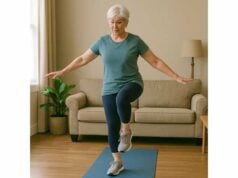
Balance needs dedicated practice too. Walking improves balance, but it does not cover every direction, speed, or perturbation. Add single-leg stands, tandem walking, step-downs, backward walking near support, and turning practice. A short balance and fall-prevention routine makes walking safer and more confident on real terrain.
Safety, Recovery, and Red Flags
Walking is safe for most adults, but safe does not mean careless. The main risks come from sudden jumps in volume, heavy loads, poor surfaces, low visibility, dehydration, heat, icy conditions, and ignoring pain signals.
Use the 24-hour rule. A walk or ruck was probably the right dose if joints feel normal the next day, energy is steady, and soreness stays mild. Reduce the next session if pain changes your gait, soreness lasts more than 48 hours, or stairs feel unusually difficult.
The most common mistakes are easy to avoid:
- Adding a weighted vest before building regular unloaded walking
- Turning every walk into a hard workout
- Using hills, load, and longer distance all at once
- Walking through sharp foot, knee, hip, or back pain
- Ignoring toe scuffing, tripping, dizziness, or new imbalance
- Wearing new shoes on a long route
- Carrying weight low and far from the body
- Skipping strength training while increasing ruck volume
Heat and cold need respect. In hot weather, walk earlier, use shade, reduce load, and carry water. In cold weather, warm up gradually and watch for slick surfaces. Dark walks need reflective gear and a light. Trail walks need a charged phone, route awareness, and footwear with grip.
Medical red flags deserve prompt attention. Stop and seek qualified care for chest pressure, fainting, severe shortness of breath, new irregular heartbeat symptoms, sudden one-sided weakness, new confusion, severe calf pain with swelling, or a fall with head impact. Also get assessed for new foot drop, repeated unexplained trips, progressive numbness, or pain that worsens week by week.
Rucking has extra caution points. Avoid heavy loaded walking during a flare of plantar fasciitis, Achilles pain, knee swelling, hip pain, sciatica, or acute back pain. People with osteoporosis, spinal compression fracture history, significant balance problems, neuropathy, or recent joint replacement should get individualized guidance before using meaningful load. Rucking is useful only when the body handles it well.
Recovery is part of the walking plan. Sleep, protein intake, hydration, and strength work all influence how well the body adapts. Calves and feet often need gradual exposure more than motivation. When returning after illness, surgery, or injury, a staged return-to-training ramp-up protects progress better than testing fitness too soon.
Walking should expand life. The clearest sign of success is not a perfect step count; it is a wider radius of freedom. You walk farther without dread. You cross streets with confidence. Hills feel like training rather than threats. Trails become enjoyable again. Rucking, when added patiently, gives ordinary walking enough challenge to keep building capacity for the decades ahead.
References
- WHO guidelines on physical activity and sedentary behaviour 2020 (Guideline)
- Daily steps and health outcomes in adults: a systematic review and dose-response meta-analysis 2025 (Systematic Review)
- Measurement properties of the usual and fast gait speed tests in community-dwelling older adults: a COSMIN-based systematic review 2024 (Systematic Review)
- Effects of different exercise modalities on balance performance in healthy older adults: a systematic review and network meta-analysis of randomized controlled trials 2025 (Systematic Review)
- Metabolic Costs of Walking with Weighted Vests 2024 (Study)
- Daily steps and all-cause mortality: a meta-analysis of 15 international cohorts 2022 (Meta-analysis)
Disclaimer
This article is educational and does not replace care from a qualified clinician, physical therapist, or exercise professional. Get individualized guidance before rucking or increasing walking intensity if you have heart disease symptoms, recent surgery, osteoporosis with fracture history, neuropathy, repeated falls, severe joint pain, or unexplained shortness of breath.