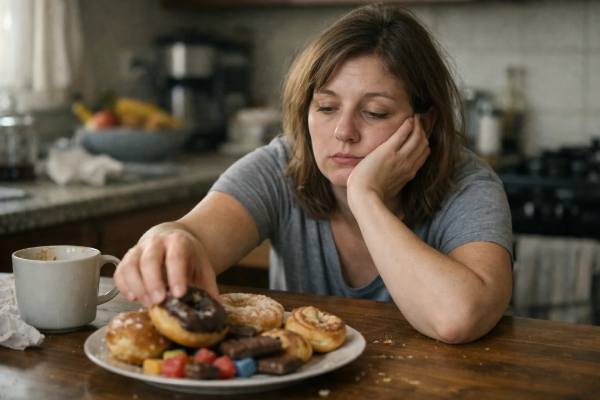
A rough night can change the way food sounds the next day. Suddenly cereal, pastries, candy, sweet coffee drinks, or “just a little dessert” feel much harder to resist. That is not only about habit or willpower. Poor sleep can push appetite, reward-seeking, stress, and decision-making in the same direction, making sugary foods feel especially appealing.
The good news is that this pattern is common, understandable, and manageable. Below, you will see why bad sleep can intensify sugar cravings, what is happening in your brain and body, why cravings often hit harder later in the day, what to eat after a short night, and how to steady your appetite without overcorrecting.
Table of Contents
- Why bad sleep can spark sugar cravings
- What changes in your brain and appetite signals
- Why cravings get worse later in the day
- How fatigue pushes you toward easy calorie foods
- What to eat after a short night
- How to reduce sleep-related sugar cravings fast
- When sleep and cravings need more attention
Why bad sleep can spark sugar cravings
When you sleep badly, your body usually does not respond with one simple signal. It responds with a cluster of changes that all make sweet, highly rewarding foods more tempting.
First, sleep loss often increases hunger. Second, it can make tiredness feel like an energy emergency, so quick calories look especially attractive. Third, exhaustion tends to lower patience and make short-term comfort matter more than long-term goals. Sugar checks all three boxes: it is easy, familiar, and immediately rewarding.
That is why cravings after poor sleep often feel more urgent than ordinary appetite. You may not be craving a balanced meal. You may want something fast, sweet, and low-effort. Many people notice this as a strong pull toward pastries at breakfast, vending-machine snacks in the afternoon, or dessert after dinner even when they are not especially hungry for a full meal.
This can happen after one bad night, but repeated short nights make it stronger. If you are under-sleeping several days in a row, the effect often becomes less about one craving and more about a pattern: more snacking, more grazing, more “treating yourself,” and less ability to stop at a moderate portion.
It also helps to separate craving from character. A strong desire for sugar after poor sleep does not mean you are weak, lazy, or failing. It means your brain and body are operating under a more appetite-promoting, reward-seeking state. That is one reason poor sleep can make you hungrier even when your goals have not changed.
A useful mindset shift is this: after a short night, do not expect your appetite to behave like it does on a well-rested day. Plan for more friction. Structure matters more. Food choices matter more. The environment matters more. When you understand that, you can respond strategically instead of feeling blindsided by cravings.
What changes in your brain and appetite signals
Sugar cravings after bad sleep are driven by both biology and behavior.
On the biology side, sleep loss can alter the signals involved in hunger and fullness. The popular shorthand is that appetite-stimulating signals tend to rise while satiety signals become less reliable. Real life is a little more complicated than that, and individual studies do not all show the same hormone pattern under every condition. Still, the bigger picture is consistent: inadequate sleep often shifts people toward higher appetite and greater interest in energy-dense foods.
At the same time, the brain’s reward system becomes more responsive to palatable food. In plain language, sweet and highly processed foods can look more appealing when you are tired. That matters because cravings are not only about an empty stomach. They are also about anticipated pleasure. Exhaustion can make the brain value immediate reward more strongly, especially when the reward is easy and familiar.
Sleep loss can also affect glucose regulation and stress response. When you are tired, you may feel more shaky, foggy, irritable, or “off,” and the brain often interprets that state as a need for fast relief. Many people label this as “I need sugar,” when the real need may be some combination of food, rest, hydration, and a break from overstimulation.
Another important point: hormones are only part of the story. Appetite is shaped by timing, routine, mood, food cues, and what is available around you. That is why two tired people can respond very differently. One might want chocolate. Another might want salty takeout. Another might lose their appetite early, then overeat late. Still, the same basic mechanism is often underneath it: poor sleep makes appetite regulation less stable.
If you want a deeper explanation of the hormonal side, the article on hunger hormones and sleep helps connect ghrelin, leptin, fullness, and food drive in a more focused way.
The most practical takeaway is this: after bad sleep, trust your appetite less as a precise guide. It may be louder without being wiser. That does not mean you should ignore hunger. It means you should give yourself more structure than usual so your next decision is not made by fatigue alone.
Why cravings get worse later in the day
A lot of people notice that sugar cravings after poor sleep are manageable in the morning, then much worse in the afternoon or at night. There are several reasons for that pattern.
One is simple accumulation. If you start the day tired, each hour adds more mental wear-and-tear. By late afternoon, you are dealing not only with poor sleep but also with work stress, screens, decisions, commute fatigue, and whatever food choices happened earlier. That compounds the pull toward something comforting and easy.
Another reason is meal timing. People who sleep badly often run the next day in a slightly chaotic way. They skip breakfast because they feel rushed. They rely on coffee. They delay lunch. They grab whatever is nearby. Then they hit a wall later and feel ravenous. At that point, cravings can feel intense and very specific. Sweet food is not the only option, but it is often the option your brain advertises the loudest.
Late-day cravings also tend to rise when your environment gets looser. At work, you may have some structure. At home, the pantry is right there. The day’s discipline is already partly spent. You are more likely to think, “I already slept badly, so today is off anyway.” That kind of permission-giving is common, and it is one reason night eating escalates so easily.
There is also a timing issue with the foods people choose after bad sleep. Tired people often drift toward quick carbohydrates earlier in the day, then find themselves chasing satisfaction later because those choices were not very filling. A muffin and sweet coffee may feel helpful at 8 a.m., but by 11 a.m. or 3 p.m. you may feel even more appetite noise.
That is one reason bad sleep can blend into night-time sugar cravings. The day begins with fatigue, continues with inconsistent fueling, and ends with low mental resistance plus easy access to snacks.
A better way to think about late-day cravings is not “I lost control,” but “the whole day set this up.” That framing matters because it points to a solution. Often, the fix is not only to resist dessert at 9 p.m. It is to prevent the buildup that made dessert feel impossible to ignore.
How fatigue pushes you toward easy calorie foods
Bad sleep does not only change appetite. It changes effort tolerance.
When you are exhausted, almost every healthy choice becomes slightly harder. Cooking feels annoying. Chopping vegetables feels excessive. Packing lunch feels optional. Going to the store feels draining. Even deciding what to eat can feel like too much. In that state, easy calories win.
This is where sugar cravings often overlap with convenience cravings. Sometimes you are not specifically craving sugar as a taste. You are craving the easiest form of relief available. Sweet foods happen to be excellent at that. They require no prep, no planning, and almost no patience.
Fatigue also narrows your time horizon. On a well-rested day, you are more able to think, “I’ll have a real lunch so I do not overeat later.” On a tired day, the brain leans toward, “What gets me through the next ten minutes?” That is a major reason why sleep-deprived eating can feel impulsive even in people who are usually disciplined.
The other piece is mental control. Poor sleep can weaken attention, self-monitoring, and the ability to pause before acting. That is why you might find yourself halfway through a sleeve of cookies before you really register what happened. The same pattern shows up in other areas too: overspending, doomscrolling, procrastination, and irritability. Food is just one place where tired brains seek fast reward.
This is closely related to decision fatigue and overeating. The more mentally depleted you feel, the more likely you are to default to habit, proximity, and immediate pleasure. If sweets are visible, convenient, and associated with comfort, they become even harder to resist.
There is also an emotional layer. Tired people often feel that they deserve a reward. That “I earned this” feeling can be powerful after a hard day and a bad night. The problem is not the desire for comfort. The problem is when comfort becomes automatic and always edible.
A practical fix is to reduce how many food decisions tired-you has to make. Keep satisfying, higher-protein options visible. Have a default breakfast. Keep fruit where you can see it. Put candy farther away, not because sugar is forbidden, but because distance buys you a pause. When sleep is poor, small environmental advantages matter more than motivation speeches.
What to eat after a short night
The day after bad sleep is usually not the day to get aggressive. Many people respond to cravings by trying to “be extra good,” eating too little, skipping meals, or pretending they are not hungry. That often backfires. By later in the day, appetite is louder, cravings are sharper, and overeating feels much more likely.
A better approach is to eat in a way that steadies appetite early and keeps it steadier all day.
Focus on three things:
- Protein
- Fiber
- Regular meal timing
Protein helps meals feel more satisfying. Fiber slows things down and improves fullness. Regular meals reduce the “I waited too long and now I want everything” effect.
A good breakfast after poor sleep usually works better than a sugary one, even if the sugary option sounds more appealing in the moment. Examples include:
- Greek yogurt with berries and oats
- Eggs with toast and fruit
- Cottage cheese with fruit and nuts
- Protein oatmeal
- A smoothie built around yogurt or protein powder plus fruit and chia
The goal is not perfection. The goal is to avoid starting a tired day with a breakfast that disappears fast and leaves you hunting for more sweetness two hours later.
At lunch and dinner, build meals around a solid protein source, vegetables or fruit, and a satisfying carb. Tired people often do better with balanced meals than with very low-carb restriction. A meal that includes chicken, rice, and vegetables, or beans, potatoes, and a salad, often controls cravings better than picking at random snack foods and trying to “be good.”
This is where quick protein and fiber fixes can help. The best anti-craving foods are not the ones that sound the most virtuous. They are the ones you will actually eat when tired and that still keep you full. Think yogurt cups, hard-boiled eggs, edamame, apples, popcorn, protein bars you genuinely like, tuna packets, cottage cheese, and high-fiber wraps.
It also helps to choose slower-digesting carbs more often on sleep-deprived days. That does not mean sugar is banned. It means your base meals should do more of the work. Oats, potatoes, beans, fruit, higher-fiber breads, and rice paired with protein usually support steadier appetite than relying on sweets to carry your energy.
One more helpful strategy: plan a sweet food instead of fighting vague cravings for hours. Sometimes a balanced lunch plus a sensible dessert works better than trying to resist, then ending up in an evening free-for-all. Planned satisfaction often beats all-day negotiation.
How to reduce sleep-related sugar cravings fast
When you are tired and craving sugar, you usually do not need a long-term philosophy lesson. You need a practical reset. The fastest way to reduce sleep-related cravings is to lower physiological chaos and make the next good choice easier than the impulsive one.
| What is happening | What to do next | Why it helps |
|---|---|---|
| You are tired, shaky, and thinking about sweets | Eat a protein-and-fiber snack within 15 to 30 minutes | It reduces the chance that the craving turns into uncontrolled grazing |
| You want sugar in the afternoon | Take a short walk, drink water, then reassess | Fatigue, dehydration, and mental overload can masquerade as food cravings |
| You keep chasing energy with coffee and pastries | Pair caffeine with real food and stop adding new caffeine too late | That can reduce the crash-and-crave cycle and protect the next night of sleep |
| You want dessert because the day feels ruined | Choose one satisfying portion and sit down to eat it | Planned enjoyment is usually easier to stop than distracted snacking |
Beyond the immediate moment, these five habits make a noticeable difference:
- Do not wait too long to eat. Long gaps can make tired-day cravings feel more urgent than they need to be.
- Use daylight and movement. Even a brief walk outside can improve alertness and interrupt the “I need sugar now” loop.
- Be careful with caffeine timing. Too much caffeine late in the day can worsen the next night and keep the craving cycle going. The guide on caffeine timing is useful here.
- Recover instead of compensating. You do not need to punish a bad night with more restriction. Aim to normalize meals and get back to routine.
- Prioritize the next night, not only the next snack. If poor sleep keeps repeating, cravings keep repeating. That is why learning how to recover from sleep debt often helps more than trying to out-discipline your appetite every day.
The deeper lesson is simple: sleep-related sugar cravings are easiest to manage when you treat them as a recovery issue, not a morality issue. Your job is not to prove toughness. Your job is to reduce the number of decisions that exhausted-you has to win.
When sleep and cravings need more attention
Occasional sugar cravings after a bad night are normal. Persistent, intense cravings tied to chronically poor sleep deserve a closer look.
One sign is frequency. If you are sleeping badly several nights per week and regularly feeling driven toward sweets, snacks, or late-night eating, the issue may be bigger than “I need more discipline.” Another sign is severity. If cravings feel compulsive, lead to repeated binges, or seem tightly connected to mood and stress, it may help to look beyond food alone.
Common sleep-related issues that can worsen appetite and cravings include:
- chronic insomnia
- loud snoring, gasping, or unrefreshing sleep suggestive of sleep apnea
- highly inconsistent sleep schedules
- shift work
- heavy late-evening screen use
- frequent nighttime waking
- high stress, anxiety, or depression
It is also worth considering medical and medication factors when the pattern feels unusually strong. Blood sugar issues, some medications, and some mental health conditions can all affect appetite, sleep, or both. If you often feel extreme thirst, frequent urination, repeated energy crashes, or unusually intense hunger, it is reasonable to discuss that with a clinician.
Sleep deserves more attention too if you wake up exhausted even after spending enough time in bed, fall asleep unintentionally during the day, or rely on sugar and caffeine just to function. Those are not just annoying habits. They can be clues.
If sleep itself is clearly the ongoing problem, targeted help may matter more than another food rule. Articles on insomnia and weight loss and sleep apnea and weight loss can help you recognize patterns worth addressing.
Most importantly, do not ignore a repeating cycle just because each individual episode feels minor. Poor sleep, cravings, overeating, guilt, and another poor night can turn into a self-reinforcing loop. Breaking that loop usually starts with sleep support, meal structure, and a less reactive plan for tired days.
You do not need perfect sleep to make progress. You do need a strategy for the nights that are not perfect. When you expect cravings, fuel yourself early, reduce friction, and protect the next night of sleep, the pull toward sugar becomes much easier to manage.
References
- The role of insufficient sleep and circadian misalignment in obesity 2023 (Review)
- Sleep Deprivation: Effects on Weight Loss and Weight Loss Maintenance 2022 (Review)
- Effect of Sleep Extension on Objectively Assessed Energy Intake Among Adults With Overweight in Real-life Settings: A Randomized Clinical Trial 2022 (RCT)
- Stress and eating behaviours in healthy adults: a systematic review and meta-analysis 2022 (Systematic Review and Meta-Analysis)
- Recommended amount of sleep for a healthy adult: A joint consensus statement of the American Academy of Sleep Medicine and Sleep Research Society 2015 (Consensus Statement)
Disclaimer
This article is for general educational purposes only. It is not medical advice and is not a substitute for professional diagnosis or treatment, especially if poor sleep, intense cravings, snoring, insomnia, daytime sleepiness, or blood sugar symptoms are ongoing or worsening.
If this article helped you, please share it on Facebook, X, or your preferred platform.