A rowing machine can look deceptively simple: strap in, pull, repeat. But when it is used well, it becomes one of the most efficient cardio tools for weight loss because it combines steady aerobic work, hard intervals, and meaningful muscular effort in a single machine. It also has a practical advantage that many people notice after the first few sessions: rowing feels like a full workout, not just “cardio time.” Your legs, hips, back, trunk, and arms all contribute, which can make short sessions feel productive and time-efficient.
That said, rowing is not automatic. Poor technique can turn it into an awkward arm exercise or a lower-back irritant, while random interval sessions can leave you exhausted without building much fitness. The best results come from learning a clean stroke, choosing workouts that match your current level, and progressing your volume and intensity with some patience. This guide explains how rowing supports fat loss, how to row with better mechanics, which intervals to use, and how to build a plan that keeps working after week two.
Table of Contents
- Why rowing works for weight loss
- Rowing technique that builds power
- Beginner workouts and intervals
- How to progress without burning out
- Mistakes, metrics and troubleshooting
- Who rowing suits best
Why rowing works for weight loss
Rowing works well for weight loss because it solves several common training problems at once. It gives you a meaningful calorie burn, trains large muscle groups, and stays low-impact compared with running or jumping. That combination matters. The best cardio for fat loss is rarely the one that looks most impressive online. It is usually the one you can do often enough, hard enough, and long enough to keep repeating for months.
One reason rowing feels effective is that it is not just lower-body cardio. A good stroke uses the legs to drive, the hips and trunk to transfer force, and the upper body to finish the pull. That whole-body pattern means even moderate sessions can feel substantial. For busy people, that makes the rower attractive because a 20- to 30-minute session often feels like real training rather than a placeholder.
It also fits well into a broader fat-loss plan. Weight loss still depends mainly on a sustainable energy deficit, which is why rowing works best when it supports a realistic calorie deficit rather than trying to replace it. The machine can help increase daily or weekly energy expenditure, but its bigger value is often behavioral. A rower is easy to use at home or in the gym, easy to track, and easy to scale from short recovery sessions to hard intervals.
Another advantage is versatility. Rowing can be used for:
- Easy aerobic work on recovery days
- Short interval sessions when time is tight
- Longer steady-state sessions to build endurance
- Conditioning blocks alongside strength training
That flexibility is one reason rowing regularly shows up among the best exercises for weight loss. It can cover multiple jobs without demanding multiple machines or environments.
Still, the rower is not magic. It does not automatically burn more fat than every other machine, and it does not guarantee weight loss if the rest of the plan is inconsistent. It also has a technical learning curve. Many people spend their first few sessions pulling mostly with their arms, rushing the recovery, or setting the resistance too high. When that happens, the workout feels harsher than it needs to, and the output often stays lower than it should.
The key point is simple: rowing earns its place because it is efficient, joint-friendly for many people, and adaptable to many fitness levels. When technique improves, the sessions become smoother and more powerful, which makes the machine far more useful for long-term fat loss and fitness than it first appears.
Rowing technique that builds power
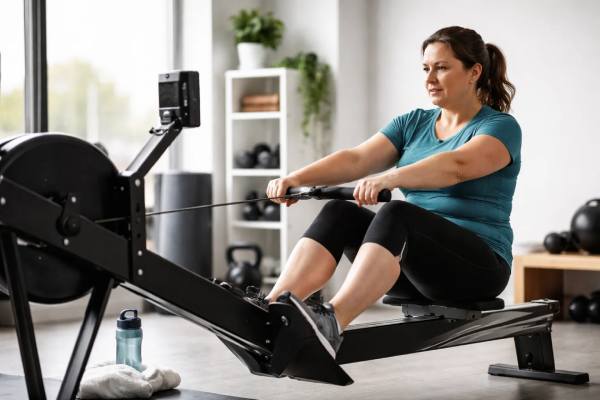
Good rowing technique is not about looking elegant. It is about making the stroke powerful, repeatable, and comfortable enough that your legs and lungs do most of the work instead of your lower back and forearms. The easiest way to learn the stroke is to think of it in four parts: catch, drive, finish, and recovery.
At the catch, you are at the front of the machine with knees bent, shins close to vertical, torso leaning slightly forward from the hips, and arms long. The handle should be held lightly, not death-gripped. From there comes the drive, where the power begins. Push the floor away with your legs first. Then let the torso open slightly. Only after that do the arms finish the pull toward the lower ribs. The finish is brief: legs long, torso slightly leaned back, handle touching or nearing the lower chest or upper abdomen. Then the recovery happens in reverse: arms away first, body pivots forward, knees bend last, and the seat rolls back to the front.
A useful rhythm cue is this:
- Legs
- Body
- Arms
- Arms
- Body
- Legs
That order matters. When people reverse it and pull early with the arms, the stroke becomes weak and inefficient. It also tends to overload the shoulders and back.
The biggest technique mistakes are common and fixable:
- Yanking with the arms too early
- Rounding the lower back at the catch
- Shooting the seat back while the handle lags
- Rushing the slide on the recovery
- Setting the damper very high and mistaking it for better training
That last point deserves attention. A high damper setting does not automatically make rowing harder in a useful way. It often just makes the stroke feel heavy and encourages poor mechanics, especially for beginners. Many people row best at a moderate setting where they can move smoothly, keep the stroke rate under control, and generate power with the legs.
A short technical warm-up helps a lot. Before hard work, spend 5 minutes building the stroke:
- 1 minute easy rowing
- 1 minute legs-only or leg-dominant strokes
- 1 minute half-slide rowing
- 1 minute full strokes at easy pace
- 1 minute smooth steady rowing
That kind of ramp-up improves coordination and lets you feel the sequence before effort rises. It also pairs well with a broader warm-up and mobility routine, especially if your hips, ankles, or upper back feel stiff.
Rowing should feel leg-driven, smooth, and rhythmic. If your forearms are burning, your shoulders are climbing toward your ears, or your lower back is taking over, the stroke probably needs adjusting. Clean technique will not just make the workout safer. It will make every interval, steady session, and progression plan more effective because you will finally be putting your effort where it belongs.
Beginner workouts and intervals
The best rowing workouts for weight loss are not the hardest ones you can survive. They are the ones you can repeat consistently while still improving fitness. For most beginners, that means using a mix of steady rowing and simple intervals instead of jumping straight into punishing tests.
A good starting week usually includes two or three rowing sessions. One should be easier and more aerobic. One can be interval-based. If you recover well, a third session can sit in the middle.
Here are three effective beginner templates.
Workout 1: Easy steady row
- 5 minutes easy warm-up
- 15 to 25 minutes steady rowing
- Pace should feel controlled, not breathless
- Stroke rate often works well around 18 to 22 strokes per minute
- Finish with 3 to 5 minutes very easy
This session builds the aerobic base that makes everything else easier. It also helps you groove technique under lower fatigue. If you want a broader framework for that effort level, it fits naturally within zone 2 cardio work.
Workout 2: Simple time intervals
- 5 minutes warm-up
- 8 rounds of 1 minute hard and 1 minute easy
- Hard means challenging but repeatable, not an all-out sprint
- 4 to 5 minutes cool-down
This is one of the best entry-level rowing workouts because the work periods are short enough to maintain decent form. It also teaches pacing. If the first two rounds feel heroic and the last six fall apart, you started too hard.
Workout 3: Moderate repeat efforts
- 5 minutes warm-up
- 4 rounds of 3 minutes moderately hard and 2 minutes easy
- 5 minutes cool-down
This session begins to bridge the gap between easy steady rowing and more demanding intervals. It teaches you how to stay under control while still working.
As fitness improves, you can add variety:
- 6 rounds of 2 minutes hard and 90 seconds easy
- 5 rounds of 500 meters with generous recovery
- 20-minute steady row with a slight pace increase every 5 minutes
The main principle is that intervals should match your skill. Beginners often copy advanced rowers doing brutal sprint sets, but that is rarely the best place to start. Hard rowing magnifies technical errors. If your stroke collapses as soon as the pace rises, the session becomes more about surviving than training.
That is also why the rower works well within the larger conversation around HIIT and steady-state cardio. You do not need to choose only one. Most people get better results by combining the two: easier rows to build fitness and harder intervals once technique is stable enough to support them.
The simplest rule is this: hard sessions should feel earned, not random. Build the base first, then make the intervals sharper.
How to progress without burning out
Progression is where most rowing plans either start working or quietly fall apart. In the first two weeks, almost any structured rowing plan feels productive because it is new. By week four, the difference between smart progression and random effort becomes obvious. People who improve one or two variables at a time keep building. People who row hard whenever they feel motivated usually stall, get sloppy, or start skipping sessions.
A good rowing progression plan is based on three levers:
- Duration
- Intensity
- Frequency
You do not need to push all three at once. In fact, that is usually a mistake.
A simple 8-week progression might look like this:
Weeks 1 and 2
- 2 sessions per week
- One 15- to 20-minute steady row
- One interval workout such as 8 x 1 minute hard and 1 minute easy
Weeks 3 and 4
- Keep two sessions or add a third if recovery is good
- Extend the steady row to 20 to 25 minutes
- Progress intervals to 6 x 2 minutes hard with 90 seconds easy
Weeks 5 and 6
- Add modest intensity to one workout
- Keep one easier technique-focused session
- Add one moderate session such as 4 x 4 minutes at a controlled hard pace
Weeks 7 and 8
- Build the steady row to 25 to 35 minutes if desired
- Keep one interval session
- Maintain at least one lower-stress session so every workout is not a test
That structure works because it respects recovery. The rower is low-impact, but it is not low-fatigue. Hard rowing taxes the legs, lungs, trunk, and grip, and it can leave beginners surprisingly sore. That is why spacing sessions sensibly matters. If every row feels flat, your plan may need more recovery rather than more motivation. A realistic approach to rest days per week often improves progress more than adding yet another interval day.
Nutrition supports progression too. Rowing is demanding enough that under-fueling can show up quickly as fading pace, poor recovery, or stalled workouts. You do not need a perfect diet, but you do need enough structure and enough protein to help preserve lean mass while losing fat. For many people, paying attention to protein intake during weight loss makes the rower feel more productive rather than just draining.
One more progression rule matters: increase volume before turning every session into a race. Many people are better served by growing from 15 to 30 minutes of quality work than by trying to crush their split every day. Better fitness usually comes from repeated good sessions, not dramatic single sessions.
The rower rewards patience. Small improvements in technique, pacing, and weekly consistency add up quickly, and once they do, you can train harder without feeling like every workout is hanging by a thread.
Mistakes, metrics and troubleshooting
The rowing machine gives you a lot of data, which is both useful and distracting. Pace per 500 meters, watts, distance, stroke rate, time, calories, drag setting, heart rate, and splits can make the workout feel precise. But if you do not know what matters, the numbers can pull your attention away from better decisions.
The most useful metrics for most people trying to lose weight are:
- Time rowed
- Total distance
- Average split or average pace
- Stroke rate
- Effort level or rating of perceived exertion
- How well you recovered for the next session
Those numbers tell you whether you are building more work over time. If you row for longer, hold a slightly better pace at the same effort, or recover faster between intervals, you are progressing.
The common mistakes are predictable.
Mistake 1: Chasing calories burned
Machine calorie numbers can be motivating, but they are estimates. Treat them as rough feedback, not as a license to eat back everything the screen shows.
Mistake 2: Sprinting every interval
Intervals are not all-out tests unless the workout is specifically designed that way. Most should be hard but controlled.
Mistake 3: Letting stroke rate climb too high
A faster stroke rate is not automatically better. Many beginners get more output by rowing slightly slower and driving harder with the legs.
Mistake 4: Ignoring form when tired
If your back rounds, the shoulders tense, and the handle path gets messy, the session has moved from productive fatigue to poor-quality fatigue.
Mistake 5: Measuring progress only with body weight
The rower can improve fitness, posture, work capacity, and body composition even before the scale moves dramatically. That is why a broader view of body recomposition and scale loss is useful.
Troubleshooting is easier when you ask the right question.
- Lower back gets sore?
Check whether you are rounding at the catch or swinging too much through the trunk. - Arms burn first?
You are probably pulling too early. - Pace falls apart halfway through workouts?
Start slower and shorten the first few work intervals. - Knees feel irritated?
Reduce compression at the front, shorten the slide slightly, and keep the setup moderate. People with joint sensitivity may also prefer guidance similar to low-impact cardio for bad knees when adjusting volume and intensity.
A training log helps more than most people expect. Write down the workout, average pace, stroke rate, and one sentence about how it felt. After three or four weeks, patterns become obvious. You stop guessing whether you are improving because the evidence is there.
On a rower, the best progress is usually quiet. Splits drift down slightly. Recovery improves. Sessions feel smoother. Your breathing settles faster. Those are the signs that the plan is working.
Who rowing suits best
Rowing suits people who want efficient, low-impact conditioning and do not mind learning a skill. It is especially good for exercisers who are short on time, want a full-body cardio option, or need an alternative to repetitive treadmill sessions. It can also work well for people who dislike impact-heavy exercise but still want something more physically involving than a leisurely walk.
It tends to suit:
- People who enjoy structured, measurable workouts
- Former athletes who like performance feedback
- Busy adults who want effective sessions in 20 to 30 minutes
- People who respond well to interval training
- Home exercisers who want one machine that covers a lot of ground
It may be a less natural fit for people who strongly prefer simpler forms of movement like walking outdoors or cycling, or for those with certain mobility limits that make the catch position difficult. Tight hips, limited ankle mobility, or current low back irritation can make rowing feel awkward until those issues are addressed. That does not always mean rowing is off the table. It may just mean the machine is not the first best option right now.
Beginners also sometimes assume rowing is safer because it is seated. It is lower-impact, yes, but it still requires coordination and repeated spinal control. If technique is neglected, the rower can become more tiring than expected. That is why it works best when it is treated as a skill-based conditioning tool rather than a mindless calorie burner.
Rowing is also not the only tool you need. For many people, the strongest long-term plan includes rowing plus daily movement, some strength training, and a routine that fits real life. If you have only been doing cardio, a complementary strength training plan can make the rower more effective by improving force production, posture, and muscle retention during fat loss.
The final test is practical. A good exercise choice should answer yes to most of these questions:
- Can I do it consistently?
- Can I recover from it?
- Can I improve at it?
- Does it support my weight-loss goal without making the rest of my plan harder?
If rowing checks those boxes, it can be one of the most productive pieces of your program. If it does not, that is useful information too. The best cardio is not the one with the strongest reputation. It is the one that keeps you training well enough, often enough, to create real change.
References
- Physical Activity and Excess Body Weight and Adiposity for Adults. American College of Sports Medicine Consensus Statement 2024 (Consensus Statement)
- Aerobic Exercise and Weight Loss in Adults: A Systematic Review and Dose-Response Meta-Analysis 2024 (Systematic Review and Meta-Analysis)
- Movement competency in rowing: the key to an effective stroke 2025
- High-intensity interval training combining rowing and cycling efficiently improves insulin sensitivity, body composition and VO2max in men with obesity and type 2 diabetes 2022
Disclaimer
This article is for general educational purposes only and is not a substitute for medical advice, diagnosis, or treatment. If rowing causes sharp pain, marked dizziness, worsening back symptoms, or persistent joint irritation, get individualized guidance before continuing.
If this article helped you, please share it on Facebook, X, or your preferred platform so more readers can build a smarter, more sustainable approach to rowing for weight loss.