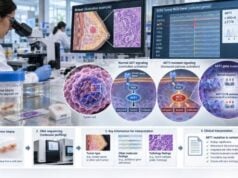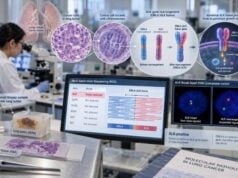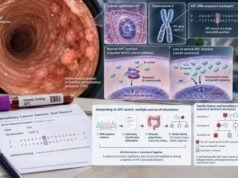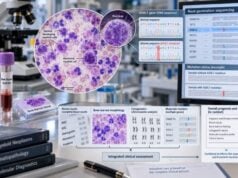
A BRCA1 mutation test looks for inherited or tumor-acquired changes in the BRCA1 gene, a major DNA-repair gene and one of the best-established causes of hereditary breast and ovarian cancer. A germline pathogenic or likely pathogenic BRCA1 variant is present in essentially every cell and can substantially increase lifetime risks of breast, ovarian, fallopian tube, and primary peritoneal cancer, with smaller increases in some other cancers. Because a germline result can affect relatives, testing has implications beyond the person being tested. BRCA1 can also be altered only within a tumor; a somatic finding may influence cancer treatment without automatically proving inherited risk. Results are classified as pathogenic, likely pathogenic, uncertain, likely benign, or benign. The most important distinction is that a variant of uncertain significance (VUS) is not managed as a harmful mutation. Interpretation should combine the exact variant, whether testing was germline or tumor-based, personal and family cancer history, ancestry, and current genetics and oncology guidelines.
- A germline pathogenic BRCA1 variant causes an inherited cancer-predisposition syndrome and is passed in an autosomal-dominant pattern.
- Current estimates place female breast cancer risk around 55%–72% by age 70 and ovarian cancer risk around 39%–44% for BRCA1 carriers.
- A positive tumor BRCA1 result may be somatic or germline, so confirmatory germline testing is often needed when inheritance is clinically possible.
- A VUS should not be used by itself to recommend risk-reducing surgery or predictive testing of relatives.
- A known familial pathogenic variant allows targeted cascade testing, and each child of a carrier has a 50% chance of inheriting it.
Table of Contents
- What BRCA1 Does and Why Mutations Matter
- Who May Be Offered BRCA1 Testing
- How BRCA1 Testing Is Done
- How to Interpret BRCA1 Results
- Cancer Risks and Risk Management
- BRCA1 Results and Cancer Treatment
- Family Risk, Cascade Testing, and Next Steps
What BRCA1 Does and Why Mutations Matter
BRCA1 is a tumor-suppressor gene that helps repair dangerous DNA double-strand breaks through homologous recombination and coordinates several other DNA-damage responses. Every person normally inherits one BRCA1 copy from each parent. If one copy carries a germline pathogenic variant, cells still have a working second copy, but cancer can develop after that remaining normal copy is lost or inactivated in a susceptible cell.
This “two-hit” biology helps explain why carriers are born with increased susceptibility rather than with cancer itself. A positive germline test means risk is elevated; it does not mean cancer is inevitable or predict the exact age at which cancer will develop.
BRCA1-associated breast cancers are more likely than sporadic breast cancers to be triple-negative, lacking estrogen receptor, progesterone receptor, and HER2 expression. That pattern is common but not universal, and tumor receptor status cannot substitute for genetic testing.
The laboratory term pathogenic variant is preferred to “mutation” when discussing inherited genetics because not every DNA change is harmful. Thousands of BRCA1 variants have been described. Some clearly disrupt protein function, some are harmless population variation, and others initially have too little evidence to classify.
A BRCA1 and BRCA2 test for breast cancer often evaluates both genes together because their hereditary syndromes overlap, although their cancer-risk patterns are not identical. Multigene panels may also include PALB2, TP53, PTEN, CDH1, ATM, CHEK2, and other genes when the personal or family history could be explained by more than one syndrome.
Who May Be Offered BRCA1 Testing
BRCA1 germline testing is offered when the result could clarify inherited cancer risk, guide treatment, or identify relatives who may benefit from prevention and screening. Testing eligibility has broadened as costs have fallen and treatment indications have expanded.
The 2024 ASCO–Society of Surgical Oncology guideline recommends BRCA1/2 testing for all patients newly diagnosed with breast cancer at age 65 or younger and for selected patients older than 65 based on family history, ancestry, personal history, or PARP-inhibitor eligibility. Testing is also appropriate in many people with ovarian, fallopian tube, primary peritoneal, pancreatic, or metastatic/high-risk prostate cancer according to tumor-specific guidelines.
Family-history clues include multiple relatives with breast cancer, breast cancer at young ages, ovarian cancer, male breast cancer, pancreatic cancer, certain prostate cancers, bilateral breast cancers, or a previously identified BRCA1 variant in the family. Founder variants are more common in some populations, but ancestry alone should not be used to assume that only a small set of variants needs testing.
A breast cancer hereditary gene panel can be more efficient than BRCA1-only testing when several genes fit the history. The tradeoff is a higher chance of finding a VUS, which may create uncertainty without changing care.
Testing an affected relative first is often most informative when no family variant is known. If a person without cancer tests negative before an affected relative has been tested, that result may be “uninformative” because another gene or an undetected family variant could still explain the history.
Children are generally not tested for an adult-onset BRCA1 syndrome because medical screening and risk-reducing decisions usually begin in adulthood. Testing is ordinarily timed to when results can change care and the individual can participate in informed consent.
How BRCA1 Testing Is Done
Germline BRCA1 testing usually uses blood or saliva and should include methods capable of detecting both small sequence variants and larger deletions or duplications. Modern hereditary cancer panels use next-generation sequencing for most single-nucleotide and small insertion/deletion variants, plus copy-number analysis for larger rearrangements.
Blood and saliva are suitable because an inherited variant is present throughout the body. Occasionally, blood can be difficult to interpret after an allogeneic stem-cell transplant or in settings of clonal hematopoiesis; a genetics team may choose another normal-tissue source when needed.
Tumor testing is different. A tumor sequencing panel can identify BRCA1 alterations that are either somatic, meaning limited to the cancer, or germline, meaning inherited and present in normal tissue as well. Tumor-only testing often cannot make that distinction with certainty. If a potentially inherited pathogenic BRCA1 variant is found in a tumor, separate germline testing should be considered.
The report should name the transcript, DNA change, protein effect when known, and classification. It may also state the evidence used, such as population frequency, functional studies, segregation with disease, computational evidence, or expert-panel classification.
Large genomic rearrangements are clinically important in BRCA1, so a test limited to a few founder variants or a narrow sequencing method can miss disease-causing changes. Direct-to-consumer tests may examine only selected variants and should not be assumed to exclude hereditary BRCA1 risk when the personal or family history is concerning.
Genetic counseling—before testing, after testing, or both—helps explain possible results, insurance and privacy considerations, reproductive implications, and the difference between a true negative and an uninformative negative.
How to Interpret BRCA1 Results
BRCA1 results are clinically actionable only when the variant classification and testing context are understood correctly.
| Result | Meaning | Typical management implication |
|---|---|---|
| Pathogenic / likely pathogenic | The variant is considered disease-causing or very likely disease-causing | Use BRCA1-specific surveillance, prevention, treatment, and family-risk guidance |
| VUS | Evidence is insufficient to call the variant harmful or benign | Do not use the VUS alone for irreversible risk-reducing decisions |
| Likely benign / benign | The variant is not considered a cause of hereditary BRCA1 cancer risk | Manage based on other risk factors |
| True negative for a known family variant | The familial pathogenic variant was specifically absent | The person did not inherit that family BRCA1 risk |
| Uninformative negative | No pathogenic variant was found, but no family cause was previously established | Family history may still justify enhanced risk assessment |
A VUS is not a positive result. ASCO guidance states that VUS findings should not drive clinical management. Most VUS results that are later reclassified move toward benign or likely benign, although laboratories should continue to update classifications as evidence accumulates.
A negative result has different meaning depending on the family context. If a mother has a known pathogenic BRCA1 variant and her adult child tests negative for that exact variant, the child is a true negative and cannot pass that familial variant to their children. If no affected relative has ever been tested, a negative multigene panel may not fully explain a strong family history.
Variant classification can change. Patients should keep a copy of the laboratory report and maintain contact with the testing service, genetics clinic, or another clinician who can help determine whether a reclassification affects care.
Cancer Risks and Risk Management
A germline pathogenic BRCA1 variant substantially increases female breast and ovarian cancer risk and changes recommended surveillance and prevention. Current GeneReviews estimates place female breast cancer risk at about 55%–72% by age 70 and ovarian cancer risk at about 39%–44%. Contralateral breast cancer risk after a first breast cancer is also elevated, roughly 20%–30% within 10 years and 40%–50% within 20 years in pooled estimates.
Other risks are smaller. GeneReviews estimates male breast cancer risk around 1%–2%, prostate cancer risk around 21% by age 75 and 29% by age 85, and pancreatic cancer risk around 1%–3% for BRCA1 carriers. Exact estimates vary among studies and families.
Risk estimates describe groups, not a fixed destiny for one carrier. Penetrance varies with age, family history, reproductive and hormonal factors, lifestyle, ancestry, and modifying genetic factors. Two relatives with the same BRCA1 variant can develop different cancers at different ages, and one may never develop cancer. Risk calculators and genetics specialists can incorporate more of this context when counseling an individual.
Breast surveillance and prevention
Current high-risk surveillance generally starts annual breast MRI around age 25 and annual mammography around age 30, with clinical assessment beginning in young adulthood. Exact sequencing and use of tomosynthesis vary by guideline and individual circumstances.
Risk-reducing bilateral mastectomy can markedly lower breast cancer risk and may be considered, but it is not mandatory. Decisions involve age, prior cancer, imaging burden, breast reconstruction preferences, other medical conditions, and personal values.
Ovarian and fallopian tube risk
There is no proven ovarian screening strategy that reliably detects BRCA1-associated ovarian cancer early enough to improve survival. Transvaginal ultrasound and CA-125 are therefore not substitutes for definitive risk reduction.
Risk-reducing salpingo-oophorectomy is generally recommended for BRCA1 carriers around ages 35–40 after childbearing is complete. Removing ovaries before natural menopause has consequences for vasomotor symptoms, bone health, cardiovascular health, sexual function, and quality of life, so counseling about surgical menopause and appropriate hormone therapy is important.
Salpingectomy with delayed oophorectomy is under active study as a way to delay menopause, but it should not automatically be assumed equivalent to standard salpingo-oophorectomy outside an evidence-based protocol or individualized specialist discussion.
Pancreatic and prostate screening recommendations vary among organizations and depend on age, family history, and local expertise. A BRCA1/BRCA2 prostate cancer risk evaluation may support discussion of PSA screening in male carriers, while BRCA1/BRCA2 pancreatic cancer testing can inform whether MRI/MRCP or endoscopic ultrasound surveillance is appropriate in a high-risk program.
BRCA1 Results and Cancer Treatment
BRCA1 status can affect treatment because BRCA1-deficient tumor cells have impaired homologous-recombination DNA repair and may be especially sensitive to therapies that exploit that weakness. The best-known example is the class of poly(ADP-ribose) polymerase, or PARP, inhibitors.
PARP inhibition creates DNA lesions that normal cells can often repair, while homologous-recombination-deficient cancer cells are less able to survive the damage. This synthetic-lethality principle led to approvals of PARP inhibitors across specific breast, ovarian, pancreatic, and prostate cancer settings.
The indication depends on tumor type, disease stage, prior therapy, whether the variant is germline or somatic, and the particular drug. A BRCA1 result should therefore not be interpreted as a universal prescription for a PARP inhibitor.
In breast cancer, germline BRCA1/2 status can influence systemic therapy in both high-risk early and metastatic settings. In ovarian cancer, BRCA status and broader homologous recombination deficiency testing can help define maintenance-treatment options. In prostate and pancreatic cancer, BRCA alterations can also identify selected patients for DNA-repair-targeted approaches.
Platinum chemotherapy can be particularly active in some BRCA1-deficient tumors because it creates DNA cross-links and double-strand damage. However, treatment choice still depends on disease-specific evidence and competing options.
Tumors can develop resistance to PARP inhibitors through several mechanisms, including BRCA reversion mutations that restore the reading frame or DNA-repair function. This is another reason treatment biomarkers may need to be interpreted differently at diagnosis and after multiple therapies.
A tumor BRCA1 finding may therefore carry two separate questions: Does this alteration predict treatment sensitivity? Could it also be inherited? Both may need to be addressed, sometimes with different tests.
Family Risk, Cascade Testing, and Next Steps
Once a germline pathogenic BRCA1 variant is identified, close biological relatives can have targeted testing for that exact familial variant. BRCA1 cancer predisposition follows an autosomal-dominant inheritance pattern. Each child of a carrier has a 50% chance of inheriting the variant, regardless of sex.
Parents, siblings, adult children, aunts, uncles, and cousins may be at risk depending on which side of the family carries the variant. Men can inherit and transmit BRCA1 just as women can, even though their cancer-risk pattern differs. A small number of families also have rare biallelic BRCA1-related conditions, but routine hereditary breast/ovarian counseling focuses on heterozygous carriers.
Cascade testing is more efficient than ordering a broad panel in every relative because once the familial variant is known, relatives can usually be tested specifically for that change. A relative who tests negative for the known family variant is not considered a BRCA1 carrier, although unrelated family-history risks may still apply.
The result can also affect reproductive planning. Options may include natural conception with prenatal diagnosis, in-vitro fertilization with preimplantation genetic testing, donor gametes, or choosing not to test embryos. These are personal decisions rather than medical requirements.
After a positive result, practical next steps include meeting with a genetics professional, documenting a three-generation family history, arranging age-appropriate breast surveillance, discussing timing of risk-reducing surgery, reviewing pancreatic or prostate screening criteria where relevant, and sharing a copy of the laboratory report with relatives who may pursue testing.
A BRCA1 and BRCA2 test for ovarian cancer is often part of the same hereditary-risk framework, but the final management plan should remain gene-specific. BRCA1 and BRCA2 overlap, yet their ovarian, male breast, prostate, and age-specific risks differ enough that recommendations are not always identical.
The most useful BRCA1 result is one that is connected to action: appropriate screening, informed risk-reducing choices, tumor-specific treatment when cancer is present, and accurate testing of relatives. The report is therefore not simply a laboratory finding; for a pathogenic germline variant, it becomes a long-term family health document that should be preserved and periodically reviewed as guidelines and variant knowledge evolve.
References
- Germline Testing in Patients With Breast Cancer: ASCO-Society of Surgical Oncology Guideline 2024 (Guideline)
- Selection of Germline Genetic Testing Panels in Patients With Cancer: ASCO Guideline 2024 (Guideline)
- A pan-tumor review of the role of poly(adenosine diphosphate ribose) polymerase inhibitors 2025 (Review)
- Recontact and follow-up for individuals with germline pathogenic variants in hereditary breast and ovarian cancer susceptibility genes: a UK Cancer Genetics Group consensus meeting 2025 (Guideline)
- BRCA1- and BRCA2-Associated Hereditary Breast and Ovarian Cancer 2026 (Review)
- BRCA Gene Changes: Cancer Risk and Genetic Testing Fact Sheet 2024 (Official Page)
Disclaimer
This article is for general educational information and does not replace genetic counseling, individualized cancer-risk assessment, or medical care. BRCA1 surveillance, surgery timing, and treatment recommendations depend on age, sex, personal and family history, exact variant classification, and evolving guidelines; discuss results with a qualified genetics or oncology professional.