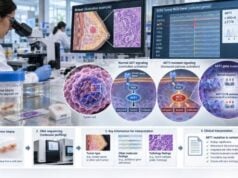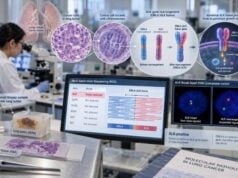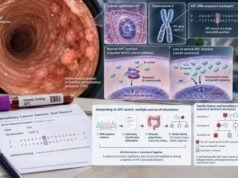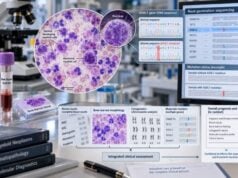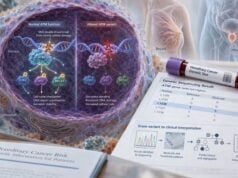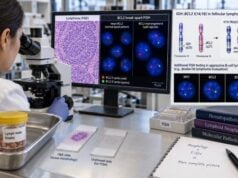
A BRCA2 mutation test looks for changes in the BRCA2 gene that can affect DNA repair and, in some cases, substantially raise the risk of certain cancers. The most important question is not simply whether a “mutation” was found, but what kind of variant it is, whether it is pathogenic, and whether it is present in the germline—the DNA a person was born with—or only in a tumor. A confirmed germline pathogenic or likely pathogenic BRCA2 variant can influence breast, ovarian, prostate, pancreatic, and male breast cancer screening and prevention. It can also matter for blood relatives because BRCA2-associated cancer susceptibility is usually inherited in an autosomal dominant pattern. By contrast, a variant of uncertain significance should not be treated like a positive hereditary-cancer result. Testing is most useful when the laboratory report is interpreted together with personal cancer history, family history, ancestry, and genetic counseling.
- A positive hereditary BRCA2 result means a pathogenic or likely pathogenic germline variant was found and cancer risk is higher than average, but cancer is not inevitable.
- A negative result may be reassuring when a known family variant is absent, but an uninformative negative test does not erase cancer risk from personal or family history.
- A BRCA2 VUS is not a positive result: a variant of uncertain significance should generally not drive preventive surgery or predictive testing of relatives.
- No fasting or medication changes are usually needed: germline testing commonly uses blood or saliva, while tumor testing uses cancer tissue or circulating tumor DNA.
- Relatives may need targeted testing: each child of a person with a germline BRCA2 pathogenic variant has a 50% chance of inheriting that familial variant.
Table of Contents
- What BRCA2 testing measures
- Who may benefit from BRCA2 testing
- How the test is done
- How to interpret BRCA2 results
- Cancer risk and medical care after a positive result
- Family risk and cascade testing
- Common questions and next steps
What BRCA2 testing measures
BRCA2 testing looks for DNA changes that reduce or disrupt the function of the BRCA2 protein. BRCA2 is a tumor-suppressor gene involved in repairing dangerous double-strand breaks in DNA through homologous recombination. When one inherited copy of BRCA2 already carries a pathogenic variant, a cell has less protection against genomic damage if the remaining normal copy is later lost or disabled. Over time, this can contribute to cancer development.
The test can look for several types of changes. DNA sequencing detects many single-letter changes and small insertions or deletions. Separate deletion/duplication analysis may be needed to identify larger losses or gains involving one or more exons. Modern hereditary-cancer panels often combine both approaches. This matters because sequencing alone can miss some large rearrangements.
BRCA2 can be tested in two clinically different settings:
- Germline testing uses blood, saliva, or another normal-tissue source to ask whether a person inherited a BRCA2 variant that is present throughout the body.
- Tumor testing examines cancer cells for BRCA2 alterations that may have arisen only in the tumor. These somatic findings may help with treatment selection, but they do not by themselves establish hereditary risk.
If tumor profiling identifies a BRCA2 alteration that could be inherited, clinicians often recommend confirmatory germline testing. A tumor panel may also fail to detect some types of germline changes, so a negative tumor result should not replace hereditary testing when the personal or family history supports it.
BRCA2 is often tested together with other cancer-susceptibility genes. A combined BRCA1 and BRCA2 test for hereditary breast cancer risk may be appropriate when the clinical question centers on these two genes, while a broader multigene panel may be useful when several hereditary syndromes are plausible.
Who may benefit from BRCA2 testing
BRCA2 testing is most useful when the result could change medical care for the person tested or clarify risk for relatives. Eligibility criteria vary by guideline, cancer type, age, ancestry, and family history, and they have expanded over time.
Testing may be considered for people with breast, ovarian, pancreatic, or prostate cancer in situations where hereditary susceptibility is more likely or where the result could guide treatment. Examples include breast cancer at a younger age, male breast cancer, ovarian or fallopian tube cancer, pancreatic cancer, metastatic or high-risk prostate cancer, multiple primary cancers, or a family pattern involving BRCA2-associated cancers.
Family history can be important even in a person who has never had cancer. Features that may prompt a hereditary-cancer evaluation include:
- a close relative with a known BRCA2 pathogenic variant;
- several relatives with breast, ovarian, pancreatic, or aggressive prostate cancer;
- breast cancer occurring unusually young in the family;
- male breast cancer;
- multiple related cancers on the same side of the family; or
- ancestry associated with a higher frequency of specific founder variants, considered together with the broader history.
Whenever possible, hereditary testing in a family starts with a relative who has had a relevant cancer. That strategy has a better chance of identifying the familial cause. If an affected relative is unavailable, testing an unaffected person can still be appropriate, but a negative result may be less informative.
Testing is also increasingly ordered because a tumor profile reveals a BRCA2 alteration. In that setting, the next question is whether the change is somatic or germline. The answer can affect both treatment and family counseling.
People being evaluated for hereditary breast and ovarian cancer may also encounter other genes such as PALB2, ATM, CHEK2, TP53, or mismatch-repair genes. A broad panel can be efficient, but it also raises the chance of finding a VUS. The decision should match the clinical question rather than simply choosing the largest panel available.
How the test is done
Germline BRCA2 testing usually requires a blood or saliva sample and generally needs no fasting, sedation, or medication changes. The sample is sent to a molecular genetics laboratory, where DNA is analyzed for clinically relevant variants.
Turnaround time varies by laboratory and urgency. Many hereditary panels return in roughly two to four weeks, although rapid testing may be available when a result is needed for an immediate treatment or surgical decision. The ordering clinician or genetics professional should explain what genes and variant types the assay can detect.
A complete hereditary BRCA2 evaluation commonly includes both sequence analysis and deletion/duplication analysis. Ask whether the assay covers large genomic rearrangements if that is not clear from the report.
Tumor BRCA2 testing works differently. DNA may come from a surgical specimen, biopsy, or, in selected situations, circulating tumor DNA in blood. Tumor testing can be limited by low tumor content, degraded DNA, prior treatment, or insufficient material. A liquid-biopsy result can be useful when tissue is unavailable, but a negative result may reflect low shedding rather than true absence of a mutation.
Before testing, it helps to clarify three questions:
- Is the test germline, tumor-only, or paired tumor-and-normal testing?
- Will the assay detect both sequence variants and larger deletions or duplications?
- What will happen if the result is positive, negative, or uncertain?
Genetic counseling can be particularly valuable before germline testing because the result may have implications for surveillance, preventive surgery, reproductive decisions, insurance or privacy questions, and relatives who were not part of the original testing decision.
How to interpret BRCA2 results
The laboratory classification is central to interpretation. A report may classify a variant as pathogenic, likely pathogenic, uncertain, likely benign, or benign. These categories are not interchangeable.
| Result | Usual meaning | What generally follows |
|---|---|---|
| Pathogenic | Strong evidence the variant disrupts BRCA2 function and is disease-causing | Use hereditary-risk guidance if germline; consider cancer-specific treatment implications when relevant |
| Likely pathogenic | Evidence strongly favors a disease-causing effect | Usually managed similarly to a pathogenic variant |
| Variant of uncertain significance | Evidence is not sufficient to call the variant harmful or harmless | Do not use the VUS alone for major risk-reducing decisions; management relies on history |
| Likely benign or benign | The change is not considered a cause of hereditary BRCA2 cancer susceptibility | No BRCA2-specific hereditary management based on that variant |
| No reportable variant detected | No pathogenic or likely pathogenic change was found by the assay | Interpret in light of whether a familial variant is known and what the test could detect |
A true negative is especially informative. If a pathogenic BRCA2 variant is already known in the family and a relative tests negative for that exact variant, the relative did not inherit that familial BRCA2 risk. Their cancer screening can often return to recommendations based on their remaining personal and family risk factors.
An uninformative negative is different. If no familial cause has ever been identified, a negative panel does not prove the cancer pattern is nonhereditary. There could be a variant the assay cannot detect, a gene not tested, a risk mechanism that is not yet understood, or a chance clustering of cancers.
A VUS should not be treated as a mutation-positive result. Most VUS findings are eventually downgraded rather than upgraded. Preventive surgery, intensified screening, or predictive testing of healthy relatives generally should not be based on a VUS alone. The laboratory may reclassify the variant as evidence accumulates, so keeping contact information current is useful.
The exact wording also matters. “BRCA2-positive” is too vague unless the report states whether the finding is germline or somatic and how the laboratory classifies it.
Cancer risk and medical care after a positive result
A germline BRCA2 pathogenic variant increases cancer risk, but it does not determine when or whether cancer will occur. Risk is influenced by age, sex, family history, reproductive factors, other genetic modifiers, and environmental factors.
Published estimates vary, but BRCA2 carriers have substantially increased risks of female breast cancer and ovarian, fallopian tube, or primary peritoneal cancer. Male carriers have increased risks of male breast and prostate cancer. Pancreatic cancer risk is also higher than in the general population. The magnitude of risk is not identical for every person or every variant.
For female breast cancer, contemporary sources commonly place lifetime risk in a high range, with GeneReviews summarizing estimates around 45%–69%. Ovarian cancer risk is lower than with BRCA1 but still clearly elevated, commonly summarized around 11%–17%. Male breast cancer and prostate cancer risks are also meaningfully increased, and BRCA2-associated prostate cancers can be clinically important because of their tendency toward more aggressive disease in some cohorts.
Medical management is individualized. Depending on age and anatomy, options may include earlier and more intensive breast imaging, discussion of risk-reducing mastectomy, and risk-reducing salpingo-oophorectomy after childbearing. Prostate screening may start earlier for male carriers than for average-risk men. Pancreatic surveillance may be considered for selected carriers, particularly under specialist guidance and depending on family history and current recommendations.
A positive BRCA2 result can also influence cancer treatment. BRCA2-deficient tumors may be sensitive to therapies that exploit homologous-recombination repair defects, including PARP inhibitors in several cancer settings. Treatment decisions depend on the cancer type, stage, prior therapy, whether the variant is germline or somatic, and other biomarkers; a hereditary result alone does not dictate a specific drug.
For prostate cancer, a dedicated BRCA1 and BRCA2 prostate cancer assessment can help place a DNA-repair result in the context of hereditary risk and treatment. For ovarian cancer, the related BRCA1 and BRCA2 ovarian cancer test addresses how germline and tumor findings can intersect.
Family risk and cascade testing
A confirmed germline BRCA2 pathogenic variant has implications beyond the person tested. BRCA2-associated hereditary cancer susceptibility is generally autosomal dominant, which means each biological child has a 50% chance of inheriting the variant. Full siblings also commonly have a 50% chance if one parent carries it.
This does not mean that half of relatives will develop cancer. It means that first-degree relatives have a predictable chance of carrying the familial genetic change. Cancer penetrance is incomplete, so some carriers never develop a BRCA2-associated cancer.
Cascade testing means offering targeted testing to relatives after a familial pathogenic variant is identified. Instead of repeating a large panel, the relative can often be tested specifically for the known BRCA2 variant. A positive relative can then discuss age-appropriate surveillance and prevention. A relative who tests negative for that known variant usually does not need BRCA2-specific high-risk management based on that branch of the family.
Testing children for adult-onset BRCA2 cancer susceptibility is usually deferred until adulthood because BRCA2-related surveillance generally does not begin in childhood. There are rare circumstances involving biallelic BRCA2 variants and Fanconi anemia, but that is a different inheritance situation and requires specialist genetics evaluation.
Family communication can be difficult. A genetics clinic may provide a family letter that explains the finding without requiring the person tested to interpret technical laboratory language. Sharing the exact laboratory report is especially useful because relatives need the precise gene and variant designation for targeted testing.
Common questions and next steps
A BRCA2 report is best used as a decision tool, not as a standalone prediction. The practical next step depends on what the report actually says.
If the result is pathogenic or likely pathogenic and germline: arrange genetics follow-up, review cancer screening and prevention recommendations, discuss any treatment implications if cancer is present, and identify relatives who may benefit from cascade testing.
If a BRCA2 alteration was found only on tumor testing: ask whether confirmatory germline testing is recommended. Tumor-only results can be hereditary, but many are acquired by the cancer.
If the result is a VUS: do not assume increased hereditary risk from the variant itself. Continue screening based on personal and family history, and make sure the laboratory or ordering clinic has a process for reclassification updates.
If the result is negative: ask whether it is a true negative for a known familial variant or an uninformative negative. Also confirm whether the test included deletion/duplication analysis and whether the selected panel was appropriate for the family history.
Common mistakes include interpreting any BRCA2 change as dangerous, assuming a negative test eliminates inherited risk, and overlooking the difference between germline and tumor testing. Another mistake is focusing only on female relatives. BRCA2 matters for people of all sexes because male breast, prostate, and pancreatic cancer risks can be relevant.
If the testing question extends beyond BRCA2, a broader hereditary panel may be reasonable. For example, breast cancer gene panel testing can evaluate BRCA genes alongside other established susceptibility genes. The right test is the one that answers the clinical question with adequate coverage and a clear plan for interpreting the result.
Reassessment can be useful as guidance changes
A germline BRCA2 result can remain medically relevant for decades. Screening ages, risk-reducing options, and treatment implications may change as new evidence and guidelines appear. People with a pathogenic variant should periodically review their plan with a clinician or genetics professional, particularly after a new cancer diagnosis in the family or a major change in their own health. A VUS can also be reclassified over time, but management should not change unless the laboratory interpretation changes to a clinically actionable category.
References
- BRCA1- and BRCA2-Associated Hereditary Breast and Ovarian Cancer 2026 (Review)
- EMQN best practice guidelines for genetic testing in hereditary breast and ovarian cancer 2024 (Guideline)
- Risk reduction and screening of cancer in hereditary breast-ovarian cancer syndromes: ESMO Clinical Practice Guideline 2023 (Guideline)
- BRCA1, BRCA2, and Associated Cancer Risks and Management for Male Patients: A Review 2024 (Review)
- NCCN Guidelines® Insights: Genetic/Familial High-Risk Assessment: Breast, Ovarian, and Pancreatic, Version 2.2024. 2023 (Guideline)
- BRCA1/2 Mutations and Breast/Ovarian Cancer Risk: A New Insights Review 2024 (Review)
Disclaimer
BRCA2 testing can affect cancer screening, treatment, preventive options, and relatives, so results should be interpreted by a clinician or genetics professional familiar with hereditary cancer. Risk estimates and management recommendations vary by age, sex, personal history, family history, and the exact variant. This article is educational and is not a substitute for individualized medical or genetic advice.